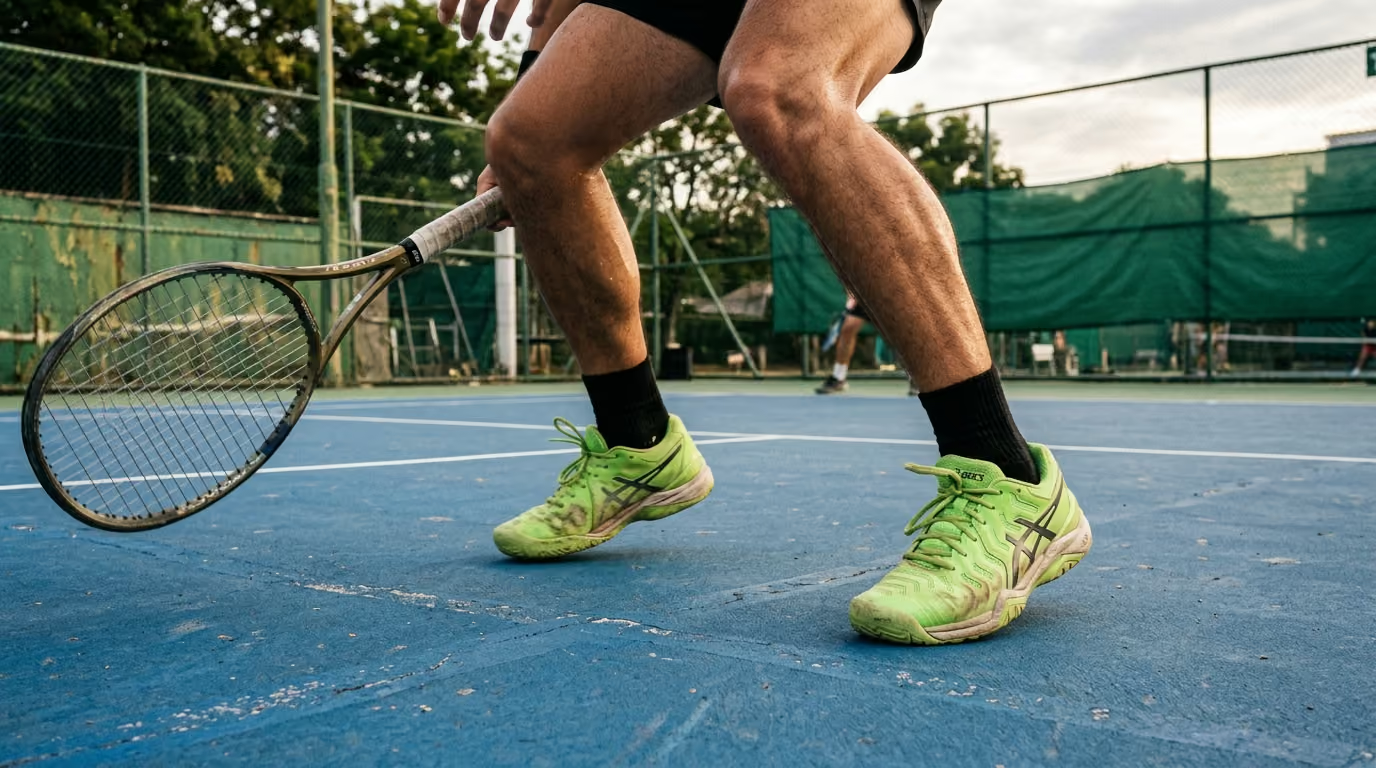
While many believe playing through pain builds resilience, true athletic longevity often requires adjusting or postponing play based on your body's recovery needs.




You pull into the club parking lot, but your body is sending mixed signals. Your shoulder has a dull ache from Tuesday, your sleep was terrible last night, and you have a competitive league match in two hours. Deciding whether to step onto the court under these conditions is a challenge that every recreational and competitive player faces regularly.
Deciding whether to play on a given day is not a simple yes or no choice. Instead, you should match your current physical and mental capacity with the specific physical demands of the planned session. True athletic longevity relies on modifying, replacing, or postponing a game when your body cannot safely absorb the stress of full play.
Readiness is your current capacity to tolerate and benefit from a planned training session. It is not a permanent label of being fit or unfit. Rather, it fluctuates daily based on physical, psychological, and environmental factors.
According to the International Olympic Committee consensus on athlete recovery, performance is a balance between training stress and recovery. When you step onto the court, your body experiences both external and internal loads.
External load refers to the physical work you complete during a match or practice. This includes your total minutes on court, the number of games played, and your sprint volume. It also includes the number of jumps, overhead swings, and rapid changes of direction.
Internal load describes the physiological and psychological stress that this work imposes on your body. For example, playing a single set of singles tennis might feel easy on a cool morning. However, that same set can impose a massive internal load on a hot afternoon when you are dehydrated or stressed.
To manage these loads, you must understand your acute and chronic training history. Your acute load is the training stress you accumulated over the last few days. Your chronic load is your longer-term physical preparation over several weeks.
A sudden spike in acute load is more concerning when it occurs on top of poor sleep or high stress. The International Olympic Committee guidelines emphasize that rapid weekly increases in load are key drivers of tissue fatigue. Keeping your acute load in line with your chronic capacity is essential for healthy aging on the court.
A few years ago, I realized my tennis serve speed was dropping, and my shoulder was constantly throbbing after matches. Instead of pushing through the pain, I took a month to rebuild my mechanics and focus on rotator cuff endurance.
I stopped trying to hit flat aces and developed a much heavier kick serve. My win rate actually went up, and my shoulder stopped hurting. Sometimes longevity means outsmarting your own ego on the court.
Muscle soreness is a common experience for active court athletes. Delayed-onset muscle soreness, or DOMS, typically develops after unfamiliar, strenuous, or eccentric exercise. Eccentric actions occur when your muscles lengthen under tension, such as when you brake during a hard sprint or land from an overhead smash.
A systematic review published in the Journal of Strength and Conditioning Research analyzed the recovery time course after strenuous exercise. The research showed that eccentric and plyometric work can impair sprint and change-of-direction performance for up to 72 hours.
During this period, athletes also experience reduced joint range of motion and decreased shock absorption. This is highly relevant for court players because braking, cutting, and jumping are often the first physical qualities to deteriorate.
Sleep is another critical pillar of your daily readiness. A systematic review involving over 18,000 monitored nights found that athletes average about 7.2 hours of sleep per night. However, many players fall well below this average during busy training weeks or stressful life periods.
Sleep restriction impairs your motor control, visual tracking, and tactical decision-making on court. A few milliseconds of delay in your reaction time can cause you to hit a pickleball late.
This delay often leads to poor wrist mechanics and chronic tendon irritation over time. You can learn more about managing these physical patterns by reading our articles on injury prevention resources.
Finally, psychological stress acts as an internal load on your body. High mental stress increases muscle tension, which can restrict your natural range of motion. It also reduces your concentration, making you more vulnerable to sudden movement errors on court.
Environmental heat strain also increases the physiological cost of a session. Exercising in high temperatures increases your heart rate and sweat rate, even when your movement is light.
Sports medicine guidelines recommend spending 10 to 14 days gradually adapting to hot conditions. If you are not acclimated, you must reduce your training volume to avoid heat-related illness.
To make an objective decision about playing, you can use a simple four-step process before you pack your racquet bag.
Before you evaluate your general readiness, look for any symptoms that require you to stop immediately. You should not play if you experience chest pain, shortness of breath, confusion, or dizziness.
Focal pain in a specific tendon, joint, or bone is also a clear warning sign. If you have a fever, systemic illness, or joint instability, postpone your session. Seek an assessment from a qualified healthcare provider before returning to play.
Evaluate your status on a simple 0 to 10 scale, comparing today with your normal baseline. Rate your sleep quality, general energy, muscle soreness, and mental stress.
A single low score in one category is rarely a reason to cancel a practice. However, a cluster of low scores across multiple categories suggests that your body is under-recovered.
Not all activities on the court impose the same physical cost. Look at your planned session and identify the most demanding elements.
Low-cost components include gentle warm-ups, mobility drills, and slow technical repetitions. These movements place minimal stress on your joints and energy systems.
Moderate-cost components include controlled hitting drills, tactical walk-throughs, and steady-state rallying. You can often complete these sessions even when you are mildly fatigued.
High-cost components include repeated maximal sprinting, hard braking, high-volume jumping, and competitive match play. These movements require high nervous system output and excellent physical coordination. If your readiness is low, these high-cost elements are the first things you should remove.
Once you have assessed your status and your planned session, apply the traffic-light model to make your final decision.
You are clear to train normally when you have no major pain or severe stiffness. Your sleep, mood, and general energy are close to your normal standards.
Your movement feels fluid during your warm-up, and your perceived effort matches your expectations. A green day does not require you to feel perfect. It simply means you can safely tolerate the planned training stress.
You should modify your session if you have one or two mild concerns. These might include a single poor night of sleep, mild generalized muscle soreness, or moderate life stress.
A yellow-day adjustment involves reducing your total training volume by 20% to 40%. You should remove maximal sprinting and hard, repetitive cutting.
Focus instead on controlled footwork and technical consistency. Extend your rest intervals between drills to allow your heart rate to recover.
You should replace your planned session if multiple warning signs cluster together. Examples include consecutive nights of poor sleep, significant muscle soreness, and low motivation.
Instead of playing a competitive match, choose a low-cost alternative. You can perform easy mobility work, low-intensity technical hitting, or tactical video analysis.
This approach keeps you connected to your sport without overloading your tissues. For more recovery strategies, check out our recovery science resources.
You must postpone all training if your symptoms are severe, localized, or progressive. This applies to sharp joint pain, swelling, fever, or signs of heat illness.
A readiness tool is not a medical clearance device. If you fall into the red category, prioritize rest and consult a medical professional.
The mechanical demands of racquet sports vary, meaning your modification strategies must also differ depending on your sport.
Tennis requires covering a large court, which demands explosive lateral movement and deep lunging. The sport also involves repetitive overhead serving, which places high stress on the shoulder and lower back.
If you are on a yellow day, reduce the size of the court you are covering. Play half-court rallying games rather than full-court singles matches.
You should also limit your overhead serves. Focus on groundstroke consistency and let your practice partner feed balls to you instead of serving. You can read more about managing these demands in our tennis articles.
Pickleball is played on a smaller court, but it requires exceptionally fast reaction times. The game demands rapid, short steps and a persistent, low-squatting posture near the kitchen line.
This low position places high stress on your knees and lower back. On a yellow day, avoid deep, explosive lunges for wide balls.
Keep your rallies focused on soft, controlled dinking rather than hard driving. This preserves your hand-eye coordination while reducing the eccentric load on your lower joints. For more safety tips, check out our pickleball articles.
Padel combines elements of tennis and squash within a glass-walled court. The game involves frequent overhead smash variations, wall rebounds, and sudden rotational turns.
These movements require high-speed acceleration and deceleration in small spaces, which can strain your Achilles tendons and calves.
If your readiness is low, focus on defensive wall play and tactical positioning. Avoid jumping for high overheads and use controlled bandejas instead. This reduces the landing forces on your lower body. Read more about these strategies in our padel articles.
To understand how to apply these rules, examine these common scenarios that racquet sports players encounter.
You slept for only five hours because of a late flight. You feel mentally slow, but you have no joint pain, muscle soreness, or signs of illness.
Your decision should be a yellow day. You can still head to the court, but you must adjust the session.
Extend your warm-up by five to ten minutes to wake up your nervous system. Avoid high-risk agility drills or maximal speed work.
Focus on steady-state hitting and technical patterns that do not require rapid tactical decisions. If your coordination feels poor during the warm-up, shorten the session and go home early.
You tried a new lower-body strength workout two days ago. Your thighs and calves are highly sore, your knees feel stiff, and squatting hurts.
Your decision should be an orange day. Your sprint and change-of-direction performance will be compromised for up to 72 hours.
Do not play a competitive match today. Instead, replace the session with a low-impact activity.
You can perform light mobility exercises or ride an stationary bike at an easy pace. If you must hit, do so from a stationary position with a partner who feeds the ball directly to you.
You played a three-set singles match yesterday. This morning, you have a sharp, localized ache in your left Achilles tendon that makes you limp.
Your decision is a red day. Localized tendon pain that alters your normal walking pattern is not ordinary muscle soreness.
Do not try to stretch or run through this discomfort. Postpone all court activities immediately.
Resting now can prevent a mild tendon irritation from becoming a chronic injury. Schedule an appointment with a physical therapist to evaluate the tendon.
You have been working sixty hours a week to meet a major project deadline. You are sleeping poorly, feeling highly irritable, and your motivation to play is very low.
Your decision should be an orange day. Your high psychological load has depleted your physical and mental reserves.
Forcing yourself to play a high-pressure competitive match will likely lead to frustration or movement errors. Replace the game with a relaxed, low-key hit with a friend.
Focus on the social and rhythmic aspects of the game rather than the score. Alternatively, take the night off to catch up on sleep and rest.
You are scheduled to play an outdoor match at 2:00 PM on the first hot day of summer. You are not acclimated to the heat, and you did not drink enough water this morning.
Your decision should be a yellow or orange day, depending on how you feel. Do not treat extreme heat as a test of mental toughness.
If you choose to play, shorten the match and take extended breaks in the shade every two games. Drink water and electrolyte fluids before, during, and after the session.
If you begin to feel dizzy, nauseous, or unusually weak, stop playing immediately. Move to an air-conditioned room and cool your body down.
You are playing in a weekend tournament and have completed three long matches in the last 48 hours. Your legs feel incredibly heavy, and you are scheduled to practice again on Monday morning.
Your decision should be an orange day. Consecutive-day competition significantly reduces your perceived recovery and joint torque.
Replace your normal high-intensity practice with a recovery-focused session. Focus on gentle stretching, light walking, and technical visualization.
If you must step onto the court, keep the session under thirty minutes. Focus exclusively on easy ball contact without any dynamic running.
Your fitness tracker shows a very low recovery score this morning. However, you slept well, your body feels energetic, and you have no muscle soreness or pain.
Your decision should be a green day, but with sensible monitoring. Wearable recovery algorithms are based on general trends, not absolute clinical facts.
Subjective feelings of readiness are often more accurate than device-generated scores. Begin your planned warm-up and pay close attention to how your joints feel.
If your movement is clean and your energy remains high, proceed with your session. Do not let an app dictate your training choices when your body says otherwise.
Your fitness tracker claims you are fully recovered and ready for peak performance. However, you woke up with a scratchy throat, a mild headache, and very low energy.
Your decision should be an orange or red day. Always trust your physical symptoms and subjective feelings over a device score.
Your wearable cannot detect the early stages of an illness or local tissue strain. Reduce your activity level and focus on hydration and rest.
Playing through an oncoming illness can prolong your recovery time. It also increases the physical stress on your cardiovascular system.
Many dedicated players make consistent mistakes when deciding whether to step onto the court.
The most common error is assuming that a lack of pain means you are fully recovered. Pain is only one signal that your body sends.
You can have zero joint pain but still suffer from central nervous system fatigue or severe sleep deprivation. Playing under these conditions reduces your coordination and speed. This increases your risk of acute injuries like ankle sprains or muscle strains.
Another frequent pitfall is allowing a wearable device to make all your training decisions. Some players cancel hard workouts because of a red score on their watch, even when they feel excellent.
Other players push through severe fatigue because their app gave them a high recovery rating. Use your device as a helpful trend tracker, but always prioritize your actual physical symptoms.
Many players believe that they must train through intense muscle soreness to maintain their fitness. While light movement can temporarily reduce stiffness, performing high-velocity cutting or jumping with severe DOMS is highly risky.
Your muscles cannot absorb shock efficiently when they are damaged and sore. This forces your passive structures, like your tendons and joints, to bear the extra load.
Some athletes rely on massage guns, compression boots, or ice baths to bypass natural recovery. While these tools can reduce your perception of soreness, they do not replace the fundamental need for sleep and nutrition.
No recovery gadget can restore depleted muscle glycogen or repair tissue micro-tears as effectively as sleep and food. For more information on evidence-based practices, visit our player health articles.
Consistently making poor training decisions can lead to chronic under-recovery. When you play on fatigued tissues, your biomechanics inevitably change.
Your foot strikes the ground differently, your knees cave inward during deep lunges, and your shoulder drops during your serve. These subtle changes alter the distribution of force across your joints.
Over several months, these altered movement patterns can lead to chronic overuse conditions. These include patellar tendinopathy, rotator cuff strains, and plantar fasciitis.
Allowing your body time to adapt to training stress is the key to athletic longevity. By adjusting your play based on daily readiness, you protect your joints and keep playing for years.
You do not need an expensive lab to track your daily readiness. A simple notebook or a note app on your phone is highly effective.
Every morning, take sixty seconds to record five basic metrics on a scale of 1 to 5. These metrics are sleep quality, muscle soreness, fatigue, stress, and joint comfort.
Next, write down your planned session and its estimated duration. After your workout, record your session rate of perceived exertion on a scale of 1 to 10.
Multiply this rating by your session duration in minutes. This simple calculation gives you a clear number representing your daily training load.
Review these numbers at the end of each week. Look for trends such as rising soreness accompanied by falling sleep quality.
If your perceived exertion for a standard rally session increases over several weeks, your body is sending a warning. Use these patterns to adjust your upcoming training week before an injury occurs.
To learn more about tracking your play, check out the resources on the Evercourts Blog. We offer practical advice designed to help you understand your body and improve your performance.
While this guide can help you manage normal fatigue, it is not a substitute for clinical care. You should consult a qualified sports medicine professional if you experience any of the following symptoms:
A qualified physical therapist or sports physician can provide a precise diagnosis. They can also design a targeted rehabilitation program to help you return to play safely.
You should return to this guide whenever you are planning a busy tournament schedule or returning to play after an illness. Reviewing these principles will help you make objective choices when your competitive drive tempts you to ignore your body's warning signals.
True court longevity is not about pushing through every obstacle at maximum intensity. It is about having the intelligence to adjust your training so you can keep playing the sports you love for decades to come.
Follow Evercourts for practical insights on tennis, pickleball and padel performance, movement, recovery and healthy ageing. Stay connected for new articles, research-led guidance and ideas to help you play well and keep playing for years.


Read practical guidance for better movement, smarter preparation and a game that keeps working for you.
explore the Blog