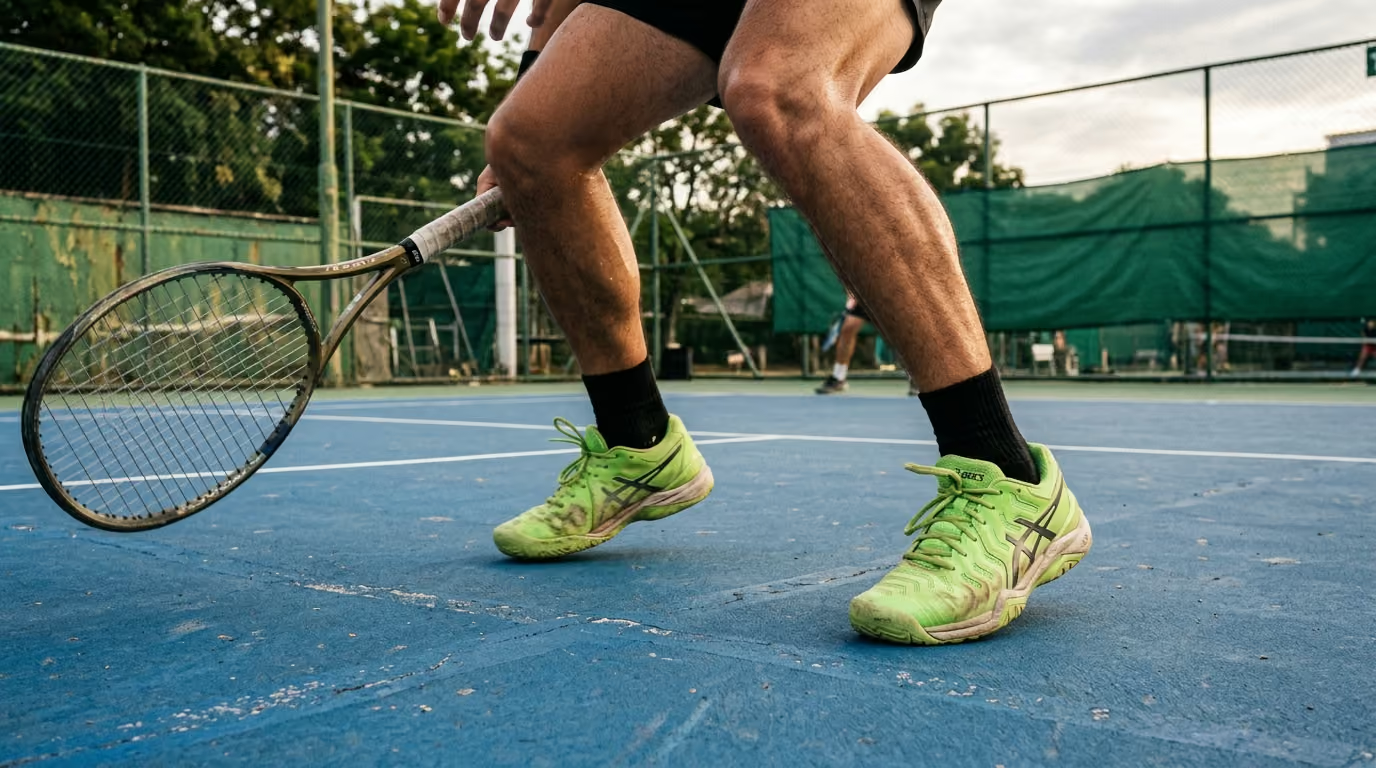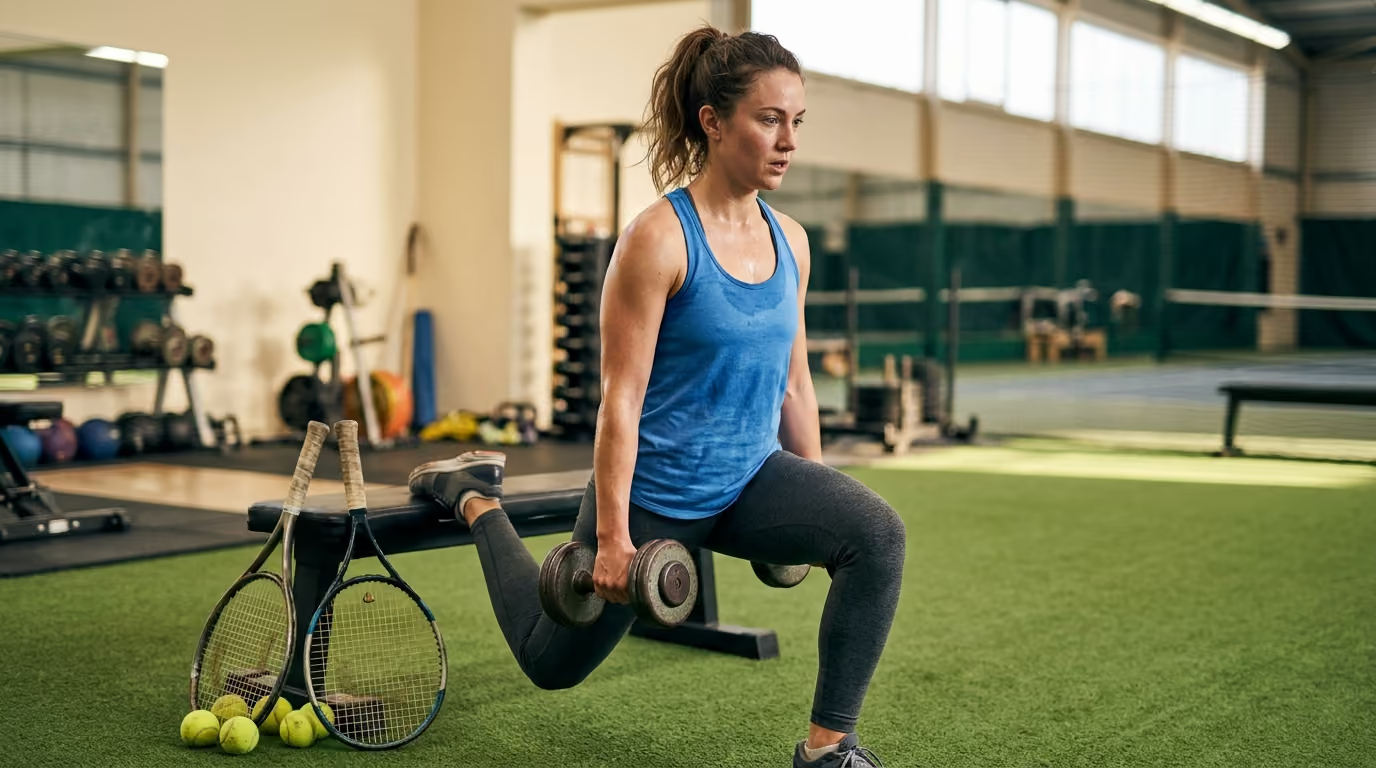

Single-leg and single-arm strength training is essential for racquet sports players to improve balance, power, and movement efficiency on the court.




Many racquet sports players notice that one side of their body feels more fatigued or stiffer than the other after a long match. You might find yourself searching online for ways to correct this uneven muscle development or improve your balance when lunging for wide shots. This guide provides a clear pathway to balance your strength and improve your movement on the court.
Unilateral training develops single-leg stability and single-arm power to match the asymmetrical movements of racquet sports. By combining targeted single-limb exercises with foundational two-legged lifts, players can build a resilient body that handles quick stops and powerful strokes. This balanced approach helps protect your joints and supports long-term healthy aging and athletic longevity on the court.
Racquet sports are inherently asymmetrical. We swing with one dominant arm, push off a preferred leg during serves, and lunge dynamically in multiple directions. These sports require repeated short bursts of speed rather than steady running. According to research on tennis movement, most court sprints are under twenty meters in distance. This means you must start, stop, and change directions constantly.
Every time you reach for a wide ball, your body undergoes a complex physical sequence. First, you must brake your forward momentum using a single leg. Next, that single leg must absorb several times your body weight. You must keep your knee, hip, and trunk stable while you swing. Finally, you must push off that same leg to recover back to the center of the court.
This sequence highlights why single-leg strength is so valuable. It is not just about building muscle. It is about learning to manage force during fast deceleration. If one leg is significantly weaker, your ability to brake and recover will suffer. This can lead to slower court movement and increased fatigue over a long match.
In our experience at Evercourts, ignoring these asymmetrical demands often leads to chronic stiffness. I remember finishing a tough two hour padel match on a cold Tuesday night and waking up the next morning feeling like my lower back was locked in concrete. For a long time, I just accepted this as the price of playing hard in my forties. But once I started spending just ten minutes on targeted hip mobility before heading to the club, the stiffness almost completely vanished. It taught me that we do not have to accept physical decline as a default state of healthy aging.
Some fitness sources claim you should only perform single-leg exercises. They argue that because running and lunging happen on one leg, traditional two-legged squats are a waste of time. However, sports science does not support this extreme view. A balanced program should include both types of training.
A major meta-analysis compared unilateral and bilateral training across fourteen different studies involving nearly four hundred participants. The researchers found that both methods are highly effective for improving athletic performance. Neither approach was universally superior for speed or change of direction. Both methods help players build lower-body capacity.
The research did reveal some important differences. Unilateral training showed a clear advantage for single-leg jumping performance. If you want to jump higher off one foot or improve your single-leg bounds, you need single-leg exercises. On the other hand, bilateral training showed a small but clear advantage for building maximal bilateral strength. Two-legged squats and deadlifts allow you to lift heavier loads, which builds a strong physical foundation.
Therefore, your strength program should combine both strategies. Use bilateral lifts to build general strength and joint tolerance. Use unilateral exercises to train balance, single-leg force, and specific court coordination. This combination ensures you get the benefits of heavy loading while preparing your body for the specific demands of court play. For more details on designing a balanced routine, you can read our strength and conditioning resources.
To move efficiently on the court, you must understand how your muscles work during a lunge. A deep lunge is not just a quadriceps exercise. It requires coordination across your entire lower body. Your glutes, hamstrings, quadriceps, and calves must work together to control your descent.
When your foot hits the court, your ankle must remain stable. If your ankle collapses inward, your knee will follow. This inward collapse can place excessive stress on your knee joint. Your hip muscles, especially the gluteus medius, must contract to keep your knee aligned over your toes.
At the same time, your trunk must remain upright and stable. If your core is weak, your torso will lean too far forward or tilt to the side. This makes it much harder to hit a clean, accurate shot. It also increases the rotational stress on your lower back.
Once you strike the ball, your muscles must transition instantly from absorbing force to producing force. Your quad and glute muscles must contract powerfully to push you back to the center of the court. This rapid transition requires excellent eccentric strength, which is the ability to control deceleration. Single-leg training is the most effective way to develop this specific capacity.
A powerful shot or serve does not start in the shoulder. It begins when your feet push against the court. This force travels up through your legs, hips, torso, and shoulder, before finally reaching your hand. This path of energy is called the kinetic chain.
For racquet players, the upper body must be able to transfer this force while resisting unwanted movement. When you swing, your torso rotates dynamically. However, your spine must remain stable to prevent injury. Single-arm training teaches your trunk to resist rotation while your arm produces force.
Consider the dumbbell one-arm row. As you pull the weight, your body wants to twist toward the floor. To keep your chest level, your abdominal muscles must contract intensely. This is called anti-rotation training, and it directly transfers to a more stable swing on the court.
Additionally, shoulder health depends heavily on scapular control. The shoulder blade must move smoothly along the rib cage to allow safe overhead movement. One-arm presses and pulls allow each shoulder blade to move independently. This helps address imbalances caused by years of playing a one-handed racquet sport.
Many players assume they have dangerous strength imbalances. It is common to see advice online claiming that any difference between your left and right side will cause an immediate injury. However, the scientific evidence on asymmetry is much more nuanced.
A systematic review of twenty-eight studies found that the link between physical asymmetry and injury is inconsistent. Some studies showed that larger differences increased risk, while others found no relationship at all. We must accept that playing a racquet sport will naturally make your dominant side different from your non-dominant side.
Instead of chasing perfect numerical equality, we should aim for functional symmetry. This means ensuring both sides have enough strength and control to perform court tasks safely. A common guideline in sports medicine is to keep side-to-side differences under fifteen percent. However, this threshold should be used as a general guide rather than a strict rule.
To measure your own asymmetry, you must use reliable and consistent tests. You can calculate your side-to-side difference using a simple formula:
Asymmetry Percentage = ((Dominant Limb Score minus Non-Dominant Limb Score) divided by Dominant Limb Score) multiplied by 100
You can perform simple assessments in the gym, such as counting your maximum comfortable repetitions on a single-leg split squat. You can also test your single-leg jump distance. Write down the results for both sides, ensuring you use the same technique, footwear, and rest times for each limb. For a structured approach to identifying these patterns, refer to our injury prevention resources.
When starting unilateral training, you should progress from stable positions to more dynamic movements. Do not start with complex jumping exercises if you cannot balance on one foot. Begin with supported variations to build coordination and confidence.
The split squat is the ideal starting point for single-leg strength. Keep both feet on the floor in a wide stance. Lower your hips until your back knee is just above the ground, then push back up. Keep your front heel firmly planted on the floor.
To make this exercise harder, you can elevate your rear foot on a small bench or step. This variation is called the Bulgarian split squat. It places more load on the front leg and challenges your balance. Hold dumbbells at your sides to increase the resistance.
Step-ups are excellent for building hip and thigh power. Step onto a sturdy box, pressing through your heel to lift your body. Avoid pushing off the floor with your trailing foot. Step down slowly and under control to protect your knee.
For deceleration control, perform step-downs. Stand on a low platform and slowly lower one foot to touch the floor, keeping your working knee completely stable. This teaches your thigh muscles to control the descent. It is highly effective for building deceleration capacity.
To strengthen your glutes and hamstrings, practice the single-leg Romanian deadlift. Stand on one leg with a slight bend in your knee. Hinge forward at your hips, reaching your non-working leg straight behind you. Keep your hips level and your back flat throughout the movement.
If you struggle with balance, place one hand on a wall for support. Once you can perform the movement with good form, hold a dumbbell in the opposite hand. This contralateral loading forces your core to work harder to stay level. It builds excellent hip stability.
Because court sports require lateral movement, you must train in multiple directions. The lateral lunge is highly specific to wide-ball recovery. Step wide to the side, bending your active knee while keeping your other leg straight. Push off the bent leg to return to your starting position.
Start with bodyweight before adding dumbbells. You can also practice reverse lunges, which are gentler on the knees than forward lunges. Step backward into a lunge, keep your front shin relatively vertical, and push back to a standing position. This builds the hamstring and glute strength needed for quick recovery steps.
Just like the lower body, your upper-body training should progress from stable, supported movements to standing variations. This approach ensures you build local muscle strength before challenging your balance and trunk stability.
Begin with the one-arm dumbbell floor press. Lying on the floor protects your shoulder joint and provides a stable base. Press the dumbbell straight up, keeping your shoulder blade flat against the floor. This variation builds chest and arm strength with minimal shoulder strain.
As you get stronger, progress to the standing one-arm landmine press. This movement uses a barbell secured in a pivoting base on the floor. Press the barbell upward and forward at an angle. It provides a natural, comfortable path for overhead pressing and engages your core.
The three-point dumbbell row is a classic exercise for building back strength. Place one hand and one knee on a bench, keeping your back flat. Pull a dumbbell toward your hip with your free hand. Keep your elbow close to your side and squeeze your shoulder blade.
To challenge your trunk stability, try a standing one-arm cable row. Stand in a split stance and pull the cable toward your rib cage. This exercise requires your entire lower body and core to resist the pull of the machine. It mimics the pulling and stabilizing demands of a court swing.
The suitcase carry is a simple but highly effective exercise. Hold a heavy dumbbell in one hand and walk slowly in a straight line. Do not let the weight pull your torso to the side. Keep your shoulders level and your head upright.
Your opposite-side abdominal muscles must contract to keep your spine straight. This builds excellent trunk endurance for long matches. You can also perform the waiter carry, where you hold a lighter dumbbell overhead. This variation challenges shoulder stability and scapular control.
To get the most out of your training, you must organize your exercises logically. The American College of Sports Medicine recommends placing high-intensity, multi-joint exercises early in your session. This ensures you perform the most demanding movements when your mind and body are fresh.
A typical strength session should begin with a thorough warm-up. Next, perform any explosive power work, such as light jumps or medicine ball throws. After that, move to your primary strength lift, which could be a bilateral squat or a heavy split squat. Finally, complete your accessory exercises, such as one-arm rows, carries, and mobility drills.
A simple four-week progression can help you build unilateral strength systematically:
When choosing your weights, prioritize technical quality over heavy loads. For general strength, aim for two to four sets of six to ten repetitions per side. If your left leg is weaker, always start with your left leg. Match the number of repetitions on your right leg, even if it feels easy. This ensures you do not widen the strength gap.
We recommend training these patterns two to three times per week. Be mindful of your court schedule. Do not perform a heavy single-leg workout the day before an important match. Give your muscles at least forty-eight hours to recover before playing competitive points. For general advice on court life and maintaining your health, visit our player health articles.
While the basic principles of strength remain the same, each racquet sport has unique physical demands. Understanding these differences allows you to tailor your training to your specific sport.
Tennis players cover the largest court area and must deal with high-velocity movements. You must run fast, slide on clay, and change direction with immense force. Because of this, tennis players need a strong focus on lateral lunges and deep split squats. You must prepare your lower body to absorb high impact forces when landing from a serve or overhead smash.
You must also prepare your shoulder for the high eccentric forces of the serve. One-arm dumbbell presses and rotator cuff exercises are essential. These exercises help decelerate the shoulder arm smoothly after contact. They reduce the risk of common overuse issues in the rotator cuff.
Pickleball is played on a much smaller court, which reduces the need for long, high-speed sprints. However, it requires constant low-level squatting and rapid lateral shifting at the kitchen line. Pickleball players should focus on isometric split-squat holds and controlled step-downs. These exercises build the muscle endurance needed to stay low for long rallies.
One-arm rows are also valuable for controlling your paddle position during quick hand exchanges. A strong upper back helps you maintain a stable paddle face. This improves your control and accuracy during fast dinking exchanges. It also reduces fatigue in your forearm and wrist.
Padel involves many rapid turns, wall rebounds, and overhead smash attempts. The sport requires excellent rotational control and quick acceleration. Padel players benefit greatly from single-leg rotational hinges and standing one-arm cable presses. These exercises prepare your body to rotate quickly while maintaining your balance.
Carries are also useful for building the trunk stability needed to handle wall rebounds. When you twist to retrieve a ball off the glass, your core must remain stable. This protects your lower back from twisting injuries. It also allows you to transfer force from the court surface to your racket.
It is easy to make mistakes when performing single-leg and single-arm exercises. Because these movements challenge your balance, they require close attention to detail.
One common error is using too much weight too soon. If you cannot perform a split squat without wobbling, the weight is too heavy. Excessive weight forces your body to use momentum or rely on other muscles to complete the lift. This reduces the effectiveness of the exercise and increases your risk of injury.
Another mistake is ignoring your foot position. During single-leg exercises, your foot should remain flat on the floor with your weight distributed evenly. Do not let your arch collapse or your heel lift off the ground. A stable foot provides the foundation for a stable knee and hip.
Finally, avoid using unstable surfaces, such as wobble boards, for heavy strength training. While these tools have a place in early rehabilitation, they drastically reduce the amount of force your muscles can produce. To build real court-relevant strength, perform your exercises on a solid, stable floor. For more on safe movement, check out our mobility and movement resources.
Single-leg and single-arm exercises place a unique stress on your body. Because you are loading one side at a time, your stabilizing muscles must work twice as hard. This can lead to localized muscle soreness, especially when you first start. This soreness is a normal response to new physical demands.
To support recovery, ensure you get adequate sleep and nutrition. Muscles need rest to repair and grow stronger. If you feel excessively sore, reduce the volume or intensity of your next workout. It is better to perform a shorter, high-quality session than to push through extreme fatigue.
We also recommend incorporating gentle mobility work between your strength sessions. Simple hip and shoulder stretches can help reduce muscle tension and maintain your range of motion. This is particularly important for older athletes who want to maintain their physical capabilities. Managing your training volume is key to maintaining your athletic longevity.
While mild muscle soreness is a normal part of training, you should never push through sharp or persistent pain. If you experience sudden joint pain during an exercise, stop immediately. Continuing to train through pain can worsen underlying tissue issues.
You should consult a qualified physical therapist or sports medicine professional if you notice:
A professional can help identify the root cause of these symptoms and design a safe recovery plan. Do not try to self-diagnose severe or chronic issues. Early intervention often leads to a faster return to the court.
Use this simple checklist to start building your unilateral strength this week:
Follow Evercourts for practical insights on tennis, pickleball and padel performance, movement, recovery and healthy ageing. Stay connected for new articles, research-led guidance and ideas to help you play well and keep playing for years.


Read practical guidance for better movement, smarter preparation and a game that keeps working for you.
explore the Blog