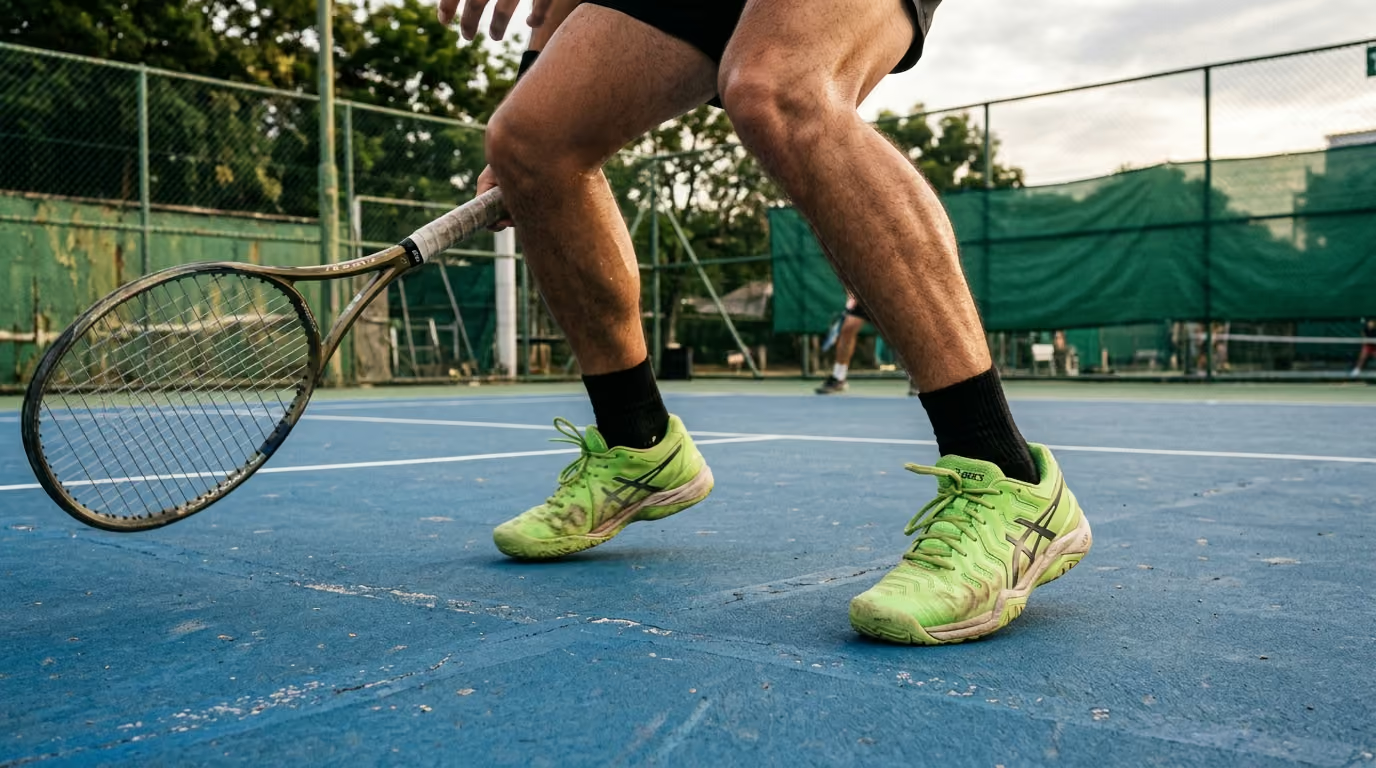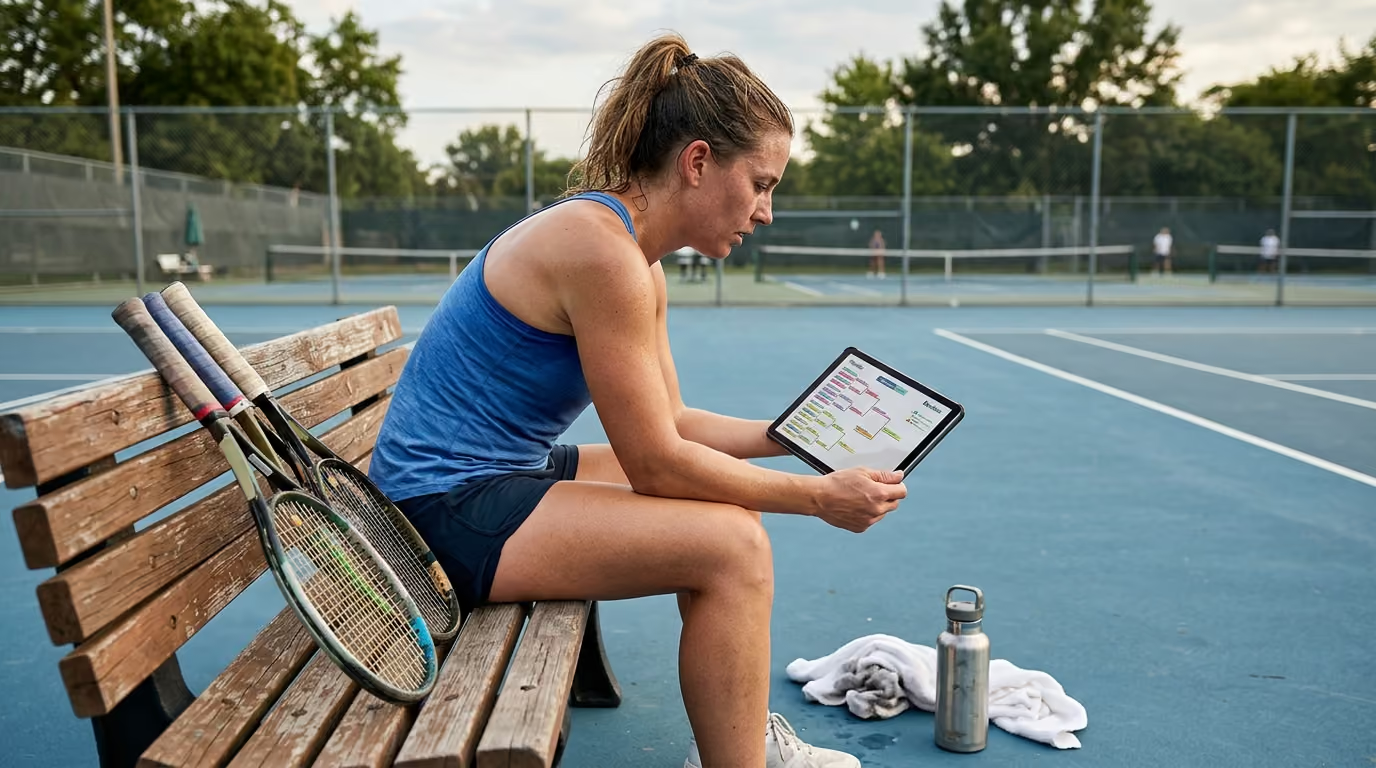

While many athletes assume doubles is less demanding than singles, these formats stress the body differently, requiring a strategic approach to competition load.




You step onto the court for your third match of the day. Your legs feel like lead, your feet are burning, and your focus starts to slip. This scenario is familiar to any recreational or competitive court athlete.
To protect your athletic longevity, you must choose a competition load that aligns with your physical preparation. Enter the greatest number of events that supports your primary competitive objective without degrading your movement quality, decision-making, or recovery. This balance ensures you perform at your best while protecting your body from overtraining.
Understanding your physical limits is a crucial part of long-term tournament planning and court lifestyle choices. By managing your tournament entries with precision, you can enjoy the sport for years to come.
Competition load is not merely a count of the divisions you enter. It represents the total physical, mental, and environmental stress placed on your body during an event. To make informed decisions about your tournament entries, you must break this load down into three distinct categories.
External load refers to the physical work you perform on the court. This includes the duration of your matches, the total number of games played, and the total points contested. It also includes specific movement metrics such as steps, jumps, lunges, and changes of direction.
For example, a physical tracking system might show that you ran two miles during a match. However, that distance does not tell the whole story. The speed of your movements, the force of your landings, and the number of times you accelerated to catch a drop shot define the true external load.
Internal load describes how your body and mind respond to the external work. Practical markers include your heart rate, blood lactate levels, muscle soreness, and psychological fatigue. It also includes your Rating of Perceived Exertion, which is a subjective score of how hard you felt you worked.
Two players can complete the exact same match and experience completely different internal loads. A highly conditioned player might finish the match feeling energized. A player returning from a break might finish the same match with high muscular soreness and elevated stress.
Contextual load includes the environmental and organizational factors surrounding your matches. This includes the time spent waiting at the venue, the quality of your sleep, the ambient temperature of the courts, and travel stress. It also includes the emotional strain of playing with a new partner or facing a highly ranked opponent.
The International Olympic Committee highlights that tournament calendar congestion, emotional stress, and travel are vital components of athletic load. Waiting five hours for your next match can be more exhausting than playing two matches back-to-back. The mental strain of remaining focused while sitting in a cold venue drains your energy reserves.
To choose the right tournament entries, you must understand how singles and doubles stress your body in different ways. Many players assume doubles is simply half the work of singles. While doubles requires less court coverage, it presents its own unique physical and mental challenges.
Research consistently shows that singles play demands a higher cardiovascular output than doubles play. A comparative study of court movement reported that singles players maintain a mean heart rate of roughly 88.8 percent of their maximum. In contrast, doubles players maintain a mean heart rate of around 75.5 percent of their maximum.
Singles players also show higher peak heart rates during intense rallies. This higher cardiovascular strain leads to faster glycogen depletion and higher blood lactate levels. If you enter a singles draw, your aerobic and anaerobic energy systems must be highly developed to sustain your performance across multiple rounds.
The physical volume of movement also differs heavily between the two disciplines. A 2025 study comparing movement profiles found that singles players took an average of 593.8 steps per game. Doubles players took an average of 314.5 steps per game.
Singles players also move at a higher average velocity throughout the match. They must cover the entire playable court, which requires longer sprint distances. This constant running makes singles a massive challenge for your cardiorespiratory fitness.
A match-analysis study revealed that singles play contains roughly 250 percent more lunges than doubles play. It also contains about 40 percent more jumps. These findings are critical for players managing joint health.
Lunges place immense eccentric stress on the quadriceps, patellar tendon, and gluteal muscles. Jumps demand high force production from the calves and Achilles tendons, followed by high force absorption upon landing. If you have a history of knee or Achilles issues, the high lunge and jump volume of singles represents a major risk factor.
While doubles requires fewer steps and shorter sprint distances, it demands much faster reaction times. Doubles matches feature shorter rally durations, higher shot frequencies, and rapid transitions from attack to defense. You must perform explosive first steps, quick split-steps, and rapid upper-limb movements.
Doubles is highly demanding for your nervous system. The rapid pace requires constant cognitive processing and split-second decision-making. A player with excellent running endurance may still struggle in doubles if they lack explosive power and rapid coordination.
Signing up for singles, doubles, and mixed doubles seems like a great way to maximize your court time. However, entering multiple divisions creates a cumulative physical and mental load that can quickly overwhelm your system. The total strain is often much greater than the sum of the individual matches.
When you play multiple matches in a single day, your nervous system begins to fatigue. This neuromuscular fatigue reduces your ability to produce explosive power. Your muscles cannot contract as quickly or as forcefully as they did during your first match.
A study of tournament players competing in five consecutive matches showed a significant decline in drop-jump performance as the day progressed. The players also reported rising muscle soreness and elevated RPE scores. This loss of reactive power makes it harder to explode toward the ball, leaving you vulnerable to late arrivals and poor positioning.
As physical fatigue sets in, your technical execution is often the first thing to suffer. Your split-step timing becomes slightly delayed, which slows your reaction to your opponent's shot. Your racket preparation slows down, forcing you to contact the ball behind your body.
Fatigue also compromises your lunge stability. You may find yourself collapsing into your lunges rather than controlling the descent. This technical decay not only hurts your performance but also increases your risk of injury. If you cannot maintain proper mechanics, your joints and tendons must absorb the excess impact forces.
Playing multiple divisions requires constant tactical and emotional switching. You must transition from the individual responsibility of singles to the shared responsibility of doubles. You must adapt to different partner communication styles, changing court dimensions, and varying tactical patterns.
This constant mental shifting consumes a massive amount of cognitive energy. By your fourth match, you may struggle to focus on your tactical plan. You might find yourself making poor shot choices, getting frustrated by simple errors, or losing your emotional stability during tight points.
Tournament schedules are rarely predictable. You may face long delays between matches, or you may be called to play back-to-back matches with virtually no rest. These scheduling issues make it incredibly difficult to manage your recovery.
If you have a long break, your body will begin to cool down and stiffen up. You must perform another warm-up to prepare your muscles for the next match, which consumes more energy. If your matches are back-to-back, you will have no time to replenish your fluids, eat recovery food, or rest your nervous system.
To protect your athletic longevity and perform at your best, you need a systematic way to choose your tournament entries. Do not let enthusiasm or partner pressure dictate your schedule. Use this structured, six-step framework to determine your optimal competition load.
Before you look at the entry form, define your main goal for the event. Your primary objective will guide all your subsequent decisions.
Look at the tournament format to estimate how many matches you are likely to play. Do not just look at the first round. Calculate your potential matches using three different scenarios.
First, consider the low-volume scenario, where you lose early or play short matches. Second, look at the expected-volume scenario, where you reach your typical progression point. Finally, calculate the high-volume scenario, where you reach the finals in every division you enter.
Your entry plan must be safe and manageable under the high-volume scenario. If a deep run in multiple events would push you to the point of physical collapse, you have entered too many divisions.
Evaluate how the physical demands of your chosen divisions fit with your current fitness and injury history. If you are recovering from a lower-limb issue, prioritize events with lower lunge and jump demands.
Rate each division on its movement characteristics. Singles will place a heavy demand on your whole-court movement, lunging, and cardiovascular endurance. Doubles will test your reaction speed, short-distance acceleration, and upper-limb repetition. Use this analysis to ensure you are not overloading a specific joint or energy system.
For your doubles entries, assess the quality of your partnership. A reliable, communicative partner can make a match much easier physically and mentally. They can share court coverage effectively and keep you calm during stressful moments.
A chaotic or unsupportive partnership can significantly increase your physical and emotional load. If you must cover for a partner who is out of position, or if you are constantly managing their frustration, you will burn valuable energy. Choose partnerships that support your competitive goals and reduce your overall stress.
Analyze the tournament schedule to determine how much time you will have between matches. Remember that a sixty-minute gap does not mean sixty minutes of rest.
You must subtract the time it takes to walk off the court, change your clothes, cool down, eat, and perform your next warm-up. If your usable recovery window is under thirty minutes, your body will struggle to restore its energy reserves. If the schedule looks tight, consider reducing your entries to protect your health.
Write down specific conditions that will trigger your withdrawal from an event. Having these rules in place before the tournament begins helps you make rational, health-first decisions under pressure.
While the general principles of load management apply to all racquet sports, each discipline presents unique physical demands. You must tailor your tournament strategy to the specific challenges of your chosen sport.
Tennis is played on a massive court, which makes singles play an incredible physical challenge. Singles players must cover large lateral distances and perform heavy rotational movements on every groundstroke. The hard court surface also subjects your joints to high impact forces during explosive stops and directional changes.
Doubles tennis features a completely different movement signature. It is a fast-paced game of quick volleys, sharp reaction times, and explosive vertical jumps for overheads. While tennis doubles reduces your total running distance, it still demands high levels of power and shoulder endurance.
To maintain your joint health, you should integrate targeted strength and conditioning advice into your weekly routine. Strengthening your core, hips, and shoulders will help you handle the unique rotational forces of tennis.
Pickleball is played on a much smaller court, which reduces your total running distance. However, the game features incredibly fast exchanges, high repetition, and rapid lateral shuffling at the non-volley zone line. The constant transition from the baseline to the kitchen requires frequent acceleration and decelerative braking.
Pickleball singles is a highly demanding game of endurance and court coverage. Because the court is small, you must react instantly to keep rallies alive, resulting in a high volume of short, explosive lunges.
Pickleball doubles reduces your court responsibility, but it increases the speed of the exchanges. The rapid volley battles at the kitchen line require exceptional hand-eye coordination and constant split-step adjustments. Managing your movement quality in pickleball is essential for long-term joint comfort.
Padel is played exclusively in a doubles format on an enclosed court. The presence of glass walls and metal mesh fences creates unique tactical and physical challenges. Rallies are often long and feature constant changes of direction, defensive transitions, and high-frequency lobs and overheads.
The physical load of padel is highly dependent on which side of the court you play. Left-side players typically take on more offensive responsibility, which requires a high volume of explosive jumps and overhead smashes. Right-side players often focus on defensive consistency, which demands exceptional lateral mobility and constant low lunges.
Because padel features so many overheads and quick rotational movements, shoulder and elbow health are common concerns. To protect your body, explore specific injury prevention strategies designed for court athletes. Maintaining your rotator cuff strength and thoracic mobility will help you handle the repetitive overhead demands of padel.
Many dedicated court athletes make the same critical errors when planning their tournament schedules. Recognizing these pitfalls can help you avoid unnecessary fatigue, poor performance, and avoidable injuries.
The most common mistake is assuming that doubles is always an easy choice that requires no recovery. While doubles reduces your individual court coverage, it still places high demands on your joints and nervous system. The rapid accelerations, explosive jumps, and high reaction speeds of doubles can be incredibly fatiguing.
If you are already physically exhausted from a tough singles match, stepping onto the doubles court is not a form of active recovery. The high-intensity movements required to react to quick shots can easily overload your tired muscles. Treat every doubles entry as a significant physical commitment.
Another frequent error is underestimating the physical and mental cost of waiting at the venue. Many players believe that a five-hour gap between matches provides plenty of time to fully recover. In reality, these long, unstructured breaks often lead to physical stiffness and mental exhaustion.
When you sit around for hours, your body temperature drops and your muscles tighten up. The mental strain of waiting for your name to be called also drains your cognitive energy. By the time you step back onto the court, you may find it incredibly difficult to find your rhythm and move with fluid grace.
When you compete in a tournament, your muscles, tendons, and joints experience significant micro-trauma. Managing your competition load is essential for allowing these tissues to heal and adapt.
The repetitive acceleration, deceleration, and lunging of court sports cause microscopic tears in your muscle fibers. This tissue damage leads to delayed onset muscle soreness, which typically peaks twenty-four to forty-eight hours after competition. It also reduces your muscle force production and coordination.
Your tendons also experience high levels of stress during competitive play. Tendons have a limited blood supply compared to muscles, which means they take longer to recover from heavy loads. If you do not allow sufficient time for these tissues to heal, you can develop chronic overuse issues.
To support your body through a demanding tournament, you must prioritize your recovery. While passive rest is important, active recovery protocols can help accelerate your physical preparation for the next match.
Research suggests that a combination of active cooling down, light stretching, and targeted hydration can help restore your physical readiness. A gradual cool-down helps flush metabolic waste products from your muscles, while proper nutrition provides the building blocks needed to repair tissue damage.
To build a reliable routine between matches, study current recovery science protocols to see what works best for your body. Developing a structured recovery plan will help you maintain your movement quality across multiple rounds.
While muscle soreness and physical fatigue are normal parts of competitive sports, you must be able to recognize the signs of a more serious issue. Continuing to play through significant pain can lead to long-term tissue damage and extended time away from the court.
You should consult a qualified healthcare provider if you experience any of the following symptoms:
A qualified physical therapist or sports medicine physician can provide an accurate assessment of your symptoms. They can help you design a safe return-to-play plan and identify specific strength or mobility limitations that may be contributing to your discomfort. For more guidance on managing physical issues, consult our player health resources section.
You should revisit this guide whenever you are planning your tournament schedule for an upcoming season. Review these load-management principles before you select your divisions, calculate your potential match volumes, or commit to multiple partnerships. Returning to these guidelines will help you make objective, health-first decisions that protect your performance and athletic longevity.
Choosing the right competition load is a skill that requires self-awareness, discipline, and a commitment to long-term physical health. By managing your tournament entries with precision, you can continue to enjoy the thrill of competitive play for many years to come.
Follow Evercourts for practical insights on tennis, pickleball and padel performance, movement, recovery and healthy ageing. Stay connected for new articles, research-led guidance and ideas to help you play well and keep playing for years.


Read practical guidance for better movement, smarter preparation and a game that keeps working for you.
explore the Blog