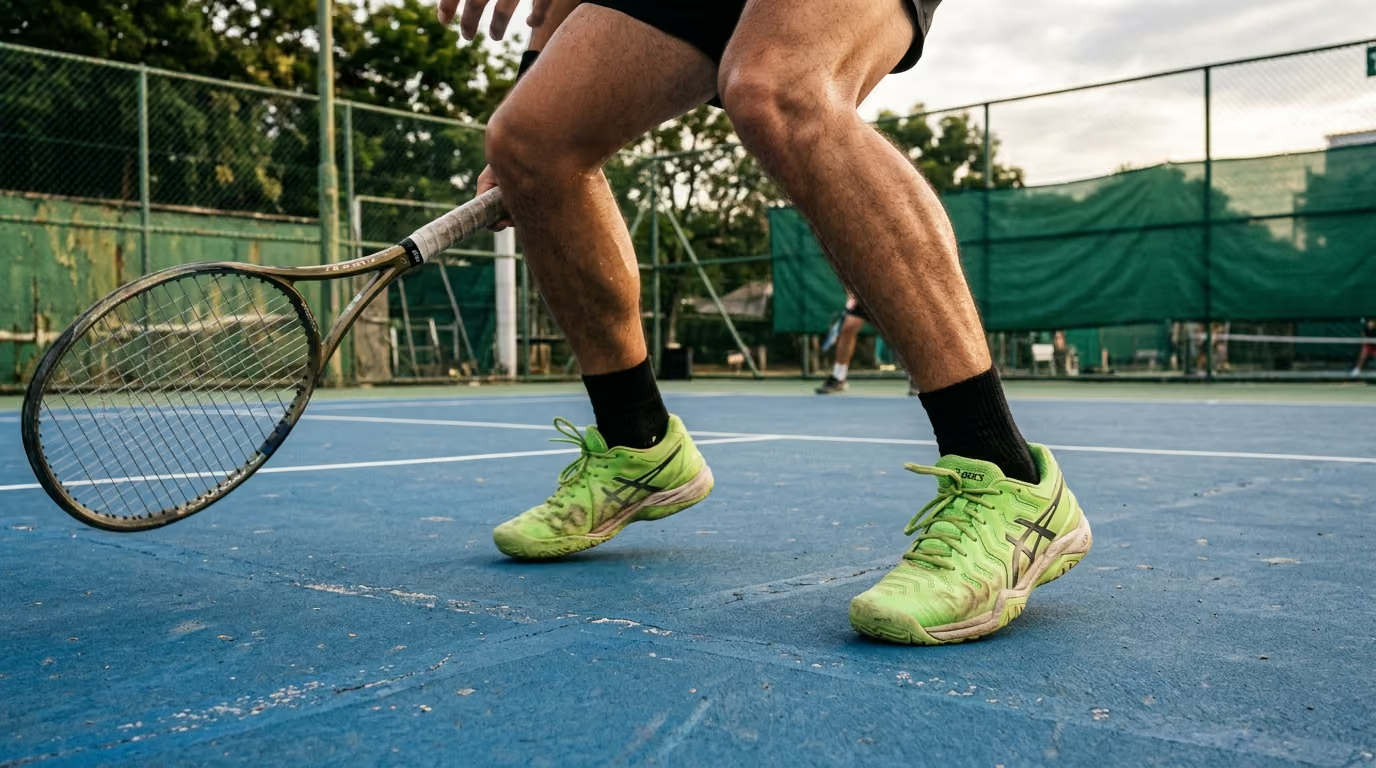
Racquet sports recovery demands vary significantly across singles, doubles, drilling, and matches due to unique cardiovascular, mechanical, and psychological stressors.




The recovery demands of racquet sports depend on the balance of cardiovascular, mechanical, and psychological stressors unique to each session type. While singles match play often demands significant court coverage and muscular endurance, structured drilling or social play can accumulate surprising physical fatigue through high-density repetitions and prolonged court time. Understanding these distinct recovery demands allows court athletes to manage cumulative fatigue, maintain physical readiness, and support long-term athletic longevity.
Many racquet sports players judge the difficulty of a session solely by how tired or out of breath they feel immediately afterward. This immediate feedback can be highly deceptive. A training session or match may feel relatively comfortable because the heart rate remains moderate, yet it can still place immense physical stress on the body. We must distinguish between a session that leaves us feeling winded and one that creates deep physical strain.
To understand this difference, we look at training load through two distinct lenses. These lenses are external load and internal load.
External load is the objective work you perform on the court. It represents the physical exposure of the session. Examples include the total duration of the match, the distance you run, and the number of shots you hit.
In racquet sports, external load also encompasses the number of accelerations, decelerations, and lateral shuffles you execute. Every change of direction places stress on your muscles and tendons. Measuring external load helps players track their total weekly exposure.
Internal load is your body's physiological and psychological response to that work. It represents how hard your cardiovascular system, muscles, and nervous system had to work. Two players can perform the exact same external work but experience very different internal loads.
For instance, a fast-paced game of doubles might be easy for a well-conditioned player. However, it can represent a high internal load for someone returning from an injury. Factors like sleep quality, stress levels, and hydration modify your internal response. This is why we must focus on personalized recovery science resources to optimize our playing schedule.
Metabolic demand refers to the energy cost and cardiovascular stress of playing. This is what makes you sweat and breathe heavily. Mechanical demand, on the other hand, is the physical force exerted on your muscles, joints, and connective tissues.
A long, slow doubles session can create high metabolic demand over several hours. Yet, a short singles match can generate much higher mechanical demand due to sudden braking and explosive sprints. Both types of demand require distinct recovery approaches.
Acute fatigue is the tiredness you feel during or immediately after your session. It usually resolves after a short rest, a meal, and a good night of sleep. Residual recovery demand represents the deeper, longer-lasting tissue repair your body requires.
You might walk off the court feeling energized, only to experience severe calf stiffness the next morning. This delayed onset muscle soreness indicates high mechanical tissue loading. Recognizing this difference helps prevent overuse injuries.
Current sports science research emphasizes that we cannot rely on heart rate alone to measure overall court stress. According to the International Olympic Committee consensus on athlete load, monitoring must include both physical and psychological variables. This framework recognizes that life stress and mental fatigue directly impact recovery times.
In recreational racquet sports, studies reveal surprising similarities in cardiovascular demands across different formats. For example, research published by Webber and colleagues compared recreational singles and doubles play. They found that mean heart rates were almost identical.
The singles players recorded an average heart rate of 111.6 beats per minute. Meanwhile, the doubles players averaged 111.5 beats per minute. In both formats, players spent more than 70 percent of their court time in moderate-to-vigorous heart-rate zones.
This evidence challenges the common assumption that singles is always more cardiovascularly demanding. However, the singles players recorded significantly more steps per hour. This indicates a much higher mechanical load, even though heart rate values were matching.
Another study by Denning and colleagues compared doubles play to self-selected walking. Walking actually produced 54 percent more steps than playing doubles. Despite taking fewer steps, the doubles players experienced much higher heart rates and caloric expenditure.
Specifically, doubles play increased average heart rate by 14 percent and peak heart rate by 19 percent compared to walking. This demonstrates that step counts alone do not capture the explosive nature of court sports. The short bursts of lateral movement and split-steps create high physical stress.
Research examining post-match fatigue has produced mixed results. One study found that playing a single doubles match did not produce measurable lower-body neuromuscular fatigue. In fact, some players showed improved jump performance after playing.
This improvement is likely due to the warm-up effect and enhanced muscle recruitment. However, this does not mean the match created zero fatigue. It simply shows that a single match may not deplete a player's immediate explosive power.
Singles and doubles represent two completely different movement profiles. Singles is an individual pursuit where you must cover the entire court alone. This requires continuous movement, rapid changes of direction, and deep lateral lunges.
In singles play, you are solely responsible for every ball. This reality forces you to cover approximately 20 percent more steps per hour than in doubles. The steps you take are also higher in intensity.
You must accelerate rapidly to reach wide shots, then decelerate sharply to recover your position. This cycle of acceleration and deceleration places immense mechanical stress on your patellar tendons and calf muscles. Because there is no partner to share the court, every positional error costs you extra movement.
Doubles is often perceived as a lighter option, but it has its own unique physical demands. The movement in doubles is characterized by short, explosive steps near the non-volley zone or kitchen line. You must react quickly to fast-paced volleys and overheads.
This requires excellent reaction times and rapid lateral shuffles. While you may cover less total distance, the density of explosive, short-range movements can be very high. The constant crouching and split-stepping also challenge the muscular endurance of your thighs and lower back.
To compare these formats, we can look at how they distribute stress across the body. Singles is characterized by high locomotor volume and continuous running. Doubles is characterized by high-density reaction steps and upper-body rotation.
The mechanical stress of singles falls heavily on the knees, ankles, and cardiovascular system. The mechanical stress of doubles is often concentrated in the lower back, shoulders, and elbows. Knowing this helps you choose appropriate injury prevention methods tailored to your preferred format.
Drilling sessions and private lessons are highly structured environments. Because a coach or training partner controls the pace, these sessions differ significantly from matches. They can create a very high local-tissue load, even if your heart rate remains low.
During a typical match, you might hit a few dozen backhand volleys. In a structured drilling session, you might hit several hundred of them in a single hour. This high repetition density is excellent for technical skill development.
However, it creates concentrated stress on specific joints and tendons. The elbow, wrist, and shoulder of your hitting arm are particularly vulnerable. Without adequate recovery, this repetitive loading can lead to tendon irritation, such as epicondylalgia.
Drills vary widely in their movement demands. Some technical drills are performed from a nearly stationary position. Other drills, like cross-court running sequences, require full-court movement.
A movement-focused drill combines technical hitting with intensive footwork. These drills often produce higher cardiovascular and mechanical loads than a recreational match. The predictable nature of the drill allows you to move at maximum intensity without pausing.
Private lessons often involve high cognitive and psychological loads. You are processing technical corrections, adapting your movement, and trying to please your coach. This constant mental focus can be exhausting.
Research shows that mental fatigue can negatively affect your physical performance and movement coordination. When your brain is tired, your reaction times slow down. This mental fatigue is a critical component of your overall recovery demand.
The environment in which you play plays a massive role in your recovery needs. A competitive tournament match demands a different physical and mental state than a weekend social session. Understanding these differences helps you plan your weekly schedule on Evercourts.
In a competitive match, you cannot control the pace or take unscheduled breaks. Your opponent is actively trying to exploit your weaknesses. This creates a high-pressure environment that increases your emotional arousal.
This psychological stress elevates your heart rate and muscle tension. High muscle tension makes your movements less efficient, which can increase mechanical stress. Furthermore, tournament days often involve playing multiple matches with unpredictable rest times in between.
Recreational social play is often viewed as a low-demand activity. Players spend time chatting, rotating partners, and resting between games. This relaxed atmosphere can make the session feel very easy.
However, social sessions often last much longer than competitive matches. You might spend three hours at the court, even if you only play for half of that time. The cumulative exposure of standing, walking, and playing can still create substantial fatigue.
In our experience, players often underestimate the physical toll of these long sessions. We have found that the repeated warm-up and cool-down cycles of social rotation can stiffen the joints. Staying warm during downtime is crucial for preventing injuries.
To help players manage their training, we can evaluate every session using a six-dimension framework. This system allows you to look beyond simple metrics like court time or steps. It helps you see the complete picture of your physical exposure.
The first dimension is cardiovascular load, which tracks heart rate and breathing intensity. The second is locomotor load, which measures steps, distance, and changes of direction. The third is repetition load, which counts the total number of hits and specific shots.
The fourth dimension is neuromuscular load, which assesses muscle tiredness and first-step sharpness. The fifth is cognitive load, representing mental focus and competitive pressure. Finally, the sixth is contextual load, which includes factors like sleep, weather, and life stress.
By evaluating these six dimensions, you can assign a recovery score to your sessions. A short, intense singles match would score high on locomotor and cardiovascular loads. A long volley drill would score high on repetition load but low on cardiovascular load.
This multidimensional view prevents you from overtraining. It ensures you do not schedule back-to-back high-demand sessions. Balancing these loads is the key to maintaining long-term performance.
Many players use smartwatches and fitness trackers to monitor their sessions. These devices are helpful for tracking heart rate trends over time. However, they have significant limitations that you must keep in mind.
Studies show that while wearables are accurate for heart rate, their calorie estimates are often highly inaccurate. Some devices show error rates of up to 28 percent for energy expenditure. Relying on calorie metrics to plan your recovery can lead to poor nutritional and rest decisions.
To see how this framework works in real life, let us examine several common court patterns. These patterns illustrate how different sessions create unique physical demands. They show why a single recovery strategy does not fit every scenario.
I remember finishing a tough two hour padel match on a cold Tuesday night and waking up the next morning feeling like my lower back was locked in concrete. For a long time, I just accepted this as the price of playing hard in my forties. But once I started spending just ten minutes on targeted hip mobility before heading to the club, the stiffness almost completely vanished.
It taught me that we do not have to accept pain as a default state of aging. This experience highlights the importance of proactive movement preparation. By improving our hip mobility, we can protect our lower back from the mechanical stress of rotational sports.
Consider a player who completes four hours of recreational doubles on a Saturday. They took many breaks and never felt out of breath. However, their total court time was exceptionally long.
The next day, they feel a deep, systemic fatigue and joint stiffness. This is a classic case of high cumulative locomotor and mechanical load. The player needs passive recovery, hydration, and gentle walking to recover.
Another player takes a 45-minute private lesson focusing on serving and overheads. They did not run much, so their smartwatch shows a low heart rate. Yet, their shoulder and elbow are extremely sore the following day.
This session had a high repetition load concentrated on a single limb. The recovery priority here is local tissue rest and targeted stretching, rather than full-body cardiovascular recovery. Understanding these patterns helps you make smarter decisions about your training.
The demands of racquet sports are not identical. Tennis, pickleball, and padel each place unique stresses on the human body. Understanding these differences allows you to tailor your recovery to your specific sport.
Tennis is played on the largest court of the three sports. This larger scale requires longer sprint distances and higher maximum speeds. Tennis players must cover significant ground, resulting in high cardiovascular and locomotor loads.
The heavier ball and racquet also increase the impact forces on the hitting arm. Tennis recovery must focus on full-body cardiovascular restoration and shoulder care. Developing total-body power through strength and conditioning guidelines is highly beneficial for tennis players.
Pickleball is played on a much smaller court, which reduces the need for long sprints. However, the game is incredibly fast-paced, with rapid volley exchanges. This demands exceptional reaction times and quick, short-range steps.
The low bounce of the plastic ball forces players into a deep, constant squatting position. This posture places high mechanical demands on the knees, lower back, and thighs. Pickleball recovery should emphasize lower-body flexibility and patellar tendon care.
Padel is played in an enclosed glass cage, which changes the dynamics of the game. The walls keep the ball in play longer, resulting in extended rallies and high metabolic demands. Players must perform frequent overheads, lobs, and rotational turns.
The court surface, often synthetic turf with sand, requires rapid changes of direction. This movement profile places high stress on the Achilles tendons and calves. Padel players should focus on ankle stability and calf flexibility using mobility and movement programs.
Many players hold beliefs about training and recovery that can hinder their progress. These myths often lead to inappropriate training volumes or inadequate rest. Let us examine the most common misconceptions.
The belief that doubles is always easy is a common pitfall. While doubles reduces total step count, it can still maintain a high heart rate. The explosive reactions and rapid lateral movements require significant physical effort.
Assuming doubles requires no recovery can lead to cumulative overtraining. Another myth is that singles is always harder. Singles is mechanically more demanding, but doubles can match its cardiovascular intensity.
Many athletes believe their fitness tracker tells them everything they need to know. They look at their average heart rate and decide if they are tired. As we have seen, heart rate does not measure mechanical or repetition load.
A session with low heart rate can still leave your muscles and tendons highly fatigued. We must learn to listen to our bodies, not just our screens. Perceived exertion and muscle soreness are excellent indicators of recovery needs.
Some players believe that playing more frequently always increases injury risk. However, research from South Korea indicates that playing frequency alone is not the primary risk factor. Instead, sudden increases in playing volume and poor movement quality are more closely linked to injuries.
Overuse injuries, such as elbow tendinopathy, often develop from repetitive stress combined with inadequate recovery. These injuries can occur even if you only play twice a week, if those sessions are excessively long. Consistency and gradual progression are much safer than sporadic, intense sessions.
To play your best for years to come, you must protect your tissue health. Your muscles, tendons, and ligaments adapt to the stress of play, but only if they have time to recover. Neglecting recovery leads to chronic tissue degradation and reduced performance.
Tendons have a limited blood supply compared to muscles. This means they take longer to repair and adapt after a hard session. When you perform high-repetition drills, your tendons experience micro-damage that requires time to heal.
If you play again before this healing is complete, the tissue begins to break down. This can lead to chronic tendinopathy, which is difficult to resolve. Giving your tendons adequate rest is essential for maintaining your athletic longevity.
As your muscles tire, your movement mechanics begin to change. You may start lunging with a more upright posture, placing extra stress on your knees. Your hitting arm may compensate for a tired shoulder by using more wrist action.
These subtle changes in technique increase the risk of acute injuries and chronic strains. Monitoring your movement quality during a session is a vital safety measure. When you notice your movement deteriorating, it is time to stop.
While managing your own recovery is highly effective, there are times when professional help is necessary. Ignoring warning signs can turn a minor strain into a chronic issue. Knowing when to see a qualified healthcare provider is crucial for your long-term health.
You should consult a professional if you experience sharp, localized pain that does not improve with rest. Pain that changes how you walk, run, or swing is a clear warning sign. If you experience joint swelling, clicking, or a feeling of instability, seek medical advice.
Persistent numbness, tingling, or radiating pain down your leg or arm also requires immediate attention. These symptoms can indicate nerve involvement that needs expert diagnosis. Do not try to push through these types of pain.
A physical therapist or sports medicine physician can help you identify the root cause of your pain. They can design a personalized rehabilitation and strength program to address your specific weaknesses. This proactive approach helps you return to the court safely and quickly.
Remember, seeking professional help is not a sign of weakness. It is a smart strategy for protecting your ability to play the sports you love. Your health and longevity on the court should always be your top priority.
To put this knowledge into practice, use this simple checklist to plan your court time and recovery this week.
Follow Evercourts for practical insights on tennis, pickleball and padel performance, movement, recovery and healthy ageing. Stay connected for new articles, research-led guidance and ideas to help you play well and keep playing for years.


Read practical guidance for better movement, smarter preparation and a game that keeps working for you.
explore the Blog