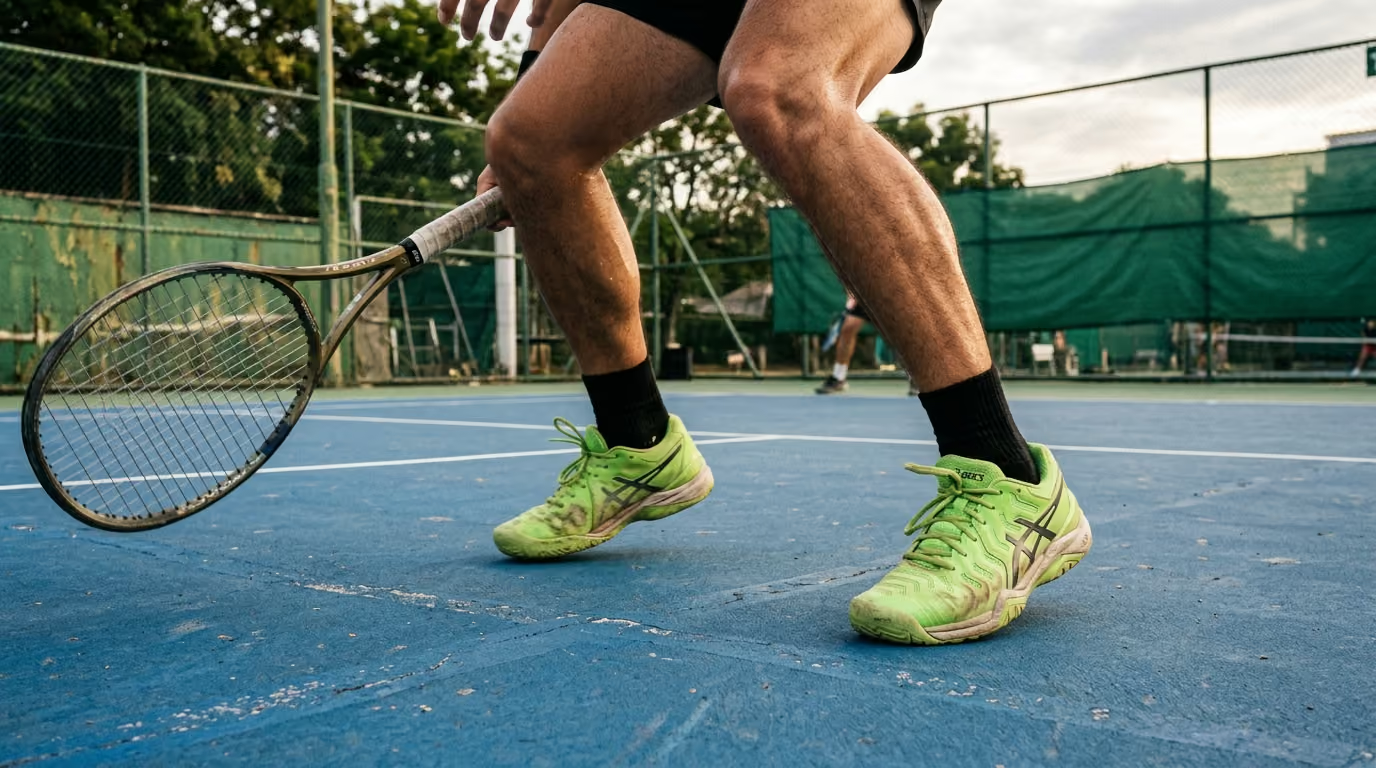
When playing singles, the constant demands of court coverage, rapid deceleration, and high-intensity movements can lead to injuries if not properly managed.




Many court athletes struggle with how to stay healthy playing singles when the court feels too big and their joints ache after three games. The common response is to run longer distances on the road. However, jogging does not prepare your body for the sudden stops, deep lunges, and rapid directional changes of single-player games.
To play singles without injury, you must build specific physical capacity to brake, change direction, and recover from deep positions rather than just adding cardiovascular volume. This requires matching your weekly court time with targeted single-leg strength and gradual exposure to rapid, multi-directional movements. When you balance these elements, you protect your joints while improving your court coverage.
Singles play represents a unique physical puzzle. In doubles, you share the court with a partner, which limits your running distance and lets you specialize in specific zones. Singles removes this safety net. Every corner is your responsibility, every open space is a target for your opponent, and every recovery step must be taken alone. This makes singles a highly demanding form of intermittent, high-intensity exercise that requires a deliberate approach to physical preparation.
Our team at Evercourts believes in helping players move well and perform better without relying on fitness hype. Understanding the physical demands of your sport is the first step toward athletic longevity. By learning how to manage your court coverage, deceleration forces, and overall training load, you can enjoy competitive singles play for many years.
Scientific research highlights the physical toll of single-player racket sports. According to a systematic review published in 2025, racket sports players experience an injury incidence rate between 1 and 4 injuries per 1,000 hours of play. Overuse injuries make up a significant portion of this total, ranging from 25 percent to 74 percent across various studies. Muscle strains and joint sprains are the most common diagnoses, representing up to 64 percent and 61 percent of injuries respectively.
The lower body bears the majority of this physical stress. A comprehensive meta-analysis covering 28 separate studies found that lower-limb injuries accounted for over 52 percent of all reported issues. Within the lower limb, ankle sprains and muscle injuries of the calf and thigh were highly prevalent. This confirms that moving across the court places immense stress on the ankles, knees, and hips.
Interestingly, injury risk is not distributed evenly across a match. A prospective study of international competitive players found that injury incidence was significantly higher during actual matches than during training sessions, reaching 11.6 injuries per 1,000 hours of match play. The same study revealed that 46.2 percent of these injuries occurred during the first third of play. This finding challenges the common assumption that injuries only happen when a player is completely exhausted. It suggests that poor warm-up habits, early-match intensity, and inadequate physical preparation play a massive role in early-stage tissue damage.
Rally length also dictates the internal stress placed on your body. Research tracking elite single-player matches showed that regular rallies lasted an average of 6.3 seconds, while extended rallies averaged over 21 seconds. These long rallies are not just cardiovascular challenges. They alter how you move during the next point. The research demonstrated that after a long rally, players showed a significant increase in unforced errors and slower recovery times. This indicates that acute fatigue compromises your movement mechanics, which increases your susceptibility to acute joint sprains.
Finally, the physical mechanisms behind these injuries are highly specific. The same prospective study identified the deep lunge as the primary mechanism for lower-limb injuries, while explosive overhead strokes were the main cause of upper-limb issues. This means injury prevention programs must focus on joint stabilization during deep reaches and force absorption during heavy landings. General fitness programs that do not address these specific movement patterns will fail to protect court athletes.
To build a useful prevention strategy, we must view singles movement as an interaction of three distinct physical demands. These demands are court coverage, acceleration speed, and deceleration braking capacity. If you improve one without addressing the others, you create a physical mismatch that can lead to joint strain.
Court coverage is your ability to reach relevant areas of the play space, execute your shot, and return to an effective base position. It involves much more than simply running a long distance. To evaluate your coverage capacity, you must look at four distinct phases:
Acceleration is the first-step speed that allows you to start moving toward the ball. This is highly dependent on your split-step timing and your starting posture. In singles, you rarely run in a straight line for more than three steps. Instead, you must accelerate laterally, diagonally, or backward from a split-step. This explosive start places high demand on your calf muscles and your Achilles tendons, which must transfer force rapidly from the court surface.
Deceleration is the act of slowing down your body weight so you can strike the ball with balance. This is perhaps the most neglected aspect of court preparation. When you rush to a ball, your quadriceps and calf muscles must work eccentrically to absorb your momentum. If your muscles cannot absorb this force, the stress travels directly into your patellar tendons, your knees, and your lower back. Improving your eccentric strength allows you to brake under control and protects these vulnerable structures.
Load management brings these elements together by balancing your physical output with your body's ability to recover. Your external load includes the number of games you play, the sprints you perform, and the lunges you complete. Your internal load is how your cardiovascular and nervous systems respond to that work. We can monitor this internal load using the session Rating of Perceived Exertion, which is a simple scale from one to ten multiplied by the duration of your session. Tracking this number helps you avoid sudden spikes in weekly training volume, which are highly correlated with tissue failure.
Applying this scientific knowledge to your weekly routine requires a structured approach. You cannot simply jump into high-intensity agility drills without building a foundation of movement quality. We recommend using a progressive ladder system that separates coordination, speed, strength, and fatigue tolerance into manageable steps. You can learn more about these movement principles in our [mobility and movement drills] (https://www.evercourts.com/resource-category/mobility-movement) resource section.
To improve your court movement without overloading your tissues, follow this five-stage progression. Only move to the next stage when you can complete the current stage with perfect balance and zero joint discomfort.
Because lunging is a primary cause of lower-limb injuries, you must train your legs to absorb impact. Use this off-court progression twice a week to build structural capacity in your hips, knees, and ankles. This is a core component of our [strength and conditioning programs] (https://www.evercourts.com/resource-category/strength-conditioning) designed for court athletes.
While the biomechanical principles of singles play remain constant, the specific physical demands change depending on your racket sport of choice. Understanding these nuances helps you tailor your training to the exact stresses of your preferred game. For a broader look at staying healthy across different sports, consult our [injury prevention resources] (https://www.evercourts.com/resource-category/injury-prevention) hub.
Tennis singles presents the largest physical territory to cover, requiring explosive, long-distance sprints across a court that is 78 feet long. The court surface plays a massive role in how your joints absorb force. Clay courts allow you to slide into shots, which reduces the absolute braking force but demands excellent rotational hip stability. Hard courts do not slide, which creates massive deceleration forces on your knees and ankles during sudden stops.
Furthermore, the tennis serve introduces a unique overhead stress that is absent in sports where underhand serving is mandatory. The combination of a deep back-bend during the trophy position and an explosive upward jump places immense strain on your lumbar spine and your rotator cuff. Tennis players must therefore balance their lower-body movement training with dedicated thoracic mobility and shoulder blade stabilization work to protect the upper body.
Pickleball is played on a much smaller court, but this does not mean it is physically easy. The compact space compresses your reaction time, which leads to incredibly rapid, micro-directional adjustments. Instead of long sprints, pickleball singles consists of constant lateral shuffling and deep, low lunges near the kitchen line.
When I first started playing pickleball, I noticed how many people skipped warming up entirely. They would jump straight out of their cars and right up to the kitchen line. I tried doing that and immediately pulled a calf muscle. Pickleball requires just as much explosive lateral movement as tennis, just in a tighter space. Since then, I always spend five minutes doing dynamic lunges and ankle rolls. It changes everything about how confident I feel pushing off the baseline.
The paddle design also influences physical strain. Because pickleball paddles are short and stiff, more impact vibration travels up your arm. This can lead to elbow tendon issues if you do not have sufficient wrist and forearm strength. Additionally, the low bounce of the plastic ball forces you to play in a deep, constant semi-squat. This position places a high mechanical load on your quadriceps and patellar tendons, making lower-body endurance essential.
Padel is played in an enclosed glass cage, which completely changes the tactical and physical nature of singles movement. Because the ball can bounce off the walls, you must constantly turn, rotate, and run backward to retrieve shots. This multi-directional tracking requires exceptional hip mobility and spatial awareness to avoid awkward, last-second twists that can strain your lower back.
Overhead actions are also incredibly frequent in padel. Shots like the bandeja and the vibora require you to strike high balls while moving backward or sideways. This constant overhead volume can easily overload the shoulder joint if your shoulder blades do not move efficiently. Padel players must focus heavily on posterior shoulder strength and core stability to handle these continuous overhead demands.
Recreational players often make predictable mistakes when trying to improve their singles performance. Recognizing these errors early can save you from months of rehabilitation and keep you on the court. You can find more detail on avoiding these issues in our [player health insights] (https://www.evercourts.com/category/player-health) section.
The belief that running long distances will make you a better singles player is a common misconception. While a basic aerobic base is helpful, slow jogging teaches your nervous system to move in a single plane without change of direction. It does not prepare your tendons for the high-impact, eccentric braking required when chasing a drop shot.
To prevent injuries, you must replace some of your long runs with high-quality, multidirectional movement sessions. Five reps of 10-second court sprints with full recovery will do more for your joints than a 5-mile run. This specific training builds the tendon stiffness needed to handle explosive movements safely.
As shown in the prospective research on elite players, nearly half of all injuries occur during the first third of play. Walking onto the court cold and immediately attempting a maximal sprint or a deep lunge is a recipe for muscle strains. Your tendons and muscles need a physical temperature increase to become elastic and resilient.
A proper warm-up should take at least 10 minutes and should mimic the movements you will perform during the match. Start with a light jog, move into side-shuffles and high-knees, and finish with progressive lunges and shadow swings. This primes your nervous system and lubricates your joints, reducing your early-match injury risk.
Your body is highly adaptable, but it requires time to build tolerance to new physical stresses. A sudden increase in court time, such as playing a three-day tournament after weeks of single-session play, creates a massive load spike. This acute overload often exceeds your tissues' capacity to repair, leading to overuse tendinopathies.
Keep a simple training log to track your total playing hours and your perceived exertion. Try to limit any weekly volume increases to no more than 10 percent. If you plan to play a heavy tournament, gradually increase your court time over the preceding six weeks to prepare your body for the demand.
When you get tired late in a singles match, your brain naturally looks for ways to save energy. This often manifests as poor movement mechanics. You might stop performing your split-step, bend from your waist instead of your knees, or allow your front knee to collapse inward during a lunge.
These mechanical compensations place massive, unnatural stress on your ligaments and tendons. If you notice your movement quality deteriorating significantly, it is better to reduce your intensity or end the session. Practicing with poor mechanics simply trains your brain to move inefficiently, which increases your long-term injury risk.
When you play a demanding singles match, the physical toll extends far beyond your lungs and your cardiovascular system. Systemic fatigue directly impacts the mechanical properties of your muscles, tendons, and joints. Understanding this relationship is critical for designing an effective recovery plan. Our [recovery science strategies] (https://www.evercourts.com/resource-category/recovery-science) guide offers deeper insights into how to restore your body after intense play.
During prolonged singles play, your muscles gradually lose their ability to produce force rapidly. This reduction in contractile speed impairs your ability to decelerate. As your muscles tire, they cannot absorb the impact forces of your landing steps. This means the shock of every step must be absorbed by your passive structures, including your articular cartilage, your ligaments, and your spinal discs. Over time, this repetitive microtrauma can lead to chronic joint irritation.
Tendons are particularly sensitive to cumulative fatigue. Unlike muscles, tendons have a limited blood supply, which means they adapt and recover much more slowly. When you perform hundreds of rapid movements during a singles match, your Achilles and patellar tendons experience micro-tears. Under normal conditions, your body repairs these fibers during rest. However, if you play again before this repair process is complete, the micro-damage accumulates, leading to chronic tendinopathy.
Furthermore, systemic fatigue affects your proprioception, which is your brain's ability to sense where your joints are in space. When you are tired, your split-step timing slows down, and your foot placement becomes less precise. This delay in neuromuscular control is why many acute ankle sprains occur late in a match or training session. To protect your tissues, you must respect your body's recovery timeline.
To support healthy tissue recovery, we recommend the following parameters:
While minor muscle soreness is a normal part of training, you must be able to distinguish between acceptable physical adaptation and early warning signs of injury. Ignoring persistent symptoms can turn a simple, easily managed strain into a chronic issue that keeps you off the court for months.
You should consult a qualified healthcare provider, such as a physical therapist or a sports medicine physician, if you experience any of the following clinical warning signs:
A professional assessment can help identify the root cause of your pain. Often, pain in one joint is caused by a weakness or mobility restriction in another part of your kinetic chain. For example, chronic knee pain can stem from limited hip mobility or weak gluteal muscles. A physical therapist can design a targeted rehabilitation plan to correct these imbalances. This targeted approach ensures you can return to the court safely and continue enjoying your sport for years to come.
To apply these principles to your play this week, use this step-by-step checklist to guide your physical preparation, court time, and recovery.
Follow Evercourts for practical insights on tennis, pickleball and padel performance, movement, recovery and healthy ageing. Stay connected for new articles, research-led guidance and ideas to help you play well and keep playing for years.


Read practical guidance for better movement, smarter preparation and a game that keeps working for you.
explore the Blog