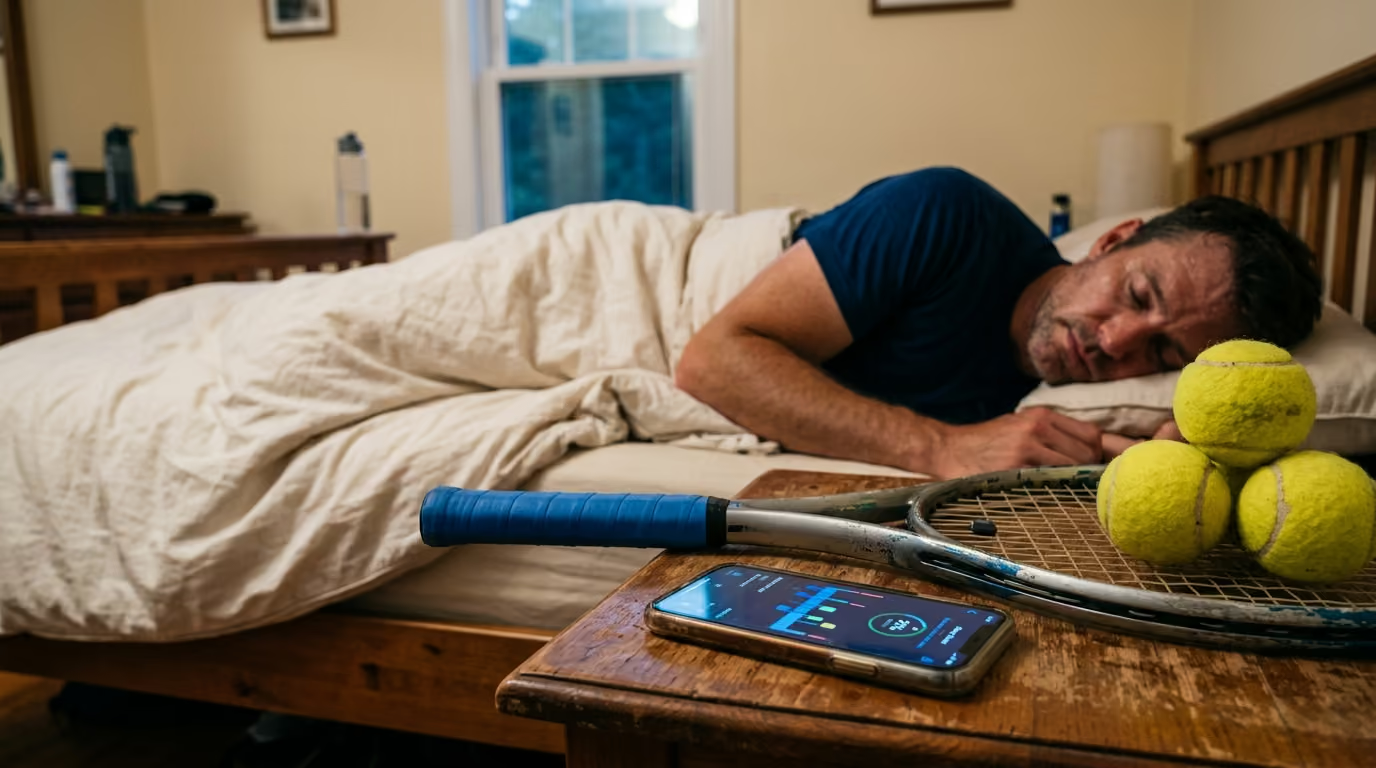

While many athletes focus on physical training for injury prevention, sleep is a crucial, often underestimated factor that significantly impacts recovery and performance.




Many racquet sports players search for ways to recover faster or avoid the nagging calf strains and shoulder aches that disrupt their playing seasons. While court training and physical conditioning are important, one of the most powerful tools for staying healthy on the court is often overlooked.
Sleep acts as a powerful modifier of injury risk by restoring reaction time, visual attention, and physical coordination. While getting enough sleep does not guarantee an injury-free season, chronic sleep loss impairs decision-making and increases pain sensitivity on the court. To play safely, adult athletes should aim for at least seven hours of sleep per night and adjust their training intensity on days when sleep is compromised.
Managing your sleep schedule is a key component of athletic longevity resources. When you understand the relationship between rest and physical performance, you can make better choices before, during, and after your matches.
Understanding sleep requires looking beyond the total number of hours you spend in bed. Sleep is a complex physiological process that relies on several distinct factors. For adult athletes, these factors determine how well the body restores itself after a demanding training session.
Sleep duration refers to the actual time you spend asleep rather than the total time you lie in bed. For healthy adults aged 18 to 60, the American Academy of Sleep Medicine and the Sleep Research Society recommend obtaining at least seven hours of sleep per night on a regular basis.
The Centers for Disease Control and Prevention offers slightly modified recommendations based on age. Adults aged 18 to 60 should target seven or more hours. Adults aged 61 to 64 should aim for seven to nine hours, while those aged 65 and older need seven to eight hours. These numbers represent population-level health thresholds rather than individualized athletic targets. Some players may require more sleep when recovering from intense training or travel.
To evaluate your rest, it is helpful to understand the components that make up healthy sleep. The American Academy of Sleep Medicine describes healthy sleep as involving adequate duration, good quality, appropriate timing, and regularity.
The physical impact of sleep loss depends on whether the restriction is a single event or a long-term habit. Acute sleep loss refers to a single night of shortened rest, which might happen after a late match or during travel. Experimental research shows that reaction time can suffer after even one night of complete sleep deprivation.
Chronic sleep restriction occurs when you routinely get too little sleep over weeks or months. This pattern can be deceptive because your mind adapts to feeling tired, making you believe your performance is unaffected. However, objective testing shows that attention and coordination remain impaired even when you feel subjectively fine.
Racquet sports place high demands on your brain and nervous system. On a fast-paced court, sleep loss directly compromises your ability to track the ball, move efficiently, and make smart tactical choices.
Tennis, pickleball, and padel require you to process visual information and move your body in fractions of a second. Reaction time is not a single process. It is made up of several distinct stages.
When you sleep poorly, your response consistency drops. You may hit several good shots but then react slowly to a sudden volley. Research on athletic performance shows that sleep deprivation negatively affects reaction time, accuracy, vigor, submaximal strength, and endurance.
Conversely, extending your sleep can bring measurable benefits. A study on professional baseball players showed that adding an extra hour of sleep for five nights improved cognitive processing speed by 13 percent. This change allowed players to react 122 milliseconds faster. While this study was not conducted on a tennis court, the underlying demands of visual tracking and selective attention are nearly identical.
Your brain relies on sleep to maintain executive function, which governs your judgment and self-regulation. When you are sleep-deprived, you are more likely to make poor decisions during a match.
This decline in executive control can manifest in several ways. You might attempt a risky shot from a defensive position instead of hitting a safer recovery ball. You might ignore a mild pull in your hamstring and continue playing, which increases the risk of a more severe muscle tear.
Sleep loss also makes it harder to manage frustration, communicate clearly with a doubles partner, or remember to hydrate between games.
This simple pathway shows how a tired mind leads directly to physical vulnerability. By protecting your sleep, you preserve the mental clarity needed to avoid unnecessary risks.
To keep playing for years, your muscles, tendons, and ligaments must recover from the physical stress of every match. Sleep is a vital part of this biological recovery process.
The relationship between sleep and tissue repair is a key subject in recovery science resources. During deep sleep, your body experiences hormonal shifts that support tissue healing.
Research indicates that sleep deprivation after muscle-damaging exercise can alter your inflammatory and hormonal responses. Specifically, sleep loss can increase certain inflammatory markers, like interleukin-6, and alter the ratio of cortisol to testosterone.
In laboratory studies, sleep-deprived animals showed slower functional muscle recovery and reduced muscle repair markers. While these laboratory findings do not translate directly to a human player, they suggest that poor sleep creates a less hospitable environment for tissue healing.
Sleep and pain share a highly connected, bidirectional relationship. Poor sleep can make you more sensitive to pain, while persistent pain can make it difficult to sleep.
A systematic review and meta-analysis of 38 studies found that sleep disturbances significantly influence how the body processes pain signals. Sleep loss can increase pain facilitation, making a mild ache feel more intense, while reducing your body's ability to inhibit pain.
This finding means that if you are sleep-deprived, a familiar knee or elbow symptom may feel substantially worse. This increased sensitivity does not mean the pain is imaginary. However, it does highlight how a lack of rest can amplify your discomfort, making it harder to distinguish between temporary soreness and a structural issue.
When examining the scientific literature, it is important to distinguish between solid evidence and overstated claims. Sleep is a major factor in overall health, but the direct links between sleep and injury rates in adult racquet-sport athletes are still being studied.
Several studies suggest an association between sleep duration and musculoskeletal injuries, though most of these studies focus on younger or collegiate populations.
A systematic review of 12 prospective cohort studies concluded that the overall evidence was limited. It did not support poor sleep as a completely independent injury risk factor across all adult athletic populations.
This discrepancy exists because injuries are caused by many different factors. Your training load, physical preparation, shoe selection, court conditions, and medical history all play a role.
The most accurate conclusion is that sleep loss impairs your physical and mental capacities, which can make you more vulnerable to injury. However, sleep should be treated as one part of a comprehensive safety strategy, not as a standalone guarantee against getting hurt.
The physical demands of racquet sports vary, and each sport places unique stresses on your joints and muscles. These differences influence how sleep loss can affect your movement on the court.
Tennis matches often involve long rallies, wide lateral sprints, and explosive changes of direction. The deceleration forces are particularly high on hard courts, placing stress on your knees, ankles, and lower back.
When you are tired, your footwork can become sloppy. You may arrive late to a ball and attempt to compensate by reaching with your arm, putting extra stress on your shoulder and elbow joints.
To learn more about managing these demands, you can review our dedicated tennis articles.
Padel is played in a tight, glass-walled court and requires constant rotation, overhead smash preparations, and rapid reflexes. The three-dimensional nature of the game means you must track the ball as it rebounds off multiple surfaces.
Sleep restriction can impair your spatial awareness and visual tracking, making it easier to misjudge a bounce. If you react late to a wall rebound, you may twist your torso awkwardly to reach the ball, risking a lower back strain.
For targeted advice on this sport, explore our selection of padel articles.
Pickleball requires rapid lateral lunging and extremely fast hand-eye coordination, especially during quick exchanges at the kitchen line. Because the paddle and ball are light, the game demands immediate reflexes and precise paddle control.
When I first started playing pickleball, I noticed how many people skipped warming up entirely. They would jump straight out of their cars and right up to the kitchen line. I tried doing that and immediately pulled a calf muscle. Pickleball requires just as much explosive lateral movement as tennis, just in a tighter space. Since then, I always spend five minutes doing dynamic lunges and ankle rolls. It changes everything about how confident I feel pushing off the baseline.
A sleep-deprived pickleball player may experience slight delays in their visual processing. This lag can cause them to lung awkwardly or plant a foot incorrectly, increasing the risk of a calf or ankle strain.
You can find more practical advice on court safety in our pickleball articles.
Many adult players must balance their love for racquet sports with the demands of careers, families, and social lives. Maintaining a consistent sleep schedule requires a practical, realistic approach.
An early-morning tournament or practice session can significantly cut into your sleep opportunity. If you must wake up early, simply trying to force yourself to fall asleep hours before your usual bedtime rarely works.
Late-night league matches can make it difficult to fall asleep due to elevated adrenaline, bright court lights, and post-game excitement.
If your sleep is frequently disrupted by family duties or irregular work hours, you must adapt your training to match your recovery capacity.
Traveling for tournaments or weekend matches introduces additional challenges, including travel fatigue and jet lag. Managing these issues is essential for maintaining your physical coordination.
Jet lag is a temporary mismatch between your internal circadian clock and local time, usually occurring when you cross two or more time zones. Travel fatigue can happen without crossing time zones. It is caused by long hours of sitting, mild dehydration, disrupted meals, and the stress of navigating airports or highways.
To combat travel fatigue, prioritize hydration and move your body regularly during long trips. If you are crossing time zones, shifting your sleep schedule by one to two hours toward your destination's time zone in the days leading up to your trip can help shorten the adjustment period.
Once you arrive at your destination, take steps to align your internal clock with the local environment.
To make smart decisions about your play, you need a simple way to assess your physical readiness. The Sleep-Load-Symptom-Decision model offers a practical framework for evaluating your body before you step onto the court.
Before every match or practice session, ask yourself four key questions to gauge your physical state.
To simplify your daily assessment, categorize your physical readiness using a simple traffic-light system.
This system is not a medical diagnostic tool. It is a practical decision aid designed to help you listen to your body and avoid preventable training mistakes.
When trying to improve their recovery, many athletes fall into common traps that can hinder their progress.
While seven hours is a recommended minimum, it is not a one-size-fits-all number. Some players naturally require eight or nine hours to feel fully recovered, especially during periods of heavy training. Pay attention to your personal level of alertness and mood rather than focusing solely on a specific number.
Many players enjoy a cold drink after a tough match to help them relax. While alcohol can make you feel sleepy, it significantly disrupts your sleep quality by fragmenting your sleep cycles and reducing deep, restorative sleep. If you choose to drink, try to do so several hours before bedtime to minimize its impact on your recovery.
Sleep trackers can provide helpful insights, but they are not perfect. If you wake up feeling refreshed and ready to play, do not let a low recovery score on your watch convince you that you are physically compromised. Your subjective feelings of alertness and physical readiness are often more reliable than sensor estimates.
No amount of sleep hygiene can resolve a clinical sleep disorder. If you experience persistent, loud snoring, waking up gasping for air, or chronic daytime sleepiness despite spending eight hours in bed, seek a professional medical evaluation. Treating conditions like sleep apnea can significantly improve both your health and your performance on the court.
While lifestyle changes can solve many sleep and recovery issues, certain signs indicate a need for professional medical guidance.
Consult a qualified healthcare provider or a sleep specialist if you experience any of the following symptoms:
For more information on when to seek help for physical symptoms, explore our comprehensive injury prevention resources.
To begin improving your sleep and protecting your health on the court, consider implementing these simple changes this week.
If you have questions about our resources or want to share your recovery experiences, please visit our about page or reach out directly through our contact page.
Follow Evercourts for practical insights on tennis, pickleball and padel performance, movement, recovery and healthy ageing. Stay connected for new articles, research-led guidance and ideas to help you play well and keep playing for years.


Read practical guidance for better movement, smarter preparation and a game that keeps working for you.
explore the Blog



