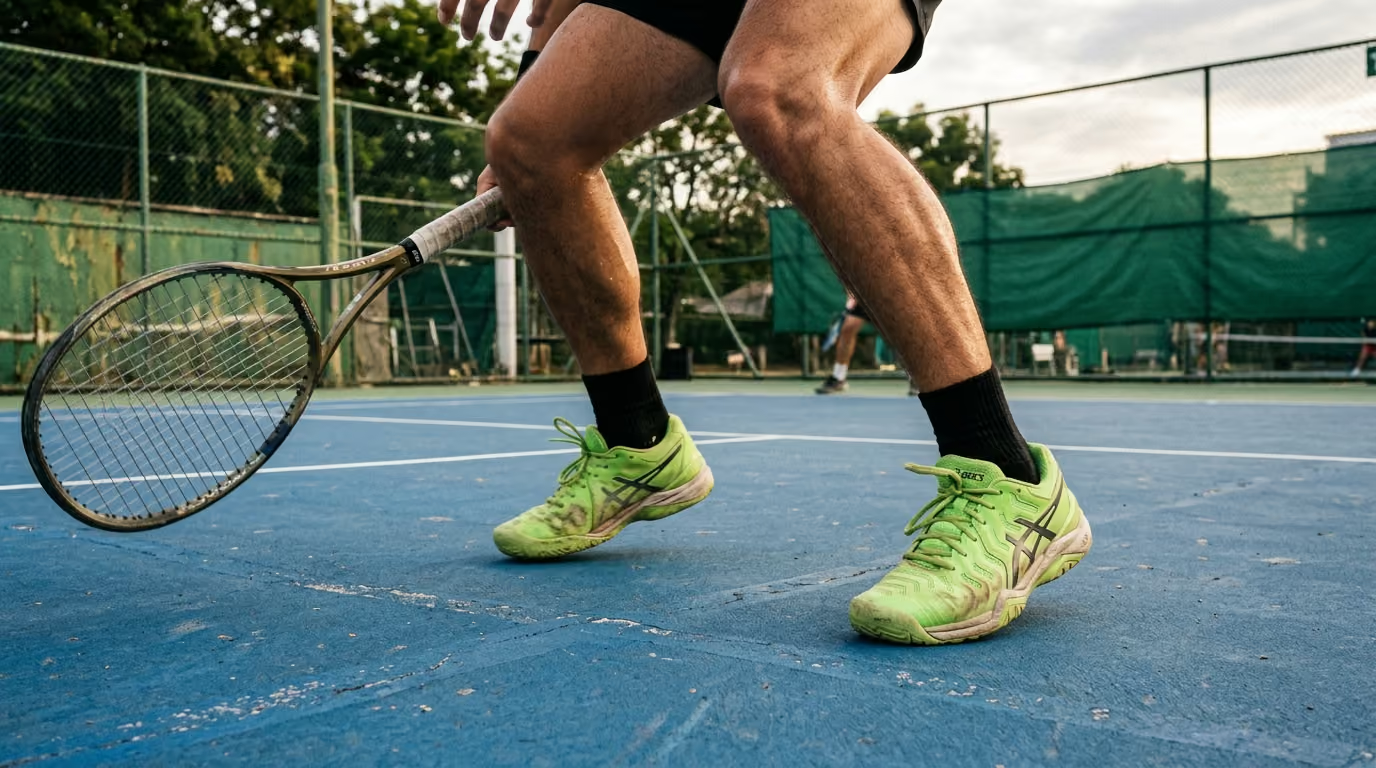
While many believe a bad day on the court demands a complete swing overhaul, most problems actually stem from minor timing, spacing, or preparation errors.




Recreational athletes often believe that a frustrating day on the court requires a complete overhaul of their swing. If they repeatedly miss wide or hit into the net, they assume their entire technique is broken. In our experience, this assumption is rarely true. Most on court problems stem from a minor timing, spacing, or preparation error earlier in the movement chain.
When a shot fails, we must look for the first physical breakdown in the sequence rather than blaming the final swing. By focusing on tiny, manageable corrections to your setup and movement, you can rapidly restore consistency to your game. This field guide provides a systematic framework to help you identify these subtle failures. It will teach you how to make small technical adjustments that yield immediate, sustainable improvements.
To make smart adjustments, we must understand how our bodies and racquets interact with the ball. Biomechanical research shows that court strokes rely on a kinetic chain. This chain begins with ground force and travels through the legs, hips, trunk, shoulder, arm, and finally the racquet face. If any link in this chain is mistimed, the entire shot breaks down.
Consider the complexity of the tennis serve. Biomechanical models divide the serve into preparation, acceleration, and follow through phases. Within those phases, researchers identify eight distinct stages including loading, cocking, and deceleration. Elite servers move from maximum shoulder external rotation to ball contact in less than one hundredth of a second.
This incredibly brief window shows why late stage corrections during the swing are nearly impossible. A study published in the Journal of Applied Academics in Physical Education and Recreation measured serve racquet velocities between 38 and 47 meters per second. The research showed that these high speeds correlate strongly with back foot vertical ground reaction force and trunk rotation. If your lower body loading or trunk rotation is slightly off, trying to swing faster with your arm will not fix the speed. It will only increase physical strain and reduce your accuracy.
Similar principles apply to paddle sports. A study of badminton net shots found that elite players actually use lower angular velocities in their upper limb joints during delicate shots. They rely on compact, controlled movements to preserve touch. In contrast, recreational players often over swing, which introduces unnecessary wrist action and errors.
The data also cautions against the mental trap of believing one mistake guarantees another. A study of over 650,000 Grand Slam points found that a previous unforced error can increase the likelihood of a subsequent forced error under pressure. However, a separate point level analysis found no clear evidence that committing an error significantly changed subsequent serve accuracy across a whole match. This means a single bad shot does not mean your technique has collapsed. It simply means you need to adjust your physical alignment.
When a stroke begins to break down during a match, you need a logical diagnostic process. Do not start changing your grip or swing path immediately. Instead, apply the adjustment hierarchy to find the least disruptive correction. This hierarchy prioritizes simple changes in timing and spacing before altering your physical mechanics.
First, check your read and timing. Ask yourself if you recognized the ball early enough. Second, adjust your court position and spacing to ensure you are not too close or too far. Third, shorten or simplify your preparation. Fourth, examine your contact point to ensure it is in a functional location.
Fifth, alter your racquet face control and swing path. Sixth, change your stance or loading pattern to improve your physical balance. Only after these six steps fail should you consider a major grip or stroke reconstruction.
To make this practical, use the five questions diagnostic tool on the court. Did I recognize the ball early enough? Did I create enough space between my body and the ball? Was my racquet prepared before the ball entered the hitting zone? Was contact in a functional location for my grip? Did I finish balanced and recover before the opponent struck?
By answering these questions, you can isolate the first failure point. A ball struck late is often caused by a late shoulder turn, not a slow forward swing. A cramped forehand is usually a failure of lateral footwork, not an incorrect grip. Changing no more than three variables in a single session keeps your brain focused and prevents technical confusion.
Proper preparation is the sequence that organizes your body and racquet before the forward swing begins. In groundstrokes, this includes the split step, the first movement, the unit turn, and stance selection. Many players think preparation simply means taking the racquet far back. This is a common misconception that leads to rushed, late contact.
The unit turn is the coordinated rotation of your shoulders, trunk, and racquet as a single unit. It is highly beneficial because it prevents you from relying on an isolated arm takeback. When you turn your shoulders early, you automatically create space and prepare your muscles for acceleration. Keeping your non dominant hand on the racquet throat during the initial turn helps guarantee this full body rotation.
Your backswing should never be a rigid, identical motion on every shot. Instead, backswing length must change based on available time, court position, and tactical intention. If you are facing a fast, deep ball, a large loop will cause you to hit late. In this situation, a compact, direct preparation is much more effective.
Shortening your preparation does not mean you have to stop your swing or lose power. You can use a very compact takeback and still accelerate fully through the ball. The key is to complete your shoulder turn before the incoming ball bounces on your side of the court. This simple adjustment buys you the time needed to strike clean, controlled shots.
Spacing is the physical distance between your body and the ball at the exact moment of contact. Perfect spacing is not a fixed measurement. It is a dynamic relationship that depends on your racquet length, contact height, and swing path. If your spacing is poor, even the most beautiful swing in the world will produce a weak shot.
To master spacing, you must understand the different phases of footwork. The first movement is a quick, explosive step that gets your body moving in the right direction. After this initial move, you must use small adjustment steps to fine tune your distance. Finally, you use braking steps to decelerate and establish a stable base before swinging.
If you find yourself repeatedly jammed by the ball, the issue is usually lateral movement. You are likely running directly toward the path of the ball instead of maintaining a comfortable side distance. To fix this, take an early lateral step away from the ball flight line. This creates a wide hitting corridor and preserves your natural swing radius.
If you are constantly reaching, you are likely stopping your movement too early. Reaching forces your arm to extend fully, which destabilizes your wrist and ruins your control. Take one extra adjustment step toward the ball, lower your center of mass, and strike the ball with a slightly bent, comfortable elbow. For deeper technical guides on movement, you can explore our court performance resources to improve your court coverage.
The contact point is the precise location in space and time where your string bed or paddle face meets the ball. This point includes the height of the ball, its distance from your body, and its position relative to your front hip. A consistent contact point is essential for directional control and power transfer.
A common issue is contacting the ball too far behind the body. This delay usually pulls the ball wide or causes it to float short and weak. To correct this, focus on turning your shoulders earlier and starting your forward swing sooner. On a one handed backhand, you must contact the ball even further in front of your lead hip than on a forehand.
When contact is too close to your torso, your elbow collapses and your body gets jammed. You can use a simple trapping exercise to calibrate your feel for proper distance. Hold your racquet or paddle out, place a ball against the strings, and touch the butt of the handle to your stomach. This physical check reminds your nervous system of the space required to swing freely.
Your contact height must also match your intended swing path. Attempting to hit a heavy, upward topspin shot on a ball that is at eye height is extremely difficult. If the ball is low, you must bend your knees and hips to lower your entire body. If the ball is high, you may need to adopt a more open stance and use a flatter, more level swing path.
Many recreational players believe they must use a long, sweeping swing on every single shot. They associate swing size with power and depth. However, managing your swing length is actually the key to controlling ball depth and maintaining accuracy under pressure.
The total swing can be divided into preparation length, acceleration length, extension length, and the finish position. When you need to reduce your power or handle a very fast ball, always shorten the preparation length first. Do not shorten your extension toward the target. You want to maintain a clean, continuous follow through even when your takeback is compact.
If your shots are consistently landing short, do not simply try to swing harder with your arm muscles. This extra physical effort often causes your body to tense up and actually slows down your racquet. Instead, focus on extending your racquet face further toward your target after contact. Engaging your legs and rotating your hips will also add effortless depth to your shots.
If your balls are flying long, check your racquet face orientation at impact. An open racquet face will launch the ball high and deep, regardless of your swing speed. Keep your preparation compact, contact the ball slightly earlier, and ensure your racquet path rises through the ball to create topspin. For more advice on stroke mechanics and physical wellness, check out our player health articles.
While the core principles of timing and spacing apply to all racquet sports, each game has unique physical demands. The size of the court, the weight of the ball, and the implement dimensions require specific technical adaptations. Understanding these differences will help you transition smoothly between sports.
In tennis, you must deal with high ball bounds and heavy topspin. Because the court is large and the yellow ball is heavy, you need a complete kinetic chain to generate pace. The one handed backhand requires a very early preparation to ensure contact occurs well in front of the body. On the tennis serve, you must coordinate your knee bend, trunk rotation, and racquet drop to strike the ball at peak extension. For deeper insights into tennis mechanics, you can read our library of tennis articles.
Pickleball requires a much more compact style of play than tennis. The court is small, the paddle is short, and the plastic ball does not bounce as high. You must avoid large, tennis style backswings, especially when playing at the kitchen line.
Instead, prepare your paddle early and use short, push style strokes. The serve in pickleball is also restricted by rules. You must strike the ball using an underhand motion with the paddle head below your wrist. To improve your soft game and kitchen line dinks, browse through our pickleball articles.
Padel introduces the unique challenge of playing off the glass walls. This requires a major shift in your timing and spatial awareness. When the ball passes you and hits the back wall, you cannot swing immediately. You must wait for the ball to rebound off the glass, move with it, and prepare your racquet compactly.
Because padel is played in a very tight space, large swings will cause you to hit the glass or mistime the ball. Keep your preparation short, use continental grip variations, and rely on leg transition to guide the ball. To learn more about this fast growing sport, read our dedicated padel articles.
Many players struggle because they are following outdated or misunderstood coaching clichés. These technical myths often cause athletes to force their bodies into unnatural positions. Recognizing these misconceptions is the first step toward building a more relaxed, efficient game.
The first major myth is that a larger backswing always creates more power. While a longer path can build racquet speed, it also requires much more time to execute. If you are rushed, a large backswing will make you hit late, which actually destroys your power. A compact takeback with clean, forward acceleration is far more reliable.
Another common error is believing that every stroke has one single, ideal contact point. In reality, your optimal contact location changes constantly based on your grip, the ball height, and your stance. Trying to force a single contact point on every shot will make your movement rigid and awkward.
Many players also believe that full extension means locking their arm completely straight at contact. This rigid locking can cause joint strain and reduces your control. Extension should be a smooth, dynamic reaching motion toward the target, not a frozen, stiff arm position.
Finally, do not treat your finish as a static pose that you must force on every swing. The finish is simply the natural deceleration of your swing path. Forcing your racquet to finish over your shoulder when you are hitting a defensive, low slice will ruin the shot. Let the follow through emerge naturally from the angle of your swing.
A great shot is useless if you are out of position for the next ball. Every stroke must be viewed as a continuous loop that includes recovery. This recovery loop consists of hitting, decelerating, returning to a tactical position, and split stepping as the opponent strikes.
I remember finishing a tough two hour padel match on a cold Tuesday night and waking up the next morning feeling like my lower back was locked in concrete. For a long time, I just accepted this as the price of playing hard in my forties. But once I started spending just ten minutes on targeted hip mobility before heading to the club, the stiffness almost completely vanished. It taught me that we do not have to accept pain as a default state of aging.
Integrating a proper split step into your recovery loop also has massive physical benefits. Research shows that performing a timely split step improves the efficiency of your next movement. It pre loads your calf and thigh muscles, which makes your first step faster and less physically taxing. This reduced muscular effort protects your joints and supports your athletic longevity.
If you want to maintain your court mobility for years to come, we offer specialized healthy aging and athletic longevity guides. These materials focus on joint health, warm up routines, and physical conditioning. Remember, staying healthy is just as important as perfecting your forehand.
Use this structured troubleshooting guide to diagnose and correct common technical errors during your matches. Focus on one symptom at a time to prevent mental fatigue.
To make these technical adjustments permanent, you must practice them under controlled conditions. Constraint-based training is a powerful method that forces your body to adapt naturally. By limiting certain movements, you learn to find efficient solutions without overthinking.
One effective drill is the contact isolation game. Start a rally with your racquet already placed in the backswing position. This constraint prevents you from taking a long, late swing and forces you to focus entirely on footwork and spacing. It teaches your brain to judge distance without relying on a rushed arm movement.
Another excellent tool is the USTA trapping exercise. Stand near the net and have a partner feed easy balls to your side. Instead of swinging, simply trap the ball between your racquet strings and your hand. This simple activity helps you find the perfect comfortable distance between your body, the racquet, and the ball.
When practicing, use this simple video review checklist to analyze your movement:
While small technical adjustments can solve many on court problems, there are times when self correction is not enough. Knowing when to seek professional help is vital for your athletic longevity and physical safety. If you experience persistent physical pain, you must stop playing and consult a healthcare provider.
Do not try to play through pain that lasts for more than 48 hours after a match. Sharp pain, joint swelling, or numbness are clear signs of an injury that requires medical attention. Trying to adjust your technique to avoid pain often leads to poor habits and secondary injuries. For more details on physical health and injury management, visit our injury prevention resources.
You should also consult a certified teaching professional if a technical error persists despite systematic practice. A qualified coach can provide external feedback and identify movement errors that you cannot feel. They can help you make safe, highly effective adjustments that protect your body. Combining professional coaching with smart physical recovery will keep you playing the sports you love for many years.
If you have questions about your training or want to share your court experiences, feel free to contact our team. We are always happy to help players move well, perform better, and enjoy their sport.
By focusing on these subtle, manageable corrections, you can enjoy a more consistent game and maintain your physical health on the court for years to come.
Follow Evercourts for practical insights on tennis, pickleball and padel performance, movement, recovery and healthy ageing. Stay connected for new articles, research-led guidance and ideas to help you play well and keep playing for years.


Read practical guidance for better movement, smarter preparation and a game that keeps working for you.
explore the Blog