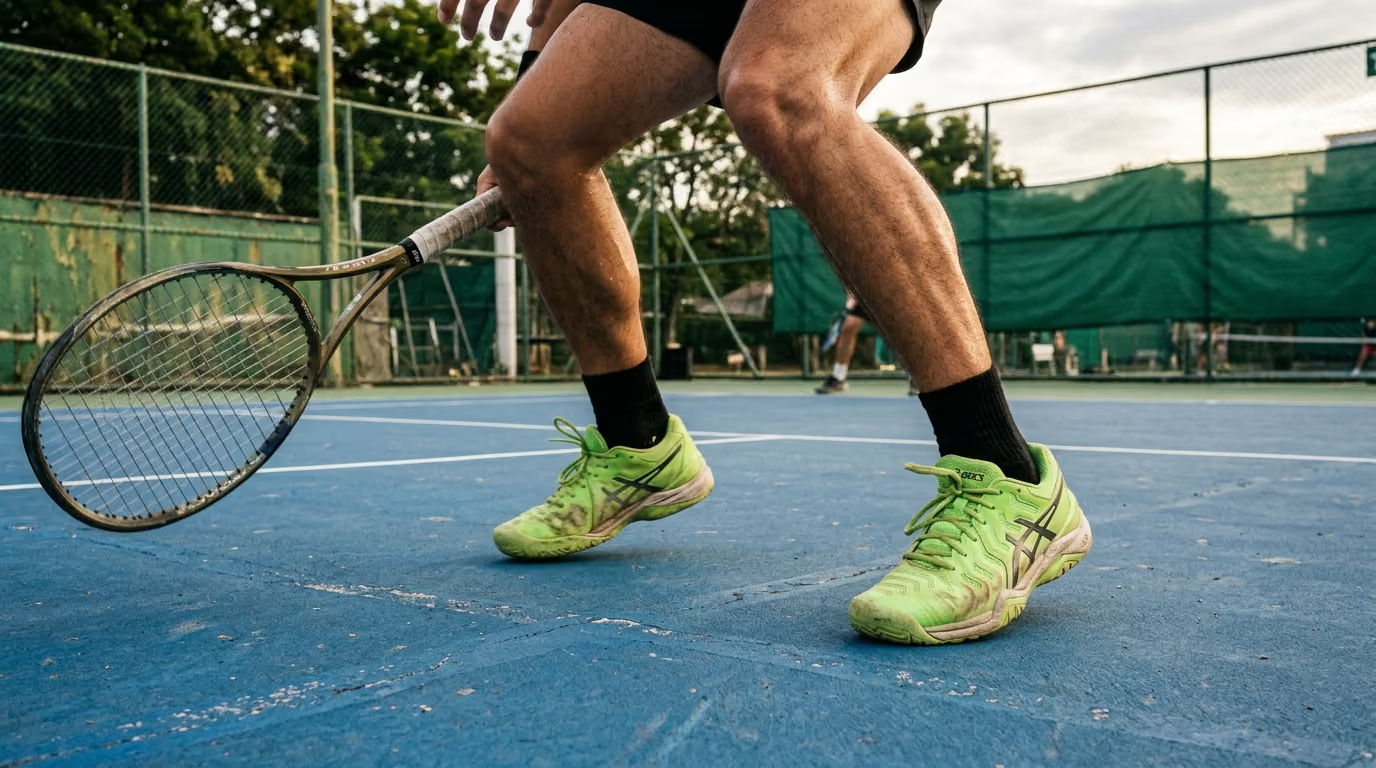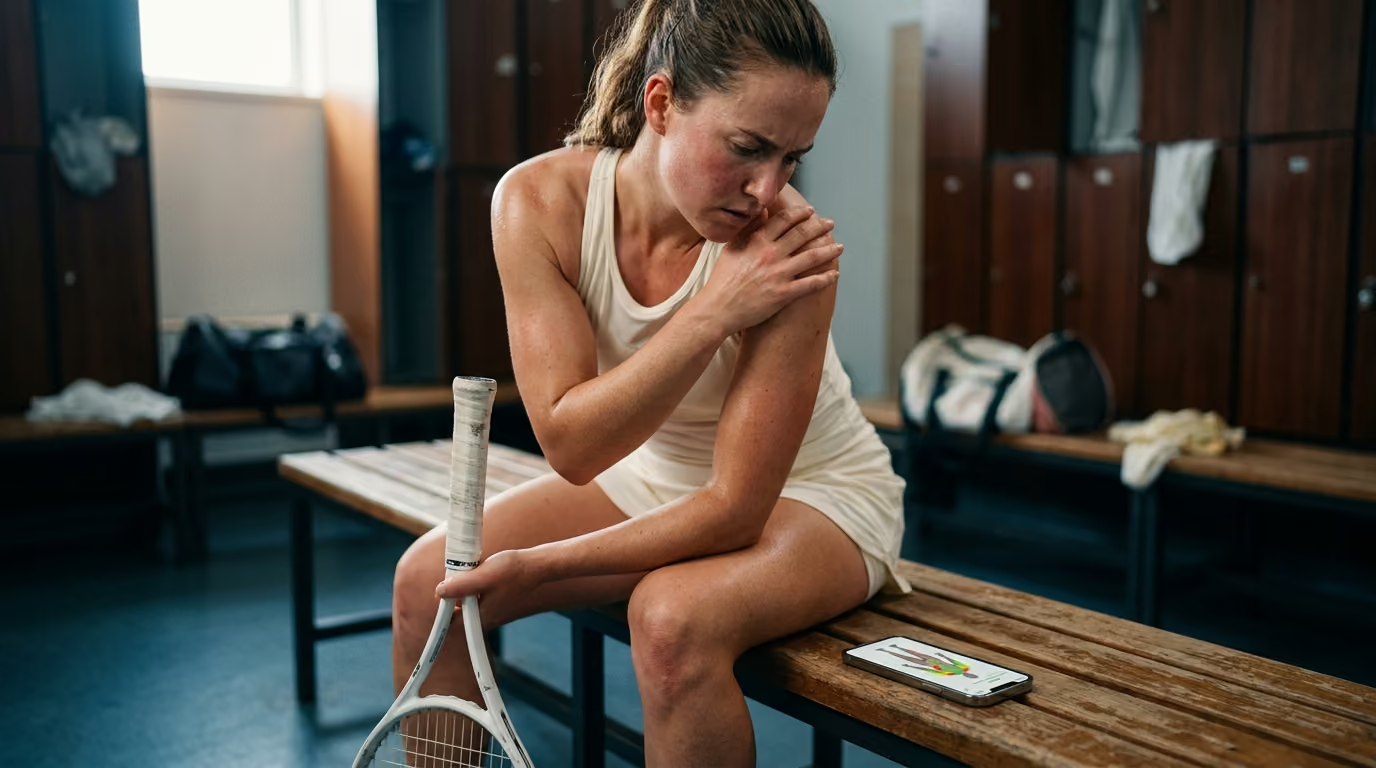

While many assume all post-match discomfort signals injury, distinct physical sensations actually indicate normal soreness, systemic fatigue, or genuine tissue damage.




If you have ever woken up the morning after a demanding match wondering whether that deep ache in your shoulder or stiffness in your knee is a sign of a good workout or the start of a serious problem, you are not alone. Many players search for terms like how to treat tennis elbow, court knee pain, or shoulder soreness after serving, hoping for a simple answer. Yet, pain is not a simple diagnosis, and treating every physical symptom the same way can lead to prolonged layoffs or avoidable physical setbacks.
To manage your physical longevity on the court, you need a reliable method to distinguish normal post-exercise soreness from systemic fatigue and genuine tissue injury. Determining your next step does not require complex medical training or guesswork. By evaluating your symptoms based on their timing, location, quality, physical behavior, and 24-hour response, you can make informed decisions that protect your body while keeping you in the game. This guide provides a repeatable, practical framework to help you decide whether to continue playing as planned, modify your court time, or seek professional medical evaluation.
Every racquet sport demands a high physical price from your body. The quick transitions from sprints to stops, the deep lunges, the overhead reaches, and the constant rotational forces create a highly demanding athletic environment. Because of these forces, experiencing physical sensations after a match is a normal part of the athletic experience. However, a common mistake is grouping all post-play physical sensations into a single category of pain.
To make smart decisions about your training, you must understand that your body communicates through different channels. Some sensations indicate that your muscles are successfully adapting to new demands. Other sensations indicate that your systemic energy reserves are low, or that specific structural tissues are approaching their breaking point.
When you feel discomfort, the goal is not to self-diagnose a complex anatomical issue at home. Instead, your goal is to choose one of five practical paths: continue your schedule as planned, reduce your immediate training dose, take a temporary recovery day, arrange a clinical evaluation, or seek urgent medical care. Having a systematic way to choose between these paths is the foundation of long-term athletic health.
To understand what you are feeling, you must look at how different types of physical stress affect your body. This requires categorizing your symptoms into four distinct physiological states: normal post-exercise soreness, systemic fatigue, acute injury, and overuse injury.
Normal post-exercise soreness, scientifically known as delayed-onset muscle soreness, or DOMS, is a temporary response to strenuous or unfamiliar physical work. It is especially triggered by eccentric exercise, which occurs when a muscle lengthens while producing force. On the court, eccentric actions happen every time you decelerate from a sprint, land from a overhead jump, or lower your body into a deep low-bounce lunge.
This mechanical stress causes microscopic changes in the muscle fibers, triggering a mild inflammatory response. Research shows that this soreness typically begins 12 to 24 hours after your session, peaks between 24 and 72 hours, and then gradually resolves on its own.
According to research published in sports medicine journals, DOMS is highly variable. In one comparative study of physical exertion modes, 45 percent of participants in a stepping trial reported peak soreness between 36 and 48 hours, while only 14 percent of those in a running trial experienced the same timeline.
It is vital to understand that the presence of muscle soreness is not a sign of a superior workout, and its absence does not mean your training was ineffective. Muscle soreness is simply a symptom of physical adaptation, and your subjective level of soreness does not directly match objective laboratory markers of muscle damage.
Unlike localized muscle soreness, systemic fatigue is a temporary reduction in your overall physical, mental, and technical capacity. It can affect your entire system, resulting in slower reaction times, difficulty concentrating, sleep disturbances, and a general lack of motivation.
According to consensus statements from the European College of Sport Science and the American College of Sports Medicine, prolonged fatigue associated with excessive training without rest is often studied under the umbrella of non-functional overreaching or overtraining syndrome. However, these consensus papers emphasize that no single scientific test can reliably distinguish true overtraining syndrome from temporary fatigue. This is why a single bad week or a temporary drop in mood should not lead you to assume you have a serious medical syndrome. Systemic fatigue is often a simple warning that your energy output has outpaced your lifestyle recovery.
An acute injury is characterized by a specific, sudden event. This might be rolling your ankle on a baseline clay patch, feeling a sharp pop in your calf during a sprint, or falling onto an outstretched hand while reaching for a short ball. These incidents cause immediate mechanical damage to ligaments, tendons, muscles, or bones.
In contrast, an overuse injury develops gradually without a single traumatic moment. This happens when the cumulative workload on a specific tissue exceeds its ability to repair itself over time. Common examples include localized discomfort on the outside of your elbow, deep shoulder stiffness during overhead strokes, or persistent tenderness in your Achilles tendon during early morning steps. The key feature of an overuse issue is not how fast it arrived, but rather that your tissue is becoming progressively less tolerant of your normal playing volume.
To remove guesswork from your recovery, you can process your physical symptoms through a sequential series of five analytical checkpoints.
Your first step is to recall exactly how the discomfort started. Ask yourself if the physical sensation began during one specific movement on the court. Did you experience a sudden twist, a heavy fall, a collision, or an awkward landing? Did you hear or feel a distinct pop, crack, or snap in the affected area?
If you answer yes to any of these questions, you should bypass routine recovery protocols. A clear, sudden mechanical event shifts your focus away from standard muscle soreness management and toward active injury screening.
The precise physical location of your symptom offers critical clues about the involved tissues. To analyze this, pay attention to how broad or narrow the painful area feels.
Ordinary post-exercise soreness is typically diffuse. It affects broad muscle groups, such as both thighs, the entire calf complex, or the larger muscles of your upper back. It is often symmetrical, meaning both sides of your body feel a similar level of stiffness.
A localized tissue problem is different. If you can point to the discomfort with a single finger, or if the pain is situated directly over a joint line, a bone, or where a tendon connects to a bone, you should exercise caution. Persistent, one-sided tenderness in a highly specific spot is rarely simple muscle soreness. While you should not use this to self-diagnose, you should treat focal joint or tendon pain as a signal to modify your court activities.
The physical quality of the sensation provides immediate operational guidance. You can divide these sensations into low-concern and high-concern categories.
Low-concern sensations feel like a deep, dull ache, a general sense of muscular heaviness, or widespread stiffness. These feelings are predictable and tend to occur when you move after sitting for a long period.
High-concern sensations are sharp, stabbing, catching, or electric. If a movement causes a sudden physical grab that forces you to flinch, or if you feel a sensation of instability where a joint feels like it might give way, this is a clear warning. These high-concern qualities suggest that nerves, joint structures, or compromised connective tissues are under stress.
Observing how your body responds to movement is a valuable tracking tool, but it should never be used as a simple clearance test to play a high-intensity match.
If your discomfort is merely mild morning stiffness, it will typically ease as you begin to move and your tissue temperature rises. However, feeling better during a light warm-up does not mean your tissues are ready to handle the high-velocity demands of competitive serving or explosive directional changes. To test your physical capacity safely, you should progress through a controlled, sport-specific sequence:
If your symptoms return, worsen, or force you to alter your natural movement patterns at any point during this progression, you must stop.
The way your body feels the morning after activity is one of the most reliable indicators of tissue tolerance. A court session is considered successful and well-tolerated if your symptoms remain mild, stable, and return to your baseline level within 24 hours. You should experience no new swelling, no loss of joint range of motion, and no need to limp during daily activities.
Conversely, a court session was likely too demanding if your pain is noticeably worse the following morning, or if you experience increased physical stiffness. The development of localized swelling, a limp during normal walking, or a drop in physical performance that lasts beyond normal tiredness indicates that the physical load exceeded your current tissue capacity.
Clinical guidelines for active recovery suggest that persistent joint or tendon discomfort lasting more than 24 hours is a clear sign that the preceding physical volume was too high. While this 24-hour rule is not an absolute medical law, it serves as a highly practical check on your training load.
To prevent chronic physical problems before they start, you need to understand the relationship between the physical work you perform and how your body registers that work. This is the difference between external and internal training loads.
External load is the objective physical work you perform on the court. It includes the total minutes you play, the number of singles or doubles matches you complete, your total serve count, and the number of high-intensity sprints you perform.
Internal load is the physical and psychological cost of that work to your individual body. It is influenced by your current level of fitness, your sleep quality, ambient heat, psychological stress, and your injury history.
Two players can participate in the exact same 90-minute doubles match, yet experience completely different internal loads. A player who slept poorly, is returning from a brief illness, or is experiencing high work stress will carry a much higher internal load than a well-rested partner. The International Olympic Committee consensus on athlete health emphasizes that monitoring both of these dimensions is crucial for reducing injury risk.
You do not need complex technology to track your training loads. You can calculate a highly reliable estimate of your daily physical work using a simple formula:
On this scale, a 0 represents complete rest, while a 10 represents a maximal, exhausting physical effort. For example, if you complete a moderate 60-minute drilling session that you rate as a 5 on the exertion scale, your calculated session load is 300 units. If you play a highly competitive, grueling singles match for 90 minutes and rate it an 8, your session load is 720 units.
By keeping a simple log of these numbers alongside a brief note about your morning stiffness, you can easily identify dangerous spikes in your training volume. Research indicates that sudden increases in your weekly load are far more hazardous than maintaining a consistent, high volume of play. If your weekly load spikes by more than 30 to 40 percent compared to your average over the previous month, your risk of experiencing an overuse issue rises significantly.
While daily wellness questionnaires can help you track trends, they should never be used as a sole method for clearing yourself to play. A systematic review examining the popular Hooper questionnaire, which tracks sleep, stress, fatigue, and soreness, found that relying on these subjective numbers alone is not an effective way to control training load.
Instead, you should pair subjective scores with simple, functional movement checks. Before you step onto the court, ask yourself these practical questions:
If your movement quality is altered during these simple tests, your body is telling you to modify your upcoming session, regardless of what your wellness tracker or subjective scores suggest.
While the basic principles of recovery apply to all court athletes, the physical demands and injury profiles of tennis, pickleball, and padel are quite different. Understanding these differences allows you to tailor your recovery strategies to your specific sport.
Tennis is characterized by its high court-surface variety, heavy racquets, and large physical court dimensions. These factors place a heavy physical demand on the upper body and trunk. Research shows that tennis has a high proportion of upper-limb and trunk overuse problems, particularly in the shoulder girdle, lower back, and abdominal muscles.
The tennis serve is a complex kinetic chain movement that requires rapid shoulder internal rotation and back extension. If you regularly read tennis articles to improve your game, you should know that shoulder and lower back soreness are often connected to poor trunk rotation or a sudden increase in serving volume.
Additionally, the longer sprint distances on a tennis court require significant eccentric braking forces to stop and change direction. This places a high physical load on your quadriceps and patellar tendons.
Pickleball is played on a much smaller court with lightweight paddles and a plastic ball, which changes the physical loading profile. Because the ball does not bounce as high, pickleball players must spend a significant amount of time in a low, crouched position, especially when playing near the non-volley zone line. This constant low stance places a continuous isometric demand on the quadriceps, hips, and lower back.
Epidemiological data reveals that pickleball has a unique injury profile, particularly among older adults. Falls are a common source of acute injury, often resulting in wrist sprains, shoulder contusions, or fractures.
If you browse pickleball articles, you will find that lower-extremity strains and sprains are highly prevalent during sudden lateral movements. The quick, repetitive wrist actions required for fast net exchanges also make pickleball players susceptible to localized forearm and wrist tendon issues.
Padel is played within an enclosed glass court, creating a fast-paced game with continuous play and frequent overhead shots. Because players must constantly react to ball rebounds off the glass walls, they perform a very high volume of rapid, short-distance rotational turns. This unique movement profile places a high physical demand on the rotational stabilizers of the knee and the lower back.
Padel has a high association with elbow overuse injuries, commonly called padel elbow. The combination of a solid, stringless paddle, a pressurized ball, and a very high volume of overhead smash strokes creates significant vibration and stress on the forearm tendons.
According to padel articles, managing elbow and shoulder health requires careful attention to paddle weight, grip size, and the cumulative volume of your overhead play. The continuous play also means padel players experience high volumes of low-intensity deceleration, making calf and Achilles recovery a top priority.
When you decide that your physical discomfort is simply normal muscle soreness or general fatigue, your focus should shift to optimizing your recovery window. Real recovery is not about expensive gadgets or trendy treatments. It is about supporting your body’s natural physiological repair systems.
In our experience, players often look for advanced physical therapies while ignoring the most powerful recovery tool available: high-quality sleep. Our team has spent decades tracking court fatigue and performance.
I used to think a tough conditioning block was the only way to improve my court endurance. Then I started tracking my sleep. I noticed that on days I slept less than six hours, my reaction time at the net was noticeably sluggish, and I felt gassed by the second set. Prioritizing consistent rest did more for my late match stamina than any extra sprints ever did. Recovery is the true foundation of performance.
During deep sleep, your body releases human growth hormone, which is essential for repairing microscopic muscle damage and restoring glycogen reserves. If you are sleeping poorly, your tissues simply do not have the chemical resources they need to rebuild, making you far more susceptible to overuse injuries over time.
When you are experiencing normal muscle soreness, complete physical inactivity is rarely the best path. Light, low-impact movement is highly effective for reducing the sensation of muscle stiffness.
Engaging in 20 to 30 minutes of easy walking, casual cycling on a stationary bike, or swimming promotes blood flow to your tired muscles without adding mechanical stress. This increased circulation delivers oxygen and essential nutrients to damaged tissues, helping to accelerate your natural recovery process.
Additionally, gentle dynamic mobility exercises can help restore your normal joint range of motion, preparing your body for your next scheduled court session.
It is easy to get confused by the wide array of recovery products on the market, from compression garments to massage guns and ice baths. Scientific evidence regarding these interventions is highly mixed, and many popular claims are not supported by rigorous research.
A comprehensive meta-analysis of post-exercise recovery methods found that cold water immersion, or ice baths, can be effective for reducing the subjective sensation of muscle soreness when applied within one hour of exercise. However, these effects are mostly temporary and tend to diminish after 24 hours.
Furthermore, some research suggests that using ice baths too frequently after strength-training sessions can actually blunt your muscles' long-term adaptation and growth, as the natural inflammatory response is a necessary trigger for building strength.
Other passive therapies, like static stretching, have been shown to have very little direct effect on reducing DOMS or accelerating muscle repair. While light stretching can feel relaxing and temporarily improve your flexibility, you should never forcefully stretch a muscle that is acutely painful or injured. Ultimately, these passive modalities should be viewed as optional tools for temporary symptom relief, rather than essential requirements for athletic longevity.
Many dedicated racquet-sports players find themselves sidelined because they fall into predictable recovery traps. Recognizing these common errors can save you months of physical frustration.
One of the most persistent errors is the belief that if you can physically manage to play through an ache, the issue cannot be serious. Many early stage overuse injuries, such as patellar tendinopathy or tennis elbow, will actually feel better once you warm up and start playing.
However, continuing to load an irritated tendon without modification simply drives the tissue deeper into a state of chronic degradation. By the time the pain becomes severe enough to force you to stop playing, the path back to full health is often much longer and more complex.
Another frequent mistake is the classic rest-and-restart cycle. When a player experiences localized joint or tendon pain, they often decide to take two weeks of complete rest. During this layoff, the pain naturally subsides because the provocative physical load has been removed.
Believing they are fully healed, the player then returns to the court and immediately plays a high-intensity, two-hour match at full volume. Within 24 hours, the pain returns with a vengeance.
This happens because complete rest does nothing to increase the capacity of your tissues. In fact, total inactivity actually lowers your muscles' and tendons' tolerance for work.
When you return to high-intensity play, the gap between your tissue capacity and the physical demand is even wider than before. The solution is not complete rest, but rather a structured, progressive load management plan that keeps your tissues active without overloading them.
Many modern court athletes rely heavily on fitness trackers, smartwatches, and recovery scores to tell them when they are ready to play. While these devices can track interesting systemic metrics like heart rate variability and sleep duration, they have significant limitations.
A wearable device has no way of knowing that your lateral elbow tendon is highly irritated, or that your ankle ligament is slightly lax after a minor twist. If your watch gives you a green readiness score but your shoulder feels sharp pain when you raise your arm, you must always trust your local physical symptoms over a digital algorithm.
Knowing when to manage a physical issue on your own and when to seek professional medical help is a vital skill for any court athlete. Ignoring clear clinical red flags can turn a minor, manageable issue into a chronic, limiting condition.
You should bypass all self-care protocols and seek immediate medical evaluation if you experience any of the following acute symptoms:
These symptoms indicate that structural damage has occurred, and a timely clinical assessment is required to ensure proper healing and prevent long-term complications.
Not all injuries require an emergency room visit, but many warrant a scheduled consultation with a qualified healthcare professional. You should arrange an appointment if you experience:
A sports physiotherapist or sports medicine physician can provide an accurate diagnosis, identify the underlying physical biomechanical contributors to your issue, and design a customized rehabilitation program to help you safely return to the court.
This practical, three-zone framework helps you quickly determine the appropriate path forward based on your daily physical symptoms.
Symptom Profile:
Recommended Actions:
Symptom Profile:
Recommended Actions:
Symptom Profile:
Recommended Actions:
To put this decision framework into practice this week, follow this simple checklist:
For more evidence-based guidance on maintaining your physical health and longevity on the court, explore our extensive library of injury prevention resources and athletic longevity resources.
Follow Evercourts for practical insights on tennis, pickleball and padel performance, movement, recovery and healthy ageing. Stay connected for new articles, research-led guidance and ideas to help you play well and keep playing for years.


Read practical guidance for better movement, smarter preparation and a game that keeps working for you.
explore the Blog