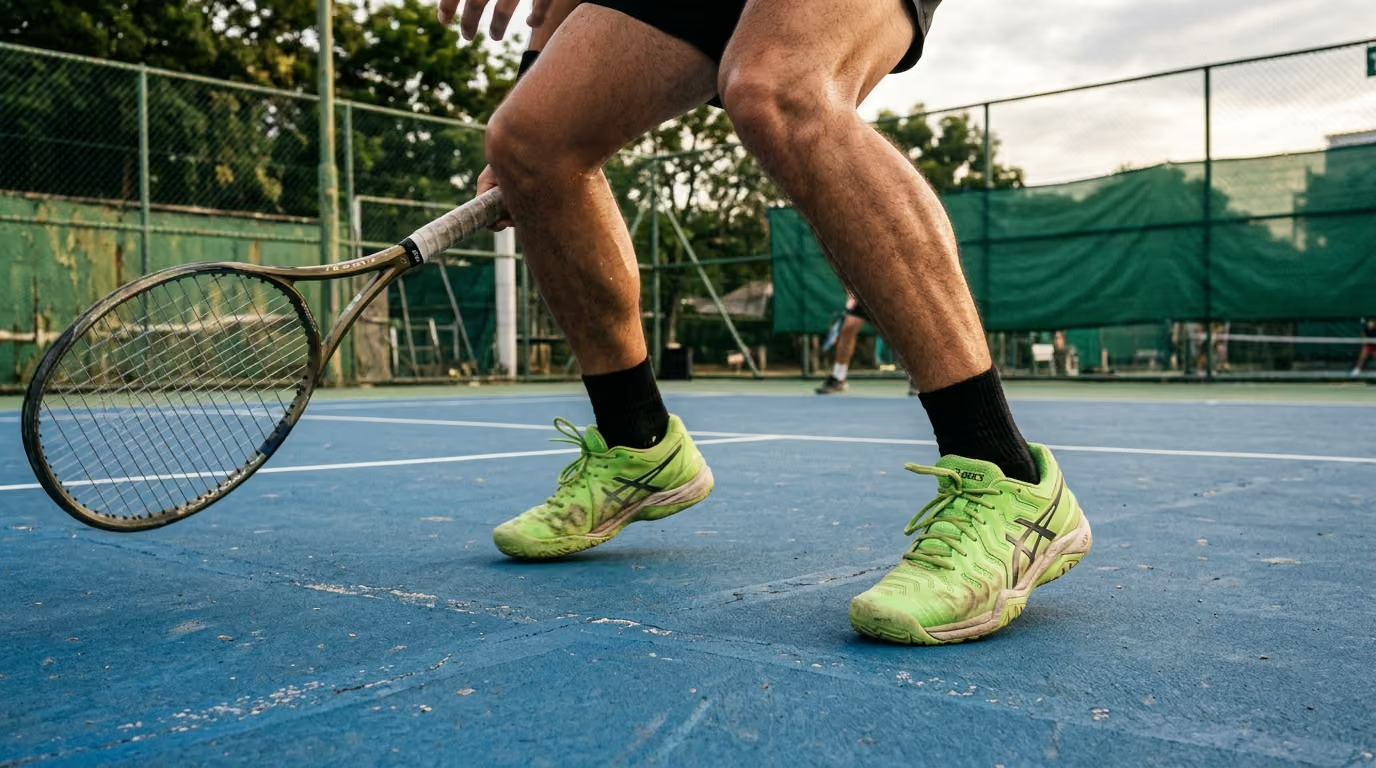
When a fast ball lands near the baseline, kicking up dust, sportsmanship in racquet sports offers a practical framework for managing emotions and ensuring fair play.




You are deep in the final set of a competitive match. Sweat is dripping, your breathing is heavy, and the score is tied at deuce. A fast ball from your opponent lands near the baseline, kicking up a tiny puff of dust from the back edge of the line. Your brain must process the call in a fraction of a second while your heart is racing.
Sportsmanship in racquet sports is a practical, competitive skill that uses a repeatable set of behaviors to manage emotion, protect fairness, and resolve disagreements. Rather than just decorative etiquette, it provides a functional framework for self-officiated matches where players carry the responsibility of making line calls and managing the score. Implementing these standards maintains player focus, reduces unnecessary stress, and supports long-term participation in court sports.
To understand how behavior influences performance, players must look beyond vague ideas of character. True sportsmanship consists of concrete, observable actions. It can be broken down into five distinct core elements.
Fair play is the active commitment to follow both the written rules and the underlying spirit of the sport. In self-officiated matches, this means making honest line calls even when a point is critical. It involves accepting legitimate decisions without arguing, avoiding intentional distractions, and giving a complete, honest effort. Fair play also requires that you do not exploit an opponent's lack of rule knowledge or manipulate the match conditions to gain an edge.
Respect is behavior that recognizes the dignity and safety of everyone on the court. It operates on multiple levels during a match. Interpersonal respect prevents insults, threats, or demeaning gestures. Procedural respect ensures players follow official match protocols and accept authority. Competitive respect means trying your best while acknowledging the skill of your opponent. Finally, environmental respect involves caring for the courts, net systems, and shared facilities.
Self-control is the ability to process difficult emotions without turning them into destructive actions. Competitive racquet sports naturally trigger frustration, anxiety, and anger. Highly sportsmanlike players do not pretend these emotions do not exist. Instead, they separate the internal feeling from their external actions. They experience the disappointment of a missed shot but choose not to throw their equipment or shout profanity.
Honesty requires absolute accuracy in calling balls, reporting scores, and acknowledging touches. If you touch the net during a rally, you must call the infraction on yourself immediately. Accountability means accepting your performance without shifting the blame. It prevents players from blaming partners, bad officiating, wind, or court surfaces for their mistakes.
Graciousness prevents competitive intensity from turning into hostility once the match ends. In victory, a gracious player avoids gloating, taunting, or patronizing comments. In defeat, it means offering a sincere acknowledgment of the opponent's victory without making excuses. A positive end to a match reinforces the social connections that keep players returning to the courts.
Behavior on the court has a measurable impact on how long players stay active in their sports. Current research shows a direct link between the quality of the sporting environment and player retention.
According to a study published by Gardner, Magee, and Vella, the social and emotional quality of sports participation directly influences dropout rates. The researchers followed 327 regular participants in organized sports over one year. They found that 75.5 percent of the participants continued in their primary sport, while 8 percent dropped out. The study revealed that peer acceptance, coach-athlete relationships, and overall enjoyment were key factors in predicting who would continue playing. Peer acceptance was the only social factor that remained highly significant in predicting long-term persistence.
This research shows that when players face hostile opponents or unsupportive partners, their desire to play declines. A toxic competitive environment directly reduces athletic longevity.
Further evidence is found in a systematic review and meta-analysis on sports enjoyment and persistent behavior. This review showed that sports enjoyment is strongly correlated with the intention to continue playing. The study calculated a high correlation coefficient between enjoyment and persistence. It also identified peer support and the satisfaction of basic psychological needs as critical drivers of lifelong athletic participation.
The way players view their goals also influences their court-side conduct. Research on athletic motivation has examined competitiveness, goal orientation, and sportsmanship. A study of 319 athletes found that intrinsic motivation, which focuses on skill mastery and personal improvement, predicts higher levels of sportsmanship.
Conversely, players with purely extrinsic goals, such as seeking social status or dominating others, showed lower levels of sportsmanship. These players are under greater pressure to bend rules, make questionable line calls, and experience emotional outbursts.
Understanding the boundary between strategic play and unsportsmanlike behavior is essential for competitive integrity. Players must be able to identify where competitive tactics end and manipulative actions begin.
A competitive player uses legal tactics to challenge their opponent. It is entirely sportsmanlike to target an opponent's weaker side or vary your spin and pace. Serving strategically to exploit a physical limitation is a normal part of competition. Using the allowed time between points to catch your breath or discussing tactics with your partner is legal. These actions respect the boundaries of the rules while pursuing victory.
Gamesmanship is the intentional use of questionable tactics to disrupt an opponent's concentration. Examples include repeatedly questioning obvious line calls to break an opponent's rhythm. Deliberately delaying the serve or faking injury to obtain a rest break also violates sportsmanship. Some players pretend not to know the score or use distracting gestures during play.
The Singapore Pickleball Association explicitly identifies unnecessary delays, invalid medical timeouts, and improper challenges as disruptive conduct. These behaviors undermine the flow of play and ruin the competitive experience.
To maintain composure and fair play under pressure, athletes can use a simple, structured framework. This system is organized into six logical phases to guide your behavior before, during, and after a match.
Your conduct begins long before the first serve of the match. Arrive at the court early so you do not rush your warm-up or delay the schedule. Make sure you have the correct equipment and know the tournament or league rules. Introduce yourself to your opponents, your partner, and any officiating staff. Agree on warm-up timing and local court procedures before starting. Use this time to set a personal commitment to maintain your composure, regardless of the score.
Ambiguity is one of the most common causes of on-court arguments. Before the first point, clarify how disputes will be resolved and who will keep score. State clearly how you will call out-of-bounds balls on your side of the net. If you are playing on a multi-sport surface, confirm which lines are active. Clarifying these details early prevents minor misunderstandings from turning into personal conflicts later in the match.
In self-officiated matches, you are responsible for making line calls on your side of the court. Make your calls immediately, clearly, and loud enough for your opponent to hear. Use hand signals alongside verbal calls to prevent confusion on noisy courts. If you are uncertain about a call, you must give the opponent the benefit of the doubt.
According to the United States Tennis Association’s publication, The Code, any ball that cannot be called out with absolute certainty must be played as good. Once you make a call and your opponent questions it, state what you saw calmly. If you remain uncertain after a brief discussion, do not argue. Offer to replay the point or accept the opponent's view to maintain the flow of play.
When a bad call happens or your performance drops, you must control your physical response. Implement a short, physical reset routine to manage your physiological stress. Step away from the net, take a slow breath, and focus your eyes on your strings or paddle. Use a simple, neutral verbal cue like "next point" to clear your mind.
Keep your equipment secure. Shouting, throwing racquets, or hitting balls away in anger are clear conduct violations.
All on-court communication should be brief, calm, and focused on facts rather than character. If you need to discuss a score discrepancy, do so before the next service motion begins. Use neutral statements that address the situation rather than attacking the person.
For example, say, "I have the score as 4-3, let us review the last two points." Avoid accusatory language such as, "You are trying to cheat me out of points." If a disagreement cannot be resolved quickly, stop play and call for a court monitor or tournament director.
The end of the match requires a clear transition back to a respectful social connection. Shake hands, tap racquets, or exchange a friendly gesture at the net. Thank your opponent for the match, and express gratitude to the partner, officials, and volunteers.
Collect all your gear, return the match balls, and leave the court clean. Avoid discussing disputed points or venting your frustrations on social media after you leave.
While the core values of sportsmanship remain constant, the physical differences between racquet sports create unique behavioral challenges. Each sport requires specific court-side etiquette.
Tennis is played on a large court where ball speeds are high and distances between players are significant. This spatial separation can make communication difficult and line calls harder to see. Because players are far apart, verbal calls must be exceptionally loud and clear.
The USTA’s The Code provides the historical foundation for self-officiating in tennis. It emphasizes that players must make calls quickly and give the opponent the benefit of any doubt on close lines. Because there are no physical walls, players must also manage stray balls from adjacent courts with great care. Returning a stray ball should be done safely and only when the neighboring court has finished their point.
Pickleball is played on a much smaller court, which places opponents in close physical proximity. This closeness makes non-verbal communication, facial expressions, and casual comments highly visible and audible. The fast pace of kitchen exchanges requires rapid reactions and honest calls on kitchen line infractions.
Because players stand just feet apart, the potential for verbal conflict is high. Pickleball England's code of conduct stresses the importance of kindness, respect, and courtesy toward everyone on court. Paddle taps at the net are a standard tradition, representing mutual respect regardless of the competitive intensity. To learn more about maintaining court life and player health, you can read the Evercourts blog for regular updates.
Padel is a unique doubles-only sport played inside an enclosed cage of glass and metal mesh. The presence of walls means the ball remains in play after bouncing off various surfaces, creating complex officiating situations. Players must be honest about whether a ball hit the glass before or after bouncing on the turf.
The enclosed space amplifies sound, making racquet hits, shouts, and partner communication very loud. Padel etiquette requires extreme care when returning high balls or celebrating close to the glass. Because you are constantly playing in pairs, maintaining a supportive partnership inside the cage is essential. You can find detailed resources on padel and other court lifestyles in our curated materials for court athletes.
A comprehensive sportsmanship framework must address how you interact with everyone involved in the match. Each stakeholder group requires specific, respectful behaviors.
Opponents are your partners in creating a competitive match, not your enemies. Always greet them warmly before the match starts and respect their preparation time. Avoid making distracting noises or movements while they are preparing to serve. Acknowledge their exceptional shots with a simple, genuine compliment rather than silence or frustration. Never gloat after winning a lucky point, such as a ball clipping the net cord and falling over.
Doubles play puts your relationship with your partner under a spotlight. When your partner makes a mistake, your reaction dictates the team's future performance. Avoid visible signs of frustration, such as rolling your eyes, sighing heavily, or dropping your shoulders.
Discuss tactics privately between points, and keep your comments constructive. Use encouraging language to support their confidence, focusing on the next point rather than past errors. Misunderstandings about court coverage should be resolved with clear, pre-planned communication.
When officials are present, they hold the authority to manage the match. Address them politely by their role or name, and accept their decisions with dignity. If you believe a rule has been misapplied, ask for a calm clarification using the correct procedure.
Never use profanity, make abusive gestures, or follow an official after the match. If you disagree with a ruling, raise the issue through the tournament's official reporting channels rather than arguing on the court.
Tournament volunteers and court staff work hard to keep events running smoothly. They often manage schedules, coordinate courts, and handle administrative duties. Treat them with gratitude and patience, even if the schedule is delayed.
Remember that volunteers do not control the weather or facility issues. Thanking them for their time helps build a healthy, welcoming environment for everyone.
Spectators play a supportive role and should never interfere with the active match. They must not make line calls, comment on close points, or shout coaching instructions from the sidelines.
Parents and coaches should focus their praise on effort, composure, and sportsmanship rather than just winning. They must remain respectful of opposing players and families, setting a positive example for younger competitors.
Even experienced players can fall into behavioral habits that damage the competitive experience. Identifying these common mistakes is the first step toward correcting them.
A common misconception is that sportsmanship requires you to be passive or let opponents take advantage of you. This is incorrect. Sportsmanship does not mean surrendering legitimate points or ignoring clear rules violations.
You can be highly competitive and protect your rights while remaining completely respectful. If an opponent repeatedly makes questionable calls, you are fully entitled to pause play and request a court monitor. You do not need to accept unfair treatment to be considered a good sport.
Another frequent error is asking spectators to make line calls during a self-officiated match. Spectators do not have the official authority to make rulings, and their view is often obstructed or biased.
According to the USTA Pacific Northwest handbook, spectators are explicitly prohibited from making line calls. Relying on outside opinions usually increases tension and complicates disputes. Keep the decision-making power strictly between the players on the court.
Your behavioral choices on the court have direct physical consequences for your body. Experiencing intense anger, frustration, or anxiety triggers a strong autonomic nervous system response.
When you lose control of your temper, your sympathetic nervous system activates, releasing cortisol and adrenaline. This sudden hormone spike causes your heart rate to surge and your muscles to tighten.
This unnecessary physical tension increases your energy expenditure, causing you to fatigue much faster during a match. Chronic muscle tension also alters your joint mechanics, which can significantly elevate your risk of acute strains or overuse injuries. For detailed training tips on protecting your joints, visit our guide on injury prevention resources.
Furthermore, high stress levels during play negatively impact your physical recovery after the match. Elevated cortisol levels suppress your body's immune response and delay tissue repair. This delay means your muscles and tendons take longer to heal from the micro-tears caused by intense exercise.
In contrast, maintaining a calm, focused composure allows your body to return to a parasympathetic state quickly. This shift supports efficient nutrient delivery, reduces inflammation, and accelerates muscle recovery. To learn more about how your body recovers from competitive stress, read our articles on player health.
Sometimes, on-court emotional challenges or physical stress symptoms require support from a qualified specialist. Understanding when to consult a professional can help you maintain your well-being.
You should consider consulting a licensed sports psychologist or mental performance coach if you experience any of the following signs:
Additionally, if physical outbursts or intense muscle tension lead to recurring joint pain, muscle strains, or other physical symptoms, you should consult a physical therapist or healthcare provider. Professional guidance can help you build healthy physical patterns. For structural strength programs that support your court movement, check out our strength and conditioning resources.
To help you apply these principles, review these six common match scenarios and the recommended behavioral responses.
Scenario: Your opponent hits a deep ball near your baseline. You see it land out and call it, but your opponent is certain it was in.
Poor Response: You start arguing, shouting, "You always try to cheat me on deep balls!"
Recommended Response: State clearly, "I saw the ball land just behind the baseline." If your opponent asks if you are sure, confirm your call calmly. According to the USTA rules, if you are certain of your view, your call stands, and you should move on to the next point without further discussion.
Scenario: You miss an easy volley at the net to lose a game, and in frustration, you throw your racquet against the back fence.
Poor Response: You ignore the racquet, complain loudly about the court surface, and refuse to apologize to those nearby.
Recommended Response: Walk over, retrieve your racquet immediately, and check it for damage. Take a deep, slow breath to lower your heart rate, and apologize to your opponent and partner for the outburst. Use a simple physical reset routine to focus your attention entirely on the next point.
Scenario: You are playing a recreational match against a less-experienced competitor who consistently commits foot faults during their serve.
Poor Response: You stay silent but grow increasingly angry, eventually making aggressive, retaliatory line calls to punish them.
Recommended Response: During a changeover or break in play, explain the rule briefly and politely. Say, "Just so you know, your back foot is crossing the baseline before you strike the ball on your serve." Keep your explanation helpful and encouraging, ensuring they feel welcomed rather than embarrassed.
Scenario: Your doubles partner misses three consecutive easy overheads, costing your team a crucial break point.
Poor Response: You roll your eyes, turn your back to them, and sigh loudly so the opponents can see your frustration.
Recommended Response: Walk over to your partner, tap paddles or racquets, and offer a positive, forward-looking comment. Say, "No problem, let us focus on getting the next return in play." Keep your body language open and supportive to help them rebuild their confidence.
Scenario: A spectator sitting near the court begins calling out-of-bounds balls and criticizing your opponent's play.
Poor Response: You join in the discussion, arguing with the spectator and letting the distraction ruin your focus.
Recommended Response: Walk to the net and speak quietly with your opponent. Say, "Let us agree that only we will make the calls on this court." If the spectator continues to interfere, pause play and ask the tournament director or facility manager to step in.
Scenario: A referee makes an incorrect score call or misapplies a rule during a league tournament match.
Poor Response: You shout at the official, call them incompetent, and threaten to walk off the court.
Recommended Response: Walk to the net and ask the official for a calm clarification. Say, "Could you explain how you calculated that score?" If they confirm their decision, accept the ruling with dignity, adjust your focus, and continue playing hard.
To assess your competitive behavior, rate yourself on these twelve key statements after your next match. Use a scale of 1 to 5, where 1 means "never" and 5 means "always."
You should review this guide before starting a new competitive league, when preparing for an intense tournament, or whenever you feel your on-court frustration starting to affect your enjoyment of the game.
By treating sportsmanship as a practical competitive skill, you can maintain your focus, support your partner, and keep playing the sports you love for years to come.
Follow Evercourts for practical insights on tennis, pickleball and padel performance, movement, recovery and healthy ageing. Stay connected for new articles, research-led guidance and ideas to help you play well and keep playing for years.


Read practical guidance for better movement, smarter preparation and a game that keeps working for you.
explore the Blog