
Players can maintain their physical capabilities for racquet sports longevity through structured, long-term strength and conditioning programs.




What does physical preparation for racquet sports longevity actually look like? It is not about trying to replicate a youthful training load, nor is it about chasing extreme fitness trends. Instead, it is a structured, long-term system designed to maintain the physical capabilities that keep your game safe, enjoyable, and repeatable through the decades.
To play racquet sports well into your later decades, you must perform regular resistance and balance training that maintains muscle mass, physical power, and deceleration capability. This structured approach builds a physical reserve that protects joints from the repetitive forces of match play while preserving your ability to react quickly. It is not about permanent maximal effort, but rather about progressive adaptation tailored to your current physical capacity.
In our experience, many players accept physical decline and joint stiffness as an inevitable consequence of aging. However, targeted physical preparation can significantly alter this trajectory. By focusing on muscle mass, maximal strength, rate of force development, dynamic balance, and joint mobility, you can continue playing the sports you love with confidence.
We provide research-led guidance to help court athletes move better and play longer. You can learn more about our team and our commitment to helping recreational players maintain athletic longevity.
As we age, our bodies undergo natural physiological changes that directly impact our performance on the court. Two primary conditions that affect mature athletes are sarcopenia, which refers to the gradual loss of muscle mass and quality, and dynapenia, which is the loss of muscle strength. These changes can quietly compromise a player's stability, speed, and endurance.
The European Working Group on Sarcopenia in Older People defines sarcopenia through three distinct domains. These are low muscle strength, low muscle quantity or quality, and low physical performance. Low strength serves as the primary entry characteristic for assessment. Low muscle quantity or quality confirms the diagnosis, while poor physical performance indicates severe sarcopenia.
To screen for these conditions, clinical guidelines use specific performance baselines. For example, screening values include a handgrip strength below 27 kilograms in men or 16 kilograms in women. Another common assessment is a five-times-sit-to-stand time of more than 15 seconds. Severe sarcopenia is characterized by physical performance markers such as a gait speed at or below 0.8 meters per second, or a timed-up-and-go test result of 20 seconds or more.
While these are clinical diagnostic values, they highlight why proactive training is essential. Long-term evidence indicates that after age 75, strength loss can occur at a rate of 3 to 4 percent per year in men. In women, the average decline is approximately 2.5 to 3 percent per year. This rate of decline means that simply playing your sport is rarely enough to preserve your physical capabilities.
Research shows that resistance training can increase maximal strength by 6.6 percent to 37 percent in older populations. It also improves muscle mass, power, and overall functional capacity. Furthermore, multicomponent programs that combine strength and balance work are highly recommended to support daily function and reduce fall risks. By committing to structured resistance training, you build a physical buffer that protects your joints and enhances your movement on the court.
Your physical preparation needs to evolve as you move through different stages of your athletic life. What works in your thirties may require adjustment in your fifties, sixties, and beyond. Understanding these shifting priorities allows you to train productively without overtaxing your recovery systems.
During your thirties and forties, your body can still tolerate relatively high training volumes and intense physical demands. The primary focus during this phase is to build a substantial physical reserve. You should concentrate on developing deep lower-body strength, posterior chain capacity, and trunk rotational control.
This is also the ideal time to develop robust tendon and connective tissue tolerance. A common error during these decades is to train only what feels athletic, such as sprinting, hitting, and jumping. Instead, you should dedicate time to deliberate upper-body pulling exercises, single-leg strength, and controlled rotational movements. Building this foundation early creates a buffer that protects your joints in later decades.
As you enter your fifties and sixties, recovery demands become more pronounced. You can still make significant progress in your physical conditioning, but you must manage your training volume more closely. The focus shifts toward maintaining your heavy strength capacity while introducing deliberate, low-impact power work.
You should prioritize unilateral leg control, lateral braking capacity, and the management of joint discomfort. It is crucial to monitor common trouble spots such as the shoulders, elbows, Achilles tendons, and lower back. Studies show that older adults respond exceptionally well to resistance training across various frequencies. Benefits have been recorded using one to three sets of six to 15 repetitions, with loads ranging from 30 percent to 70 percent of a one-repetition maximum.
In your seventies and beyond, the central training question becomes how to apply the most effective training stimulus that you can consistently recover from. The objective is to maintain movement confidence, joint mobility, and your overall options on the court.
Your program during this phase should utilize external stability to keep your training safe and productive. You might use machine-based exercises for safety, supported split squats, box squats, and step-ups with a handrail. Seated rows, cable presses, and moderate suitcase carries are excellent choices. You should also incorporate short, frequent balance sessions and allow for longer warm-up periods and rest intervals.
To maintain your physical capabilities, you need a structured yet flexible program. The World Health Organization recommends that older adults perform muscle-strengthening activities involving major muscle groups on at least two days per week. They also recommend balance-enhancing activities on three or more days per week for those with poor mobility.
To help you implement these recommendations, our team has developed a practical, two-day full-body training template. This framework is designed to fit around your playing schedule without causing excessive fatigue. You can find more structured options in our strength and conditioning resources.
This session focuses on developing foundational force production. Perform this workout on a day when you have at least 24 hours of recovery time before your next competitive match.
This session is designed to train rapid force development and dynamic coordination. The focus is on moving light to moderate loads quickly while maintaining perfect movement control.
I remember finishing a tough two hour padel match on a cold Tuesday night and waking up the next morning feeling like my lower back was locked in concrete. For a long time, I just accepted this as the price of playing hard in my forties. But once I started spending just ten minutes on targeted hip mobility before heading to the club, the stiffness almost completely vanished. It taught me that we do not have to accept pain as a default state of aging.
To help manage these common joint limitations, we recommend integrating structured mobility and movement training into your weekly routine. Simple hip, ankle, and thoracic spine drills can dramatically improve how you move on the court.
While all racquet sports share some similarities, each placing unique biomechanical demands on your body. Tailoring your strength and conditioning to your specific sport can improve your performance and help you avoid common injuries.
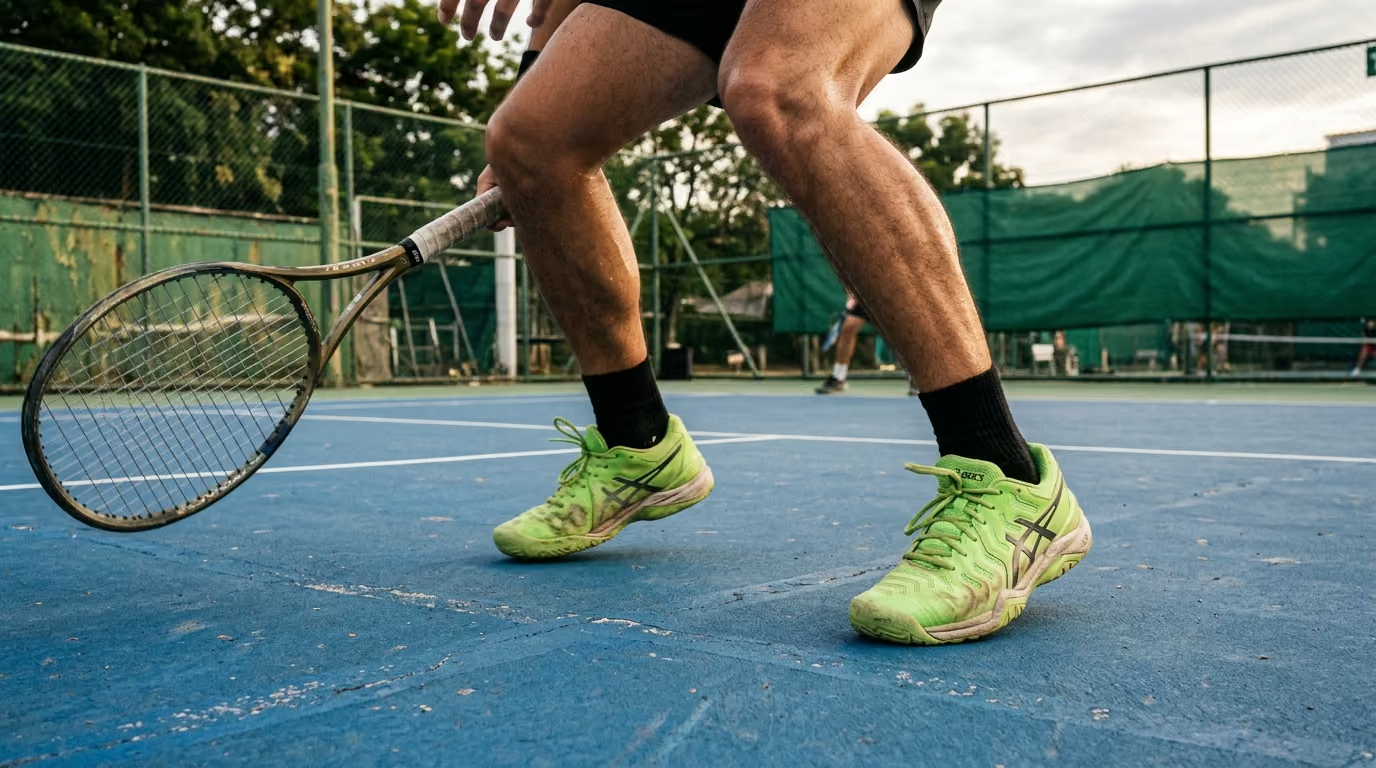
Tennis is characterized by wide court coverage, rapid accelerations, and high-velocity deceleration. An analysis of matches at the Australian Open found that players perform an average of 1.6 changes of direction per point. Approximately two-thirds of these movements involve a change of direction greater than 105 degrees.
This constant braking and restarting places immense strain on your lower body, particularly your knees, calves, and Achilles tendons. To prepare for these demands, tennis players must prioritize eccentric strength training. Exercises like slow-tempo squats and controlled lunges help build the braking power needed to stop quickly. Furthermore, the long overhead serving motion requires significant thoracic spine mobility and shoulder rotator cuff endurance.
Pickleball is played on a much smaller court, which reduces the need for long-distance sprinting but increases the demand for rapid reactions and quick lateral adjustments. However, the injury rates in pickleball have risen significantly in recent years. A national emergency-department analysis estimated that annual pickleball injuries increased from 1,313 in 2014 to 24,461 in 2023, with the majority of injuries occurring in players aged 60 to 79.
The analysis revealed that mature pickleball players are particularly vulnerable to falls, wrist and hand injuries, and fractures. In fact, players in the 60 to 79 age bracket had more than twice the odds of sustaining a fall-related injury compared with younger groups.
To mitigate these risks, pickleball players should focus on dynamic balance training, lower-body strength to handle the deep squatting positions at the kitchen line, and wrist and grip conditioning. For a deeper understanding of these risks, you can read our specialized injury prevention strategies.
Padel is played within an enclosed glass court, which creates a highly dynamic environment with rapid, unpredictable ball rebounds. The sport requires constant turning, backward running, and rotational play as you adjust to the ball coming off the walls. This demands excellent hip mobility and the ability to change directions in tight spaces.
Additionally, padel involves a high volume of overhead strokes, such as the bandeja and vibora, which are unique to the sport. These repetitive overhead actions can place substantial stress on your shoulder joint and upper back. Padel players should focus on thoracic spine rotation, posterior shoulder strength, and single-leg stability to handle the constant, rapid turning.
To ensure your training supports your longevity, you must avoid several common pitfalls. Many well-intentioned players make mistakes that can lead to chronic fatigue, joint irritation, or a decline in court performance.
The most common misconception is that simply playing your sport provides all the physical conditioning you need. While tennis, pickleball, and padel are excellent for your cardiovascular health and hand-eye coordination, they do not provide systematic progressive overload.
Playing racquet sports exposes your body to high, unpredictable forces without building the underlying muscular strength to absorb them. Over time, this can lead to overuse injuries in your knees, hips, and shoulders. You need the structured environment of resistance training to build a physical reserve, strengthen neglected muscle groups, and correct lateral imbalances.
Another common error is assuming that mature athletes should only lift very light weights for high repetitions. While high-repetition training has its place, avoiding moderate to heavy loads entirely can limit your progress. Research indicates that older adults can safely lift heavier weights, around 80 percent of their one-repetition maximum, when appropriately programmed and supervised.
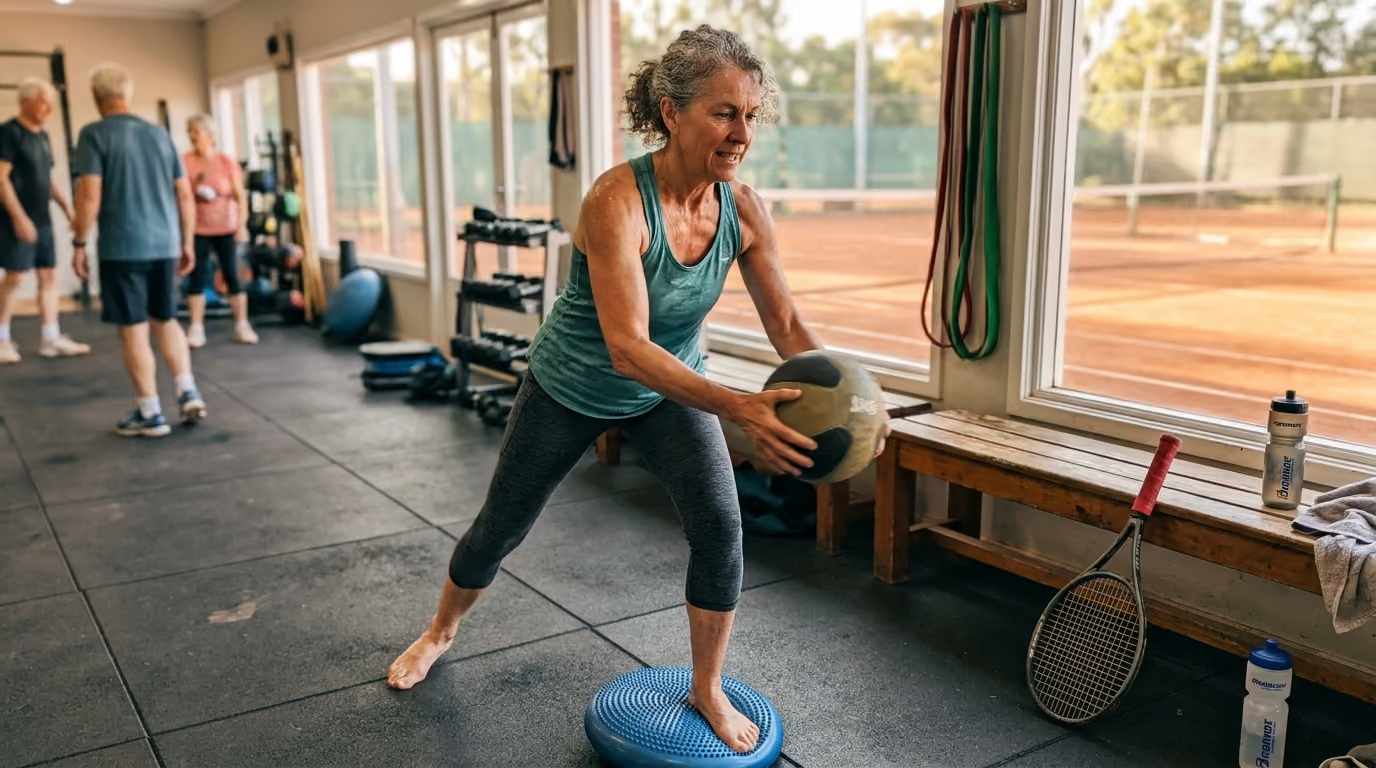
Similarly, many players avoid power training because they associate it with high-impact jumping. However, physical power, the ability to produce force quickly, is the first physical quality to decline as we age. Neglecting power training can make it harder to react to a short ball or recover your balance after a stumble. You can train power safely with low-impact options like fast sit-to-stands, cable presses, and medicine-ball throws.
Many fitness programs promote training to complete muscular failure as the gold standard for progress. For the recreational racquet player, however, this approach is often counterproductive. Training to failure causes significant muscle damage and requires extended recovery times, which can interfere with your performance on the court.
Instead, you should focus on leaving one to three repetitions in reserve on most of your strength exercises. This approach allows you to stimulate muscle growth and strength gains without causing excessive soreness. Your gym sessions should leave you feeling capable and energized, not exhausted and unable to play your sport the next day.
To maintain your physical longevity, you must view your gym sessions and your court time as part of a single, integrated system. Fatigue is cumulative, meaning your body does not distinguish between the stress of a heavy deadlift session and a intense three-set singles match.
Managing this total workload is critical for avoiding overuse injuries and chronic exhaustion. When you increase your playing hours, you must temporarily reduce your training volume in the gym. Conversely, during the off-season or periods of reduced court play, you can increase your strength training volume to build more physical capacity.
It is common to experience disruptions in your training schedule due to travel, illness, or minor injury flare-ups. When these interruptions occur, it is helpful to understand how detraining affects your body. Research shows that while strength and muscle mass do decline during periods of inactivity, your previous gains do not vanish immediately.
Studies in older adults have found that after 12 to 20 weeks of complete detraining, participants lost a portion of their strength, but their physical capacities remained significantly higher than their pre-training baselines. However, muscle volume gains can return to baseline after approximately 24 weeks of inactivity, which highlights the importance of long-term consistency.
To prevent this loss of progress during busy periods, you can utilize highly effective maintenance doses. Research has demonstrated that training just once per week is sufficient to maintain muscle strength and size for up to six months following a progressive program. This means that even when life gets busy, a single, brief full-body workout can preserve your hard-earned progress. For more advice on managing these cycles, explore our athletic longevity resources.
As we age, we must accept that our joints may occasionally complain. Experiencing minor aches, stiffness, or diagnosed conditions like osteoarthritis does not mean you have to stop strength training. Instead, you should learn to modify your exercises so you can continue to progress safely.
If standing exercises place too much stress on your joints or feel too unstable, you can modify your position to focus on the target muscles. For example, if a standing shoulder press irritates your lower back, switch to a seated dumbbell press. If your balance limits how much weight you can hold during a lunge, perform a split squat while holding onto a stable squat rack for support.
Using machines, such as a leg press or chest-supported row, can also be highly beneficial. Machines provide external stability, which allows you to safely challenge your muscles with heavier weights without worrying about losing your balance.
You do not always need to perform exercises through a maximal range of motion to get results. If deep squats cause knee pain, you can perform box squats to a height that is comfortable and pain-free. Over time, as your strength and joint tolerance improve, you can gradually lower the box.
Similarly, if a full-range shoulder press causes discomfort, you can limit the movement to the pain-free portion of the lift. A modified range of motion that allows you to train consistently is always superior to avoiding the exercise entirely or pushing through pain.
If high-impact exercises like jumping or running lateral cuts are inappropriate for your joints, you can modify the speed and stability demands of your training. You can train power using low-impact movements, such as explosive leg presses, fast step-ups, or medicine-ball throws.
To make exercises more manageable, you can also reduce the stability demands. If a single-leg deadlift feels too unstable, you can use a kickstand stance, where your back foot rests lightly on the floor for balance. This modification allows you to enjoy the benefits of unilateral training while keeping the exercise stable and safe.
While minor stiffness and temporary muscle soreness are normal responses to physical training, you must be able to recognize the signs of a more serious issue. Pushing through joint pain or ignoring warning signs can lead to chronic injuries that keep you off the court for extended periods.
You should consult a qualified healthcare provider, such as a physical therapist or sports medicine physician, if you experience any of the following symptoms:
A professional evaluation can help you identify the root cause of these symptoms and provide you with a customized rehabilitation plan. This approach ensures you can return to your sport safely and continue playing for years to come.
Yes, you can absolutely build muscle and strength in your sixties, seventies, and beyond. Research shows that older muscle tissue remains highly responsive to resistance training. While the rate of muscle growth may be slower than in your youth, consistent training with appropriate loading will yield significant improvements in muscle mass, strength, and bone density.
It depends on your current fitness level and your weekly schedule. If you choose to train on the same day, it is generally best to play your racquet sport first, when you are fresh, and perform your strength training later in the day. Alternatively, you can perform your strength workouts on your non-playing days to ensure you can recover fully between sessions.
Yes, power training can be safe and highly beneficial for players with minor joint wear, provided you select low-impact variations. You do not need to perform high-impact jumping to develop power. Fast sit-to-stands, cable rotations, and light medicine-ball throws allow you to train rapid force production while keeping joint stress to a minimum.
Normal training adaptation typically presents as a dull, generalized muscle soreness that peaks 24 to 48 hours after a workout and gradually subsides. Joint discomfort that is sharp, localized, or accompanied by swelling, stiffness, or pain during daily activities is a sign of joint irritation or injury. If you experience these symptoms, you should reduce your training intensity and consult a medical professional.
Follow Evercourts for practical insights on tennis, pickleball and padel performance, movement, recovery and healthy ageing. Stay connected for new articles, research-led guidance and ideas to help you play well and keep playing for years.


Read practical guidance for better movement, smarter preparation and a game that keeps working for you.
explore the Blog