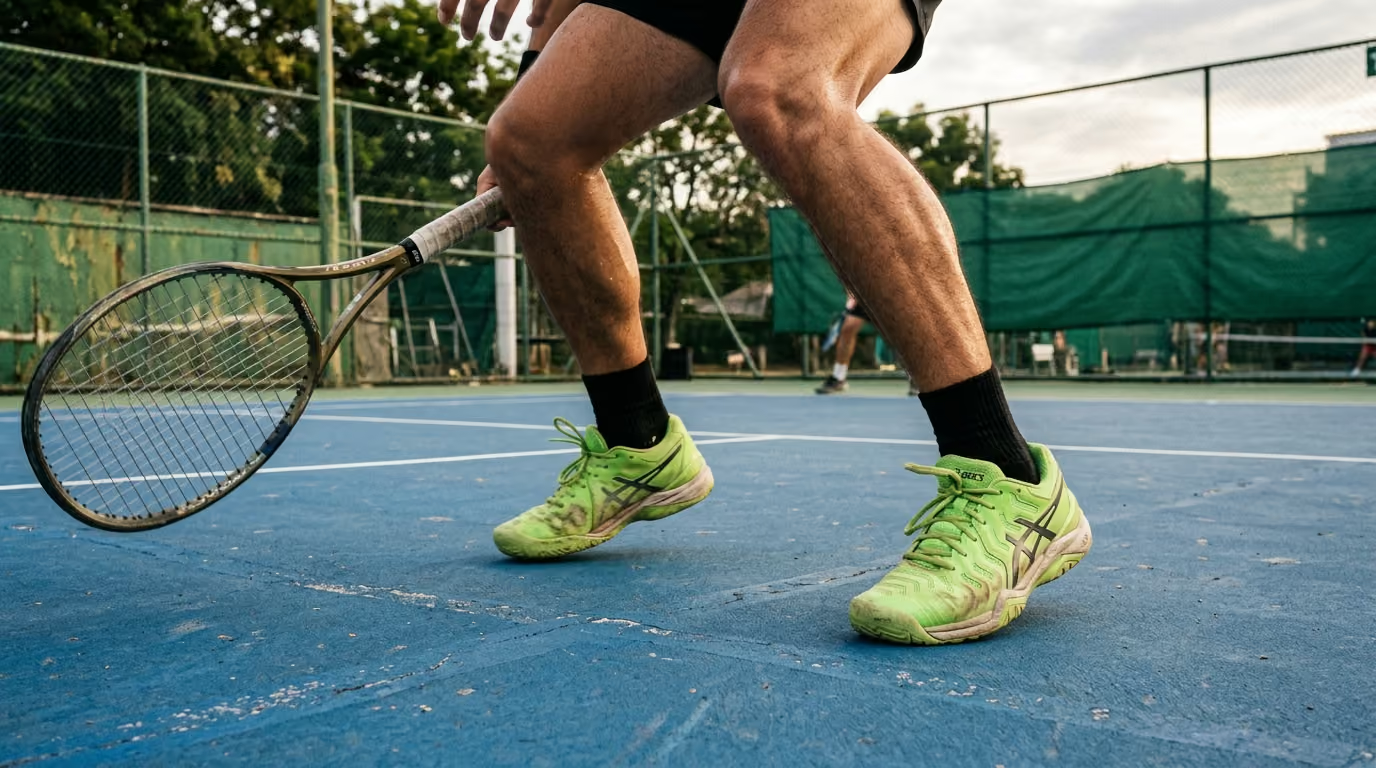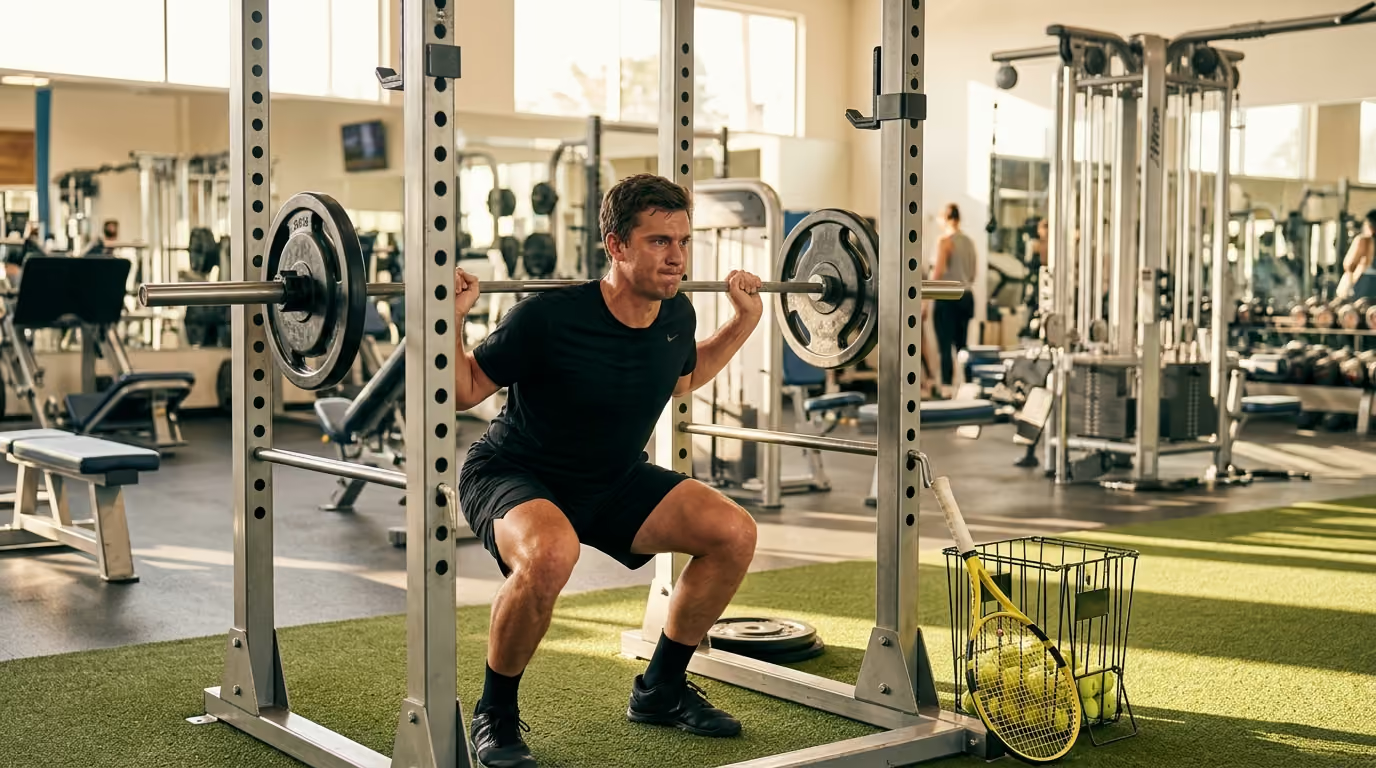

While many racquet sports players assume complex training splits are essential for power, highly segmented routines often hinder court movement and speed.




Many competitive racquet sports players believe that a complex training split is required to build true athletic power. They assume that dividing their gym work into highly isolated body parts is the signature of an advanced program. In reality, highly segmented splits often cause excessive local fatigue that degrades your court movement and speed.
The ideal training split for a court athlete is the simplest structure that lets you complete your necessary weekly training volume without compromising your matches or recovery. Current sports science shows that when total weekly volume is equated, full-body programs and split routines yield similar results in strength and muscle growth. Your decision should therefore be based on your personal schedule, competitive season, and recovery capacity rather than a search for a universally perfect routine.
To help you design the most effective plan, this guide compares the primary training splits. It provides a clear framework to match your gym routine to the demands of tennis, pickleball, and padel.
Racquet sports require a unique combination of physical qualities. You must produce rapid force, change direction quickly, and maintain endurance over several hours. To support these actions, your strength training must do more than build larger muscles. It must develop tissue capacity and protect your joints from repetitive stress.
A systematic review of strength training in competitive tennis players confirmed that combining resistance work with plyometrics is highly effective. This approach improves force production and matches the demands of competitive play. Treating gym work as an isolated bodybuilding activity can disconnect your muscles from how they must function on the court.
Current sports science research provides valuable guidance on how to structure this training. A systematic review by Ramos-Campo and colleagues in 2024 compared split and full-body resistance training routines. The researchers concluded that when weekly training volume is equal, both approaches produce similar outcomes.
This finding is supported by a meta-analysis on training frequency conducted by Schoenfeld and colleagues. Their work showed that frequency has no independent effect on muscle growth when weekly sets are matched. Furthermore, a review by Grgic and colleagues on strength gains confirmed that apparent benefits of higher frequency disappear when total work is controlled.
However, some uncertainty remains in the scientific literature. Most of these studies are performed on recreational lifters in controlled environments. Researchers rarely track how different training splits affect highly complex sports tasks. These tasks include lateral reaction times, rapid deceleration, and multi-directional agility.
Therefore, we must combine these general strength findings with the established biomechanics of racquet sports. In tennis, pickleball, and padel, movement relies on a coordinated kinetic chain. Power starts in the feet, travels through the legs, rotates through the hips and trunk, and finishes in the shoulder, arm, and racquet. This integrated demand makes highly isolated bodybuilding routines less practical for active court players.
Before choosing a routine, you must assess your current physical baseline. Your training split must align with your age, gym experience, and court schedule.
If you are new to strength training, your body will adapt quickly to almost any stimulus. You do not need a complex routine to make progress. A basic structure will allow you to learn movement patterns and build joint resilience safely.
If you have lifted weights for several years, you may need a higher volume of work to see results. An upper-lower split can help you accumulate this work without exhausting your system.
You must also consider your weekly court hours. A player who plays four matches a week has less recovery capacity than someone who plays once. Your gym routine must support your play rather than compete with it.
Your primary physical goal should also guide your choice. If you need to build muscle, an upper-lower split during the off-season is highly effective. If your priority is maintaining your speed and protecting your joints, a low-volume full-body routine is superior.
Evaluate your previous injury history as well. If you have chronic shoulder issues, you may need a split that isolates upper-body pulling to rebuild tissue capacity. You can find specialized advice for these situations in our strength and conditioning resources library.
A full-body routine trains all the major movement patterns or muscle groups in a single session. This approach typically involves one lower-body press, one hinge pattern, one upper-body push, one upper-body pull, and a rotational movement. For many court players, this is the most efficient way to maintain physical preparation.
Training major movements twice a week provides a regular stimulus that keeps the nervous system sharp. It also helps maintain muscle tissue health without causing deep, localized soreness. This makes the full-body split highly practical for players with busy schedules.
If you only have two days a week to spend in the gym, a full-body routine is your best choice. It is also highly effective during the competitive season. When match volume is high, you want to maintain your physical baseline with minimal fatigue.
A two-day full-body program is easy to recover from and simple to schedule. If you miss a session due to a rescheduled match, you have not missed an entire muscle group for the week. You simply perform the workout a day later. This flexibility is invaluable for busy recreational and competitive players.
The main limitation of full-body training is session length and mental fatigue. If you try to perform heavy squats, deadlifts, overhead presses, pull-ups, rotational throws, and shoulder stability work in one session, your energy will drop. The quality of your movements will decline toward the end of the workout.
To avoid this issue, you must rotate the focus of each full-body session. For example, you can make the first session of the week lower-body dominant. In this workout, you perform your heavy lower-body lifts first while you are completely fresh. You then follow with moderate upper-body and accessory exercises.
In the second session, you reverse the order. You start with explosive upper-body work and shoulder care, then complete moderate lower-body patterns. This rotating emphasis preserves movement quality and prevents systemic exhaustion. It allows you to gain the benefits of full-body training without the downside of excessively long workouts.
An upper-lower split divides your training by body region. In this structure, you perform upper-body exercises on one day and lower-body exercises on another. A classic intermediate program uses a four-day schedule, consisting of lower-body training on Mondays and Thursdays, and upper-body work on Tuesdays and Fridays.
This division allows you to perform more exercises for each region in a single session. Because you are not training your entire body at once, you can focus deeper on specific strength or power qualities. This split is highly beneficial during the off-season, when your court volume is low.
For a racquet sports player, these sessions should not look like traditional bodybuilding workouts. Your upper-body days should still include trunk rotation, scapular control, and rotator cuff work. Your lower-body days should emphasize unilateral exercises, braking capacity, and ankle stability.
The American College of Sports Medicine progression models suggest three to four weekly resistance sessions for intermediate athletes. An upper-lower split fits this recommendation perfectly. It provides enough volume to build strength and muscle mass while allowing adequate recovery for each body region.
However, the main limitation of a four-day upper-lower split is the total weekly stress. When you combine four gym sessions with three or four heavy court sessions, your joints may suffer. This is especially true if you are over fifty or have a history of tendon issues.
To make an upper-lower split work, you must carefully monitor your court volume. If you notice persistent stiffness in your knees or shoulders, you may need to scale back. You can reduce the split to a three-day rolling format, alternating upper and lower workouts across three sessions per week. This modification increases your recovery time between similar workouts, helping you build strength without overloading your joints.
Traditional body-part splits divide training by individual muscles. A player might train chest on Monday, back on Tuesday, shoulders on Wednesday, and legs on Thursday. While this approach is popular in fitness magazines, it is rarely appropriate for court athletes.
Isolating single muscle groups is inefficient for movements that require sequential coordination. A tennis serve, a pickleball lunge, or a padel overhead smash require your entire body to work as a unit. Isolating your chest or biceps does little to improve these actions.
Furthermore, training a single muscle group with high volume once a week causes severe muscle soreness. This soreness can ruin your lateral movement and court coordination for days. If your legs are stiff from a high-volume leg day, your split-step and reaction time on the court will suffer.
A much better option is a movement-pattern split. This structure divides your sessions by physical performance objectives rather than muscle groups. One session might focus on lower-body strength and deceleration, while the next session targets upper-body pulling and shoulder capacity. A third session can prioritize rotational power and trunk control.
This approach allows you to concentrate on specific physical qualities, keeping your sessions shorter and highly focused. However, it requires a high level of training experience to organize correctly. If you do not balance the movements, you can create muscle imbalances.
Research shows that when weekly volume is equated, these splits do not offer a strength advantage over full-body routines. Therefore, you should only use a movement split if you have a specific physical weakness that needs concentrated work. For most healthy players, the simplicity of a full-body or upper-lower structure is superior. It keeps your training simple and aligned with the demands of court play.
To apply this knowledge, you must integrate your gym sessions with your court schedule. The goal is to arrive at your matches feeling fresh and explosive. To achieve this, you must manage your training fatigue carefully.
First, identify your primary match days. You should avoid heavy lower-body lifting within forty-eight hours of a competitive match. Heavy squats or lunges can cause residual fatigue in your legs, slowing down your split-step and delaying your lateral reactions.
Instead, place your hardest lifting sessions early in the week. If you play matches on Saturdays, your heavy lower-body work should occur on Monday or Tuesday. This timing allows your muscles to recover and rebuild before you step onto the court.
Second, use the concept of Repetitions in Reserve, or RIR. This method helps you manage your gym fatigue. Instead of lifting a weight until you cannot perform another repetition, always leave one to three repetitions in reserve. This approach preserves your movement technique and prevents excessive soreness while still providing a strong stimulus for strength.
Third, adjust your training volume based on your competitive phase. During a busy tournament week, you must reduce your gym work. You do not want to stop lifting completely, as this can lead to stiffness. Instead, perform a short, low-volume full-body session focusing on explosive movements and basic joint maintenance.
Here is a practical step-by-step framework to adjust your weekly schedule:
By following this framework, you ensure your gym work supports your court play rather than competing with it. This balance is critical for maintaining peak performance and avoiding chronic fatigue.
While tennis, pickleball, and padel share similar movement patterns, each sport has unique physical demands. Your strength training split should reflect these specific requirements.
Tennis requires a unique blend of maximum strength, rapid multidirectional speed, and high-velocity rotational power. Players must sprint, stop, change direction, and strike a ball under intense physical pressure. The court is large, which means you must cover significant distances during a match.
Your training split must protect your shoulder, elbow, hip, and ankle joints. In tennis, the shoulder is subjected to extreme forces during the serve. Therefore, your upper-body sessions must include dedicated rotator cuff strengthening and scapular control.
Lower-body work should emphasize eccentric hamstring strength. This helps protect your knees and thighs during rapid deceleration. It also supports your hips when you lung for a wide shot.
If you are a competitive tennis player, an upper-lower split is highly valuable during the off-season. It allows you to build the raw leg strength required for deep court lunges. During the playing season, a two-day full-body program is superior, keeping your legs fresh for long, multi-set matches.
Pickleball movement is characterized by short, rapid lateral shuffles, quick reactions at the kitchen line, and frequent deep lunging. The court is smaller than a tennis court, which reduces sprinting distances but increases the frequency of rapid direction changes.
Injury literature indicates that lower-extremity and muscle/tendon problems are major concerns, especially for older players. One study of 237 older pickleball participants found that over thirty-two percent reported an injury during the previous year. Of those injuries, nearly fifty-eight percent involved the lower extremities, and over sixty-one percent involved muscle or tendon tissue. The study also revealed that playing more hours per week was a key risk factor for injury.
This means your strength split must prioritize lower-limb resilience and tendon capacity. You should not focus solely on upper-body pressing or bicep curls. Your routine must include specific work for your calves, ankles, and Achilles tendons.
Exercises like soleus raises, lateral step-downs, and single-leg balance work are critical. A full-body routine performed twice a week is excellent for most recreational pickleball players. It provides a consistent stimulus to protect your joints without creating the deep fatigue of a dedicated leg day.
If you are a highly competitive player, a two-day upper-lower split can work well. This structure gives you more room to build the lower-body strength required for low-slung kitchen battles.
Padel combines elements of tennis and squash. It features rapid transitions, frequent overhead smash actions, and complex movements around glass walls. The sport is fast, requiring quick reactions and constant spatial awareness.
A systematic review of padel match play revealed that the sport creates moderate physiological demands and moderate-to-high perceived effort. The anaerobic contribution is relatively low, meaning players must sustain repeated submaximal efforts over a long duration. A separate review of physical and anthropometric parameters highlighted the importance of acceleration, deceleration, and rotational power.
Your training split must prepare your body for these specific physical qualities. Lower-body sessions should emphasize lateral lunges, single-leg control, and calf strength. This helps you push off quickly to chase balls off the back wall.
Your upper-body work must focus on overhead tolerance. Padel players perform a high volume of overhead strokes, which can irritate the shoulder joint. Include exercises that promote scapular upward rotation and thoracic mobility.
A three-day full-body program with rotating emphasis works exceptionally well for padel players. It allows you to train your rotational power and lateral stability frequently. This regular exposure helps your nervous system adapt to the rapid direction changes required on the padel court.
Many court players make simple mistakes when organizing their training splits. These errors can lead to chronic fatigue, joint stiffness, and poor performance on the court.
One of the most frequent mistakes is mistaking muscle soreness for a successful workout. If your training split leaves your legs too sore to walk, it is hurting your court performance. Severe soreness impairs your reaction time, coordination, and footwork during matches. Your gym sessions should leave you feeling capable and energized, not completely exhausted.
Another common error is confusing training frequency with total volume. Many players believe that moving from a two-day to a four-day split will double their progress. However, if you simply divide the same number of weekly sets across more days, your physiological adaptation will remain the same. You should only increase your training frequency if you need to add more total work that cannot fit into your current sessions.
Finally, many players neglect the shoulder and scapular system in their splits. They focus on bench presses and shoulder presses while ignoring pulling movements. This imbalance can lead to shoulder impingement and elbow strain over time.
Every push exercise in your split should be balanced with at least one pull exercise. Include regular external rotation and scapular control work to keep your hitting shoulder healthy.
Racquet sports players must balance strength training with high cardiovascular demands. This combination is known as concurrent training, and it requires careful planning to avoid overtraining.
A meta-analysis of concurrent training found that high-frequency running can interfere with lower-body power development. However, well-designed concurrent programs can still support maximal strength gains when managed correctly. Research in trained team-sport players shows that concurrent training does not prevent power development if you structure your sessions properly.
To minimize the interference effect, you should pay attention to exercise order. Performing your resistance training before your conditioning work is generally superior. This sequence favors explosive power adaptations and neuromuscular coordination.
Your training split also has a major impact on your tendon and joint health. Tendons require more time to recover than muscle tissue because they have less blood flow. If you use a split that concentrates high stress on one joint complex multiple times a week, you risk developing chronic tendinopathy.
Spreading your training volume across a full-body routine can help reduce this localized joint stress. For detailed guidance on protecting your tissues, you can read our injury prevention guides.
Managing your recovery is essential for long-term athletic success. To learn more about optimizing your post-match habits, explore our sports recovery science resources. By understanding how your split affects your recovery, you can maintain your physical capabilities and continue playing for years.
Your training split should not remain the same year-round. It must change to match the demands of your competitive calendar. This approach helps you peak for important tournaments and rebuild during the off-season.
During the off-season, your primary goal is to build strength, power, and muscle mass. You can use a four-day upper-lower split during this phase. This structure allows you to perform more exercises per session and push your limits in the gym. Since your court play is reduced, your body can handle the extra physical demands.
As you move into the pre-season, your focus must shift toward court-specific power and speed. You should transition to a three-day full-body or a modified upper-lower routine. Reduce your heavy lifting volume and add explosive plyometric exercises. This prepares your nervous system for rapid direction changes on the court.
During the in-season, your main objective is to maintain your physical baseline while avoiding fatigue. A two-day full-body routine is highly practical during this period. This simple structure keeps your muscles active without causing deep soreness. Your gym sessions should be short, leaving you with plenty of energy for your matches.
If you have a major tournament coming up, you must implement a brief tapering period. Reduce your gym volume by fifty percent but maintain high movement speed. This approach ensures your muscles are fully recovered and ready for peak performance.
By transitioning your split throughout the year, you support your healthy aging and athletic longevity. You avoid the chronic overuse injuries that occur when you perform the same routine for twelve months straight. To discover more about long-term planning, check out our athletic longevity plans.
While a structured training split can improve your performance, it is not a substitute for professional medical care. You must listen to your body and recognize the signs of a potential injury.
If you experience sharp joint pain, swelling, or persistent discomfort that does not improve after seventy-two hours of rest, you should seek help. Other warning signs include a sudden loss of strength in a specific limb, joint instability, or pain that worsens during everyday activities. Do not try to train through severe pain or use anti-inflammatory medications to mask symptoms.
A qualified healthcare provider, such as a physical therapist or sports medicine physician, can diagnose the root cause of your pain. They can help you modify your training split to protect your joints while maintaining your fitness.
If you are recovering from an injury or need personalized guidance, you can contact us through our court athlete health profiles network or visit our contact page to connect with our team. Working with a professional ensures you can continue to enjoy your sport safely for years to come.
Your gym routine should always serve your performance on the court, helping you play better and enjoy your sport for years.
Follow Evercourts for practical insights on tennis, pickleball and padel performance, movement, recovery and healthy ageing. Stay connected for new articles, research-led guidance and ideas to help you play well and keep playing for years.


Read practical guidance for better movement, smarter preparation and a game that keeps working for you.
explore the Blog