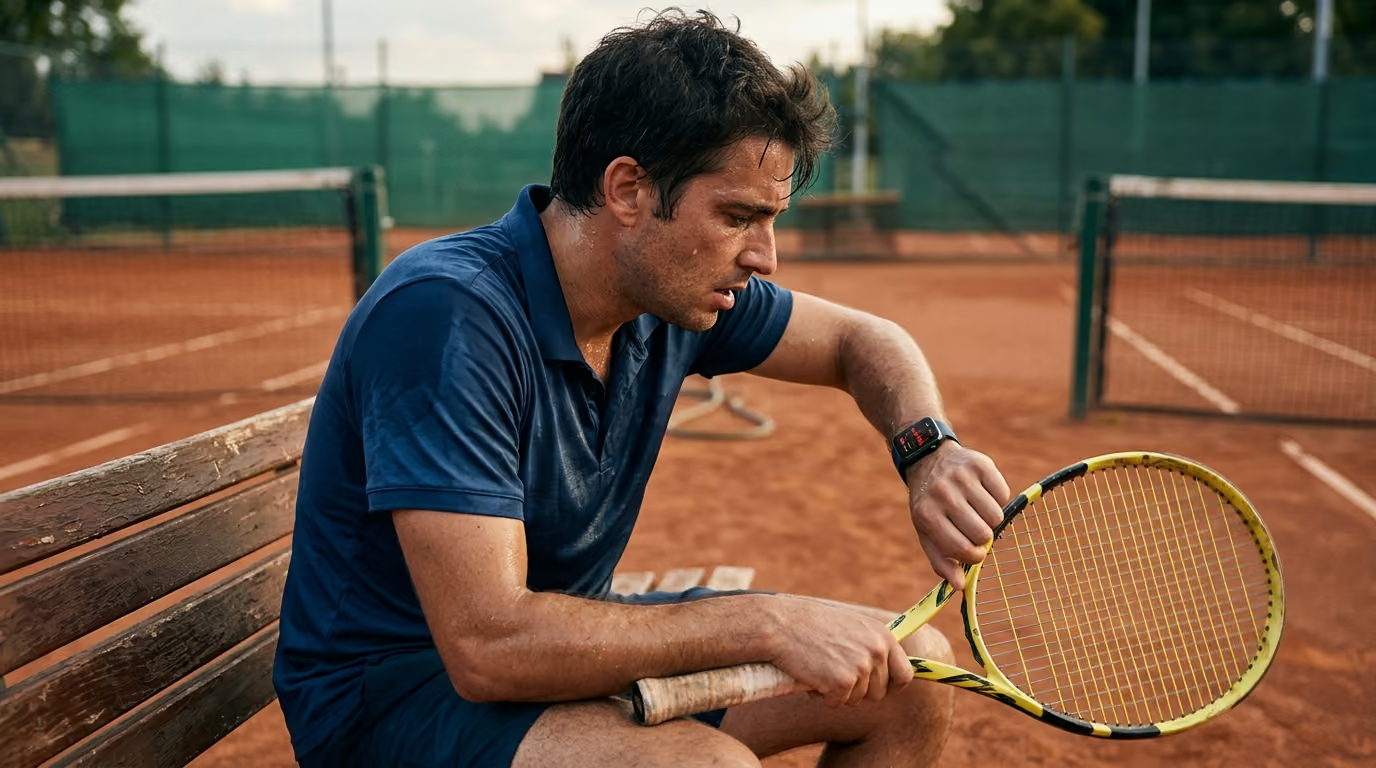

A comprehensive understanding of stress, arousal, and recovery in competitive racquet sports empowers athletes to optimize performance and mitigate fatigue.




Many recreational and competitive players struggle with a frustrating physical paradox. You can spend weeks building your aerobic fitness, but you still feel completely drained during a close competitive match. This quick exhaustion occurs because mental strain, score pressure, and competitive anxiety increase muscle tension and accelerate energy depletion. The subjective feeling of fatigue is a complex mix of metabolic waste, cardiovascular strain, and emotional exhaustion.
When you experience a sudden drop in energy during match play, the cause is rarely a simple lack of physical conditioning. Instead, it is the result of elevated mental strain, score pressure, and competitive anxiety that trigger a cascade of muscular bracing and inefficient energy expenditure. This psychophysiological reaction turns normal physical effort into a demanding trial, exhausting your energy systems much faster than in training. To perform at your best, you must learn to manage both the physical demands and the psychological pressure of match play. This guide provides a research-backed framework to help you navigate these demands.
Stress is not simply an emotional state. It is a full psychophysiological response to a perceived challenge, threat, or loss of control on the court. In racquet sports, this process begins with demand appraisal, where your brain evaluates the difficulty of the situation. You assess the score, the skill of your opponent, and the physical discomfort you feel.
Then comes resource appraisal, where you decide if you have the skill, energy, and confidence to respond. According to the Theory of Challenge and Threat States in Athletes, this evaluation determines your physical state. When you believe your resources are sufficient, you enter a challenge state. In a challenge state, your body releases hormones that prepare you for action.
In this optimal state, your blood vessels dilate, and your heart pumps more blood to your muscles. However, if you feel the demands exceed your resources, you enter a threat state. In a threat state, your blood vessels constrict. Your heart beats faster, but it pumps less blood to your limbs. This physiological response makes physical movement feel much harder.
This difference between challenge and threat explains why training sessions feel different from real tournament matches. A study of competitive tennis players published in the Journal of Sports Sciences showed that match play produced significantly higher cortisol levels than training. Cortisol is a primary stress hormone that mobilizes energy. In this study, match losers reported higher perceived exertion and higher heart rates than winners.
This research demonstrates that the emotional, social, and evaluative pressure of competition alters how your body processes physical work. Cortisol should not be viewed simply as a harmful hormone. It participates in normal energy mobilization and adaptation. However, when cortisol remains elevated for too long without recovery, it can lead to premature fatigue.
Perceived exertion is not a direct readout of one physical variable. It is influenced by cardiovascular strain, breathing discomfort, dehydration, and emotional interpretation. In the tennis study, match losers reported exertion ratings of fifteen, compared to twelve point nine for winners. Their heart rates averaged one hundred sixty-eight beats per minute, compared to one hundred fifty-nine for winners.
This shows how your mental appraisal changes your actual physical efficiency. A simulated match in training may reproduce the movement demands, but it does not fully reproduce the emotional stress of a real competition. To build true athletic longevity, you must train your mind to view competitive demands as a challenge rather than a threat. You can find detailed recovery science resources to help understand these autonomic changes.
To manage your energy on the court, you must understand the metabolic engines driving your movement. Racquet sports are highly intermittent. You perform short, explosive sprints followed by brief rest intervals. In a typical tennis match, players alternate between four to ten seconds of high-intensity effort and ten to twenty seconds of rest.
This creates an exercise-to-rest ratio of approximately one to two. This intermittent pattern places a unique burden on your cardiovascular system. During match play, players average between 60% and 80% of their maximum heart rate. Long rallies can push your heart rate past 95% of its maximum.
Research shows that average oxygen consumption across a match is about 51% of your VO2max. However, during intense games, this demand can spike to nearly 87% of your maximum oxygen intake. These fluctuations require constant coordination between your energy systems. Your anaerobic systems power your initial explosive sprints, jumps, and serves.
Your aerobic system then works to restore those quick-energy stores during the brief pauses between points. If you do not recover efficiently during these intervals, your muscles will experience a rapid build-up of metabolic waste. This physical strain is compounded by dehydration and heat. A study of elite tennis players revealed that a long match can cause players to lose more than 2.5% of their body mass in fluids.
This fluid loss reduces blood volume, which makes your heart work harder to deliver oxygen. To prevent this decline, the American College of Sports Medicine recommends specific hydration strategies. You should drink enough fluid to balance your sweat losses during play. They also recommend consuming 30 to 60 grams of carbohydrate per hour during prolonged matches.
These nutritional strategies are essential for maintaining your physical capabilities. When glycogen stores run low, your brain registers fatigue more quickly. This protective mechanism is designed to prevent muscle damage. However, it also reduces your reaction time and coordination.
Consuming sports drinks or energy gels can delay this central fatigue. Hydration plans must account for sweat rate, heat, and gastrointestinal tolerance. The American College of Sports Medicine cautions that drinking more than your sweat losses is not recommended. Overdrinking can lead to hyponatremia, a dangerous condition where sodium levels in the blood drop too low.
The emotional strain of a close match has a direct, physical effect on your muscles. Under pressure, your body initiates a fight-or-flight response. This response often causes unnecessary co-contraction, which coaches refer to as muscular bracing. Bracing occurs when opposing muscle groups contract at the same time.
This reaction can freeze your joints and ruin your stroke mechanics. In racquet sports, this bracing typically targets specific areas. You might grip the handle of your racquet with extreme force. This tight grip stiffens your forearm, elbow, and shoulder.
This stiffness prevents the smooth transfer of energy through your kinetic chain. As a result, you lose ball speed and control. This bracing also affects your hip flexors and trunk. When your trunk is too stiff, you cannot rotate your hips effectively.
This restriction forces your shoulder to do all the work during a stroke. This imbalance can lead to chronic shoulder pain. You can find useful injury prevention strategies to help manage these muscular imbalances. The key distinction is between functional stiffness, which helps transfer force, and unnecessary stiffness.
Continuous bracing restricts movement and increases your overall effort. This is why coaching cues should focus on releasing the jaw, softening the shoulders, and gripping the racquet loosely. Your breathing patterns also change when you feel anxious. You might start taking short, shallow breaths that remain in your upper chest.
This shallow breathing limits your oxygen intake. It also signals to your brain that you are in danger. This feedback loop keeps your arousal levels dangerously high. Some players even hold their breath during a point.
They hold their breath while preparing for a shot, then exhale too late. This pattern disrupts your natural rhythm and increases intra-abdominal pressure. This unnecessary pressure makes you feel tired much faster. To combat this, you must train yourself to breathe continuously throughout every rally.
A systematic review of breathing techniques in sport found that long-term breathing programs can improve performance. However, short-term breathing interventions did not show a consistent benefit. This means you must practice controlled breathing during your training sessions, rather than trying it for the first time during a match. The goal is to establish a rehearsed breathing pattern that restores control and prevents breathlessness.
To regulate your physical state, you must understand how arousal affects performance. The classic inverted-U model suggests that performance improves as arousal rises, but only up to an optimal point. If your arousal rises beyond that point, your performance will decline. One study using a simple reaction-time task found that optimal performance occurred at 60% to 70% of maximum arousal.
However, this simple model has some major limitations. It does not account for the difference between physical excitement and mental worry. It also assumes that every stroke requires the same level of arousal. In reality, a powerful serve might benefit from high arousal, while a delicate drop shot requires a calmer state.
A more precise framework is the Individual Zones of Optimal Functioning model. This model proposes that every athlete has a unique zone of anxiety that leads to their best performance. Some players perform best when they feel very calm and relaxed. Others need a high level of intensity and anger to play well.
A meta-analysis of nineteen studies found a significant positive effect when athletes were in their optimal zones. This suggests that you should not try to be calm at all times. Instead, you should aim to reach the specific level of arousal that works best for you. When arousal rises too fast, you might experience a catastrophe.
Catastrophe models suggest that high mental worry combined with high physical arousal causes a sudden, sharp drop in performance. This sudden drop is what players commonly call choking. Choking is not just a mental failure. It is a physical disruption where your attention narrows, your muscles freeze, and your coordination breaks down.
A tennis-serve study indicated that choking can reflect either a skill-focus error or increased distractibility. This means that you might be focusing too much on how you are moving, or you might be distracted by the crowd or the score. Researchers have found that pre-performance routines can protect you from choking. These routines keep your attention focused on the task at hand.
They prevent you from overthinking your stroke mechanics. They also help keep your breathing and heart rate stable under pressure. Training under pressure, known as pressure-acclimatization training, is also highly effective. By practicing with score pressure or crowd noise, you learn to maintain your coordination when the stakes are high.
To stay in your optimal zone, you need a structured routine that you can use between points. In tennis, pickleball, and padel, you have about fifteen to twenty-five seconds between rallies. This is not enough time for a full physical recovery, but it is enough time to reset your nervous system. A reliable routine should consist of four distinct phases.
The first phase begins the moment a point ends. You must immediately distance yourself from the outcome of that point. Turn your back to the net and walk toward the back wall or fence. Transfer your racquet to your non-dominant hand to relax your hitting arm.
Let your shoulders drop and loosen your jaw. This simple movement pattern creates a physical barrier between you and the previous play. It prevents you from dwelling on an error or getting too excited about a winner. This phase should be practiced after every point, regardless of how you played.
Once you have turned away, focus on your breath. Take one or two slow, controlled breaths. Let your exhalations be slightly longer than your inhalations. This breathing pattern stimulates your parasympathetic nervous system, which helps lower your heart rate.
Do not force deep breaths if they make you feel lightheaded. The goal is to establish a smooth, steady rhythm. Rehearse this breathing pattern during your practice matches so it becomes automatic. This prevents you from interpreting normal breathlessness as a sign of impending failure.
Now, select a single tactical intention for the next point. This intention should be simple and easy to execute. Do not focus on your stroke mechanics. Instead, focus on a clear target or a simple movement cue.
For example, you might tell yourself to hit deep crosscourt or to split-step early. Keeping your cue simple prevents your brain from overthinking under pressure. It also directs your focus toward what you want to achieve, rather than what you want to avoid. This approach focus is associated with a challenge state rather than a threat state.
Finally, turn back toward the net and prepare for the next point. Look at your target and complete your usual pre-serve or return ritual. This might involve bouncing the ball a set number of times or adjusting your strings. These physical actions tell your brain that you are ready to compete.
Once you start the point, commit fully to your plan without worrying about the final score. This routine should also be expanded for changeovers. During a changeover, you have more time to restore your energy. Sit down on the bench and rest your feet.
Drink water or a sports drink to replace lost fluids. Use this time to review your strategy, but do not dwell on past mistakes. Focus on what you need to do in the next game. A structured changeover routine prevents you from getting caught up in emotional commentary.
The way you apply these recovery strategies will depend on your specific sport. While tennis, pickleball, and padel share similar origins, they place different demands on your body and mind. Understanding these differences will help you tailor your training.
Tennis is played on a large court, which requires longer sprints and more sliding. The points are often longer, and the physical demands are high. This means you must focus on maintaining your cardiovascular endurance and hydration. You also have more time between points, which allows for a more complete reset.
If you want to build the strength needed for these long movements, check out these strength and conditioning programs. Tennis matches can last several hours, making nutrition and hydration critical. You must plan your carbohydrate intake to avoid running out of energy in the later sets.
Pickleball is played on a much smaller court, which reduces the need for long sprints. However, the game is incredibly fast, with rapid volleys at the kitchen line. This speed requires quick reaction times and intense mental focus. Because points end quickly, you have less time to reset between rallies.
Your routine must be faster and more focused on calming your mind. The physical strain is often concentrated in your wrist, elbow, and knees, so you should focus on maintaining your mobility and movement patterns. Pickleball matches are often shorter, but the high density of points means you must stay focused.
Padel combines elements of tennis and squash, utilizing glass walls and a mesh cage. The rallies are often very long because the ball remains in play after bouncing off the walls. This creates high physical demands, with constant twisting, turning, and overhead smashing. The mental pressure is also unique because you are constantly reacting to unpredictable bounces.
You must learn to stay calm during long rallies and manage your energy carefully. The glass walls can make the court feel confined, which can increase feelings of anxiety. Your reset routine should focus on releasing tension in your lower back and shoulders.
Many players make critical errors when trying to manage their stress and recovery. One common mistake is treating all arousal as anxiety. When your heart starts beating fast before a match, you might assume you are nervous. However, this physiological response is actually your body preparing for hard work.
If you view this arousal as a threat, your performance will suffer. Instead, view it as a helpful resource that will help you run faster and hit harder. Ask yourself what this activation is preparing you to do, rather than assuming it signals danger. Another mistake is forcing deep breathing during a match.
While slow breathing can help you calm down, taking huge, deep breaths can disrupt your natural rhythm. It can also make you feel lightheaded if you do it too quickly. In our experience, it is much better to focus on a natural, steady breathing pattern that does not feel forced. The goal is the smallest intervention that restores control.
A third pitfall is turning your between-point routine into a technical lecture. When you make an error, you might start analyzing your stroke mechanics. You might try to correct your elbow position, your footwork, or your follow-through. This analytical focus can lead to paralysis by analysis.
Your movements will become stiff and robotic. Instead, keep your cues focused on external targets or simple feelings, like a loose hand. Finally, many players rely too heavily on technology to measure their stress. While heart-rate monitors and fitness trackers can provide useful data, they should not dictate how you feel.
A single high heart-rate reading does not mean you are overtraining. Heart-rate variability, or HRV, is also influenced by many different factors. The sports-psychology literature contains methodological limitations regarding HRV. Use technology as a general guide, but trust your own body and how you feel on the court.
What you do after a match is just as important as what you do during play. Once the match is over, your body needs to shift from a fight-or-flight state to a rest-and-digest state. This shift is essential for restoring your energy and repairing damaged tissues.
I remember finishing a tough two hour padel match on a cold Tuesday night and waking up the next morning feeling like my lower back was locked in concrete. For a long time, I just accepted this as the price of playing hard in my forties. But once I started spending just ten minutes on targeted hip mobility before heading to the club, the stiffness almost completely vanished. It taught me that we do not have to accept pain as a default state of aging. Focus on active recovery to preserve your joints and promote healthy aging and athletic longevity.
Your post-match routine should begin with a slow cool-down. Instead of sitting down immediately, walk slowly for a few minutes. This gradual decrease in activity helps your heart rate return to normal. It also helps prevent blood from pooling in your legs, which can cause dizziness.
Next, focus on hydration and nutrition. You should drink enough fluid to replace any weight lost during the match. A good guideline is to drink about 450 to 675 milliliters of water for every half-kilogram of body weight lost. Combine this with a meal that contains both carbohydrates and protein.
Carbohydrates replenish your glycogen stores, while protein helps repair muscle fibers. You can also use physical recovery methods to speed up this process. Research shows that physical recovery techniques can have a moderate positive effect on your heart-rate variability. Cold-water immersion is particularly effective, with studies showing a large positive effect on recovery markers.
However, these methods are not a substitute for the basics. Good nutrition, hydration, and plenty of sleep are still the most important tools for recovery. Sleep is when your body does most of its repair work. It is also when your brain processes the mental demands of the day, helping you prepare for future matches.
While stress and fatigue are normal parts of competitive sports, you must know when to seek professional help. It is easy to mistake a medical issue for simple competitive anxiety. If you experience any of the following symptoms, you should consult a healthcare provider.
If you feel chest pain, tightness, or pressure during play, stop immediately. A racing heart rate that does not slow down after several minutes of rest is also a warning sign. These symptoms can indicate a serious cardiac issue. Do not try to push through them or assume they are just panic attacks.
While breathlessness is normal during a hard sprint, you should not feel like you cannot catch your breath. Extreme wheezing, coughing, or a tight chest can be signs of asthma. If you have a history of respiratory issues, make sure you have your medication on hand.
If you start to feel dizzy, confused, or lightheaded, you may be suffering from heat illness. Other signs include severe headache, nausea, or a sudden stop in sweating. This is a medical emergency that requires immediate cooling and medical attention. You can learn more about managing these risks by reading about healthy aging and athletic longevity.
If you have joint pain, muscle stiffness, or numbness that does not improve after a few days of rest, consult a physiotherapist. Do not rely on pain relievers to get you through your matches. This can lead to more severe injuries that could keep you off the court for months. Early intervention is key to maintaining your longevity in the sport.
To help you implement these strategies, we have created a simple four-week progression. This plan is designed to help you build these habits slowly, so they become automatic.
In the first week, focus on monitoring your current habits. Do not try to change anything yet. Simply pay attention to how you feel during your matches. Note when you feel anxious, when your muscles tighten, and how you breathe.
Keep a simple training log to record these observations. Note if your grip gets tighter after an error or if you hold your breath during serves. This awareness is the first step toward making positive changes. It helps you identify your personal triggers and patterns.
This week, start using the four-phase between-point reset routine during your practice matches. Focus on the release phase and the breathing phase. Try to turn away from the net after every single point, regardless of the outcome. Practice this until it starts to feel natural.
Do not worry about the tactical intention phase yet. Just focus on creating that physical and emotional distance from the previous point. This helps break the habit of carrying frustration into the next play.
Once you are comfortable with the reset, start adding the third phase: choosing a single tactical intention. Keep your cue simple and focused on a target. Practice using this intention under score pressure, such as a tiebreaker or a deciding point.
Monitor how this changes your focus and your physical tension. You should find that focusing on a clear task reduces your anxiety. It prevents your mind from wandering to negative outcomes or technical details.
In the final week, test your routine in a competitive match. Use the entire four-phase routine before every point. Monitor how you feel and make any necessary adjustments. Continue to track your recovery and hydration after the match to ensure your body is recovering fully.
Share your experience with your coach or playing partners to help stay accountable. Consistent practice will help these routines become second nature, allowing you to perform at your best.
Follow Evercourts for practical insights on tennis, pickleball and padel performance, movement, recovery and healthy ageing. Stay connected for new articles, research-led guidance and ideas to help you play well and keep playing for years.


Read practical guidance for better movement, smarter preparation and a game that keeps working for you.
explore the Blog



