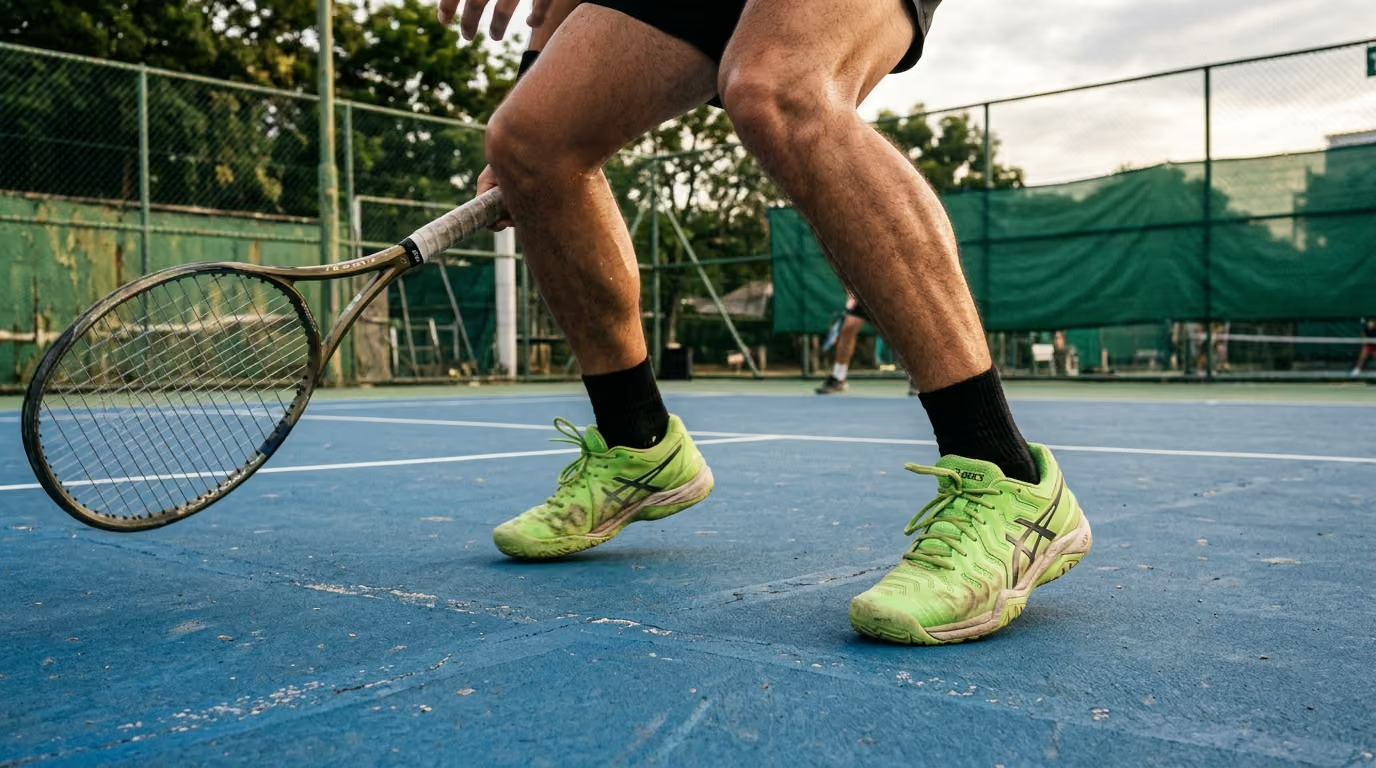

Tennis players cover an average of 9.6 meters per point, highlighting the need for systematic training to develop efficient court movement skills.




Many players believe that spending hours on agility ladders will directly translate to better court movement. They watch professionals perform rapid foot-tapping sequences and assume that foot speed is the primary driver of court coverage. In reality, isolated footwork drills without a ball or a racket rarely prepare you for the chaotic demands of a live match. True court agility requires you to coordinate your eyes, your balance, and your decision-making under intense time constraints.
To bridge the gap between technical drills and real match play, you need a systematic, step-by-step training progression. This guide outlines how to build movement skills from simple, static positions up to complex, reactive point scenarios. By understanding how to organize your body, transition through different movement modes, and recover efficiently, you can play with greater speed and preserve your joint health.
To move efficiently on court, you must systematically progress from stable, pre-planned movement patterns to variable, reactive scenarios that incorporate a racket, a ball, and an opponent. Mastering body control first, then adding technical stroke preparation, and finally introducing tactical decision-making will help you develop footwork that withstands match pressure. This step-by-step approach ensures that your physical speed translates directly into better positioning and cleaner ball striking.
Court movement is not a single physical attribute. Sports scientists separate movement capacity from movement skill. Movement capacity includes your baseline physical qualities, such as acceleration, deceleration, muscular strength, and change-of-direction speed. Movement skill is your ability to apply those physical qualities at the correct time, in the correct direction, and with appropriate body control.
According to sports science, agility is split into two relatively independent qualities. These are pre-planned change-of-direction speed and reactive agility. A traditional drill where you run around cones tests your pre-planned change-of-direction speed. However, research indicates that these pre-planned drills do not automatically improve your reactive agility. To react quickly during a point, your brain must perceive an external cue, select the appropriate response, and execute the physical movement.
To build transferrable skills, training programs should reflect the actual physical demands of match play. Research on international male tennis players reveals they cover an average of 9.6 meters per point. Female players cover approximately 8.2 meters per point. This movement is broken down into incredibly short, high-intensity efforts.
Data from the Australian Open shows that players cover about 4.8 meters per change of direction. They perform roughly 1.3 to 1.4 shots per change of direction, modifying their path every three seconds. A review published in the British Journal of Sports Medicine notes that approximately 80 percent of strokes are played within 2.5 meters of the starting position. Only 10 percent of shots require a sprint of 2.5 to 4.5 meters.
This data indicates that court movement is dominated by short, sharp repositioning steps rather than long-distance sprints. To train these short movements, you must understand the role of force production and force absorption. Every direction change requires an initial braking phase, a brief transition, and a reacceleration phase. Your body must lower its center of mass to absorb your momentum, stabilize the trunk, and then push off in the new direction.
Physical interventions can significantly enhance these movement mechanics. A six-week plyometric training program has been shown to improve change-of-direction speed in competitive tennis players. Additionally, a three-week multidirectional sprint program utilizing random paths proved highly effective for developing reactive agility.
Interestingly, studies comparing racket-in-hand training with no-racket training show unique benefits for both. An eight-week study found that training without a racket led to greater improvements in baseline physical qualities like jumping and sprinting. However, adding the racket is essential for technical transfer to the court. Therefore, a complete training program must use both methods to build both general athleticism and sport-specific skill.
To systematically build your movement, you should use the drill-to-point continuum. This framework guides you through seven distinct stages of complexity. Each stage builds on the previous one, ensuring that you do not add speed before you have established control.
The objective of this stage is to learn the correct body shapes and balance without any movement or time pressure. If you cannot hold a stable posture while standing still, your mechanics will break down when you run. Focus on maintaining a quiet head, a active trunk, and a balanced athletic stance.
Begin with the ready-position freeze. Stand with your feet slightly wider than shoulder-width apart, your knees flexed, and your weight distributed on your forefeet. Hold this position for ten seconds while a coach or partner checks your posture. You should feel balanced and ready to push in any direction.
Next, practice the lunge-and-hold drill. Step forward or diagonally into a deep lunge and freeze at the bottom of the movement for three seconds. Check that your front knee is aligned with your foot and does not collapse inward. Your trunk should remain upright and controlled, preventing your lower back from arching excessively.
Once you can control your stationary body, you can begin moving through known paths. This stage develops your movement vocabulary without the distraction of a ball or an opponent. Keep the movement speed moderate so you can focus entirely on your footwork mechanics.
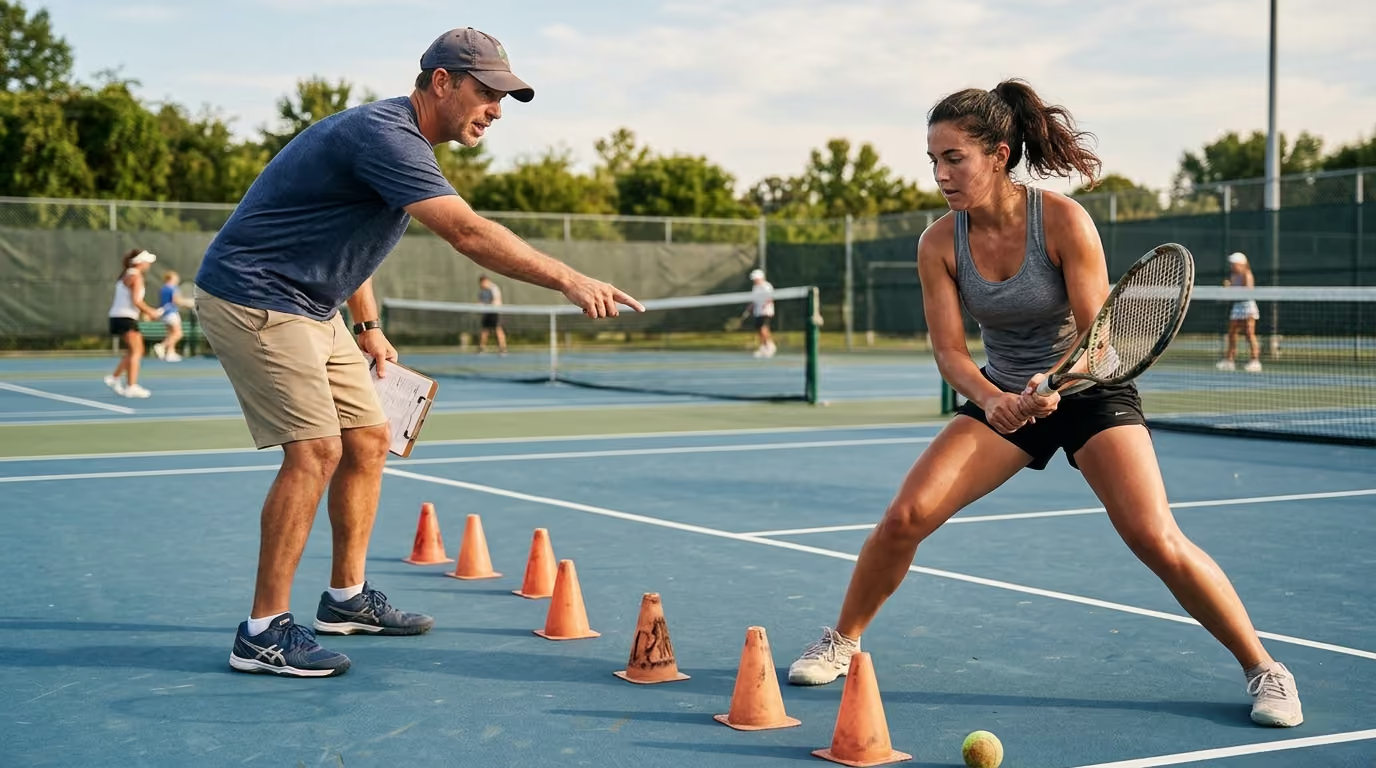
The three-zone lateral shuffle is an excellent exercise for this stage. Place three cones in a straight line, spaced three meters apart. Start at the center cone, shuffle to the right cone, touch it, shuffle back through the center to the left cone, and return. Focus on keeping your hips level and avoid crossing your feet during the shuffle.
You can also practice the four-corner shadow pattern. Start in the center of the court and move to four designated corners in a fixed sequence. At each corner, perform a slow shadow swing, focusing on your balance during the simulated contact. Immediately after the swing, execute a quick recovery step back to the center.
Adding a racket changes your center of gravity and alters how you coordinate your upper and lower body. Many players lose their footwork efficiency once they have to swing. In this stage, you integrate your movement patterns with realistic stroke preparation.
Practice the shuffle-to-forehand preparation. Start in your athletic stance, split step, and immediately turn your shoulders while taking a lateral step. Shuffle two steps to the side while keeping your racket back in a prepared position. Stop, perform a shadow swing, and recover to your starting spot.
You can apply the same principle to forward movement. Execute a drop step, run diagonally forward, and enter a controlled lunge while preparing your racket for a short ball. Ensure that your swing is timed with your foot contact, rather than swinging while you are still sliding or running. Developing these patterns is a core component of court mobility and movement methods.
Now you can introduce a ball, which adds the challenge of tracking an object through space. In this stage, the feeds are highly predictable so you can maintain your focus on clean movement. The goal is to arrive at the ball with time to set up and strike.
Try the one-direction lateral feed. A partner feeds balls to your forehand side at a constant speed and depth. You must split step, shuffle to the ball, strike it, and shuffle back to the starting point. Because you know where the ball is going, you can focus on the timing of your split step and the quality of your recovery.
Progress to the alternating lateral feed. Your partner feeds one ball to your forehand and the next to your backhand. This forces you to change directions and recover to a neutral position after every single stroke. Watch the ball leave your partner's hand to help time your initial movement.
In this stage, you remove the predictability of the drills. You must perceive where the ball is going, make a decision, and then execute the correct movement. This transition is critical for developing true, match-specific agility.
Use the racket-cue drill to build visual reaction. Stand in your ready position while a partner stands opposite you holding a racket. When your partner moves their racket to the right, you must immediately step to your right. If they move their racket to the left, you step left, mimicking the visual cues you see in a real match.
Another useful drill is the two-ball uncertainty exercise. Your partner holds two balls and feeds one randomly to either your left or right side. You cannot guess the direction before the feed. You must wait for the ball to be released, split step, and then move quickly to make the play.
Now you link your reactive movement to simple tactical goals. In a match, you do not just move to survive; you move to position yourself for an advantageous shot. This stage uses structured patterns that mimic common match scenarios.
The serve-plus-one pattern is a highly effective drill for this stage. Perform a serve, recovery step to the appropriate spot, and prepare to play the return ball. The returner is instructed to hit the ball to a specific half of the court, allowing you to practice your first movement after the serve.
You can also use the cross-court rally constraint. You and your partner rally cross-court, but at any moment, one player can choose to hit down the line. This sudden change forces you to transition from a lateral baseline rally into a rapid, diagonal defensive sprint. You can find more structured drills for building these skills by exploring our court performance resources.
The final stage of the progression involves playing live points with specific movement-focused rules. This encourages you to make smart tactical decisions and apply your movement skills under full competitive pressure.
Play a standard point, but add a recovery-zone constraint. If you fail to recover to a designated zone before your opponent strikes the ball, you lose the point automatically. This rule quickly teaches you the value of an explosive recovery step immediately after your shot.
Alternatively, play points where you are only allowed to hit from inside the baseline. This constraint forces you to move forward aggressively on short balls, rather than waiting for them to bounce deep. It develops your vertical court coverage and your ability to decelerate quickly near the net.
To navigate the court efficiently, you must master five primary categories of movement. Each category has its own technical checkpoints, progressions, and mechanical demands.
The lunge is your primary tool for reaching low, wide, or short balls while maintaining control of your body. A high-quality lunge requires a blend of leg strength, joint mobility, and dynamic balance.
Lateral movement allows you to cover side-to-side distance quickly while keeping your body facing the net. This orientation is essential for keeping your eyes on the opponent and the ball.
Rotation is the engine of your stroke power and your directional changes. Your feet, hips, and shoulders must rotate in a coordinated sequence to prepare for and recover from shots.
Recovery is the phase of movement that occurs after you strike the ball. A fast recovery ensures that you are in position to cover your opponent's next shot, reducing their target areas.
This category combines your physical movement with your visual and decision-making skills. It is the ultimate test of your match agility, requiring you to process information and move simultaneously.
While the fundamental principles of balance, timing, and recovery apply to all racquet sports, the mechanical demands differ based on court size and equipment. Understanding these nuances will help you tailor your movement training to your specific sport.
Tennis is played on a large court, which demands high-velocity sprints and intense deceleration forces. You must be prepared to run distances of four to eight meters to track down wide or deep balls. Because of these long distances, tennis players frequently transition from shuffles to full lateral runs.
Deceleration in tennis is highly demanding, especially on hard courts where your joints absorb significant impact. You must lower your center of mass and use wide, open-stance footwork to slide or brake effectively. Recovery often requires crossing over with your outside leg to cover the massive distance back to the center of the baseline. For more information on tennis-specific physical preparation, check out our specialized tennis training resources.
Pickleball is played on a much smaller court, which dramatically reduces the need for long-distance sprinting. Instead, the sport is dominated by ultra-short shuffles, rapid split steps, and precise adjustment steps near the non-volley zone line. You must be able to move laterally with absolute balance to maintain your position at the kitchen.
In pickleball, your primary movement challenge is lateral stability at the net and quick transitions from the baseline. You rarely have time for large crossover steps when playing at the kitchen line. Instead, you must rely on quick, compact side shuffles and deep, controlled lateral lunges to reach wide dinks. To improve your physical preparation for these unique demands, view our pickleball movement patterns.
Padel is played on a glass-enclosed court, which introduces complex rotational and rebound movement patterns. You must not only move forward and laterally, but you must also run backward diagonally to chase balls off the glass. This requires exceptional hip mobility and a high level of spatial awareness.
Padel footwork relies heavily on the split step and rapid rotational pivots. When a ball bypasses you, you must quickly turn your hips and run toward the back wall, positioning your body to strike the ball after it rebounds. You also face frequent transitions from the back of the court to the net, requiring rapid forward acceleration and quick deceleration before volleying.
Many players adopt training habits that actually hinder their court movement. Recognizing these common pitfalls will help you focus your energy on the most effective exercises.
You have likely seen players rapidly tapping their feet in place before a point, believing this makes them faster. While keeping a rhythm is helpful, high-frequency foot tapping does not automatically translate to explosive acceleration or efficient deceleration. In fact, excessive, frantic steps can actually delay your first movement by keeping your feet in contact with the ground too long.
Instead of focusing on "fast feet," prioritize powerful, deliberate pushes against the court. Your first step should be clean and explosive, driving your body toward the ball with minimal wasted motion. Focus on the quality of your force application rather than the sheer number of steps you take.
Some players perform the split step as a high, vertical jump, landing heavily on the court. A large jump increases your airtime, meaning you are suspended in the air when the ball is struck and cannot react. This delay can make you feel slow and heavy, even if you are physically strong.
The split step should be a small, quiet, and efficient hop that barely clears the court surface. Your goal is to land with your feet wide and your knees slightly bent at the exact moment your opponent makes contact with the ball. This landing pre-loads your leg muscles like springs, allowing you to push off instantly in any direction.
A common coaching error is teaching players to always run back to the exact center of the baseline after every shot. While the center is a useful reference point, recovering there blindly can leave you vulnerable to smart opponent play. If you hit a deep, penetrating shot, recovering all the way to the center is often unnecessary and wastes valuable energy.
Recovery is a tactical decision, not a mechanical rule. Your recovery position should be based on court geometry and the quality of the shot you just hit. If you pull your opponent wide, you should recover to a position that bisects their possible angles of return, which is often slightly off-center.
High-intensity court movement places significant stress on your muscles, tendons, and joints. The constant acceleration, sudden braking, and rapid changes of direction can lead to wear and tear if you do not prioritize recovery. To maintain your athletic longevity, you must manage these physical demands.
When you decelerate on court, your muscles perform eccentric contractions, which generate exceptionally high force. These forces can cause microscopic damage to your muscle fibers and tendons, particularly in your knees, ankles, and lower back. Over time, this stress can accumulate, leading to chronic joint stiffness or tendon issues.
To protect your joints, you must incorporate strength and conditioning work into your routine. Developing strong quadriceps, hamstrings, and gluteal muscles helps absorb the impact forces of deceleration, reducing the load on your joints. You should also focus on maintaining ankle and hip mobility, which allows your body to distribute forces evenly. To learn more about building a resilient body, explore our strength and conditioning options.
Additionally, structured warm-ups and cool-downs are essential for preserving tissue health. Before stepping onto the court, perform dynamic stretches and low-intensity movement drills to increase blood flow and prepare your nervous system. After playing, dedicate ten minutes to static stretching and self-myofascial release to promote muscle relaxation and recovery. Discover more preventative practices by visiting our injury prevention strategies.
While structured movement progressions can significantly improve your speed and efficiency, they cannot resolve structural joint issues or medical conditions. If you experience persistent pain, swelling, or instability, you should seek guidance from a qualified healthcare professional. Do not try to push through pain, as this can lead to compensatory movement patterns that increase your risk of further injury.
You should consult a physiotherapist or sports medicine physician if you experience any of the following warning signs:
A qualified professional can perform a comprehensive biomechanical assessment to identify any underlying strength deficits or mobility restrictions. They can then design a personalized rehabilitation or conditioning program to help you return to the court safely and enjoy your sport for years to come. For more resources on maintaining your physical well-being, view our player health resources.
By systematically applying this progressive framework to your practice sessions, you can transform your court movement from a series of hurried, panicked reactions into a controlled, efficient, and highly tactical weapon.
Follow Evercourts for practical insights on tennis, pickleball and padel performance, movement, recovery and healthy ageing. Stay connected for new articles, research-led guidance and ideas to help you play well and keep playing for years.


Read practical guidance for better movement, smarter preparation and a game that keeps working for you.
explore the Blog