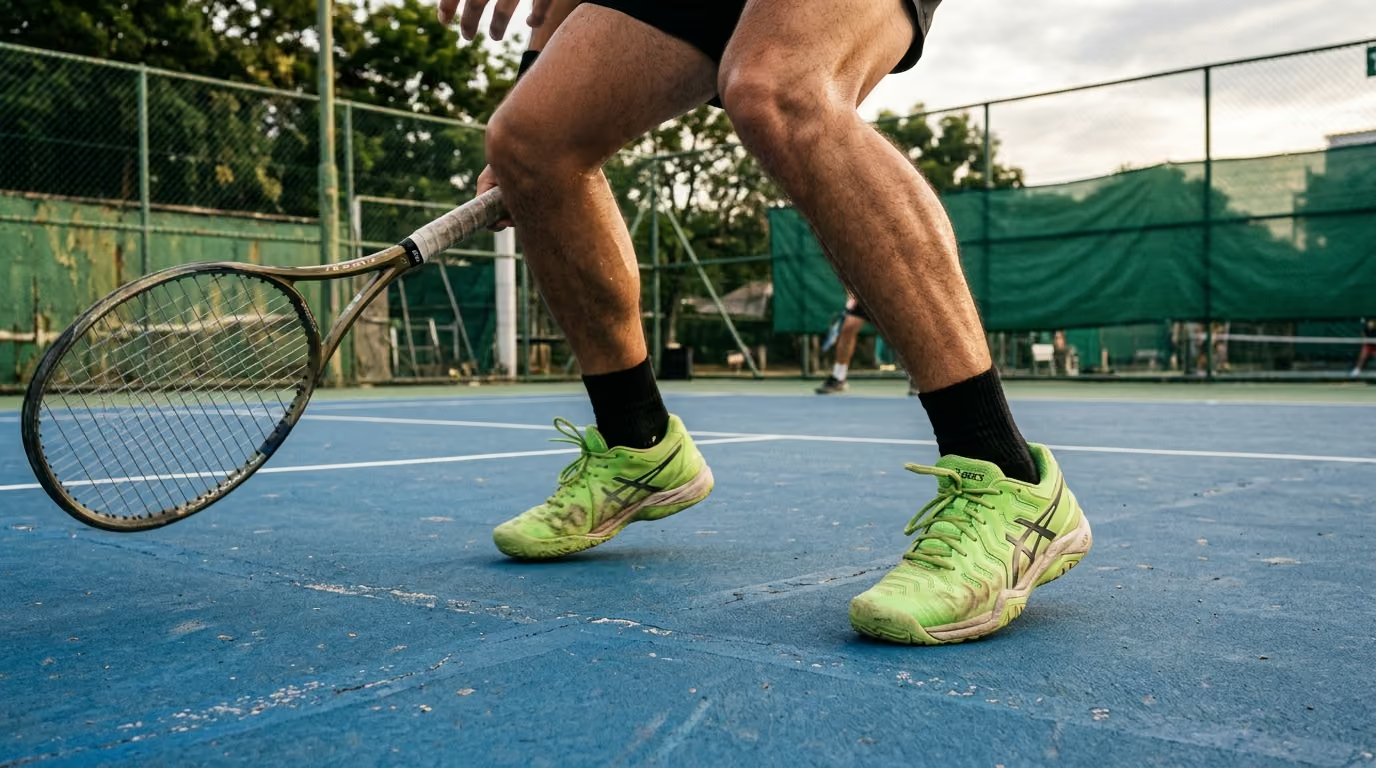
Proper racquet sport mechanics distribute impact forces through the entire body to protect vulnerable joints and prevent painful repetitive strain injuries.




You step onto the court for your third match of the week, feeling a familiar, dull ache in your shoulder. As the warm-up begins, you try to swing faster to compensate for the stiffness, but the discomfort only grows. Many recreational players assume that hitting a powerful ball simply requires more muscular effort from the arm. In reality, relying on the upper limb to generate force is one of the most common paths to chronic tissue strain.
Safer racquet technique is not defined by a single cosmetic style or a rigid checklist of body positions. Instead, it relies on distributing impact forces across the entire body through a coordinated kinetic chain while matching your overall playing volume to your current physical capacity. By sharing the mechanical load among your legs, torso, and shoulders, you can maintain high ball speeds without overworking any individual joint.
To help you understand how these mechanics protect your body, we have compiled this comprehensive guide. You can find more detailed strategies in our library of injury prevention resources.
To build a durable playing style, you must understand how physical forces act on your body. Biomechanical specialists divide the physical demands of court sports into three distinct categories.
External load refers to the measurable work you perform on the court. This includes the number of serves you hit, the duration of your rallies, your racquet head speed, and your total minutes on the court.
Internal load is your body's physiological and psychological reaction to that external work. We often measure this using heart rate, muscle fatigue, and your rating of perceived exertion.
Tissue load represents the physical stress felt by local structures like bones, tendons, and ligaments. A stroke can have a very low external workload but still create a dangerously high tissue load. For example, hitting a small number of late overheads with a stiff arm might not raise your heart rate, but it can put immense stress on your elbow tendons. Conversely, a well-coordinated player can hit many shots with low tissue stress because the workload is shared.
Force is a simple push or pull applied to a body segment or joint. When you strike a ball, the impact creates an equal and opposite force that travels back into your arm.
Torque, which is also called a rotational moment, is the rotational force acting around a joint. Hitting a ball far away from your body increases the distance between the impact point and your shoulder. This longer distance acts like a wrench, creating a much larger torque at your shoulder joint.
Impulse represents force applied over a specific duration of time. If you can lengthen the time of your contact or follow-through, you can reduce the peak force felt by your muscles.
Rate of loading describes how quickly a force is applied to a tissue. Fast, sudden loading rates are much harder on tendons than forces that build up gradually. Tendons can tolerate high tension if it develops smoothly, but they often fail when subjected to sudden, rapid forces.
Compression, tension, and shear are different directions of force. Compression squeezes tissues together, tension pulls them apart, and shear forces slide them past each other. Different joint structures are built to withstand different forces, and technical errors often subject tissues to the wrong type of stress.
The kinetic chain is the linked sequence through which force and momentum travel from the ground to your racquet. In all racquet sports, this sequence begins at the court surface and moves upward through the body.
First, your feet interact with the ground, creating and redirecting force. Next, your knees and hips bend to generate upward power and absorb the landing or braking forces of your movement.
Then, your pelvis and torso rotate to transfer this momentum while positioning your upper limbs. Your shoulder complex, particularly the scapula, stabilizes the arm and transmits the accumulated energy.
Finally, your elbow extends, your forearm rotates, and your wrist refines the racquet's angle at impact. The distal joints of the arm are designed for guidance and precision, not for generating raw power on their own.
Mechanical energy must flow smoothly through this chain of joints to produce a safe, efficient stroke. A stroke becomes potentially hazardous when one link fails to contribute, mistimes its action, or cannot absorb the resulting force.
For example, if your legs are tired and do not drive upward during a serve, your shoulder must work harder to create racquet speed. If your trunk does not rotate during a forehand, your arm must accelerate the racquet in isolation.
According to a clinical review published in the Journal of the American Academy of Orthopaedic Surgeons, the leg, hip, and trunk link can produce approximately 51% of the total kinetic energy in a tennis stroke. When this lower body engine is quiet, the smaller muscles of the upper limb must make up the difference. This localized compensation is a primary driver of overuse injuries.
The serve is generally the most mechanically demanding stroke in tennis. Biomechanical studies show that serving produces the highest peak muscle activity in the shoulder and forearm.
To understand joint loading during the serve, we must look at the movement in five distinct phases. Each phase presents unique challenges to your musculoskeletal system.
The preparation and loading phase begins with the toss and ends when your knees reach their maximum bend. During this phase, joint forces are relatively low, but you are storing elastic energy in your legs and torso.
The racquet drop and maximum external rotation phase puts the shoulder under significant stress. The arm is pulled back into an extreme position, stretching the anterior shoulder capsule and loading the chest muscles.
The acceleration phase is incredibly fast, requiring the shoulder to rotate internally at high speeds. The elbow extends rapidly, and the wrist snaps forward just before contact.
The impact phase is the brief moment where the racquet meets the ball, transferring shock back through the hand.
The deceleration and follow-through phase is often ignored, but it is highly demanding. Your shoulder muscles must work eccentrically to slow down your arm, producing high compressive forces in the joint. Abruptly stopping your racquet instead of letting it slow down naturally can damage the rotator cuff.
An effective leg drive is the foundation of a safe, powerful serve. Sports scientists recommend a front-knee loading angle greater than 15 degrees during the preparation phase.
Elite servers who use an optimal front-leg drive show lower anterior shoulder and medial elbow loads. However, you should not force a specific knee angle if your joints lack the mobility to support it. The goal is a coordinated upward and forward push, not a superficial jump that throws you off balance.
Using your legs is not about jumping as high as possible. It is about timing your leg extension so that the energy reaches your torso just as your arm begins to move forward. If you jump too early, the energy is lost, and your arm must rescue the stroke.
Many players worry about whether they should use a pinpoint stance or a platform stance. In a pinpoint stance, you slide your back foot forward during the windup. In a platform stance, your feet remain separated throughout the preparation.
A technique study by Kibler and colleagues found that backswing type had minimal influence on service velocity or shoulder and elbow loading. A recent systematic review also reported that stance technique had no clear effect on injury risk.
This means you do not need to copy the exact serve style of a professional player to protect your joints. Instead, you should focus on stable preparation, a consistent ball toss, progressive acceleration, and a balanced follow-through.
Repeatedly serving with poor mechanics is a major cause of overuse injuries in the lower back, shoulder, and elbow. Common conditions include rotator cuff strains, internal shoulder impingement, and medial epicondylitis.
The elbow moves at extreme speeds during the serve. Biomechanical data shows the elbow can extend from 116 degrees to 20 degrees of flexion in just 0.21 seconds, with impact occurring around 35 degrees of flexion.
Because this movement happens so quickly, your muscles have no time to make active corrections if your timing is off. A poor ball toss forces you to reach sideways or backward, exposing your shoulder and back to unnatural twisting forces at high speeds.
Groundstrokes are the foundation of baseline play, requiring repetitive rotation and rapid direction changes. The way you set up your feet and strike the ball dictates how these repetitive forces are absorbed.
The open stance and the square stance are often discussed as opposing technical styles. In an open stance, your feet are aligned parallel to the net, and your hips face the court. In a square stance, you step forward with your lead foot, turning your side to the net.
Biomechanical research does not establish a universal safety advantage for one stance over the other. Instead, each stance shifts the physical demands to different parts of your body.
An open stance requires high rotational force from your hips and trunk. It can place significant strain on the outside of your knee and hip if you do not have adequate lower body strength.
A square stance distributes force more evenly along a forward path, but it requires more steps to set up. If you are rushed, forcing a square stance can cause you to hit the ball behind your body. The safest approach is adaptability, using the open stance when wide on the run and the square stance when you have time to step into the court.
Contacting the ball behind your body is a primary cause of groundstroke injuries. When you hit late, you cannot use your hips and torso to accelerate the racquet.
This forces your arm to perform all the acceleration in a short, cramped space. Your wrist and elbow must flex and extend abruptly to guide the ball over the net. This isolated muscular effort spikes the rate of loading on your forearm tendons.
To avoid this, focus on early ball recognition and proactive footwork. If you find yourself out of position, it is safer to hit a defensive slice or a high, slow ball than to attempt a full, aggressive swing from a late position.
The two-handed backhand is generally very efficient because it allows both arms to share the workload. The non-dominant arm helps pull the racquet forward, which reduces the extension demand on your dominant elbow.
The one-handed backhand places unique demands on your dominant shoulder and the outside of your elbow. Because you do not have a second hand to help, your wrist and forearm muscles must work harder to stabilize the racquet.
For a safe one-handed backhand, your shoulder must be strong enough to lead the swing, and your wrist must remain firm at impact. Hitting a one-handed backhand with a bent elbow or a loose wrist is a direct path to lateral epicondylitis, commonly known as tennis elbow.
Volleys are shorter and use less momentum than groundstrokes, but they still subject your joints to significant physical stress. At the net, you have very little time to react, and you must absorb the momentum of fast incoming balls.
A common mistake is tensing the entire arm and wrist when preparing for a volley. A rigid, locked arm cannot absorb shock.
When a fast ball hits a rigid racquet, the impact force travels straight up the arm. This energy concentrates in the elbow and shoulder, leading to joint irritation over time.
Instead, your arm should act like a spring. Your muscles should be firm enough to control the racquet, but relaxed enough to allow a small amount of natural recoil upon impact.
Because time is limited at the net, taking a large backswing often leads to late contact. If your racquet is behind your body when the ball arrives, you must push forward abruptly.
This sudden acceleration requires high wrist activity, which strains the forearm muscles. A safer volley technique uses a very compact preparation.
Keep your racquet head in your peripheral vision, and use a short, downward punching motion. Your body weight, rather than your arm muscles, should drive the racquet forward.
Low volleys require you to hit balls close to the court surface. If you bend from your waist to reach these balls, you place a high bending load on your lumbar spine.
To hit low volleys safely, you must drop your hips by bending your knees. This requires adequate hip and ankle mobility. If your lower body is stiff, your back will inevitably bend to reach the ball, increasing your risk of lumbar strain.
While the core principles of the kinetic chain apply to all court sports, each discipline has unique technical demands. Understanding these differences allows you to adapt your training and protect your joints.
Tennis involves a heavy racquet, a heavy ball, and a very large court. The swing paths are long, and the speeds are high.
This combination creates the highest peak joint forces among the three sports. Tennis players are particularly prone to overuse injuries in the shoulder, elbow, and lower back due to the high volume of serving.
Because of the heavy equipment, tennis players must prioritize whole-body strength. To prepare your body for these demands, you can review our strength and conditioning guidelines for court athletes.
Pickleball is played on a small court with a lightweight paddle and a hollow plastic ball. Because the court is small, the game is incredibly fast, requiring rapid, repetitive volley exchanges.
While peak joint forces are lower than in tennis, the total repetition density is much higher. Pickleball players often perform hundreds of quick, short wrist and forearm actions in a single match.
The lack of a string bed on a pickleball paddle means that more vibration is transferred directly to your arm. Furthermore, the low bounce of the ball requires constant crouching and lunging. To prevent knee and lower back discomfort, players must maintain excellent lower body flexibility. You can learn more about these movement requirements in our guide on mobility and movement patterns.
Padel is played inside a glass-enclosed court using a thick, solid racquet with holes. The game is highly strategic, featuring many defensive rebounds off the walls and a high volume of overheads.
Padel overheads, such as the bandeja and the vibora, differ significantly from the tennis serve. They are hit with a bent arm and slide-spin to keep the ball low after it hits the glass.
This repetitive, non-traditional overhead movement places unique rotational loads on the shoulder and elbow. Padel players must have excellent rotator cuff strength and upper back mobility to perform these strokes safely. Without proper scapular control, the repetitive twisting motion of the bandeja can lead to shoulder impingement.
Many recreational players hold misconceptions about technique that actively increase their risk of injury. Recognizing these pitfalls is the first step toward building a safer game.
Many players believe there is one perfect stroke that works for everyone. They spend hours trying to make their strokes look exactly like those of elite professional players.
However, biomechanical research shows that different elite players often load their joints similarly despite having very different visual styles. Forcing your body into a position that does not match your natural biomechanics can cause unnatural loading.
Instead of chasing a cosmetic look, focus on functional principles like balance, spacing, and smooth energy transfer. Your technique should be judged by how repeatable and comfortable it is, not by how closely it mirrors a professional player.
We are often told to play with a relaxed grip to avoid muscle strain. While a relaxed arm is helpful during the backswing, an overly loose grip is highly problematic.
If your grip is too loose, the racquet will twist in your hand when you strike the ball. This twisting force travels up your arm, requiring your forearm muscles to contract violently to hold onto the racquet.
The goal is appropriate muscle tone, which is sometimes called controlled tension. Your grip should be secure enough to stabilize the racquet at impact, but relaxed enough to prevent stiffness during the preparation.
Many players believe that snapping the wrist is the primary way to generate ball speed and spin. This is a dangerous illusion that overworks the small muscles of your forearm.
In high-speed racquet sports, the wrist mainly refines the racquet's angle at contact. The actual power is generated by your legs, hips, and shoulder rotation.
A study of badminton overhead smashes found that shoulder and forearm rotation were the primary drivers of racquet velocity, not wrist movement. Relying on your wrist to create power is one of the most common causes of tendon irritation.
Some players believe the follow-through is purely cosmetic and stop their swing immediately after striking the ball. This is a serious mechanical error.
Stopping your racquet abruptly forces your muscles to contract eccentrically to absorb the racquet's momentum in a very short distance. This spikes the rate of loading on your rotator cuff and elbow tendons.
A long, smooth follow-through allows the racquet to slow down gradually over a larger distance. This distributes the deceleration forces across your entire body, protecting your shoulder and elbow.
To see how these principles apply in the real world, let us look at several common player profiles and the mechanical adjustments that can help them.
This player has a low, inconsistent ball toss and very stiff legs during the serve. They try to generate high ball speed by throwing their shoulder forward and snapping their wrist.
Because the lower body is not contributing, the shoulder and elbow must work overtime. The player often reports deep shoulder soreness after playing.
The intervention is to improve the consistency of the ball toss so that the player can contact the ball higher and slightly in front of the body. We then teach them to bend their knees to activate their leg drive. This shifts the power generation from the shoulder to the lower body, reducing localized joint stress.
This player has excellent, highly efficient stroke mechanics. However, they recently doubled their playing frequency to prepare for a local tournament.
Despite their good technique, they are beginning to experience elbow and knee soreness. This is a classic example of exposure exceeding current tissue capacity.
The intervention here is not technical, but organizational. The player must monitor their weekly playing volume and use a session load calculation to track their physical stress. They should reduce their training volume slightly to allow their tissues to adapt, utilizing recovery science principles to aid muscular repair.
This player repeatedly contacts the ball behind their body, particularly when they are forced to run sideways. They use a quick wrist flick to guide the ball over the net.
This late contact prevents them from using their hips and trunk, placing a high bending force on their wrist and elbow. They frequently suffer from lateral elbow pain.
The intervention is to focus on early ball recognition and proactive footwork to get around the ball. We also teach them to use a shorter backswing when they are under pressure. This ensures they can contact the ball in front of their body, even when they are rushed.
This player treats every volley like a groundstroke, taking a large backswing and swinging hard at the ball. They hit the ball with a very stiff wrist and elbow.
Because they take a large swing, they are often late, and the impact force of the fast-moving ball travels straight up their rigid arm. They suffer from recurrent wrist and elbow fatigue.
The intervention is to teach compact preparation, keeping the racquet in front of the chest. We encourage them to use their body weight to step into the ball rather than swinging their arm. This allows them to control the volley with minimal forearm strain.
To evaluate your own strokes on the court, you can use this simple six-question self-audit. Run through this checklist during your warm-up or when you start to feel minor physical discomfort.
Are you in a stable position to use your entire body? If you are off balance or reaching for the ball, your arm will inevitably become the emergency power source. Focus on setting a stable base before you swing.
Is your force being generated progressively? Smooth acceleration begins with your lower body and moves upward. Avoid sudden, violent jerks at the start of your swing.
Can you absorb the force of your stroke comfortably? Make sure your follow-through is long and smooth, allowing your racquet to decelerate naturally. Avoid abrupt stops or awkward landings after hits.
Does your technique survive when you get tired? Fatigue often causes players to stop using their legs, shifting all the work to their arms. If your form starts to fall apart, simplify your swings and focus on clean contact.
Is your current workload appropriate for your fitness level? Sudden spikes in playing time are a major cause of injury, even if your technique is perfect. Keep your weekly increases in playing volume gradual.
Are you adapting your strokes to the situation? Do not attempt maximum power from every position on the court. Using defensive slices or controlled placement can reduce the need for high-risk, high-effort swings.
Preventing injury is not just about how you swing. It is about the balance between the physical demand of your matches and your body's ability to recover.
Injury risk is best understood as an ongoing interaction between your load exposure and your current physical capacity.
Your capacity is determined by your muscular strength, joint mobility, tendon tolerance, cardiovascular fitness, and recovery quality. Your exposure is determined by how often you play, how long your matches last, and the intensity of your swings.
A 2025 systematic review and meta-analysis identified several risk factors for serve injuries, including dominant-shoulder rotation strength, internal-rotation range of movement, weekly tennis volume, age, body mass, and height. While you cannot change your age or height, you can manage your playing volume and improve your muscle strength.
A simple way to track your physical workload is to calculate your daily session load. You can do this by multiplying your session rating of perceived exertion by the duration of the session in minutes.
The rating of perceived exertion is measured on a scale of 1 to 10, where 1 is extremely easy and 10 is maximal effort. For example, a 60-minute match with an exertion rating of 7 gives you a session load of 420.
Tracking this number helps you avoid sudden spikes in your weekly training. Try to keep your weekly load increases below 10% to 15% to give your muscles and tendons adequate time to adapt.
A randomized trial of the TennisReady program, which was an unsupervised e-health exercise program, found no reduction in overall injury rates among participants. This demonstrates that generic, unsupervised exercise programs are often not enough to prevent injuries.
To truly protect your joints, you must combine structured strength training with personalized technical coaching. Addressing your specific movement limitations on the court is far more effective than following a generic fitness plan.
While technical adjustments can help reduce minor joint soreness, they are not a substitute for professional medical care. You must be able to recognize when your physical symptoms require clinical evaluation.
You should consult a qualified healthcare provider if you experience any of the following symptoms:
Do not try to play through these symptoms by altering your technique. Compensating for an active injury by changing your swing often leads to new injuries in other parts of your body. A physical therapist or sports physician can help you identify the root cause of your pain and guide you through a safe rehabilitation process.
You should review this guide whenever you are planning to increase your playing frequency, such as before a summer tournament season or when starting a new training program. It is also highly useful to revisit these principles when you are returning to the court after an extended break or recovering from minor, non-clinical joint stiffness.
Sustainable stroke mechanics are the single most effective tool for supporting your long-term athletic longevity, keeping you active, competitive, and comfortable on the court for years to come.
Follow Evercourts for practical insights on tennis, pickleball and padel performance, movement, recovery and healthy ageing. Stay connected for new articles, research-led guidance and ideas to help you play well and keep playing for years.


Read practical guidance for better movement, smarter preparation and a game that keeps working for you.
explore the Blog