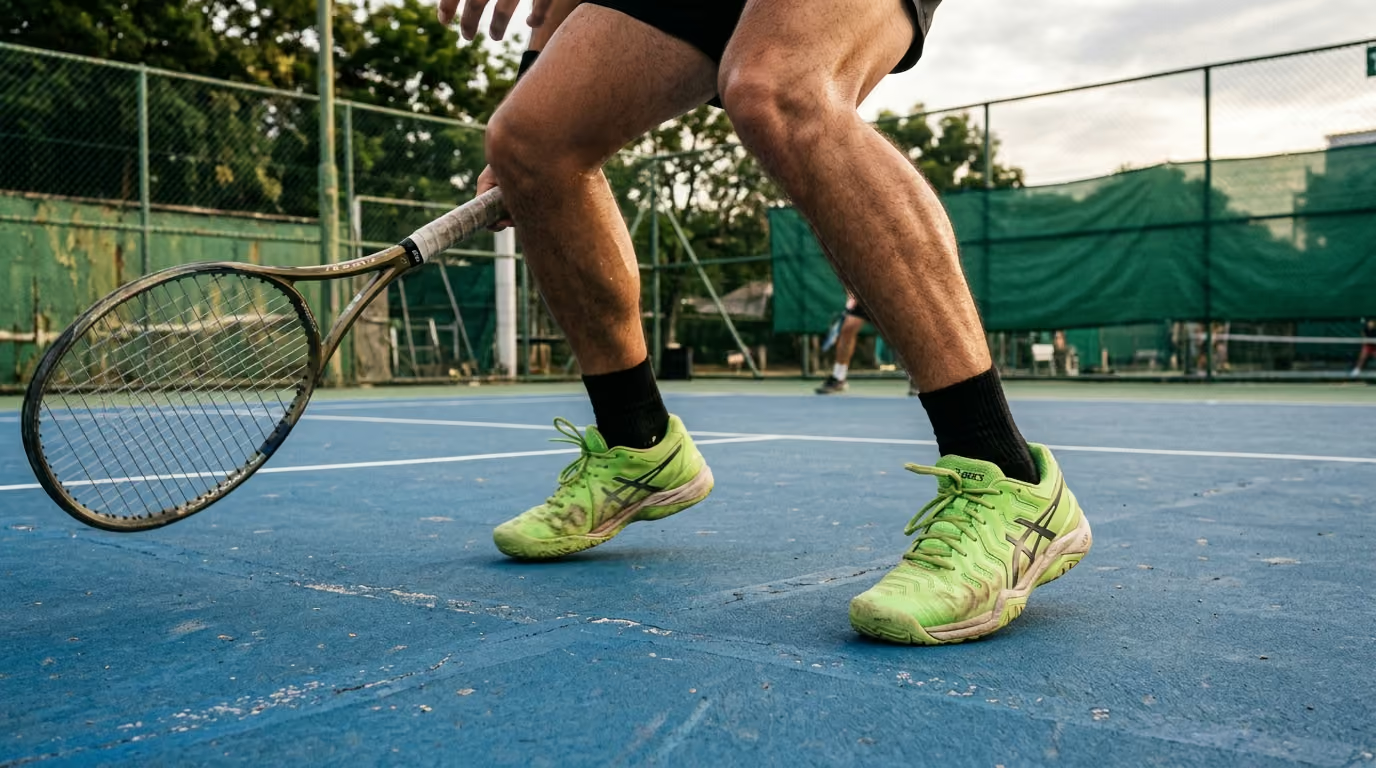
You will learn how court dimensions, rally dynamics, and equipment properties create distinct physical demands across tennis, pickleball, and padel.




This guide is a comparative examination of the specific biomechanical, cardiovascular, and cognitive loads of tennis, pickleball, and padel. It is not a ranking of which sport is superior or more demanding. Instead, we examine how spatial geometry, rally dynamics, and equipment properties create distinct physical realities for athletes.
In plain terms, these sports are not physically interchangeable because court scale, ball behavior, and tactical boundaries completely reshape your movement patterns. Tennis demands explosive long-distance sprinting and wide baseline recovery, pickleball requires rapid close-range reflex positioning near the non-volley zone, and padel combines complex wall-rebound tracking with constant partner synchronization. Adapting to these differences is essential to perform at your best and maintain athletic longevity on the court.
The physical space you must defend dictates how your body moves, how hard you must brake, and how far you must run. Each court sport uses a distinct footprint that changes the physiological cost of play.
An official tennis court is 23.77 meters long. It measures 8.23 meters wide for singles matches, and 10.97 meters wide for doubles. According to the International Tennis Federation, this creates a total singles playing area of approximately 195.6 square meters.
For doubles, the court expands to 260.8 square meters. This means each doubles player is nominally responsible for about 130.4 square meters of space.
Furthermore, tennis requires extensive run-off space. Major tournaments require at least 6.40 meters of clear space behind the baseline, along with 3.66 meters on the sides. This extra space allows players to track deep balls, slide on clay, and run down wide angles.
A pickleball court measures 6.10 meters wide by 13.41 meters long. The same dimensions are used for both singles and doubles play. The total active playing area is 81.8 square meters, which is less than half the size of a tennis singles court.
The court is divided by a non-volley zone, commonly known as the kitchen. This zone extends 2.13 meters from the net on each side. The net itself stands at 0.914 meters at the posts, and drops to 0.864 meters at the center.
This design forces players to gather closely at the kitchen line. Because volleying is prohibited inside this zone, players must constantly step backward or reach forward without committing foot-fault violations.
An official padel court is a rectangle measuring 10 meters wide by 20 meters long. The total playing area is 200 square meters. The court is entirely enclosed by walls, which are usually four meters high at the back and three meters high along the sides.
Padel is played almost exclusively as a doubles game on this court size. There are no separate singles courts in official competitions.
The presence of the glass and mesh walls alters how the space is used. The physical boundary is also an active play surface. This setup changes the court from an open field of run-off space to a tight, predictable box.
These physical differences alter the direction and speed of your movement. Tennis players must cover vast distances, requiring high-speed running, long slides, and deep recoveries. The movement is highly linear and lateral, requiring a massive acceleration phase followed by a long, controlled braking phase.
In contrast, pickleball compressed movement into a very small footprint. Sprints are short, rarely exceeding three or four steps. The movement is dominated by lateral shuffles, split steps, and micro-adjustments of the feet to maintain balance near the kitchen line.
Padel represents a middle ground in terms of floor area, but it adds a vertical component. Players must run forward to attack, and then retreat diagonally to defend wall rebounds. The walls prevent the ball from leaving the court, which keeps the players moving within a confined, high-density space.
To learn more about the specific demands of these different court layouts, you can explore our resources on Tennis Articles and Pickleball Articles.
Sports science research highlights the differences in physical demands between these three court sports. By looking at heart rate, distance covered, and match duration, we can understand the internal and external loads of each sport.
Tennis is characterized by intermittent, high-intensity efforts. A systematic review published in sports medicine literature shows that international male tennis players average rally durations of 5.5 seconds. International female players average 6.4 seconds per rally.
Across all playing surfaces, players average between 3.9 and 4.1 strokes per rally. The effective playing time, which is the actual time the ball is in play, is only about 18.6% for men and 20% for women.
A comparison of singles and doubles play in collegiate women shows a massive difference in load. Singles players covered an average of 4,023 meters per match, while doubles players covered only 1,545 meters. Peak speeds reached 5.6 meters per second in singles, compared to 4.9 meters per second in doubles. Mean heart rates were also higher in singles, reaching 161.6 beats per minute, compared to 151.5 beats per minute in doubles.
Research on professional pickleball doubles matches shows a different physical profile. In an analysis of eight professional men's doubles matches, researchers found that the average match lasted 36 minutes. The actual active playing time was 14 minutes, which represents about 39% of the total match duration.
Most rallies lasted between 3 and 9 seconds, accounting for over 67% of all points played. The average rest interval between points was 9 to 15 seconds. This resulted in a work-to-rest ratio of approximately 1 to 1.6.
For recreational players, a study on older adults found that pickleball is generally a moderate-intensity exercise. The subjects had a mean heart rate of 108.8 beats per minute, with an energy expenditure of 4.1 metabolic equivalents. However, researchers note that competitive singles matches or high-level doubles will generate significantly higher physical demands.
Padel matches tend to have longer rallies and higher total shot volumes than tennis. A detailed match-analysis study of professional padel reported an average match duration of 53.7 minutes. Active playing time was 16.8 minutes, representing about 31.3% of the total match.
The average rally in padel lasted 6.7 seconds, with a recovery period of 14.8 seconds between points. The longest recorded rally in the study was 29.4 seconds. Players hit an average of 42.6 shots per minute of active play.
A comparative study of padel and tennis doubles found that tennis involved greater total movement distances and higher peak speeds. However, padel produced more total rallies, more volleys, and more groundstrokes over the course of a match. Interestingly, the internal load, measured by average heart rate and blood lactate levels, was similar between padel and tennis doubles. Padel achieves this load through continuous, high-volume striking and constant positioning, rather than high-speed sprinting.
For more insights into the cardiovascular and physical demands of these games, visit our Padel Articles page.
The timing of a sport determines how your muscles produce energy and how your mind processes information. The tempo of play is shaped by the ball's material, the paddle or racket composition, and the rules of the game.
Tennis has a structured, classical rhythm. The ball is made of pressurized rubber covered in felt, which bounces high and travels fast. Because of the court's length, the ball has time to lose speed, but it still arrives at the receiver with significant momentum.
The rhythm of tennis is defined by clear phases:
This structure allows for a clear physical reset between shots. Players have time to run, establish their stance, execute a full swing, and recover to the middle before the next ball is struck.
Pickleball features a rapid, compressed rhythm. The ball is a lightweight, perforated plastic wiffle ball. It does not compress like a tennis ball, and it loses velocity quickly due to air resistance.
This low-velocity ball, combined with the short court, creates a unique tempo:
In professional doubles, 90.8% of shots are intercepted out of the air or right after the bounce near the net. This means players have very little time to prepare their strokes, requiring a continuous, rapid reset of the paddle.
Padel has a high-density, continuous rhythm. The ball is similar to a tennis ball but has slightly lower internal pressure. The solid, carbon-fiber or fiberglass rackets have no strings, which creates a firm, direct rebound.
The presence of the walls completely alters the tempo of the game:
Because the walls keep difficult shots in play, rallies are prolonged. Padel requires players to maintain focus through long, repetitive sequences where the advantage shifts back and forth multiple times.
The time available to make a decision varies across these sports. Your brain must read different visual cues to predict where the ball will go.
In tennis, anticipation is built on reading the opponent's body mechanics from a distance. Because the court is long, you must start moving before the ball is struck to cover the necessary ground.
Research on expert tennis returners shows how fast this process occurs. Against a fast serve, a player has only about 500 milliseconds of total ball-flight time. The receiver's split-step landing occurs roughly 133 milliseconds after the server makes contact with the ball. The lateral movement toward the ball is initiated around 177 milliseconds after contact.
To achieve this, expert players watch the server's shoulder rotation, hips, and racket face angle. If you wait until the ball is halfway across the net to make a decision, you will not have enough time to reach it.
In pickleball, decision-making is compressed into a tight, close-range window. When four players are standing at the kitchen line, they are separated by less than 4.5 meters.
At this distance, reading body language is still important, but raw reaction time and hand speed are critical. Players must make instant choices:
Furthermore, players must make these decisions while keeping their feet outside the kitchen line. This requires a high level of spatial awareness, as you cannot look down at your feet while tracking a fast ball.
Padel introduces a unique cognitive challenge: the wall rebound. Players must calculate the geometry of the ball's flight as it strikes the floor, rebounds off the glass, and potentially hits the side wall.
This requires a delayed decision-making process. In tennis, you are trained to hit the ball as early as possible. In padel, you must often let the ball go past your body, turn your hips, and wait for the rebound.
A systematic review of padel performance notes that the sport is highly cognitively demanding. Players must make rapid tactical decisions under time pressure while tracking their partner's position. This constant mental processing can lead to mental fatigue, which impairs reaction times and stroke accuracy late in a match.
Understanding these mental and physical demands is a core part of building long-term health on the court. For more information on this approach, read about About Evercourts | Research-Led Guidance for Racquet Sports.
To transition between these sports without hurting your performance or risking injury, you must apply specific movement patterns. Use these practical adjustments during your next practice or match.
The split-step is the foundation of all court movement. It is a light hop that times your landing with the opponent's contact, preparing your muscles to spring in any direction.
Taking a tennis swing onto a pickleball or padel court is a common error that leads to late hits and missed shots.
Do not use the same footwork for every sport. Focus on the specific demands of each court layout during your warm-ups.
To help you structure your training, here are specific drills and tactical focuses for each sport. These patterns are designed to build sport-specific endurance and coordination.
Tennis players must handle high-speed movement followed by sudden stops. This requires excellent eccentric strength in the quadriceps and calves.
This drill trains the body to decelerate safely and transition immediately into recovery. It builds the specific hip and knee stability needed for long singles matches.
Pickleball requires players to transition from the baseline to the net while maintaining a low, balanced stance.
This drill teaches players not to run blindly to the net. It emphasizes stopping, balancing, and making compact contact when the ball is hit hard.
Padel players must learn to comfortable with the walls and move in unison with their partner.
This drill builds the spatial awareness needed to use the walls as defensive tools. It teaches players to delay their stroke and use the ball's rebound energy.
To find more targeted training ideas for athletic longevity, check out our Healthy Aging & Athletic Longevity Resources | Evercourts.
Even experienced athletes can fall into bad habits when playing multiple racquet sports. Recognizing these patterns can prevent overuse issues and improve your court performance.
We often see tennis players struggle when they first try pickleball or padel. They bring their long, looping backswings to the smaller courts. In pickleball, this large swing makes it nearly impossible to handle fast volley exchanges at the kitchen line. In padel, a big backswing will cause you to hit the back glass with your racket or strike the ball late after a rebound.
To correct this, practice shadow swinging with your back against a wall. If your racket or paddle hits the wall during your backswing, your preparation is too long. Keep your hands in front of your chest and use compact, controlled movements.
In both padel and pickleball, doubles partners must move as a unit. Many players move independently, chasing the ball without regard for their partner's position. This leaves massive gaps in the court, especially down the middle.
In our experience, partners should imagine a four-meter rope connecting them. If one player is pulled wide to the right sideline, the other player must slide toward the center to cover the open court. This synchronized movement is essential for defensive coverage on smaller courts.
Many players focus entirely on sprinting and endurance, ignoring the physical cost of stopping. Deceleration requires your muscles to work eccentrically, absorbing your body weight against the hard court surface. This is where most joint issues and muscle strains occur.
I remember finishing a tough two hour padel match on a cold Tuesday night and waking up the next morning feeling like my lower back was locked in concrete. For a long time, I just accepted this as the price of playing hard in my forties. But once I started spending just ten minutes on targeted hip mobility before heading to the club, the stiffness almost completely vanished. It taught me that we do not have to accept pain as a default state of aging.
The physical load of each sport impacts your body in different ways:
To optimize your post-match routine, explore our Recovery Science Resources | Evercourts to find evidence-led recovery strategies.
While soreness is a normal part of training, you must be able to distinguish between simple muscle fatigue and potential structural injuries.
Please consult a qualified physical therapist or sports medicine doctor if you experience any of the following warning signs:
Ignoring these symptoms can turn minor issues into chronic conditions. A professional evaluation can help you address biomechanical imbalances and keep you playing safely for years to come.
Yes, high-quality tennis shoes are excellent for pickleball and padel because they are designed for lateral stability and toe dragging. However, padel courts often feature fine sand on the surface, which can be slippery. If you play padel regularly on sandy courts, consider buying padel-specific shoes with a deep herringbone tread pattern to ensure reliable grip.
Pickleball paddles are solid and do not have strings to absorb impact. When the hard plastic ball strikes the solid paddle, the vibration is transferred directly up your arm. Additionally, many players use a wrist-dominated flicking motion to hit dinks, which places high repetitive stress on the forearm tendons. To reduce this, focus on using your shoulder to swing, and make sure your paddle grip is not too small or worn out.
Both sports offer excellent cardiovascular benefits, but they achieve this through different patterns. Tennis singles features higher peak cardiovascular demands due to long-distance sprints and explosive recovery runs. Padel doubles generates a more consistent, moderate-intensity cardiovascular load because the rallies are longer and the ball stays in play. Choose tennis singles for high-intensity interval training, and padel for steady-state aerobic endurance and high shot volume.
To keep the ball inside the short pickleball court, you must adjust your contact angle and spin. Avoid hitting the ball with a flat, driving motion from the baseline. Instead, use a compact, low-to-high swing path to create topspin, or soften your touch to drop the ball into the kitchen. Remember that you do not need to hit clean winners to win points in pickleball; patience and placement are far more effective.
Follow Evercourts for practical insights on tennis, pickleball and padel performance, movement, recovery and healthy ageing. Stay connected for new articles, research-led guidance and ideas to help you play well and keep playing for years.


Read practical guidance for better movement, smarter preparation and a game that keeps working for you.
explore the Blog