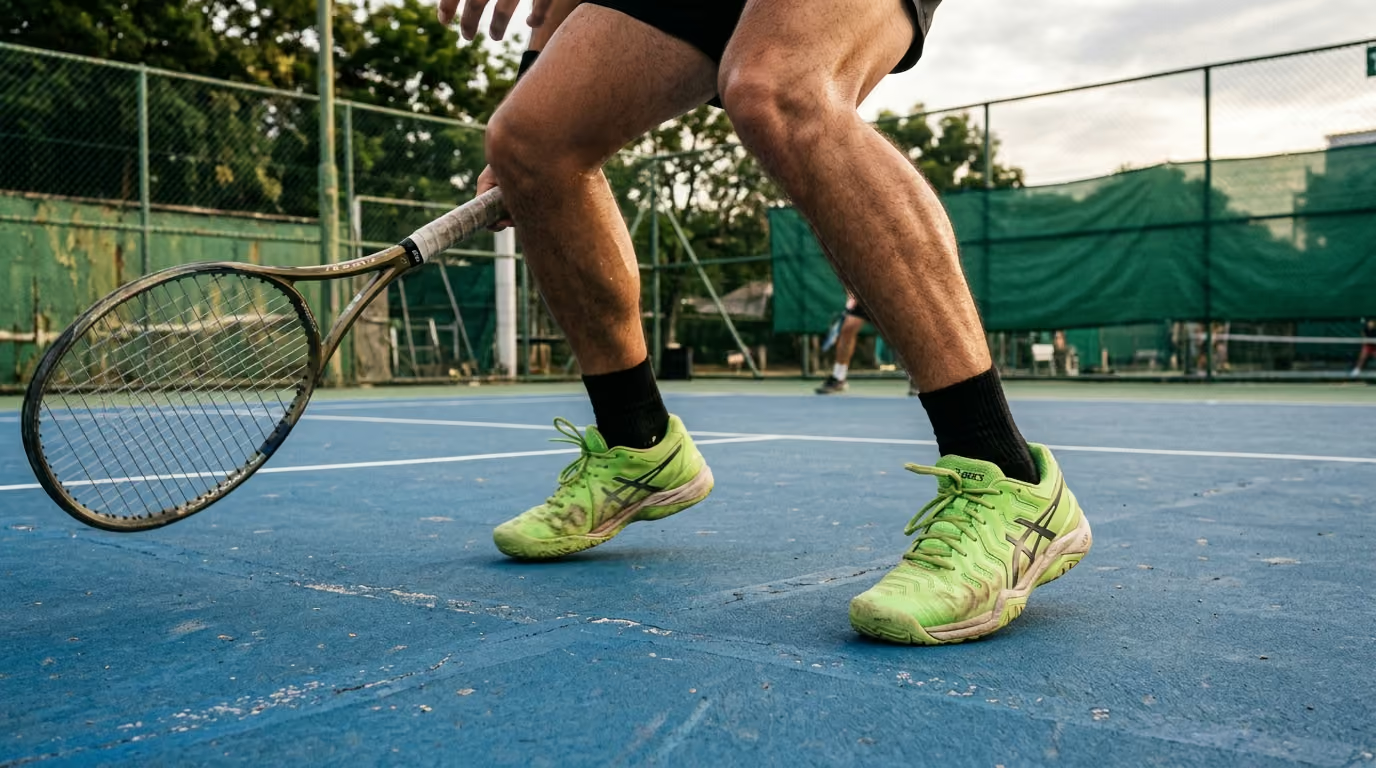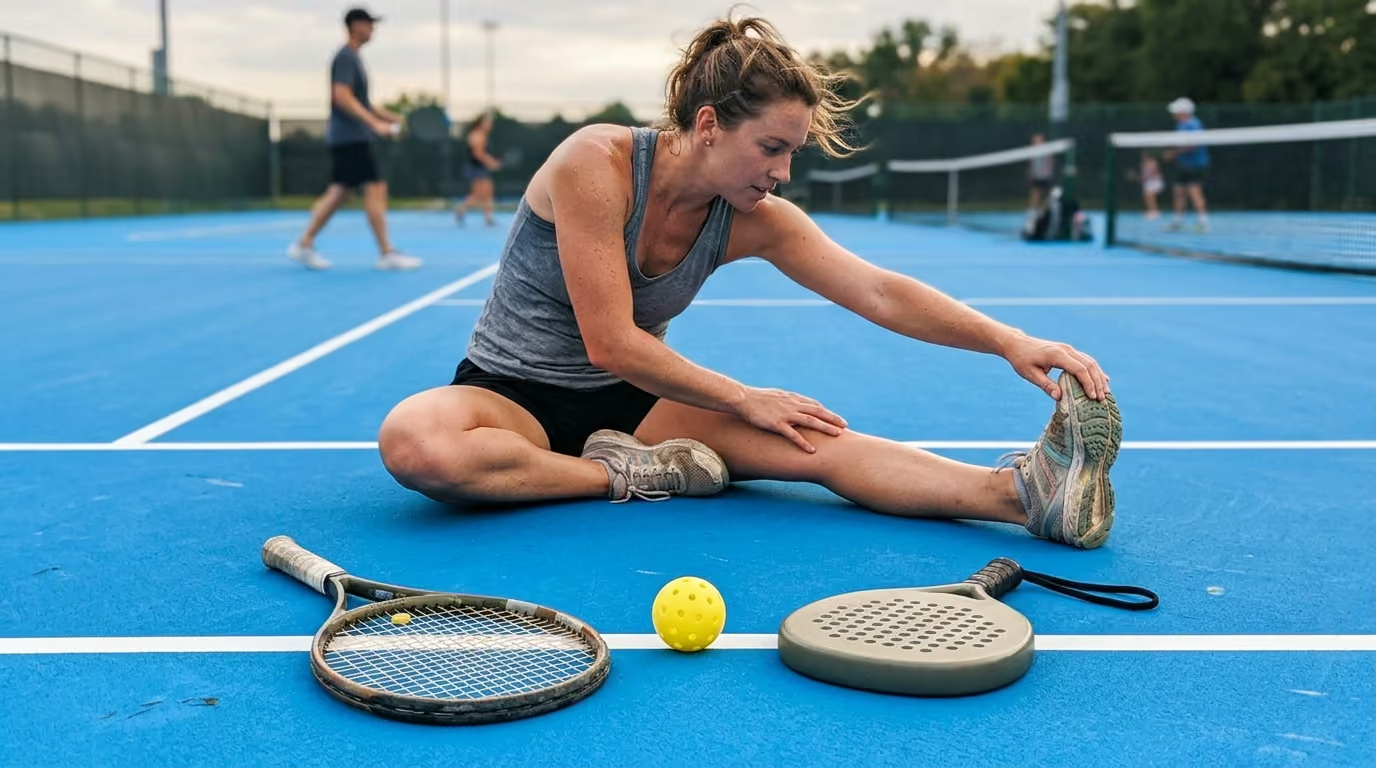

While many assume racket sports demand similar movements, tennis, pickleball, and padel each impose distinct physical stresses and movement patterns on the body.




You wake up the morning after a competitive session on the court, and as your feet hit the floor, you feel a deep stiffness in your lower back, hips, or knees. This familiar feeling is not a sign that you should stop playing, but rather a reflection of the unique physical strains that racket and paddle sports place on your body. Understanding how these court games demand different patterns of running, stopping, turning, and hitting can help you prepare your joints for long-term athletic longevity.
At a fundamental level, tennis, pickleball, and padel distribute movement stress across your muscles and joints in distinct ways. Tennis requires the greatest open-court coverage, higher peak running speeds, and large movement excursions across a wide playing area. Pickleball demands compact, reactive steps, frequent lateral shuffles, and deep lunges near the net. Padel involves repeated short-distance accelerations, rapid rotations, and complex positioning to handle balls rebounding off the surrounding glass walls.
By analyzing these physical demands, you can tailor your preparation, protect your joints, and keep enjoying your time on the court for years to come.
The physical demands of any court sport are dictated by the size of the playing area and the rules of the game. The lines painted on the court act as a blueprint for how your body must accelerate, brake, and change direction.
An official tennis court is 23.77 meters long. It measures 8.23 meters wide for singles matches and 10.97 meters wide for doubles. This expansive area makes tennis the largest open-court movement environment among the three sports.
Because the court is so wide and deep, players have ample space to reach high running speeds. You must cover large lateral distances to defend the baseline, and you must run long distances forward to reach drop shots. In singles play, a single athlete is responsible for covering this entire area, which increases the physical demand of every point. In doubles, the shared court space reduces individual coverage but requires coordinated diagonal movements and quick volleys at the net.
A pickleball court is significantly smaller, measuring 6.10 meters wide by 13.41 meters long for both singles and doubles play. This compact area is divided by a net, with a 2.13-meter non-volley zone, commonly called the kitchen, on each side.
The presence of the kitchen completely changes how you move. Because players cannot step into this zone to volley the ball, the tactical focus shifts to positioning yourself right at the edge of the kitchen line. This setup minimizes long-distance sprinting. Instead, it forces you to perform constant lateral shuffles, quick split-steps, and deep, low-stance lunges. While you rarely reach top-speed running in pickleball, the density of small, rapid movements is exceptionally high.
Padel is played on an enclosed court measuring 20 meters long by 10 meters wide. The court is surrounded by walls made of glass and metal mesh, which are an active part of the game. Padel is almost exclusively played in a doubles format, meaning four players share this enclosed space.
The walls alter your movement patterns in two major ways. First, because the ball can rebound off the back and side glass, you do not always have to run backward to chase a deep ball. Instead, you can let the ball pass you, turn, and play it after it bounces off the wall. Second, the walls compress the playing space, forcing you to make quick, multidirectional adjustments. You must constantly transition from the back of the court to the net, executing short, explosive bursts of movement.
To understand how these sports compare, we must define the scientific concepts that coaches and researchers use to track court performance. These terms help us look beyond simple step counts.
Total distance refers to the cumulative mileage a player covers during a match. When reading sports science studies, it is crucial to know how this distance was measured. Some tracking systems, like Hawk-Eye cameras, only record movement during active rallies. Other systems, like wearable GPS units, track every step, including walking between points, changing ends, and retrieving balls.
Distance per point measures how far you move during a single active rally. In professional tennis, players cover an average of 9.6 meters per point. Padel players cover a very similar average of 8 to 12 meters per point. While these numbers look identical on paper, the style of movement is entirely different. The tennis player covers that distance in fewer, larger strides, while the padel player covers it with many small, rapid adjustment steps.
Movement density describes how much physical work occurs relative to time. A sport with a small court can have high movement density if the rallies are long and the rest periods are short.
This density is best illustrated by looking at work-to-rest ratios. In hard-court tennis, the work-to-rest ratio ranges from 1:3.5 to 1:5.6, meaning you get ample rest after a short, high-intensity burst. Padel features a much tighter work-to-rest ratio of 1:1.13 to 1:1.41. In padel, you play longer rallies and have less time to recover between points, resulting in a highly continuous physical demand.
Acceleration is how fast you speed up, while deceleration is how quickly you brake. In court sports, most movements are so short that you never reach your true top speed. Instead, your performance depends on your first-step acceleration and your ability to stop safely.
A change of direction occurs when you brake, turn your hips, and push off in a new direction. Tennis players perform an average of 1.6 major changes of direction per point. In pickleball and padel, the changes of direction are more frequent but cover shorter distances. These are often executed as lateral shuffles, quick pivots, or sudden recovery steps near the net.
Tennis is a sport of explosive power, wide angles, and significant joint loading. The movement profile of tennis is characterized by high peak velocities and violent braking actions.
Because a tennis court is large, players must sprint hard to reach wide balls. Research shows that international male tennis players can reach peak running speeds of 5.5 meters per second, which is nearly 20 kilometers per hour. Female players reach peak speeds of approximately 4.2 meters per second.
Sprinting at these speeds requires immense muscular force. When you reach the ball, you must absorb your momentum on one leg, strike the ball, and immediately push off to return to the center of the court. This cycle of sprinting and hard braking places a massive load on your quadriceps, hamstrings, and patellar tendons.
The court surface plays a massive role in how your joints absorb force. Clay courts allow players to slide into their shots, which softens the braking force on the knees and ankles. However, clay rallies are longer, averaging 7.1 seconds compared to 5.6 seconds on hard courts. This longer rally length increases cardiovascular demand and muscular endurance requirements.
Hard courts do not allow for easy sliding. When you stop on a hard court, your shoes grip the surface instantly. This transfer of energy goes directly into your ankles, knees, hips, and lower back. To move safely on hard courts, you need exceptional eccentric strength to cushion these sudden stops.
Tennis features the highest overhead exposure of the three sports. The tennis serve is a complex, whole-body movement that starts in the legs, travels through the trunk, and finishes with high-speed shoulder rotation.
This repeated overhead action places unique demands on the shoulder complex. The rotator cuff muscles must work incredibly hard to decelerate the arm after the ball is struck. If you lack thoracic spine mobility or shoulder stability, your body will compensate by overworking the lower back or elbow, which can lead to chronic discomfort. For those looking to improve their physical preparation, prioritizing mobility and movement training can help protect these vulnerable areas.
Pickleball is often perceived as a low-intensity sport, but this is a misconception. While it involves lower peak running speeds, the rapid reaction times and low-stance postures create a highly specific physical challenge.
During a pickleball doubles match, players spend a significant amount of time standing at the kitchen line. To return low-bouncing shots, known as dinks, you must maintain a semi-squat position. This posture requires constant isometric strength in your thighs, glutes, and calves.
Furthermore, you must repeatedly bend forward from the waist and rotate your torso to reach wide dinks. This combination of spinal flexion and rotation can place significant pressure on the lumbar discs if your hips are tight. The physical demand of pickleball is not about running long distances, but rather about managing these sustained, low postures.
In singles pickleball, you must defend the entire width of the court on your own. This setup increases the number of deep lunges, rapid pivots, and short forward sprints you must perform. The movement profile of singles pickleball is highly anaerobic and demanding.
In doubles, your individual coverage area is smaller, but the pace of the game is much faster. Volley exchanges at the kitchen line happen at extremely close range. You have fractions of a second to react, slide your feet, and adjust your paddle. This rapid reaction requirement places a premium on lateral ankle stability and quick hand-eye coordination.
Research on recreational pickleball players shows that the sport provides a genuine cardiovascular workout. During matches, both singles and doubles players spend over 70% of their playing time in moderate to vigorous heart-rate zones.
A six-week study of older adults playing pickleball recorded an average energy expenditure of 355 calories per hour. This level of activity is highly beneficial for cardiovascular health, but it also means your muscles and joints must be prepared for continuous work. If you are interested in maintaining your court performance as you age, you can find tailored advice on long-term athletic longevity to keep you moving fluidly.
Padel occupies a middle ground between tennis and pickleball. It combines the continuous, high-speed play of tennis with the compact, reactive nature of a smaller, walled court.
Padel is defined by its high rally density. Points last an average of 10 to 15 seconds, with players hitting four to six strokes per rally. Because the ball can rebound off the walls and stay in play, rallies are rarely ended by a single fast shot.
This structure leads to a continuous loop of movement. One study of elite padel players found that 80% of all accelerations and decelerations occurred over a distance of just 1 to 2 meters. You do not need to train for long-distance sprints in padel. Instead, you must develop explosive, short-range acceleration and the ability to brake instantly in any direction.
Playing the ball off the back or side glass requires a unique cognitive and physical skill set. When a deep ball is hit toward you, your instinct is to run backward. In padel, running backward can lead to colliding with the glass or getting trapped in a poor hitting position.
Instead, you must learn to turn your hips, run forward with the ball as it passes you, and strike it after it rebounds off the wall. This requires excellent hip rotation, spatial awareness, and timing. For deeper insights into these patterns, you can read our specialized guides on padel strategy and movement to master the court.
Padel features an array of overhead strokes that are different from the traditional tennis serve. Because lobs are used constantly in padel, players at the net must repeatedly execute defensive overheads, such as the bandeja and the víbora, as well as offensive smashes.
The bandeja and víbora are struck with bent-arm techniques and slice spin, often from a position slightly behind the body. This requires high levels of shoulder endurance and scapular control. Because you may hit dozens of overheads in a single set, shoulder fatigue is a common issue for padel players.
Rotation is the engine of racket and paddle sports. Power does not come from your arms alone. It is generated in the ground, transferred up through your legs, amplified by your hips and core, and delivered to your hand.
In tennis, rotation is highly explosive and wide-ranging. When hitting an open-stance forehand, you load all your body weight onto your outside leg. As you swing, your hips and torso rotate forcefully to face the net.
This explosive rotation requires excellent mobility in your hips and thoracic spine. If your hips cannot rotate fully, your body will force your lower back to twist beyond its normal range. Over time, this compensation is a primary cause of lower back pain in tennis players.
Pickleball rotation is more compact but highly repetitive. Because you are playing near the net, you do not have the time or space for a massive backswing. Your rotation is quick, short, and focused in the upper torso.
The challenge in pickleball is that rotation often occurs while you are bent forward at the waist. Rotating your spine while in a flexed posture places unique mechanical stress on your back muscles. To protect your spine, you must learn to hinge from your hips rather than bending solely from your lower back.
Padel rotation is multidirectional and closely tied to wall play. You must rotate your body to track a ball bouncing behind you, then rapidly reverse that rotation to hit a forward-facing shot.
Furthermore, padel overheads require you to arch your upper back and rotate your shoulders while moving backward. This complex movement pattern demands a high degree of thoracic extension and rotational control. Without adequate mobility in the middle back, your shoulder joints will bear the brunt of this overhead stress.
While tennis, pickleball, and padel have different movement profiles, they all require a foundation of joint mobility. If you want to play pain-free as you get older, there are four key physical areas you must prioritize.
I remember finishing a tough two hour padel match on a cold Tuesday night and waking up the next morning feeling like my lower back was locked in concrete. For a long time, I just accepted this as the price of playing hard in my forties. But once I started spending just ten minutes on targeted hip mobility before heading to the club, the stiffness almost completely vanished. It taught me that we do not have to accept pain as a default state of aging.
Ankle dorsiflexion is the ability of your shin to move forward over your foot. Adequate dorsiflexion is essential for lowering your center of mass during split-steps, lunges, and sudden stops.
If your ankles are tight, your heels will lift off the ground when you bend your knees. This shift transfers the braking force of your movement directly into your knees and lower back. Stretching your calves and performing ankle mobility drills will allow you to stay low on the court comfortably.
Your hips are designed to move in all directions, including flexion, extension, abduction, adduction, and rotation. Court sports require all of these movements during a single rally.
Tight hips limit your stride length, prevent you from getting low to the ball, and reduce the power of your strokes. Focus on keeping your hip flexors, glutes, and deep hip rotators flexible. This will protect your lower back and knees from carrying excess stress.
The thoracic spine, or middle back, is built for mobility. It allows you to twist your torso, reach for wide balls, and arch your back for overhead shots.
Many of us spend our days hunched over desks or steering wheels, which locks the thoracic spine into a stiff, forward-bent position. On the court, this stiffness limits your rotation and forces your lower back and shoulders to overwork. Regular thoracic stretching can dramatically improve your stroke mechanics and reduce shoulder strain.
Mobility is only half of the equation. You also need the strength to control that mobility. Rotational control, or anti-rotation strength, is the ability to stop your body from twisting when you do not want it to.
When you finish a powerful stroke, your core muscles must contract to decelerate your torso and bring you back to balance. Developing a strong, stable core will help you transition smoothly from one shot to the next without losing your footing.
To get the most out of your training, you should tailor your warm-ups and conditioning to the specific demands of your chosen sport.
Tennis players should focus on preparing their bodies for high-speed running, wide lateral reaches, and explosive serving.
To dive deeper into preparing your body for court action, check out our guide on tennis court positioning to refine your tactical movement.
Pickleball players should focus on preparing their joints for low postures, rapid reaction times, and short lateral shuffles.
Padel players should focus on preparing for short bursts of speed, wall-related turns, and repeated overhead movements.
Many players make simple errors in their training that can lead to unnecessary fatigue, poor performance, or chronic discomfort.
Many court athletes believe that long, slow jogging is the best way to build fitness for their sport. However, jogging is a linear, continuous activity that does not prepare you for the physical reality of the court.
Racket and paddle sports are intermittent, meaning they consist of short bursts of multidirectional movement followed by rest. Jogging does not train your muscles to accelerate rapidly, brake hard, or change direction. Instead, your conditioning should include interval training, lateral movements, and shuttle runs.
Most players focus on how fast they can run to the ball, but they rarely train their bodies to stop. Deceleration is actually more physically demanding than acceleration.
Braking requires your muscles to contract eccentrically, which means they are lengthening while under load. This type of contraction causes the most muscle soreness and joint strain. To protect your knees and ankles, you must perform exercises like drop landings, single-leg hops, and controlled stopping drills during your training.
The different movement profiles of these sports affect how your body recovers between sessions. Managing this recovery is a key factor in your long-term athletic longevity.
Because tennis and padel involve intense braking actions, they cause more micro-tears in your muscle fibers than continuous sports. This tissue damage is what causes delayed onset muscle soreness, or DOMS, which usually peaks 24 to 48 hours after a match.
To promote recovery, prioritize light movement on your rest days, such as walking or easy swimming. This increases blood flow to your muscles, helping to flush out metabolic waste and deliver fresh nutrients to healing tissues.
Your joints do not have a direct blood supply. Instead, they rely on a process called fluid movement to stay healthy. When you move a joint through its full range of motion, it acts like a sponge, squeezing out old fluid and drawing in fresh, nutrient-rich synovial fluid.
If you sit at a desk all week and then play a high-intensity match on the weekend, your joint cartilage may not be prepared for the sudden impact. Consistent daily mobility work ensures that your joints remain hydrated and resilient, reducing the wear and tear of court play.
While some muscle soreness is normal after a tough match, you should never ignore persistent pain. Knowing when to consult a healthcare provider can prevent a minor issue from becoming a chronic injury.
It is normal to experience general muscle tightness or mild fatigue in the days following a match. However, you should seek professional medical advice if you experience any of the following warning signs:
A qualified physical therapist or sports medicine physician can help diagnose the root cause of your pain, guide your rehabilitation, and get you back on the court safely.
To summarize the physical demands of these three popular court sports, let us look at how they compare across eight key dimensions of movement.
You may want to refer back to this guide at different points in your athletic journey. If you are transitioning from tennis to pickleball, revisit the section on low-stance postures to adjust your warm-up routine. If you are starting padel, review the details on wall-related rotation to help build your spatial awareness on the court. Keeping these movement demands in mind will help you stay mobile, perform at your best, and enjoy your favorite court sports for many years to come.
Take care of your joints off the court, and they will take care of you when the match begins.
Follow Evercourts for practical insights on tennis, pickleball and padel performance, movement, recovery and healthy ageing. Stay connected for new articles, research-led guidance and ideas to help you play well and keep playing for years.


Read practical guidance for better movement, smarter preparation and a game that keeps working for you.
explore the Blog