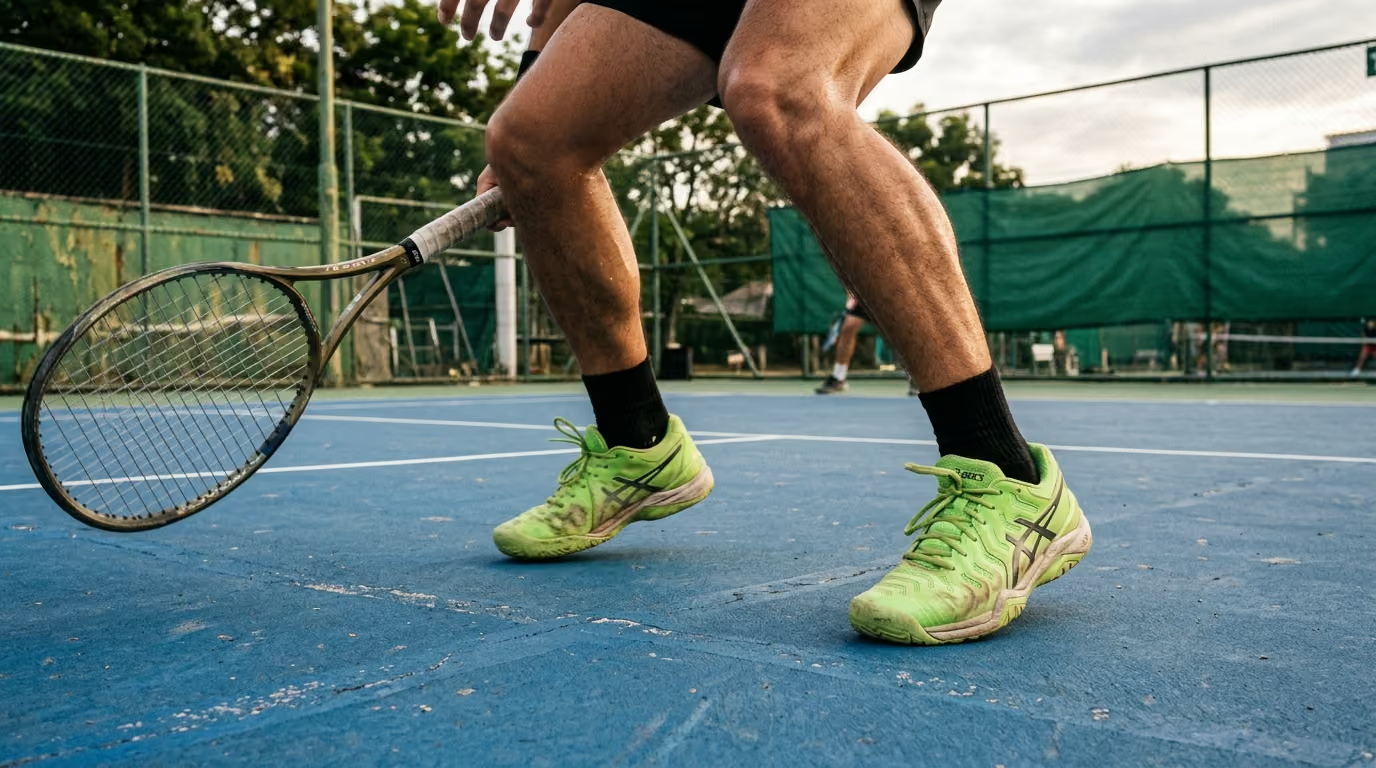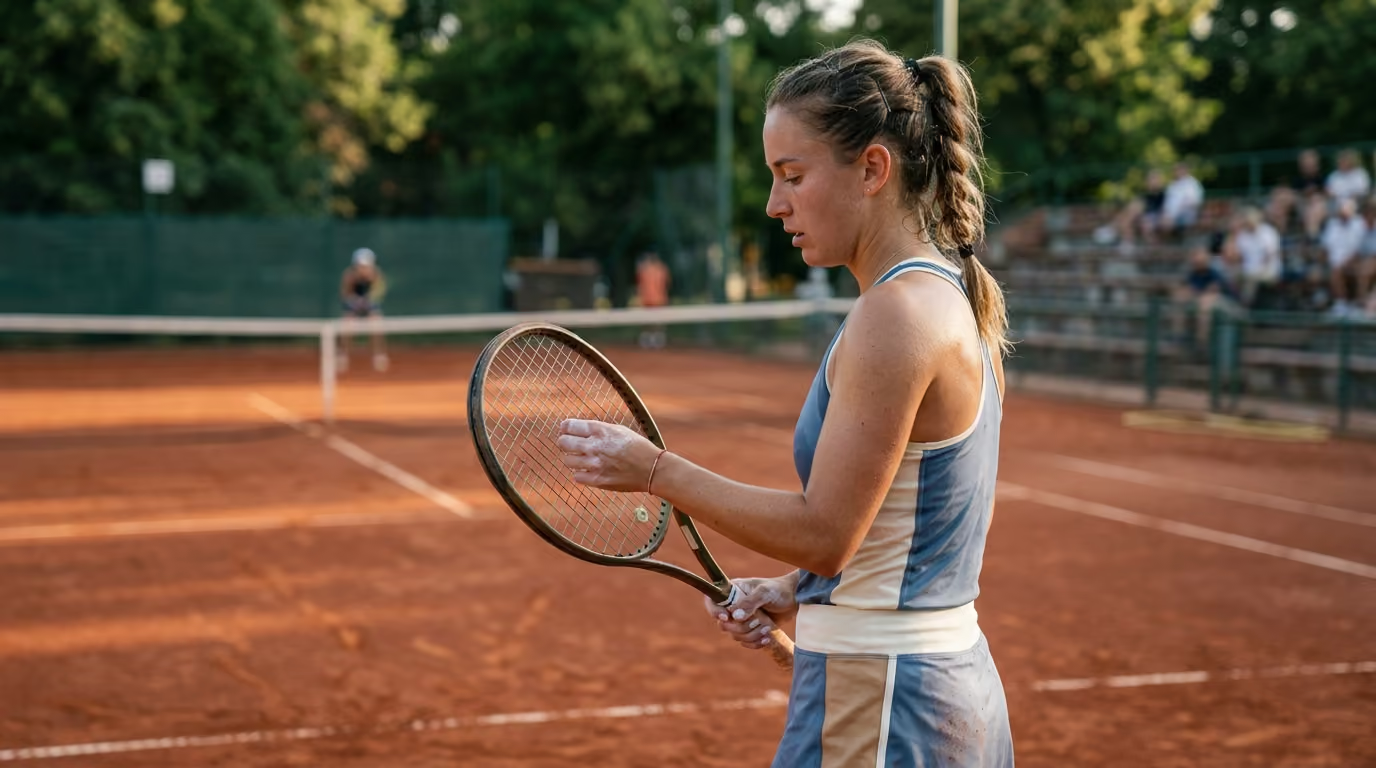

A between-point routine is a structured sequence of steps that helps racket sports players manage emotions and maintain focus under pressure.




Imagine the score is 4-4, deuce, in a high-stakes match. You miss an easy overhead directly into the net, giving your opponent a break point. Your chest immediately tightens, your heart rate spikes, and you feel an overwhelming urge to play the next point instantly to erase the memory of the error. This reaction is one of the most common ways matches slip away from competitive players. How you manage the empty seconds between the end of one point and the start of the next determines your ability to play consistent, high-quality racket sports.
A between-point routine is a repeatable, structured sequence of physical, mental, and tactical steps performed in the seconds between play. It regulates a player's physiological arousal, manages emotions, and directs focus toward the next point. Incorporating this system helps transition from reaction to deliberate execution, preserving energy and decision making under pressure.
To understand why this sequence matters, we must look at how racquet sports are actually played. In a typical match, active rally play only accounts for about 20 percent of the total time on court. The remaining 80 percent consists of walking, retrieving balls, switching sides, and standing between points. This means the majority of your match is spent not hitting the ball. What you do during these quiet windows determines your performance during active play.
A structured routine is a psychological and physical transition system designed to produce consistent performance. [16] It must not be confused with superstition. Superstitious behaviors are actions performed because a player believes they bring luck, such as avoiding lines or wearing specific socks. These actions have no practical, task-relevant purpose. In contrast, a true routine consists of systematic, task-relevant thoughts and actions that directly assist physical execution. [16] At Evercourts, we focus on helping court athletes understand these practical systems to support athletic longevity and better play.
To understand why these routines are effective, we can examine sports science research. A comprehensive meta-analysis titled "The Effectiveness of Pre-Performance Routines in Sports" analyzed 33 articles containing 61 intervention samples and 112 effect sizes across 15 sports. [16] The analysis found a small but significant positive effect for routines in pre-post designs, showing a standardized mean change of 0.31. [16] In low-pressure experimental environments, the routines showed a moderate-to-large effect with a Hedges' g of 0.64. [16]
Crucially, the positive effect remained strong under pressure. In experimental designs conducted under high-stress conditions, the effect size was Hedges' g of 0.70. [16] The authors of the meta-analysis found no significant differences in effectiveness based on age, gender, skill level, or whether the routine was highly extensive or simple. [16] This suggests that even a straightforward, easy-to-learn routine can help a player maintain execution when a match becomes stressful. [16]
These findings are particularly important for open-skill sports like tennis, pickleball, and padel. Many sports psychology studies focus on closed-skill tasks, such as golf putting or tenpin bowling, where the environment is static. A 2026 meta-analysis synthesized 21 studies on pressure interventions, reporting pooled effects for motor accuracy at g = 0.660 and executional success at g = 0.444. [31] The researchers noted that pressure intervention effects are generally larger and more robust in closed-skill sports compared to open-skill tasks. [31] Because racquet sports are highly dynamic, your routine must be flexible enough to handle changing winds, unexpected ball bounces, and varied opponent behaviors.
Routines also serve as a powerful defense against choking under pressure. A systematic review titled "Choking Interventions in Sports" evaluated 47 empirical studies across 15 sports. [21] The review concluded that interventions based on distraction control, self-focus mitigation, and physical acclimatization benefited performance under pressure. [21] Effective routines help prevent choking by keeping attention anchored on external, task-relevant cues. [16] When pressure rises, players often begin to monitor their own movement mechanics or worry about the score, which disrupts automatic coordination. [40][44] A routine keeps the mind occupied with a simple sequence of breath, target, and intent, preventing this self-destructive internal focus. [16][40]
To make a routine practical on the court, you can use a four-stage sequence. This framework is based on the United States Tennis Association model. [1] It breaks the transition down into four distinct phases: Respond, Recover, Refocus, and Ready. [1]
The Respond phase begins the exact millisecond a point ends. [1] Your immediate goal is behavioral containment, which means preventing a missed shot or a bad call from dictating the next point. [1] You must avoid throwing your hands up, slumped shoulders, or looking at your opponent with frustration. Instead, turn away from the net immediately. [1]
Move your racket into your non-dominant hand to help relax your hitting grip. Focus your eyes on a neutral physical object, such as your racket strings, your paddle face, or the court surface. [1] This simple physical action signals to your brain that the previous point is officially closed. Remember that emotion is entirely natural, but emotional continuation is optional. You do not need to force fake happiness, but you must maintain neutral, upright body language to protect your confidence. [1][2]
The Recover phase is designed to manage your physical and mental arousal. [1] High-intensity rallies or stressful scores trigger a fight-or-flight response, which causes rapid breathing and muscle tension. The goal of this phase is to return your nervous system to a state of usable activation. [21] This state means you are sufficiently calm to make smart tactical decisions, but highly alert and ready to move explosively.
Use deep, controlled breathing to regulate your arousal. Take one slow, deep inhalation through your nose, followed by a longer, controlled exhalation through your mouth. This breathing pattern helps stimulate the parasympathetic nervous system, which naturally slows your heart rate. Consciously relax your jaw, drop your shoulders, and loosen your fingers. Avoid repeatedly checking whether you feel calm, as over-monitoring your anxiety can actually increase self-focus.
The Refocus phase shifts your attention from what just happened to what you intend to do next. [1] Use a physical transition point, such as walking to your towel, touching the back fence, or picking up a ball, as a mental reset. [1] Once you reach this point, select one simple, clear tactical intention for the upcoming play. [1]
For a server, this plan might be a target area and a primary spin. For a returner, it might be a specific positioning adjustment or a target zone. Keep this intention simple, using one-step plans like "deep return to the middle" or "serve to the backhand." Avoid complex technical checklists, because trying to control your wrist angle or elbow position under pressure often leads to stiff, unnatural movements. [40][44] You can find more structured advice on court movement and preparation in our court performance resources.
The Ready phase is the final step where you end your planning and begin execution. [1] This phase occurs as you step up to the line to serve or take your stance to receive. Complete a brief, consistent physical ritual, such as bouncing the ball three times, taking one final deep breath, or adjusting your feet.
This final ritual acts as a cognitive trigger that tells your brain planning is complete. Once this trigger is pulled, you must trust your preparation and focus entirely on the ball. [1] The rule to live by is simple: plan behind the baseline, play once you are ready.
A standard routine is highly effective during normal play, but matches are filled with disruptions. To manage different levels of stress, you can use the green-light and yellow-light framework. [1] This distinction helps you adapt your routine without losing your rhythm.
The green routine is your standard, day-to-day transition sequence. [1] You use it after normal points when you feel emotionally balanced, physically fresh, and mentally focused. This routine is designed to be highly efficient, taking about 10 to 12 seconds to complete. It keeps you moving at a steady, professional pace and maintains your competitive momentum.
A standard green routine might look like this:
The yellow routine is an expanded version of your sequence used during moments of high emotional activation or physical distress. [1] You should trigger your yellow routine after double faults, bad calls, lost break points, or when you feel intense anxiety. [1] The yellow routine adds extra physical space and time to help you process the disruption. [1]
To execute a yellow routine, you might:
Under the International Tennis Federation rules, you have a maximum of 25 seconds between points. [18] Your yellow routine must still fit within this legal limit, meaning you cannot delay the match indefinitely. [18] Think of the yellow routine as a structured, 20-second emergency reset rather than a slow stall tactic.
To see how these routines work in practice, let us look at six common match situations. These scenarios demonstrate how to transition from a reactive state to a state of calm control.
When you double fault at a critical score, the temptation is to grab another ball and serve immediately to fix the error. This rushing often leads to another missed serve. Your yellow routine response should be:
Arguing with an opponent or focusing on a bad call will ruin your focus for the next several games. The disciplined response is:
Winning an incredible point often leaves you emotionally over-activated and physically winded. Rushing into the next point while celebrating can lead to an immediate unforced error. The response is:
When you lose several points quickly, it is easy to feel like the entire match is slipping away. You might try to change your entire strategy between points, which leads to confusion. The response is:
The pressure of closing out a set often causes players to monitor their movements or play defensively. The response is:
Physical exhaustion makes it very difficult to concentrate or make smart tactical decisions. When you are gasping for air, you must prioritize physical recovery. The response is:
While the core psychological principles of between-point routines remain constant, the physical application changes depending on your sport. The court size, speed of play, and presence of a partner all affect how you structure your routine.
In tennis, you have the benefit of a full 25-second limit between points. [18] The large court dimensions provide plenty of physical space to walk away from the net, visit the towel box, or walk to the back fence. [1] This makes tennis highly suited for a complete, unhurried four-stage routine. Because tennis matches can last several hours, using your routine to rest your mind between points is essential to avoid mental burnout. You can read more about managing match play in our tennis articles.
Pickleball is played at a much faster pace, and there is no official 25-second clock between points. The server is expected to call the score and serve within a reasonable time, meaning you often have only 5 to 10 seconds between rallies. Your pickleball routine must be highly compressed.
Focus on a quick physical connection with your partner, such as a paddle tap or a brief word of encouragement. Take one rapid, deep breath, adjust your paddle face, and immediately select your target. Keep your cue words extremely short, such as "soft hands" or "push deep." You can explore more about positioning and court flow in our pickleball articles.
Padel is played on an enclosed court with glass walls, which offers unique physical landmarks. You can use the back glass as a physical anchor, walking back to touch it to reset your focus. Because padel is always played in doubles, your routine must involve your partner.
Use the space between points to meet in the center of the court, make eye contact, and agree on a simple court position or tactical target. Avoid displaying negative body language to your partner, as this can quickly damage team chemistry. For detailed tactical advice, check out our padel articles.
Even experienced players can make mistakes when implementing between-point routines. Recognizing these common pitfalls will help you keep your routine functional and effective.
If you believe that skipping a ball bounce or failing to touch the back wall will cause you to lose, you have turned your routine into a superstition. Superstitions increase your anxiety and make you mentally fragile on court. [16] A routine is a practical tool, not a magic spell. If your routine is interrupted by a stray ball from another court, simply take a breath, reset, and continue play without worry.
Under match pressure, your cognitive capacity naturally shrinks. If your routine includes technical cues like "bend your knees, drop your wrist, keep your elbow high," you will experience mental overload. [40][44] This excessive self-focus disrupts your brain's ability to run automated movement patterns. Keep your mental preparation focused on external targets, such as the ball or a specific court zone.
Many players believe they must remain perfectly calm and happy at all times. However, trying to suppress your natural frustration or anger is mentally exhausting. Research on emotional regulation during physical tasks shows that suppressing your feelings increases your perceived exertion and lowers your performance. According to a study on emotional suppression during effort, trying to force yourself to feel nothing drains your energy. Acknowledge your frustration briefly during the respond phase, and then redirect your attention to your breathing.
A routine that works perfectly during a light practice match can easily fall apart during a tight third set. Many players fail to practice their routines under realistic stress. To build a resilient routine, you must practice it during challenging training sessions. Try running your routine after demanding conditioning drills, during simulated tiebreaks, or after coach-introduced errors.
A well-executed between-point routine does more than improve your score. It plays a significant role in preserving your physical health and supporting your long-term athletic participation.
Playing a competitive match requires intense concentration, which can be mentally exhausting. If you stay highly alert and emotionally reactive for two hours, you will experience severe cognitive fatigue. This fatigue leads to slower reaction times, poor tactical choices, and uncoordinated swings in the final games.
A between-point routine acts as a series of micro-breaks. It allows your sympathetic nervous system to step down from a high-stress state, preserving your mental energy for the end of the match. For more on how to structured rest supports performance, see our recovery science resources.
When you experience frustration or anxiety, your body naturally tenses up, especially in your neck, shoulders, and grip. This chronic tension reduces your swing speed and increases your risk of developing repetitive strain injuries, such as tennis elbow.
By using the recover phase of your routine to relax your shoulders and loosen your grip, you release this harmful tension. This simple practice helps you maintain smooth, natural movement patterns and protects your joints from strain. You can learn more about physical preparation and alignment in our mobility and movement resources.
I remember finishing a tough two hour padel match on a cold Tuesday night and waking up the next morning feeling like my lower back was locked in concrete. For a long time, I just accepted this as the price of playing hard in my forties. But once I started spending just ten minutes on targeted hip mobility before heading to the club, the stiffness almost completely vanished. It taught me that we do not have to accept pain as a default state of aging.
In the same way, taking care of our physical state between points through conscious muscle relaxation prevents the accumulation of defensive, protective posture that leads to chronic tightness. Protecting your body and mind on court is the key to enjoying racquet sports for years to come. To find more strategies for staying active on the court as you age, explore our healthy aging and athletic longevity resources.
While a between-point routine is an excellent tool for managing normal match stress, it has its limits. It is not designed to treat severe anxiety or clinical mental health conditions. You should consult a qualified healthcare provider, such as a sports psychologist, clinical therapist, or doctor, if you experience:
A qualified professional can provide personalized support, such as cognitive behavioral therapy, to help you manage your anxiety and enjoy your time on court.
You should bookmark and return to this guide whenever you notice your on-court focus beginning to slip. Revisit these steps if you find yourself rushing your serves, carrying anger from past points, or feeling physically and mentally exhausted after short matches.
By systematically practicing the four stages of the between-point routine, you can build a reliable bridge from one point to the next. This simple system will help you stay composed, protect your body from tension, and play your best racquet sports for years to come.
Follow Evercourts for practical insights on tennis, pickleball and padel performance, movement, recovery and healthy ageing. Stay connected for new articles, research-led guidance and ideas to help you play well and keep playing for years.


Read practical guidance for better movement, smarter preparation and a game that keeps working for you.
explore the Blog