Effective doubles strategy in racket sports minimizes physical strain and extends athletic longevity by coordinating positioning, roles, and communication.




Most players believe doubles is a relaxed alternative to singles. They assume that sharing the court naturally reduces the strain on their joints. However, uncoordinated doubles play often leads to chaotic positioning. This disorder forces sudden decelerations, emergency sprints, and awkward reaches.
Effective doubles strategy minimizes late, reactive sprinting by coordinating positioning, setting clear roles, and using proactive communication. By moving as a cohesive unit, partners make the court smaller and distribute physical demands evenly. This structured approach preserves athletic longevity and allows players to enjoy the sport for years.
Our team at Evercourts believes that smart tactical coordination is the ultimate foundation for playing without unnecessary physical wear. This guide provides a comprehensive movement management framework designed to improve your court efficiency. To help players sustain their participation, we offer a range of athletic longevity resources.
A systematic review of padel match demands reveals that the sport is highly intermittent. Rallies involve repeated explosive actions with moderate point durations. Research shows that players move approximately 8 to 12 meters per point. This accumulates to 2,500 to 3,500 meters per game.
These movements consist of short forward and lateral sprints. The average movement velocity ranges from 0.60 to 1.70 meters per second. Mean heart rates generally sit between 140 and 160 beats per minute during active play. These sudden directional changes represent a notable physical demand.
Many people view pickleball as a low-intensity pastime. However, research published in the Journal of Physical Activity and Health tells a different story. The study compared pickleball doubles to self-selected walking in healthy adults.
Doubles pickleball increased average caloric expenditure by 36 percent compared to walking. Participants also rated pickleball doubles as 44 percent more strenuous than walking. On playing days, players averaged 10,495 steps. This was nearly 3,000 more steps than on non-playing days.
Furthermore, players spent over 70 percent of their playing time in moderate to vigorous heart-rate zones. There was no statistically significant difference in intensity zones between singles and doubles formats. This highlights the true physical contribution of the game.
Because the sport requires rapid acceleration and sudden stops, injury awareness is essential. A 2025 study of older pickleball players found that 32.1 percent of participants reported an injury during the previous year. Lower-extremity injuries represented 57.9 percent of these cases. Muscle and tendon tissues accounted for 61.8 percent of the total.
A national orthopedic injury analysis estimated that 77,963 pickleball injuries occurred nationwide. Fractures and sprains each accounted for 27 percent of these medical cases. Notably, 91 percent of these injuries occurred in players aged 50 or older. This indicates a clear need for structured movement strategies.
In senior tennis, the physiological demands remain substantial but manageable. A study on senior short tennis reported a mean oxygen consumption of 21.8 milliliters per kilogram per minute. This equates to approximately 52.1 percent of maximum oxygen uptake. The study concluded that doubles games qualify as non-strenuous exercise for healthy senior participants.
Interestingly, the researchers found lower mean acceleration when skilled players partnered with other skilled players. This setup produced 130.3 milligravity units of acceleration. In contrast, skilled players partnering with novices against novice opponents produced 138.1 milligravity units. Coordinated partnership play directly reduces sudden physical acceleration demands.
To move efficiently, partners must act as a single unit. Imagine an invisible elastic band connecting you and your partner. When one player moves laterally, the other must slide in the same direction. This prevents the opponents from finding an open passing lane.
If you drift too far apart, the elastic band stretches and breaks. This leaves a massive hole in the center of the court. Matching your partner's lateral movement keeps your defensive shield intact. It also removes the need for desperate, recovery sprints.
Lateral coordination is highly relevant when one partner is pulled wide. If your partner runs outside the sideline to hit a ball, you must shift toward the center. Do not remain stationary on your side of the court.
Shifting over allows you to cover the vacant space. This movement makes the opponent's reply highly predictable. They must hit to the remaining open area, which you already occupy. This simple shift reduces the distance you must travel to reach the next ball.
Many doubles teams fail because one player stands at the net while the other stays deep. This split formation creates an enormous gap in the transition area. Opponents can easily exploit this space with soft, angled drops.
To avoid this trap, always match your partner's depth. If your partner retreats to defend, you should also step back. If they advance to attack, you must move forward with them. This synchronized movement ensures you always present a solid wall to your opponents.
Before every serve, you and your partner must have a shared plan. You can achieve this by answering five simple questions. First, where am I starting? Second, where is my partner starting?
Third, what is my first responsibility when the ball is hit? Fourth, what is my recovery position after I hit? Fifth, what call will we use to resolve any ambiguity? Answering these questions before the point prevents costly mid-point hesitation.
The court can be divided into three distinct zones. In the attack zone, your team holds a distinct positional advantage. You should remain compact, protect the center, and look to intercept weak replies.
In the transition zone, you are moving between defense and attack. You must avoid stopping in this exposed space. Instead, advance behind controlled shots and communicate whether to press forward or hold.
In the defense zone, your team is under heavy pressure. Your priority is survival and balance rather than immediate winners. Use high, deep shots to buy time so you can recover your positioning.
Many players waste valuable energy by overmoving on the court. You should move only as far as needed to reach the ball safely. Every extra step increases physical fatigue and pulls you out of position.
Overmovement also forces your partner to cover an enlarged gap. To prevent this, use clean, compact footwork. Only cross into your partner's side when it is absolutely necessary. If you do cross, communicate the change immediately.
Do not guess where the ball will go. Instead, move based on visual information. Watch the opponent's body orientation and their contact point. Observe the height and speed of the incoming ball.
A balanced opponent can hit any target. An opponent under pressure has limited options. Reading these cues early allows you to take short adjustment steps. This is far more efficient than waiting and executing a late sprint.
Tennis doubles offers several tactical formations to manage energy. The classic one up, one back formation is highly common. However, it can leave the baseline player covering a large lateral area.
To reduce this running, consider moving both players to the net when opportunity arises. The net players can intercept balls that would otherwise force long baseline sprints. You can also utilize the I-formation or the Australian formation. These setups disrupt the returner's rhythm and reduce their hitting angles. For more tactical and movement-based guidelines, visit our resources for court athletes.
In pickleball, the serving team begins behind the baseline. The receiving team has one player near the baseline and one at the non-volley zone. This creates a specific tactical challenge during the transition.
The receiver must return the serve and advance quickly to the non-volley zone line. They must become parallel with their partner. Advancing together prevents the serving team from driving balls at your feet. Maintaining this parallel alignment is the key to holding the kitchen line.
Balls hit down the center of a pickleball court cause frequent errors. Before the match, you must establish a clear middle-ball rule. Usually, the player with their forehand in the middle takes these shots.
However, this rule must be flexible. Factors like ball height, speed, and player balance play a role. If both players have backhands in the middle, assign responsibility based on court positioning. Using a clear verbal call is the best way to prevent collisions.
Padel doubles requires a unique understanding of the glass walls. When a ball passes you, do not panic and sprint backward. Instead, let the ball hit the back wall and read the rebound.
Reading the rebound allows you to step back calmly and make contact on the bounce. This requires controlled footwork rather than frantic running. Your partner must adjust their depth as you retreat. This collective movement maintains your defensive shape.
The split-depth trap occurs when partners operate in different zones. One player remains at the net while the other is stuck deep. This setup opens a massive diagonal gap across the court.
Opponents can easily place the ball into this open space. It forces the deep player to make long, diagonal sprints to save the point. To avoid this, always coordinate your forward and backward movements. Move as a connected unit.
Calling for the ball too late is often worse than saying nothing. A late call causes both players to hesitate or swing simultaneously. This can lead to paddle collisions or missed shots.
Make your verbal calls early in the ball's flight path. Use simple, single-word commands like "mine" or "yours." If you are uncertain, defer to your pre-established priority rules. This keeps the rally organized and safe.
Poaching can be highly effective in tennis and pickleball. However, constant, unplanned poaching creates chaos. It leaves your side of the court completely exposed.
Your partner is then forced to make a desperate cross-court sprint to cover for you. Only poach when you have a high-percentage opportunity. Ensure you have signaled your partner before the serve. This allows them to switch sides smoothly.
After defending a lob, many players remain standing near the baseline. This is a critical mistake in pickleball and padel. Staying deep hands the offensive advantage to your opponents.
You must work your way back to the attacking line as soon as possible. Advance behind a soft drop shot or a deep lob. Returning to your base position restores your team's defensive shield. It prevents you from being pinned deep.
A common issue occurs when the pickleball returner hits a deep return. Instead of advancing, they remain standing near the baseline. Their partner is already waiting at the non-volley zone.
This split formation allows the opponents to hit a soft drop into the open kitchen. The returner must then sprint forward at full speed. To correct this, the returner must follow their shot forward. They should reach the line before the opponents hit their next shot.
In a tennis doubles match, a ball is hit directly down the center line. Both players watch the ball but neither moves. It bounces between them for an easy opponent point.
This collision of intent happens because the team lacked a pre-point middle rule. To fix this, agree that the player with the forehand in the center has priority. Furthermore, that player must call "mine" as soon as the ball leaves the opponent's racket. This early communication prevents hesitation.
During a padel rally, an opponent hits a deep lob over the net player. The net player remains at the net. Meanwhile, the baseline partner retreats to defend the rebound off the glass.
The opponents quickly exploit the massive gap in the center of the court. To correct this, the net player must retreat as soon as the lob is hit. They must match their partner's deeper position. Once they defend the ball, both players can advance back to the net together.
A tennis net player decides to poach on every single return. They move early without watching the quality of their partner's serve. The returner easily hits a passing shot down the vacant alley.
The baseline partner must sprint sideways to reach the ball, risking injury. To correct this, the net player must use poaching selectively. They should only cross when the serve is deep and wide. They must also signal their intentions before the point begins.
The silent-shape drill is an excellent way to build movement awareness. Play a cooperative rally with your partner using no verbal communication. Focus entirely on your spatial relationship.
When your partner shifts left, you must shift left. When they step back, you must step back. This drill forces you to watch your partner's positioning. It helps build the habit of moving as a connected pair.
To master center coverage, use the middle-ball priority drill. Have a coach or partner feed balls directly down the center line. Feed these balls at varying heights and speeds.
You and your partner must call "mine" or "yours" before the ball bounces. This drill trains early decision-making. It eliminates the split-second hesitation that often leads to errors. You can progress this drill by adding movement before the feed.
This drill is designed for pickleball and tennis transition play. One player starts at the baseline while the partner starts at the net. The baseline player hits a deep shot and advances forward.
The coach then feeds either a drive, a drop, or a lob. The advancing player must respond correctly. If a lob is hit, they must retreat safely. If a drop is hit, they must establish their position at the line.
To improve your padel defense, practice the wall-read drill. Have a feeder hit balls deep into the corners. You must allow the ball to hit the back glass before playing it.
Focus on stepping back calmly and creating space for your swing. Your partner must watch your movement and adjust their depth. They must shadow your position to protect the center. This drill builds confidence in using the glass.
Strategic court movement is only one part of the longevity equation. You must also focus on recovery between points. Do not stand rigidly or rush to the next serve.
Take a few slow, controlled breaths after each rally. This helps lower your heart rate and clears mental fatigue. Release the tension in your grip by switching the racquet to your non-dominant hand. These small habits preserve your energy for the later stages of the match.
To maintain your physical health, you must monitor your weekly playing hours. Research shows that a sudden increase in playing time is associated with injury risk. This is particularly true for older players.
Keep your weekly court sessions consistent. Avoid playing back-to-back intense matches without rest days. If you plan to increase your playing time, do so gradually. This gives your muscles and joints time to adapt to the physical load.
A structured warm-up is essential before stepping onto the court. Focus on dynamic movements that target your hips, knees, and ankles. These areas experience high stress during lateral movements.
I remember finishing a tough two hour padel match on a cold Tuesday night and waking up the next morning feeling like my lower back was locked in concrete. For a long time, I just accepted this as the price of playing hard in my forties. But once I started spending just ten minutes on targeted hip mobility before heading to the club, the stiffness almost completely vanished. It taught me that we do not have to accept pain as a default state of aging. Utilizing targeted injury prevention strategies is essential for maintaining your athletic longevity.
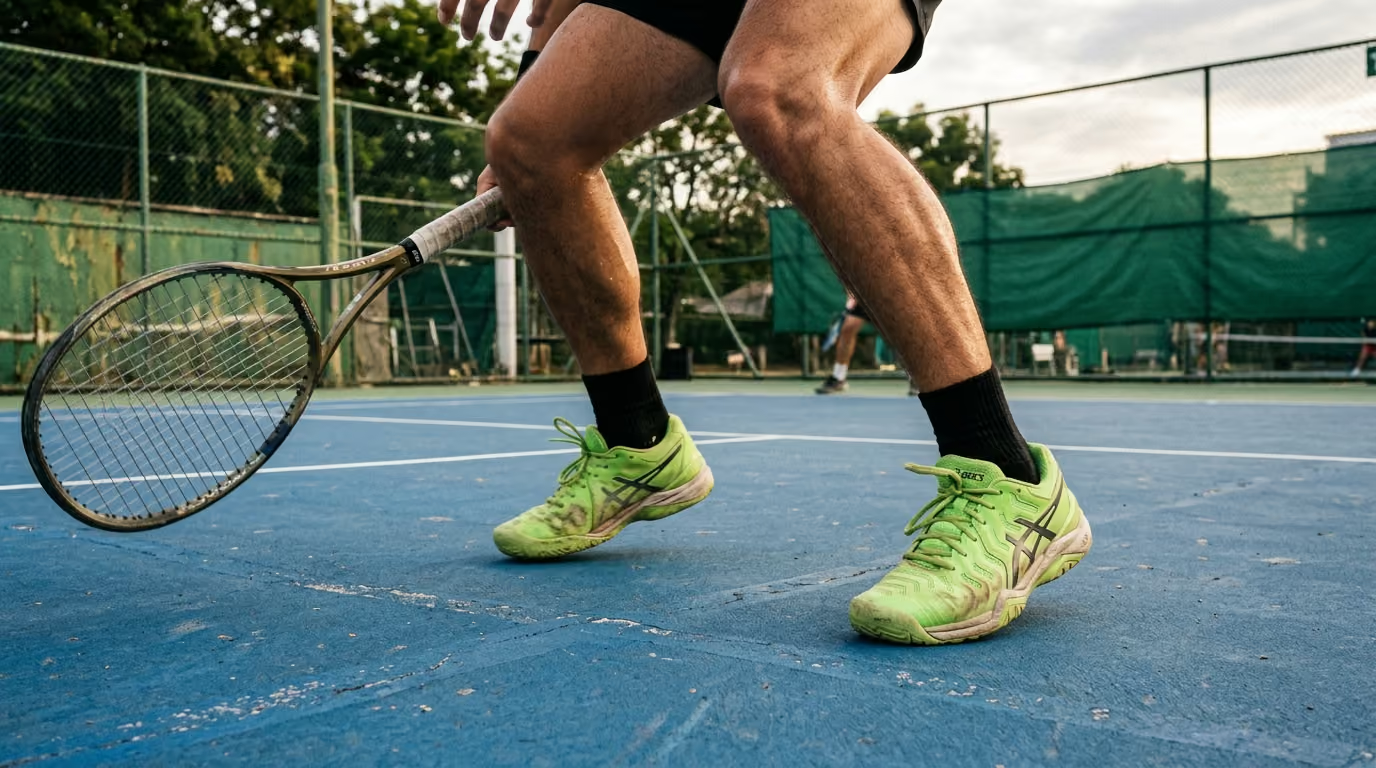
Your choice of footwear has a direct impact on joint health. Ensure your shoes are designed specifically for your sport's surface. Clay courts, hard courts, and artificial grass all require different grip patterns.
Wearing worn-out shoes reduces traction and stability. This increases the risk of slipping or rolling an ankle. Inspect your shoe treads regularly and replace them when they show signs of wear. Good footwear provides the foundation for safe, efficient movement.
While strategic movement reduces physical stress, it cannot eliminate all risks. You must pay attention to your body's warning signs. Do not ignore persistent joint pain or muscle stiffness.
Sharp pain, swelling, or a limited range of motion require immediate attention. These symptoms often indicate an underlying issue that needs professional evaluation. Continuing to play through pain can lead to chronic injuries.
If you experience persistent discomfort, consult a qualified healthcare provider. A physiotherapist or sports medicine physician can assess your movement mechanics. They can identify muscle imbalances and joint restrictions.
They can also design a personalized rehabilitation program. This helps you return to the court safely and prevents future issues. For more insights on maintaining your physical health, browse our player health articles.
Coordinating your doubles movement is the most effective way to play smarter and protect your body. By applying these positioning, communication, and recovery strategies, you can reduce physical strain and enjoy the game for years to come.
Follow Evercourts for practical insights on tennis, pickleball and padel performance, movement, recovery and healthy ageing. Stay connected for new articles, research-led guidance and ideas to help you play well and keep playing for years.


Read practical guidance for better movement, smarter preparation and a game that keeps working for you.
explore the Blog