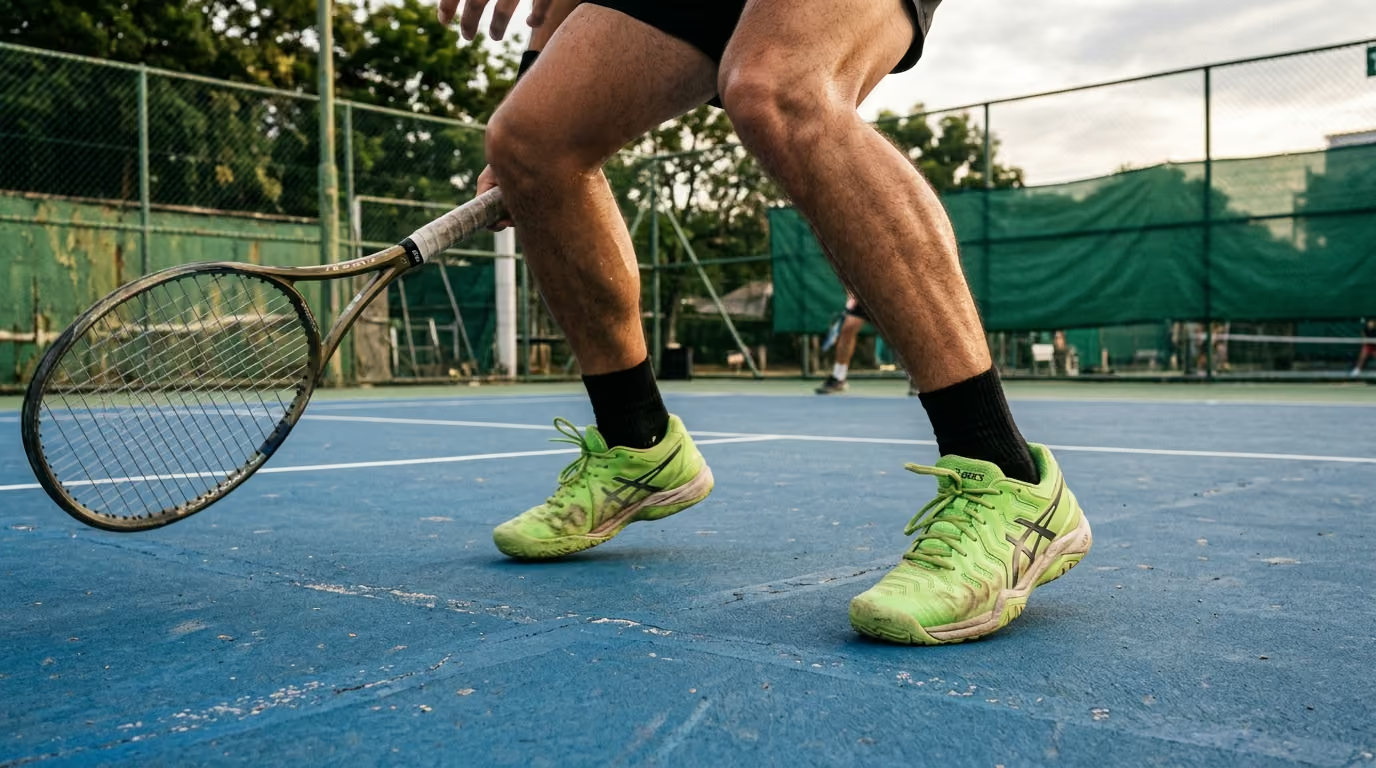
While many athletes believe maximal shoe cushioning protects their feet, true racquet sports longevity comes from building active calf capacity and ankle mobility.




To maintain confident lateral movement and avoid injuries on court, players must build active calf capacity, preserve ankle mobility, and master dynamic balance. This required durability is built by systematically increasing the physical tolerance of your tendons and joints rather than relying on thick shoe cushioning or rigid braces. Taking a proactive, function-based approach ensures you can continue to enjoy tennis, pickleball, or padel for decades.
Many court athletes believe that buying shoes with maximal cushioning is the most reliable way to protect their feet and joints. However, relying solely on heavy padding can actually dull your foot's natural ability to feel the court surface. This lack of sensory feedback can reduce your balance and place unexpected stress on your ankle ligaments. Understanding the mechanical demands of court movement is the real key to athletic longevity.
Racquet sports require a unique style of movement that you do not find in straight-line activities like running or cycling. Every point involves a chaotic mix of short accelerations, abrupt braking, lateral shuffles, and deep lunges. To prepare your body, you must understand the three distinct ways your lower limbs absorb and produce force on the court.
Propulsive loading occurs when you push off the ground to reach a distant ball. This action relies heavily on the quick contraction of your calf muscles and the spring-like recoil of your Achilles tendon.
Braking loading is the opposite action. It happens when you must absorb your forward momentum to stop suddenly before hitting a shot. During braking, your muscles and tendons must work eccentrically, meaning they lengthen under a high load to slow you down.
Repositioning loading consists of the small, low-intensity adjustment steps you take between shots. While these steps feel easy, they accumulate quickly over a multi-set match. If your muscles lack endurance, this repetitive loading leads to fatigue, which alters your movement patterns and increases your risk of a sudden sprain.
Lunging forward to reach a drop shot or a soft dink is one of the most physically demanding movements on court. In a 2024 epidemiological study of pickleball-related foot and ankle injuries published in Foot & Ankle Specialist, running or lunging forward was the most frequently documented mechanism of injury. This single action accounted for 29.7% of all cases where a specific movement mechanism was recorded.
The same study revealed that 77.8% of these documented injuries were traumatic rather than gradual flare-ups of chronic issues. When you lunge, your lead foot must plant firmly while your ankle flexes deeply to absorb your body weight. If your ankle lacks the necessary range of motion, your body will seek that mobility elsewhere, often forcing your knee or foot arch into an unstable position.
Backpedaling to cover a deep lob presents a distinct coordination challenge. According to the same 2024 pickleball study, moving backward accounted for 8.0% of documented injury mechanisms. When moving backward, players often cross their feet, lose track of their position on the court, or plant their feet at awkward angles.
Without excellent proprioception, your brain cannot accurately judge where your foot is in space. This lack of awareness makes it easy to roll your ankle outward when transitioning from a backward run to a forward sprint. Training must include controlled backward stepping and crossover recovery drills to ensure your nervous system can handle these difficult patterns.
Your calf complex is the main engine of your court movement. It does not just push you forward; it also acts as a primary shock absorber every time your foot makes contact with the hard court. To perform well over a long match, your calves require four distinct dimensions of physical capacity.
First, you need maximal force, which is the sheer strength required to push against the ground during a powerful start. Second, you must have strength endurance, allowing you to repeat those pushes hundreds of times without losing power.
Third, you need a high rate of force development. This represents how quickly your muscles can contract when you need to make a sudden, reactive jump or split step.
Finally, you need energy-storage capacity. This is the ability of your Achilles tendon to act like a rubber band, storing energy when you land and releasing it instantly when you push off.
Your calf is not just one muscle. It is composed of two primary muscles that require different training strategies. The gastrocnemius is the larger, visible bulb of the calf that crosses the knee joint. It is highly active when your knee is straight, such as when you sprint across the baseline.
The soleus sits deeper in the lower leg and does not cross the knee joint. It is the real workhorse of court sports, producing the majority of your plantar-flexion force when your knee is bent. Because racquet sports require you to play in a low, athletic stance with bent knees, building soleus capacity is essential. You can target these muscles with specific exercises on the Evercourts court performance platform.
You can easily assess your baseline calf endurance at home using a simple single-leg heel raise test. Stand barefoot on a flat floor near a wall for light balance support. Lift one foot off the ground, and perform slow, controlled heel raises on the other leg.
Raise your heel as high as possible, pause for one second at the top, and lower down over two seconds. A healthy, active adult player should ideally be able to complete 25 to 30 continuous, high-quality repetitions without resting or losing height. If you experience burning in your arch, a loss of height, or a strong urge to bend your knee before reaching 20 repetitions, your calf endurance is a primary area for improvement.
To build comprehensive calf capacity, use these four targeted exercises twice per week:
The Achilles tendon is the thickest and strongest tendon in the human body, designed to withstand loads up to twelve times your body weight during high-intensity jumping. However, as we age, our tendons naturally lose some of their elasticity and water content. To keep this vital structure healthy, you must apply consistent, progressive mechanical loading.
To manage your tendons effectively, you must understand how they respond to work. When you expose a tendon to a new, higher level of training, it goes through a predictable continuum. A normal training response involves mild, temporary stiffness that clears up within a few hours of playing.
If the load is too high or increases too quickly, the tendon can enter a reactive state. This is characterized by localized swelling, a warm sensation, and pain when you first get out of bed. If you ignore these early signs and continue to play through the pain, the tendon can develop chronic tendinopathy, which involves structural changes that take much longer to resolve.
The Journal of Orthopaedic & Sports Physical Therapy published updated guidelines in 2024 for managing Achilles tendinopathy. The clinical consensus strongly supports progressive tendon-loading exercise as the primary, first-line treatment for midportion Achilles symptoms. The guidelines state that loading should be performed at least three times per week and at an intensity as high as tolerated.
This research highlights that passive treatments like rest, ice, or massage are not enough to rebuild tendon structure. Your tendon needs a physical challenge to stimulate cellular repair and align its collagen fibers. The exercise selection should progress from slow, controlled movements to faster, spring-like actions as your pain levels and physical capacity improve.
The absolute best way to gauge if a training session or match was too demanding is to monitor your tendon's reaction over the next 24 hours. Tendons have a delayed response to stress. You might feel completely fine while playing, but wake up the next morning with severe stiffness or pain.
Use a simple traffic-light system to guide your training. If your next-morning pain is minor and disappears after five minutes of walking, you are in the green light zone; you can maintain your current playing volume. If your morning stiffness lasts for thirty minutes or causes you to limp, you are in the yellow zone; you should reduce your playing time and focus on slow, heavy strength work. If you experience sharp pain during normal walking, you are in the red zone; you must rest from court play and seek professional medical guidance. You can learn more about managing these training adjustments in our recovery science articles.
Many players believe they have excellent balance because they can stand on one foot while brushing their teeth. However, standing quietly on a flat floor is only a basic, entry-level skill. On the court, you must maintain balance while running, stopping, looking at a moving ball, and preparing your paddle or racquet.
Static balance is your ability to maintain your center of mass over a fixed base of support while stationary. Dynamic balance requires you to maintain control while your body is actively moving, such as when you lunge forward or shuffle sideways.
Reactive balance is the most complex form of control. It is your ability to recover your footing after an unexpected event, like a ball hitting the net cord or your foot sliding slightly on a dusty court.
In our experience, neglecting full-body mobility and balance eventually catches up with every dedicated player. I remember finishing a tough two hour padel match on a cold Tuesday night and waking up the next morning feeling like my lower back was locked in concrete. For a long time, I just accepted this as the price of playing hard in my forties. But once our team started spending just ten minutes on targeted hip mobility and ankle balance before heading to the club, the stiffness almost completely vanished. It taught us that we do not have to accept pain as a default state of aging.
By improving our joint mobility and balance prep, we reduced the excessive workload on our lower backs and knees. This personal experience highlights why we must treat the foot and ankle as part of a connected kinetic chain. You can find comprehensive routines to build this structural durability in our library of injury prevention guides.
To build professional-grade court balance, integrate these three dynamic exercises into your training:
Your shoes are your only point of contact with the court. Wearing running shoes or basic sneakers to play court sports is a direct recipe for ankle rolls and joint pain. Running shoes are designed for straight-line movement and have soft, high midsoles that easily collapse when you try to change directions quickly.
A dedicated court shoe must provide lateral containment, which is a reinforced frame around the outer edge of the foot to keep your foot from sliding off the sole during a hard stop. It also needs a rigid heel counter, which is a stiff plastic cup inside the heel of the shoe that stabilizes your heel bone.
The midsole should be lower to the ground than a running shoe, reducing the leverage force acting on your ankle when you cut sideways. The shoe also needs a rigid shank, which is a stiff plastic or carbon-fiber piece in the arch that prevents the shoe from twisting excessively. Finally, the toe box must be wide enough to allow your toes to splay naturally, which provides a wider, more stable base for balance.
Different court surfaces place vastly different demands on your feet and ankles. Hard courts, which are typical for tennis and pickleball, provide high traction but offer almost no impact absorption. A systematic review of tennis injuries showed that playing on hard courts is associated with a higher prevalence of lower-limb overuse injuries. The research also found that changing court surfaces has a greater impact on the pressure under your feet than changing your shoes.
Clay courts and sand-filled padel courts allow for a controlled slide, which helps reduce the peak braking forces on your joints. However, playing on clay requires specific outsoles with a full herringbone pattern to grip the loose surface. If you play on multiple surfaces, you must give your body several weeks to adapt to the new traction characteristics. Avoid switching court types and increasing your playing volume in the same week. You can find more helpful advice on selecting gear and maintaining your body in our collection of healthy aging resources.
If you suffer an ankle sprain or a calf strain, do not simply wait for the pain to stop before rushing back onto the court. Pain is a poor indicator of tissue healing and physical readiness. Returning to play before restoring your mobility, strength, and coordination significantly increases your risk of developing chronic ankle instability.
Your initial goal after an injury is to manage swelling and restore basic movement. The 2021 clinical practice guidelines for lateral ankle sprains recommend progressive weight bearing as tolerated rather than prolonged rest.
Use a supportive brace or tape to protect the joint, and walk as normally as possible. Avoid limping, as this creates compensation patterns in your hips and lower back. You can transition to the next stage once you can walk comfortably on flat ground without pain.
Once you can walk pain-free, focus on rebuilding basic strength in your lower leg. Perform bilateral and single-leg heel raises on a flat floor, progress to a step, and add tibialis anterior and peroneal band work.
Aim to restore full, symmetrical range of motion in your ankle. You can test this by kneeling near a wall and pushing your knee forward until it touches the wall. Measure how far your big toe can be from the wall while keeping your heel flat on the floor. This distance should be identical on both sides.
Before you try to play a game, your body must tolerate straight-line impact. Start with marching drills, progress to light jogging on a soft surface, and then add controlled straight-line accelerations.
Begin practicing light skipping and double-leg jump-roping. These movements reintroduce low-level elastic loading to your calf muscles and Achilles tendon. Keep your sessions short, and monitor your physical response over the next 24 hours.
Once linear running is comfortable, you must train your body to handle lateral forces. Practice slow lateral shuffling, crossover stepping, and figure-eight runs around court cones.
Introduce lunge-and-recover drills, focusing on keeping your lead knee aligned over your foot. Work on stopping suddenly from a moderate sprint, ensuring you can absorb your momentum smoothly through your hips, knees, and ankles.
This stage bridges the gap between structured exercise and the unpredictable nature of a real match. Start performing single-leg hops, lateral hop-and-holds, and continuous side-to-side jumping.
Incorporate unpredictable movement drills. Have a partner stand across from you and feed you balls or point in random directions, forcing you to react and change directions instantly. This trains your nervous system to stabilize your ankle when your attention is focused on the game.
You are now ready to return to the court, but you must strictly limit your playing volume and intensity. Start with cooperative drilling where your partner hits the ball directly to you, minimizing your need to run.
Gradually progress to half-court games, then to full-court practice sets, and finally to competitive match play. Avoid playing back-to-back days during the first month of your return. Always warm up thoroughly before every session.
Before you return to competitive match play, use these common clinical benchmarks to assess your physical readiness. These tests help ensure you have restored your basic capacities, though they do not guarantee you are immune to re-injury.
Many dedicated players spend hours training but fail to see results because they fall into common training traps. Review this list of ten physical preparation mistakes to ensure you are protecting your body effectively.
When you roll your ankle, it is easy to focus all your rehab on the injured ligaments. However, recurrent ankle sprains are often caused by deficits higher up the leg, such as weak hip abductors or poor core control. Your hips control the alignment of your leg when you land; if they are weak, your foot is more likely to plant at an unstable angle.
Sitting on the court floor and stretching your calves before a match actually reduces your muscles' ability to produce power and react quickly. A proper warm-up must be dynamic. It should include light jogging, lateral shuffling, arm swings, lunges, and small jumps to prepare your nervous system for the game.
When your Achilles tendon starts to ache, your first instinct might be to stop all movement and wait for it to heal. However, tendons lack a direct blood supply and require mechanical loading to stimulate repair. Complete rest makes the tendon weaker and less capable of handling court forces when you return.
For years, sports medicine focused almost exclusively on eccentric lowering exercises for tendon issues. Modern clinical research shows that a variety of loading types, including isometric holds and heavy slow resistance, are highly effective. The key is to find the right entry point for your specific level of pain and physical tolerance.
A player may be able to perform 30 slow, perfect single-leg heel raises but still experience severe pain when they try to run or jump. This occurs because slow strength does not test your calf's elastic capacity. You must train your body to handle high-rate, spring-like actions using jumping and hopping progressions.
Because a pickleball court is smaller than a tennis court, many players assume the sport is physically easy. However, the short distance actually requires faster, more abrupt reactions and deep, sudden lunges. The high rate of Achilles tendon ruptures in older pickleball players proves that the small court demands serious physical preparation.
If you transition from playing on soft clay to hard courts, your joints must suddenly absorb much higher impact forces. If you maintain your usual playing volume during this transition, you are highly likely to develop overuse injuries. Reduce your court time by 30% for the first two weeks on a harder surface to allow your body to adapt.
It is incredibly easy to overdo it when you join a new league or discover a passion for a sport. However, rapidly increasing your weekly playing hours is one of the most common causes of tendon and muscle strains. Limit your total weekly playing volume increase to no more than 10% per week to give your tissues time to adapt.
Adrenaline is a powerful painkiller. You might have a mild tendon or muscle strain but feel absolutely fine while playing a competitive match. Always judge your physical readiness by how your body feels the next morning; morning pain and stiffness are the most reliable indicators of tissue distress.
Reaching 90% symmetry on clinical tests is a great milestone, but it does not mean your rehabilitation is complete. A clinical test is performed in a quiet, predictable room where you can focus entirely on your movement. On the court, you must perform these same movements while tracking a ball, anticipating an opponent, and managing fatigue.
While progressive home training is highly effective for building durability, certain symptoms require immediate medical evaluation. Do not try to push through pain if you experience any of the following clinical warning signs.
First, if you feel or hear a sudden pop in your calf or ankle, stop playing immediately. This sensation often indicates a muscle tear, severe ligament sprain, or an Achilles tendon rupture.
Second, if you cannot bear weight or take four steps immediately after an injury, seek a professional medical diagnosis to rule out a fracture.
Third, if you experience rapid, severe swelling or visible deformity in your joint, seek clinical care.
Finally, if you have persistent numbness, tingling, or cold sensations in your foot, you need a professional neurological assessment.
If you live with systemic health conditions like diabetes, neuropathy, vascular disease, or inflammatory arthritis, you must manage your foot and ankle health with extra caution. These conditions can alter your pain sensation, slow your healing times, and affect your natural balance.
The 2024 JOSPT Achilles tendinopathy guidelines explicitly state that high-load tendon training should be modified for individuals with structural tissue frailty. If you have a complex medical history, work with a physical therapist or sports medicine physician to design a safe, highly individualized training and recovery plan. You can contact us through our support page if you need help finding resources or connecting with specialists.
To keep your feet and ankles healthy for the long term, you must integrate targeted training into your weekly routine. This does not require hours of extra work; spending just ten minutes, three times per week on focused exercises can produce massive improvements in your court performance. Use this simple weekly template to structure your training.
By taking a systematic approach to your training, choosing the right footwear, and listening to your body's recovery signals, you can build a durable foundation that supports fast, confident movement on court for decades.
Follow Evercourts for practical insights on tennis, pickleball and padel performance, movement, recovery and healthy ageing. Stay connected for new articles, research-led guidance and ideas to help you play well and keep playing for years.


Read practical guidance for better movement, smarter preparation and a game that keeps working for you.
explore the Blog