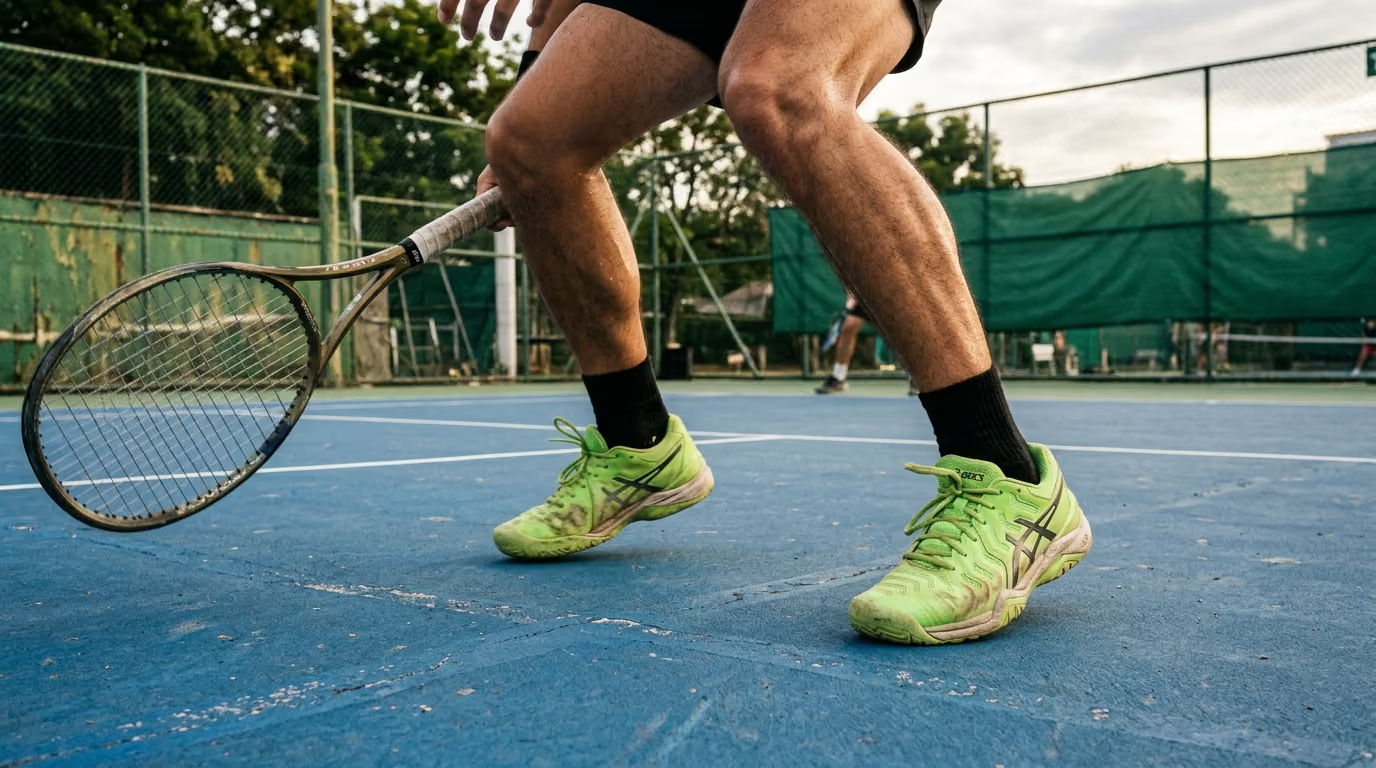
While many believe strong grip is key in racquet sports, true longevity stems from balanced muscular endurance, wrist stability, and smart workload management.




True athletic longevity in racquet sports is not built on a single high-performance metric. It is not simply about having the strongest squeeze in the local club or using the stiffest racquet available. Instead, it is the result of a coordinated physical system that balances muscular endurance, wrist stability, and smart workload management. This guide provides a practical framework for keeping your forearms, wrists, and hands healthy over decades of active play.
Long-term forearm and wrist health on the court requires a balance of targeted endurance training, progressive loading, and smart workload monitoring. Instead of squeezing the racquet with maximal force, players must learn to distribute hitting impact through the entire arm while keeping wrist tissues resilient. This comprehensive approach ensures that repetitive ball impacts do not lead to chronic tendon irritation or early retirement from the court.
I remember finishing a tough two hour padel match on a cold Tuesday night and waking up the next morning feeling like my lower back was locked in concrete. For a long time, I just accepted this as the price of playing hard in my forties. But once I started spending just ten minutes on targeted hip mobility before heading to the club, the stiffness almost completely vanished. It taught me that we do not have to accept pain as a default state of aging. The same physical principle applies to our wrists and forearms. Proactive, structured care keeps us on the court without interruption.
By focusing on healthy athletic longevity resources, recreational players can protect their joints and maintain their performance. Let us examine how the forearm, wrist, and hand function together to keep you playing at your best.
The wrist and hand represent the final link in a complex kinetic chain. This chain begins at your feet, moves through your legs, and travels up your trunk. It then transfers through your shoulder and elbow before reaching the racquet grip. When any part of this chain is weak or stiff, the smaller muscles of the forearm must overcompensate to make up the difference.
Over time, this compensation causes excessive mechanical stress. If your hips are stiff or your core is tired, you will struggle to transfer weight. This forces your wrist to snap or twist at the moment of ball impact. Over hundreds of strokes, these minor technical adjustments accumulate, placing a heavy eccentric load on your forearm tendons.
During a standard two-hour session, your forearm muscles contract thousands of times. These contractions are not uniform. They combine rapid isometric clamping, sudden concentric acceleration, and intense eccentric braking. Your muscles must stiffen instantly at impact to stabilize the racquet face, then relax immediately to prepare for the next movement.
This constant oscillation between high tension and relaxation is physically demanding. If you lack local muscular endurance, your forearm muscles will fatigue early in a match. Once fatigued, they lose their ability to absorb impact vibration. This vibration then travels directly into the tendons and the elbow joint.
As physical fatigue sets in, technical quality naturally begins to decline. A player who started the match with clean leg drive and rotational power may begin to stand upright. To maintain ball speed, they will rely more heavily on arm and wrist movement. This transition is often unconscious but highly damaging.
According to a systematic review of upper-limb injury risk factors in tennis, prolonged play, muscle fatigue, and altered shoulder kinematics are closely linked to injury. When you run out of energy, your body tries to protect larger muscle groups. This shifts the mechanical burden to the smaller, more vulnerable tissues of the lower arm.
Many players hold their paddle or racquet with a continuous, high-pressure grip. This is sometimes called the death grip. It keeps the forearm muscles in a state of constant, low-grade contraction. This continuous tension restricts local blood flow, which limits oxygen delivery and slows down waste removal.
Ideally, your grip pressure should remain dynamic. It must be relaxed during the preparation phase, firm at ball contact, and relaxed again during the follow-through. Learning this rhythm of tension and release is essential for muscular endurance and tendon health.
Grip strength is widely recognized in clinical settings as a useful marker of general health and functional capacity. It is easily measured using a hand-held dynamometer. This simple test correlates strongly with overall upper-body strength and muscle mass.
A large meta-analysis of 30 studies involving 194,767 older adults showed that higher handgrip strength was associated with an 18 percent decrease in all-cause mortality. For older women in that analysis, a minimum strength value of approximately 18.21 kilograms was identified as a key threshold. While these findings are significant, they show association rather than direct causation. Squeezing a hand gripper will not automatically extend your lifespan, but maintaining functional muscle tissue certainly supports healthy lifestyle habits.
For a court athlete, a single maximal grip test does not tell the whole story. You can possess high crushing strength but have very poor muscular endurance. Alternatively, you might have strong finger flexors but exceptionally weak wrist extensors. This imbalance is highly relevant to your athletic longevity.
To protect your joints, you need balanced strength across multiple planes of motion. You require steady endurance to sustain performance over a long third set. Standard clinical grip tests do not measure how your wrist behaves under rapid, unpredictable loading. Therefore, we must assess multiple movement patterns to build a complete profile of your hand and forearm function.
Overuse injuries are common among recreational racquet sports players. A study of German league players found that 63.2 percent of reported chronic complaints involved the upper extremity. Within that group, tendon injuries accounted for 56.8 percent of the chronic issues.
This study also revealed that racquet properties did not have a significant relationship with chronic upper-limb injuries. This finding is highly instructive. It suggests that buying a new racquet or using softer strings cannot replace physical preparation. Your body must possess the physical capacity to handle the forces of the sport.
Forearm tendons do not respond well to sudden changes in physical activity. Complete rest can cause the tendon structure to become less organized and more compliant. When you return to play after a long break, the sudden impact can easily overload these weakened tissues.
Modern clinical guidance for tendinopathy emphasizes progressive mechanical loading over complete rest. Controlled loading encourages collagen fibers to realign and strengthen. This active approach is now the standard for managing chronic tendon issues in athletes of all ages.
To assess your maximal strength, you can use a basic hand dynamometer. Test both your dominant and non-dominant hands to check for major imbalances. While some asymmetry is natural in one-sided sports, a difference of more than 15 percent deserves attention.
You should also check your pinch strength by pressing your thumb against your individual fingers. This test helps identify weakness in the small muscles of the hand. Finally, assess your ability to resist movement in your wrist. Try to hold your hand steady while pushing against it with your opposite hand in all four directions.
A simple way to test your endurance is the submaximal hold test. Hold a light weight, such as a five-pound dumbbell, with your arm extended. Keep your wrist completely straight and time how long you can maintain this position before your form breaks.
You can also perform high-repetition wrist extensions using a very light weight. Count how many controlled repetitions you can complete before feeling a significant muscle burn. Record these numbers to track your progress over several weeks of training.
To check your mobility, sit at a table with your forearm supported. Let your hand hang over the edge. Gently move your hand up and down to assess wrist flexion and extension. The movement should feel smooth and free of sharp pain.
Next, turn your palm facing up and then facing down. This measures your forearm pronation and supination. Compare these ranges of motion to your non-dominant side. Any major restriction in mobility can alter how force travels up your arm during a match.
Control is the ability to position your wrist accurately under dynamic conditions. Hold your racquet or paddle and perform light ball taps. Try to alternate between the forehand and backhand face without losing control of the ball.
You can also practice rapid grip transitions. Switch between your standard forehand grip and backhand grip as quickly as possible. Watch to see if your hand fumbles or if you need to look at the handle to make the adjustment. This coordination is essential for quick exchanges at the kitchen line or net.
The final domain of assessment is how your tissues respond after a training session. Keep a simple training diary to track your physical reactions. Note any pain during play, immediate soreness afterward, or stiffness the next morning.
A successful program should not cause worsening symptoms the next day. If you wake up with stiff, achy wrists that last for hours, your training volume is too high. Use this feedback to make timely adjustments to your play and recovery schedule.
To build a solid foundation, you should start with isometric exercises. These movements place tension on the tendons without moving the joints. This is particularly helpful if you are recovering from minor tendon irritation.
These movements are designed to build local tissue tolerance. They prepare your tendons for more dynamic loads in the future. To support these exercises, you can read our specialized strength and conditioning guides for more detailed routines.
Once isometric work is comfortable, you can transition to isotonic movements. These exercises involve moving a weight through a complete range of motion. Focus on slow, controlled repetitions to maximize muscle engagement.
These movements help build the muscular bulk and endurance needed to stabilize your wrist during impact. Always use a weight that allows you to maintain perfect form.
Eccentric training focuses on the lengthening phase of an exercise. This type of training is highly effective for building tendon resilience. Your forearm muscles must perform a similar decelerating action every time you strike a ball.
Eccentric work can be physically demanding. Perform these exercises only twice a week to allow sufficient recovery time.
This phase connects your gym work to actual on-court play. It mimics the specific physical demands of your sport. The goal here is to maintain technical precision even when your muscles are tired.
These exercises are excellent for building the physical stamina required for long matches. They help prevent the late-game technical breakdowns that often lead to overuse injuries.
When returning from a break or managing minor soreness, you must progress gradually. Do not jump immediately into competitive matches. Start with low-impact drills and monitor your physical response.
Begin with twenty minutes of light short-court hitting. Keep your swings smooth and avoid high-speed serves or overheads. If your arm feels good the next morning, you can slowly increase your playing time. Step-by-step progress is the safest way to rebuild your physical capacity on the court.
Tennis involves a relatively heavy ball and a long racquet frame. This combination creates a significant lever arm, which amplifies the force of ball impact. Your forearm must absorb substantial kinetic energy, especially on off-center hits.
Furthermore, modern tennis relies heavily on heavy topspin. This style of play requires rapid wrist acceleration and strong eccentric deceleration. The wrist extensors must work extremely hard to control the racquet face during these fast, whipping movements. A solid strength foundation is essential for tennis players to protect their elbows from these repetitive forces.
Pickleball utilizes a lightweight paddle and a hollow plastic ball. While the impact forces are much lower than in tennis, the pace of play is often much faster. This is particularly true during quick exchanges at the kitchen line.
Pickleball players require exceptional speed and coordination in their fingers and hands. You must make rapid micro-adjustments to block fast shots and hit delicate dinks. This high stroke density can fatigue the small muscles of your hand, making progressive endurance training highly beneficial.
Padel paddles are thick, solid, and do not contain strings. This design means that impact vibration travels directly into your hand and arm. Additionally, the heavy carbon fiber paddles can strain your wrist if your grip size is incorrect.
Padel also features complex shots, such as off-the-wall rebounds and spin-heavy overheads. These strokes require your wrist to remain exceptionally stable at unusual angles. Developing strong forearm rotators is crucial for padel players to manage these unique physical demands. To learn more about managing these sport-specific challenges, explore our racquet sports player health articles.
The most common technical error on the court is holding your racquet with constant, maximal force. Many players believe that a tighter grip offers better ball control. In reality, a rigid grip reduces your swing fluidity and increases the stress on your tendons.
This constant tension restricts local blood flow, which causes your forearm muscles to fatigue much faster. To correct this, try to rate your grip pressure on a scale of 1 to 10. Aim to keep your grip at a 3 during your preparation, and only increase it to a 7 at the exact moment of ball contact.
When players experience forearm tightness, their first instinct is often to perform aggressive static stretches. While stretching can offer temporary relief, it does not build tissue capacity. In some cases, deep stretching can compress and irritate already sensitive tendons.
Modern injury prevention principles suggest replacing passive stretching with active, progressive loading. Exercises like isometrics and controlled extensions are far more effective for long-term health. They help build the physical strength your tendons need to handle the forces of the sport.
During a hard match, your forearm muscles undergo hundreds of forceful contractions. Each contraction temporarily pinches the local blood vessels, which limits the flow of fresh, oxygen-rich blood. This process is normal, but it requires adequate recovery time to resolve.
If you play long matches with very short rest intervals, your muscles will struggle to clear metabolic waste. This lack of oxygen can lead to microtrauma in the muscle fibers. Over time, this unresolved fatigue can cause persistent stiffness and increase your risk of tendon irritation.
To protect your joints, you must monitor your overall training volume. This includes tracking not just your hours on the court, but also the intensity of your sessions. A simple way to do this is by multiplying your session length by your perceived exertion.
Using this simple system helps you spot sudden spikes in your physical workload. If your weekly score rises too quickly, your body will struggle to adapt. Gradual progression is the most effective way to build lasting physical capacity.
Your chronic workload represents the average training volume you have maintained over the past month. Your acute workload is the total volume of your most recent week of play. Comparing these two numbers helps you assess your injury risk.
If your recent week of play is much higher than your monthly average, your body may be under excessive stress. While this ratio is not a perfect predictor of injury, it serves as a valuable warning sign. Keeping your weekly volume close to your established baseline supports consistent, pain-free performance.
While muscular soreness is common, localized bone pain is a warning sign. If you feel sharp pain when pressing directly on the bones of your wrist or hand, you should seek professional advice. This symptom can indicate a stress fracture or joint issue that requires medical evaluation.
Numbness, tingling, or electric sensations traveling down your arm are not normal. These symptoms suggest nerve compression, such as carpal tunnel syndrome or radial nerve irritation. These conditions require professional assessment and should not be managed with standard strength training.
If you experience a sudden drop in your grip strength or struggle to hold ordinary objects, seek medical attention. This loss of function can indicate a significant muscle tear or neurological issue. A qualified healthcare provider can help identify the root cause and guide your recovery.
Pain that keeps you awake or worsens when you are resting is a key warning sign. This type of discomfort can indicate high levels of local inflammation or a more serious underlying issue. Do not attempt to work through this pain; consult a healthcare professional for a proper diagnosis.
Using the incorrect grip size can significantly increase the stress on your hand and forearm muscles. A grip that is too small requires you to squeeze harder to keep the racquet from twisting. A grip that is too large can limit your wrist mobility and make quick grip changes difficult.
To check your grip size, hold your racquet using a standard continental grip. There should be enough space between your fingertips and the heel of your hand to fit your opposite index finger. If the gap is too small, your grip size may be too small. You can easily increase your grip size by adding a high-quality overgrip to the handle.
String tension plays a major role in how much vibration travels up your arm. High string tension offers excellent ball control but transmits more impact force to your hand and wrist. Lower tension creates a spring-like effect, which absorbs more vibration and is gentler on your joints.
If you are recovering from elbow or wrist soreness, consider lowering your string tension by a few pounds. You might also try using softer string materials, such as multifilament or natural gut. These small adjustments can significantly reduce the physical stress on your forearm tendons.
For pickleball and padel players, paddle weight and balance are crucial factors. A heavier paddle can help generate power but requires more forearm strength to swing and stabilize. A lighter paddle is easier to maneuver but may transmit more vibration to your arm on fast shots.
Additionally, pay close attention to the balance point of your paddle. Head-heavy designs can place extra stress on your wrist during quick swings. Experiment with different weights and balances to find a setup that feels comfortable and supportive for your joints.
A recreational tennis player who normally hits twice a week enters a weekend tournament. They play four intense matches over two days. They also spend the week before the tournament practicing their serve for hours.
The primary issue here is not a lack of strength. It is a sudden, dramatic spike in physical workload. To prepare for this type of event, the player should have gradually increased their training volume over several weeks. They should also focus on hydration, light mobility work, and adequate sleep between matches to support their recovery.
A pickleball player performs well during the first hour of a session. However, as they fatigue, they stop using their legs and trunk to generate power. They begin flipping their wrist to push the ball over the net.
This pattern represents a classic fatigue-related breakdown in technique. The solution is not simply to perform more grip exercises. The player should focus on building core and lower-body endurance to maintain their form. They might also consider shortening their playing sessions until their physical stamina improves.
A padel player switches to a heavier, stiffer carbon fiber paddle. Within two weeks, they begin experiencing dull, aching pain in their outer elbow. They assume they just need to stretch more and continue playing through the discomfort.
In this scenario, the new equipment has introduced higher impact forces than the player's tendons can handle. The best approach is to temporarily return to their previous paddle. They can then gradually reintroduce the new paddle during shorter, lighter sessions. This step-by-step exposure allows their tissues to adapt to the new forces safely.
A competitive racquetball player has exceptional maximal grip strength. However, they consistently experience wrist extensor soreness after long, demanding matches.
This athlete has plenty of raw strength but lacks local muscular endurance. Their training should shift focus from heavy, low-repetition lifts to submaximal, high-repetition exercises. Incorporating timed static holds and shadow swings can help build the physical stamina required for long matches.
A sixty-year-old player returns to tennis after a five-year break. They attempt to play at their former intensity right away. Within a week, they develop persistent wrist stiffness and morning soreness.
This player's physical capacity has naturally declined during their time away from the sport. They must allow their body time to rebuild its tolerance for impact. A gradual return, starting with short sessions and incorporating regular rest days, is essential for a safe and enjoyable comeback.
One of the most reliable indicators of joint health is how you feel when you wake up. A small amount of muscle soreness after a hard session is normal. However, joint stiffness or aching that lasts for more than thirty minutes suggests your workload is too high.
If you experience persistent morning stiffness, take a close look at your training schedule. Consider reducing your playing time or adding an extra rest day between sessions. This gives your body the time it needs to recover and rebuild.
If you have access to a hand dynamometer, you can use it to track your physical recovery. Test your grip strength at the same time each morning. A drop of more than ten percent from your baseline indicates that your forearm muscles have not fully recovered.
When your grip strength is low, focus on active recovery rather than high-intensity play. Gentle mobility exercises and light walking can help promote blood flow and support healing. Returning to the court only when your strength has recovered helps prevent overuse issues.
Pay close attention to when pain occurs during your playing sessions. If soreness appears early in a match and worsens as you play, your tissues are telling you they are overloaded. Continuing to play through this type of pain can lead to chronic tendon issues.
A healthy response is when mild stiffness disappears after a thorough warm-up and does not return after your session. If your symptoms are progressive, it is time to scale back your volume. Taking a short break now can prevent a much longer recovery period later.
To maintain your arm health, you should space your strength and playing sessions carefully. Avoid scheduling a heavy forearm workout on the day of an important match. This simple weekly schedule is designed for a recreational player who hits three times a week.
This balanced approach ensures your muscles have sufficient time to recover between physical challenges. It also helps prevent the accumulation of chronic fatigue over the course of the week.
On your designated rest days, focus on gentle movements to support your recovery. Light walking, swimming, or general joint mobility and movement routines can help maintain healthy circulation. This low-impact activity is highly beneficial for tissue health.
Avoid sitting still for long periods, especially if your wrists and forearms feel stiff. Gentle, pain-free movement is much more effective for promoting healing than complete rest. Listening to your body and staying active supports long-term success on the court.
A counterforce strap or light brace can help manage symptoms by altering how forces travel through your forearm tendons. However, these tools are temporary aids, not long-term solutions. They should be used to support your recovery while you work on rebuilding your physical strength and improving your technique. Avoid overtightening straps, and always remove them before resting or sleeping.
Yes, some structural asymmetry is completely natural for racquet sports players. The repetitive demands of hitting will naturally lead to increased muscle bulk and bone density on your dominant side. However, a difference of more than 15 percent in strength or mobility deserves attention. Incorporating some single-arm training for your non-dominant side can help maintain a healthy balance.
Yes, monitoring your grip strength can be a valuable tool for tracking your physical recovery. If you notice a consistent drop in your grip strength over several days, your body may be struggling to keep up with your training volume. Use this feedback to adjust your workload, improve your sleep, and ensure you are allowing sufficient time for recovery.
If your soreness is mild and completely vanishes after a thorough warm-up, it is generally safe to continue playing. However, you must monitor how your arm feels after your session and the next morning. If the soreness returns with greater intensity or lasts longer, your body is signaling that the current workload is exceeding its capacity.
Follow Evercourts for practical insights on tennis, pickleball and padel performance, movement, recovery and healthy ageing. Stay connected for new articles, research-led guidance and ideas to help you play well and keep playing for years.


Read practical guidance for better movement, smarter preparation and a game that keeps working for you.
explore the Blog