
Hitting a consistent forehand in racquet sports involves a stable movement pattern that produces reliable ball flight under stress, not a rigid swing copied from pros.




A repeatable forehand is a stable movement pattern that produces consistent ball flight under physical stress and match pressure. It is not a rigid, identical swing path copied from professional players on television. Rather, a reliable stroke relies on kinetic chain efficiency, proper spacing, and dynamic adaptation to different incoming balls.
To build a repeatable forehand, a player must master a clean unit turn, establish consistent lateral spacing, and strike the ball at a comfortable height ahead of the body. Combining these elements allows the trunk and hips to drive the stroke instead of relying solely on the arm. This coordinated pattern reduces muscular fatigue, protects the joints, and keeps the ball in play when matches become competitive.
In this guide, we will analyze the biomechanical foundation of a reliable forehand, examine sport-specific differences, and outline concrete training methods to make your stroke dependable.
Many recreational athletes believe that a repeatable swing means reproducing the exact same arm path on every shot. Biomechanical research reveals that this is actually a misconception. In real match conditions, every incoming ball has a unique combination of speed, spin, bounce height, and angle. Attempting to use a completely rigid swing path against varied inputs leads to mistimed contact and high error rates.
True repeatability is built on functional variability. This means your body adjusts its smaller joints, like the wrist and elbow, to compensate for slight movement errors in the larger joints, like the hips and shoulders. The goal is to deliver the face of the racquet or paddle to the ideal contact zone consistently, regardless of how you had to move to get there. When players perform under pressure, mental anxiety often causes muscle tension, which limits this natural adaptation.
Under high pressure, players often experience a co-contraction of opposing muscles. The agonist and antagonist muscles around the shoulder and forearm tense up simultaneously. This tension locks the joints, disrupts the kinetic chain, and forces the player to push or scoop the ball. By understanding that your swing must be dynamic rather than rigid, you can train your body to remain relaxed, allowing your joints to adjust naturally to the incoming ball.
The human body generates power and control through a process known as kinetic sequencing. This sequencing functions like a whip, where energy is generated from the ground up and transferred through connected body segments. When you hit a forehand, energy starts in your feet, moves through your legs, rotates the pelvis, transfers through the torso, passes into the shoulder girdle, and travels down the arm to the contact point.
Biomechanical research from organizations like the International Tennis Federation shows that more than half of the kinetic energy in a groundstroke comes from the legs and trunk. When a player bypasses this system and swings using only the arm, they lose control and place excessive stress on smaller joints. This inefficient movement pattern is a primary contributor to chronic issues like lateral epicondylitis, which is commonly known as tennis elbow.
Current sports science literature emphasizes that there is no single ideal swing path for every human body. Anthropometric differences, such as limb length, flexibility, and natural joint laxity, mean that your most efficient swing path will look different from another player's swing. However, the underlying physics of energy transfer remains identical. A repeatable stroke must prioritize loading the large muscles of the lower body to protect the delicate tendons of the upper body.
To build a stroke that does not break down during long rallies, we must break the movement into distinct, manageable phases. Each phase builds upon the previous one, meaning a mistake in your initial preparation will directly impact your contact point.
The preparation phase begins before your opponent even contacts the ball. You must perform a split-step, which is a light hop that lands just after the opponent strikes the ball. This timed landing pre-loads your calves and thighs, allowing you to react quickly in any direction.
As soon as you recognize the ball is coming to your forehand side, you must initiate the unit turn. A unit turn means rotating your shoulders, chest, and hips away from the target as a single piece. Many players make the mistake of pulling the racquet back using only their dominant hand. Instead, keep your non-dominant hand on the throat of the racquet or near the paddle to help turn your shoulders perpendicular to the net.
Once the unit turn is initiated, your feet must calculate the path to the ball to establish proper spacing. Spacing refers to the lateral and longitudinal distance between your body and the ball at the moment of contact. If you get too close to the ball, your elbow will bend excessively, jamming your arm against your ribs and forcing a weak swing.
To find the correct spacing, visualize a comfortable circle of space around your body. Your non-dominant arm can act as a guide, pointing toward the incoming ball to gauge distance. Depending on the speed and depth of the shot, you will utilize either a neutral stance, where your front foot steps forward toward the target, or an open stance, where your feet remain parallel to the baseline to allow for rapid hip rotation.
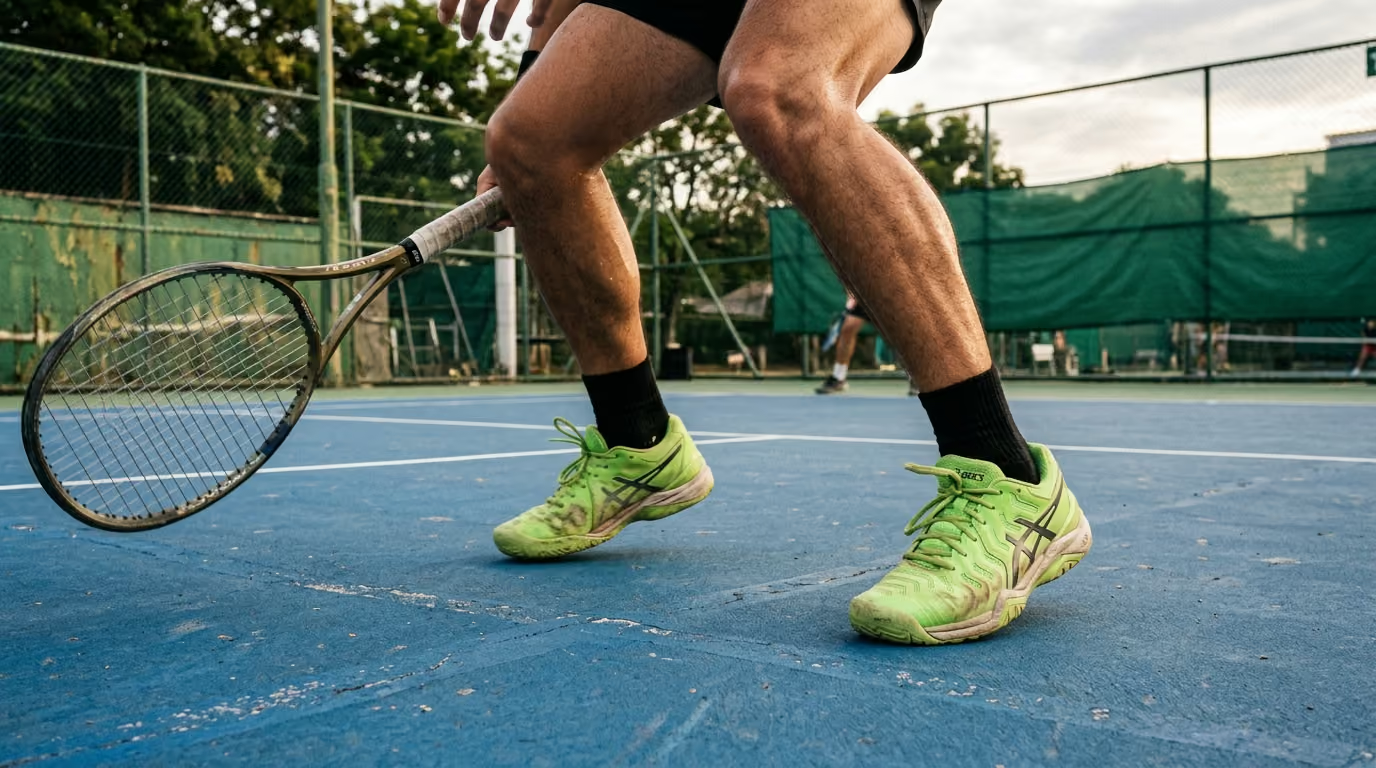
As you reach the ball, your weight must shift onto your outside leg to load the hips. This loading process stores elastic energy in the gluteal muscles and thighs. Simultaneously, you must allow the racquet head or paddle to drop below the level of the incoming ball.
This drop is driven by gravity and relaxation, not by muscular force. Letting the racquet head fall naturally creates a low-to-high swing path, which is essential for generating topspin. Keeping your wrist relaxed during this drop allows for natural acceleration as your body begins to rotate forward.
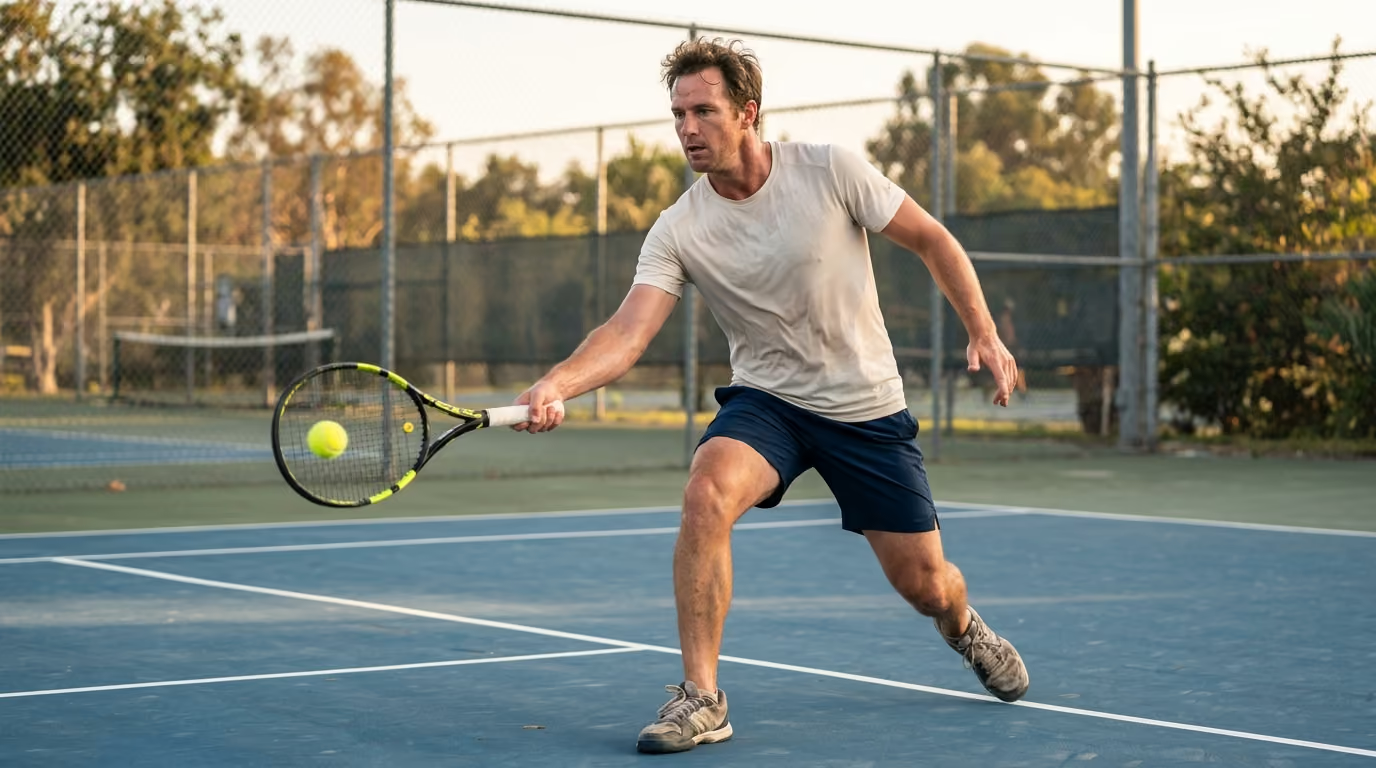
The forward swing begins with the lower body. Your back foot pushes against the ground, rotating your hips forward toward the net. This hip rotation pulls the torso, which in turn pulls the shoulder and arm along the swing path.
Contact must occur ahead of your body, rather than even with your hips. Striking the ball in front allows you to fully transfer your body weight into the shot. The optimal contact height is typically between your hip and belly button, where your shoulder joint is in its most stable and comfortable position.
After contact, the arm must continue along its natural path to decelerate safely. Do not try to stop the racquet or paddle immediately after hitting the ball, as this sudden braking force places immense stress on the shoulder muscles. Let the momentum carry your arm across your body, finishing with your elbow pointing toward your target.
As your swing finishes, your feet must immediately transition back to a balanced position. Step back toward the center of the court using a side-shuffle or cross-over step. A repeatable forehand is not complete until you are balanced and ready to react to the next incoming ball.
Translating theory into muscle memory requires structured practice. We recommend starting with isolated drills that emphasize feel and positioning before moving on to dynamic live rallies.
Our team has tested various progressions, and we find that players improve quickest when they focus on sensory feedback. I remember finishing a tough two hour padel match on a cold Tuesday night and waking up the next morning feeling like my lower back was locked in concrete. For a long time, I just accepted this as the price of playing hard in my forties. But once I started spending just ten minutes on targeted hip mobility before heading to the club, the stiffness almost completely vanished. It taught me that we do not have to accept pain as a default state of aging. Incorporating targeted preparation into your routine is essential for athletic longevity.
To improve your movement and rotation, try the following practical progressions during your next practice session:
This drill removes the complexity of footwork so you can focus entirely on your contact point and hip rotation. Stand in a comfortable semi-open stance at the baseline. Hold a ball in your non-dominant hand, drop it out to your side, and let it bounce.
Focus on turning your shoulders back as you drop the ball, then rotate your hips forward to strike it. Perform three sets of twenty repetitions, concentrating on hitting the ball in front of your lead hip. You can learn more about structuring your practice for high-level movement by reading our guide on mobility and movement resources.
Before you strike a single ball, perform ten slow shadow swings without a ball. Focus on the sensation of your weight shifting from your back foot to your front foot. Stop your swing at the moment of contact and check your position.
Is your elbow bent too tightly against your body? Is your racquet head below your wrist? Adjusting these angles without the distraction of a moving ball builds strong neural pathways. This systematic approach is a core part of optimizing your overall court performance.
Have a partner feed you balls at three different depths: a short ball in the mid-court, a deep ball near the baseline, and a standard medium ball. Your goal is to adjust your feet so that you strike every single ball at the exact same height relative to your body.
If the ball is deep, you must move back quickly to let it fall into your strike zone. If the ball is short, you must move forward to strike it before it drops too low. This drill trains your brain to prioritize spacing over arm adjustments, which is key for consistency.
While the core principles of kinetic sequencing apply to all three sports, the different implements, court sizes, and ball dynamics require specific modifications. Understanding these differences prevents injury when transitioning between sports.
The tennis forehand utilizes a relatively heavy racquet, which averages between 280 and 340 grams, and is played on a large court. Because of the court size and implement weight, the tennis forehand requires a long, looping swing path to generate sufficient depth and spin.
Topspin is highly valued in tennis to help keep fast-moving balls inside the baseline. Players use a semi-western or eastern grip to brush up the back of the ball. The kinetic chain must be fully utilized in tennis, as trying to hit a tennis ball hard with only the arm will quickly lead to shoulder or elbow strain.
Pickleball is played with a lightweight paddle, usually weighing between 200 and 240 grams, on a small court with a low-bouncing plastic ball. Because the court is small and opponents are close, reaction times are incredibly short.
The pickleball forehand requires a much shorter, more compact swing path. The backswing should rarely go past your rear hip, and your shoulder turn is smaller. Because the ball does not bounce as high as a tennis ball, players must bend their knees deeper to get the paddle below the ball, rather than relying on wrist flicking.
Padel is played inside a glass-walled court using a solid, perforated paddle and a pressurized ball. Because the ball can bounce off the walls, players must often wait for the ball to pass them before striking it.
The padel forehand is highly compact, utilizing a short backswing to avoid hitting the back wall or getting jammed by close rebounds. Padel players frequently use a continental grip, which allows them to hit both flat drives and slice variations with minimal grip changes. The follow-through is often abbreviated, keeping the paddle close to the body so the player can quickly transition to the net.
Using a tennis swing on a pickleball court will often cause you to hit the ball out of bounds, while using a pickleball swing on a tennis court will result in shallow, weak shots. Tailoring your swing length to your specific sport protects your joints and improves your accuracy.
In our coaching experience, recreational players tend to fall into the same structural traps when their forehands begin to fail. Recognizing these errors is the first step toward correcting them.
The most common technical error is swing initiation using only the arm and shoulder. This occurs when a player stands flat-footed and pulls the racquet or paddle back with their hand, leaving their hips parallel to the net.
When you arm the ball, you lose the massive power potential of your legs and core. This forces your shoulder and elbow to work twice as hard to generate ball speed, which often leads to tendon irritation. To fix this, focus on turning your chest away from the ball during your preparation.
Many players run directly toward the ball, ending up too close to it at the moment of contact. This mistake destroys your swing mechanics because it deprives your arm of the space needed to extend.
To avoid getting crowded, practice moving your feet to the side of the ball's path rather than directly behind it. Keep your non-dominant hand extended toward the side to feel the space around you. If you maintain proper lateral distance, your swing path will remain smooth and uninterrupted. You can find more targeted advice on preventing these movement-related issues in our guide on injury prevention resources.
An efficient forehand is not just about winning points. It is also about protecting your physical health so you can play for decades. When you use a biomechanically sound stroke, you distribute the physical impact of hitting a ball across your entire muscular system.
When you coordinate your legs, hips, core, and shoulders, no single joint is forced to bear an excessive load. In contrast, an inefficient swing places repetitive micro-trauma on specific tendons. Over time, this constant strain leads to tissue degeneration, chronic inflammation, and prolonged recovery times.
By prioritizing a relaxed, leg-driven forehand, you reduce the physical cost of every match you play. This efficiency keeps your muscles from fatiguing prematurely during a long third set, which helps prevent injuries that occur when tired muscles stop supporting your joints. To learn more about maintaining your physical health as you age, explore our collection of player health articles.
While muscle soreness is a normal response to physical activity, structural pain is a warning sign that should not be ignored. If you experience persistent discomfort, you should take steps to address it before it becomes a chronic injury.
You should consult a licensed healthcare professional, such as a sports physical therapist or orthopedist, if you experience any of the following symptoms:
A physical therapist can analyze your movement patterns, identify muscle imbalances, and design a customized rehabilitation program. Addressing these physical limitations early ensures you can return to the court safely and continue playing the sports you love.
Both stances have a place in a modern groundstroke game, and your choice should depend on the situation. A neutral stance, where you step forward with your lead foot, is excellent for hitting balls that land short, as it helps transfer your body weight forward. An open stance, where your feet remain parallel to the net, is better for wide balls or fast deep balls because it allows you to rotate your hips quickly and recover back to the center of the court faster.
On a scale of one to ten, where ten is a white-knuckle squeeze and one is letting the implement slip out of your hand, you should aim for a grip pressure of three or four. A loose grip allows your wrist to remain flexible, which is essential for generating topspin and absorbing shock. Squeezing the handle too tightly locks your forearm muscles, which reduces swing speed and increases your risk of developing elbow pain.
When your shots consistently fly too deep, it is usually because your racquet or paddle face is slightly open at the moment of contact, or you are failing to generate topspin. Ensure that you are dropping your racquet head below the ball before swinging, which creates the low-to-high path needed to spin the ball down into the court. Additionally, check that you are contacting the ball in front of your body, as late contact often causes the racquet face to point upward.
A rolling wrist is often a sign that you are trying to manipulate the ball with your hand rather than rotating your body. To stabilize your wrist, focus on keeping your forearm muscles firm but not rigid through the contact zone. The rotation of your torso should guide the racquet head forward, while your wrist remains relatively quiet until after the ball has left the strings or paddle.
Follow Evercourts for practical insights on tennis, pickleball and padel performance, movement, recovery and healthy ageing. Stay connected for new articles, research-led guidance and ideas to help you play well and keep playing for years.


Read practical guidance for better movement, smarter preparation and a game that keeps working for you.
explore the Blog