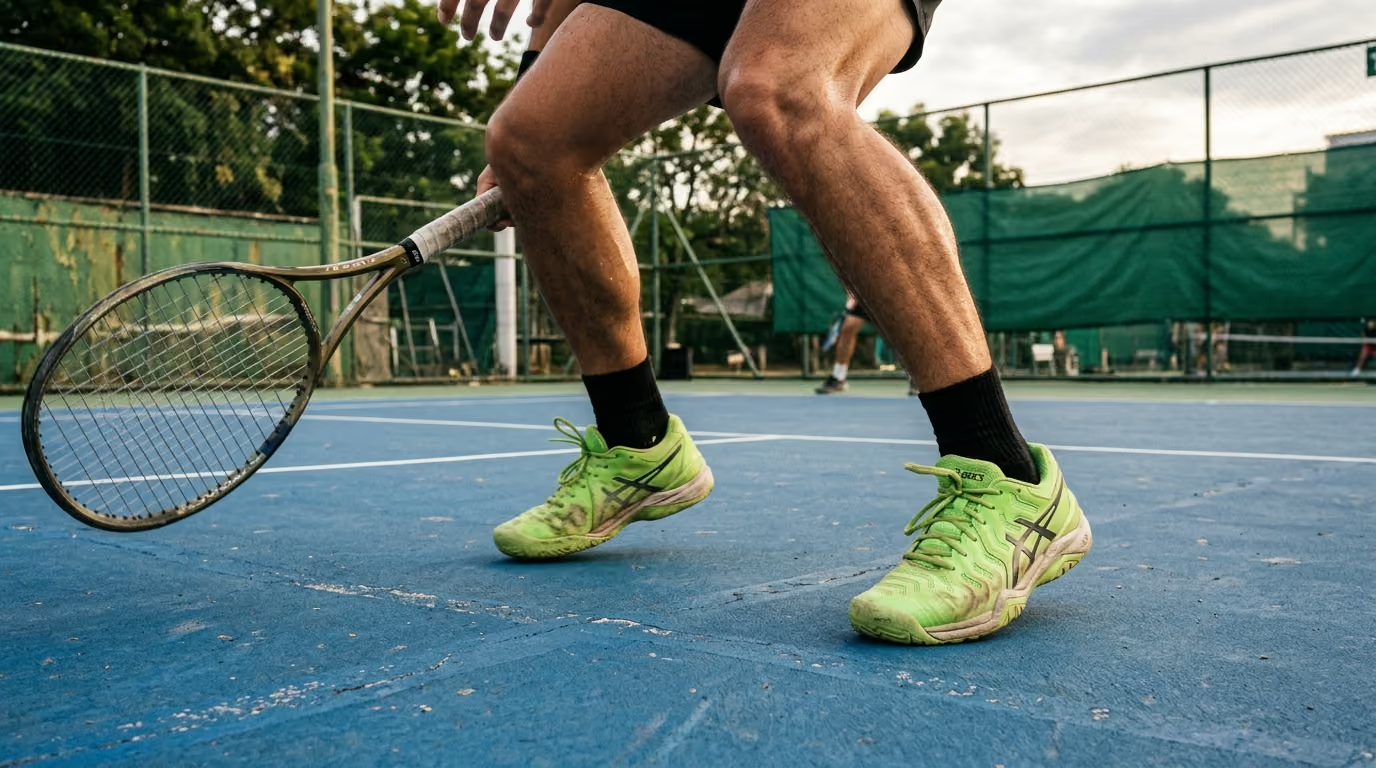
Mature athletes can significantly improve their court agility and change of direction by understanding age-related physical changes and implementing targeted training.




If you notice that stopping quickly on the court feels harder than it did a decade ago, you are experiencing a common physical shift. To move efficiently and avoid injury after age 40, you must train your body to absorb force, read visual cues, and recover your positioning. This guide provides a structured, research-backed system to improve your footwork and dynamic balance on the court.
Many racquet sports players believe that agility training requires running through plastic foot ladders as fast as possible. However, high-speed foot taps do not prepare you for the sudden, unpredictable demands of a competitive match. Real court agility is a complex blend of physical strength, spatial awareness, and decision-making.
To improve your movement, you must first understand the difference between change of direction and true agility. Change of direction is a planned movement along a predetermined path. You know exactly when you will stop, where you will turn, and which foot you will plant. True agility is a physical response to an external stimulus. This stimulus might be the trajectory of a tennis ball, the spin on a pickleball, or the sudden wall rebound of a padel ball.
For the mature player, training planned change of direction builds the structural strength required to handle intense loads. Once you possess that physical foundation, you can introduce reactive agility drills that challenge your brain and muscles together. This progression ensures you can handle the chaotic environment of a live point without overloading your joints.
We focus heavily on healthy aging and athletic longevity at Evercourts. You do not need the absolute sprinting speed of a professional teenager to play high-quality racquet sports. You do, however, need a sufficient braking reserve, single-leg stability, and reaction capacity to play without pain. Building these attributes allows you to stay on the court for decades.
Aging alters how your muscles, tendons, and nervous system interact during sudden movements. These changes are not a sudden switch that turns off your movement capacity. Instead, they represent a gradual reduction in your physical reserve. By understanding these biological shifts, you can tailor your training to target your specific needs.
The primary change is a reduction in rate of force development, which is how quickly your muscles can produce force. While you may retain much of your maximum strength, the split-second push required to reach a wide ball becomes slower. Additionally, your tendons and connective tissues become less compliant over time. This makes them less efficient at absorbing and returning energy during rapid braking and lunging.
Another major shift occurs in your sensory systems. Your proprioception, which is your body's internal GPS for joint position, can become less precise. This affects your dynamic balance, making it harder to stabilize your hips and knees when you land. Slower perception-action coupling also means it takes slightly longer for your brain to process a ball's path and send movement signals to your legs.
The scientific consensus shows that these changes are highly treatable. A systematic review of 20 clinical trials involving 1,632 older adults found that multimodal agility training significantly improved strength, mobility, balance, and endurance. This research demonstrates that your movement system remains highly adaptable as you age. Practical movement training can help maintain your court performance without requiring hours of exhausting gym work.
To train your movement systematically, you can break every court sequence down into five distinct phases. This structured system helps you identify your specific movement bottlenecks.
The first layer is your starting position, which dictates how quickly you can move in any direction. A poor starting stance forces you to make extra adjustment steps before you can even begin to run. Your feet should be placed roughly shoulder-width apart, with your knees and hips softly flexed.
Keep your weight distributed on the balls of your feet so either leg can immediately push off. Your upper body should be slightly forward, with your racket or paddle held in a neutral position. This posture allows you to initiate movement forward, backward, or laterally without wasting precious milliseconds.
Perception is your ability to read the court and anticipate where the next shot will land. You cannot move quickly if you wait until the ball crosses the net to make your decision. You must watch your opponent's body language, including their shoulder tilt and paddle angle.
The flight path, speed, and spin of the ball provide immediate clues about where you need to move. Good players use these early indicators to begin their movement sequence before the ball even bounces. If you only practice pre-planned cone drills, you completely miss this critical perceptual training.
Propulsion is your first explosive step toward the ball. This step rarely starts from a perfectly balanced position. It often requires a powerful lateral push from your outside leg or a quick crossover step.
For many players, the split-step is the foundation of propulsion. Landing softly just as your opponent contacts the ball allows you to store elastic energy in your calves and tendons. You can then redirect this energy to push off aggressively in any direction.
Braking is the most critical phase for players over 40 because it protects your joints from excessive stress. To stop safely, you must lower your center of mass by bending your knees and hips.
Avoid planting your lead leg with a completely straight, rigid knee. Instead, take multiple small adjustment steps to distribute your momentum gradually. This technique transfers the braking forces into your large hip and thigh muscles rather than your knee joints and lower back.
Once you strike the ball, you must immediately transition into the recovery phase. This involves pushing off your plant foot and returning to a tactically advantageous spot on the court.
Recovery requires efficient lateral shuffling or crossover steps that do not leave you off-balance. If you stand upright too early during your recovery, you will be highly vulnerable to your opponent's next shot. Staying low as you return to the center keeps your muscles primed for the next movement sequence.
You cannot change direction quickly if your muscles lack the strength to absorb and produce force. A well-rounded physical preparation routine is essential for maintaining your movement capacity. To get the most out of your time, focus on developing targeted strength, power, mobility, and balance.
Your strength routine should focus on single-leg control and hip stability. Movements like split squats, reverse lunges, and lateral step-downs are highly effective for court players. These exercises train your hips and knees to resist collapsing inward when you plant your foot.
Calf raises and hamstring curls are also essential for protecting your Achilles tendons and knees from sudden deceleration forces. If you are looking for ideas to design your routine, you can read our guide on strength and conditioning resources.
Power is your ability to produce force quickly, which is different from maximum strength. You do not need to perform high-impact plyometric jumps to develop power. Excellent low-impact options include fast sit-to-stands, rapid step-ups, and explosive medicine ball chest passes.
A 2023 review concluded that power training can increase functional capacity related to fall risk more than other types of exercise in older adults. Focus on moving moderate weights with maximum speed during the concentric, or lifting, phase of your exercises.
To change direction safely, your joints must be able to access deep ranges of motion under load. Focus on improving your ankle dorsiflexion, which is your ability to pull your toes toward your shins. Tight ankles force your knees and lower back to absorb excessive impact during deep lunges.
You also need adequate hip rotation to pivot smoothly without twisting your knees. To learn more about improving your joint ranges, check out our section on mobility and movement resources.
Dynamic balance is the ability to control your center of mass while your body is in motion. This is highly distinct from static balance, which involves standing still on one leg. A 2025 network meta-analysis of 49 randomized controlled trials involving 3,028 older adults found significant improvements in dynamic balance after sensorimotor and neurofunctional training.
However, the effects on static balance were not statistically significant. This suggests that you should prioritize movement-based balance challenges, such as single-leg decelerations, over quiet standing exercises.
To improve your movement safely, you must follow a systematic progression. Speed must always be earned through technical control. If you cannot brake and balance at slow speeds, moving faster will only highlight and worsen your technical errors.
Start with simple, predictable drills where you know the exact path of movement. For example, perform a forward sprint for five yards, brake smoothly at a designated line, and hold a balanced single-leg stance for two seconds.
You can also practice lateral shuffles where you focus on keeping your hips low and your feet from crossing over. The goal here is perfect postural control and joint alignment, not maximum speed.
Once you master basic technical patterns, introduce variation to prevent your muscles from memorizing a single rhythm. Alter the distance you travel, change the angle of your cuts from 45 degrees to 90 degrees, and vary your stopping methods.
You can perform diagonal lunges where you alternate between a deep, single-step plant and a multi-step deceleration. This variety teaches your nervous system to adapt to the unpredictable footwork patterns of real play.
This stage introduces a simple reaction demand. Instead of choosing when to turn, you must react to a sudden signal from a partner or coach. Your partner can point left or right, call out a color, or drop a ball that you must catch after a single bounce.
This forces your brain to process external information and quickly translate it into a physical movement. Adding this layer of reaction training bridges the gap between mechanical gym exercises and actual match play.
At this stage, you must make a tactical decision based on what you see. For example, a partner stands across the net and feeds you a random ball. You must instantly decide whether to run forward for a short ball, slide laterally for a wide shot, or retreat diagonally for a deep lob.
This trains your perception-action coupling under realistic time pressure. It ensures that your feet move in harmony with your strategic assessment of the point.
The final stage involves drills that closely mimic your actual sport. Play restricted games on reduced court dimensions with your racket or paddle in hand.
For instance, play a game where all shots must land in the crosscourt half of the court. This creates realistic physical demands, partner communication, and recovery movements while keeping the overall physical volume manageable. For more tips on structured training, explore our library of player health articles.
While tennis, pickleball, and padel share many movement characteristics, each sport places unique physical demands on your body. Understanding these specific nuances allows you to tailor your training for your preferred game.
Tennis is played on a large court, which requires you to cover significant distances. You must routinely perform high-velocity sprints, wide lateral shuffles along the baseline, and deep diagonal recoveries. Because of the court size, tennis players must master the crossover step to cover ground quickly.
You also need excellent structural tolerance for sliding and braking on different surfaces, such as clay, hard courts, or grass. Your training should emphasize longer-distance accelerations and high-energy deceleration steps.
Pickleball is played on a much smaller court, but it features incredibly rapid exchanges. The movement is dominated by short, explosive forward steps to reach the non-volley zone, followed by quick lateral reaches at the kitchen line. Because players over 60 represent a large portion of the pickleball community, managing fall risk is a primary concern.
A 2025 emergency department analysis estimated that pickleball-related injuries in the United States increased from 1,313 in 2014 to 24,461 in 2023. Most of these injuries occurred in players aged 60 to 79, with falls being the leading cause of fractures.
To stay safe, pickleball players must prioritize deceleration control before they reach or lunge for a low ball. Avoid rushing blindly toward the kitchen line without establishing a balanced base of support first.
Padel is unique because of the glass walls surrounding the court, which completely changes your spatial awareness and recovery paths. A systematic review of padel match play shows that the sport involves repeated short accelerations, decelerations, and multi-directional changes. You must frequently run backward and diagonally to track balls that rebound off the walls.
This requires exceptional hip rotation to pivot smoothly, along with rapid adjustment steps to maintain your spacing from the ball. Padel movement training should focus on tracking visual cues, changing angles quickly, and coordinating your positioning with your partner.
Many players over 40 waste time on ineffective training methods or make structural mistakes that increase their risk of injury. Recognizing these common errors can help you streamline your routine and protect your joints.
The belief that agility ladders are a complete training tool is a major misconception. While ladders are useful for warm-ups, rhythm, and coordination, they do not build the qualities needed for real court movement.
They do not require you to decelerate high momentum, push off with maximum force, or react to an unpredictable stimulus. To improve your court play, you must move beyond the ladder and perform drills that require actual braking and redirection.
Many players focus on taking tiny, rapid foot taps without actually moving their center of mass. This fast-feet movement pattern looks impressive, but it is highly inefficient.
On the court, you need purposeful steps that push you toward the ball with minimal waste. Focus on generating clean, powerful force against the ground with your plant leg rather than simply tapping your feet in place.
Some players assume that a deeper lunge is always better for reaching wide shots. However, a deep lunge is only useful if you possess the strength to push back out of it.
If you plant your foot deeply but lose control of your hips and core, you will struggle to recover your court position. It is far better to take a shorter, controlled step that keeps your trunk stable and your joints aligned.
Standing still on a foam pad with your eyes closed is a great starting point for early rehab, but it will not automatically improve your movement during a fast rally. Court balance is highly dynamic and reactive.
You must practice stabilizing your body while landing from a split-step, lunging for a wide shot, or turning your head to track a ball. Your balance training must match the movement challenges you actually experience during play.
To make lasting progress without overtraining, you must design a structured weekly routine. Your agility training should complement your matches and general health guidelines. The World Health Organization recommends that adults perform 150 to 300 minutes of moderate aerobic activity, or 75 to 150 minutes of vigorous activity weekly.
They also suggest muscle-strengthening activities on at least two days per week. For those over 65, incorporating multi-component balance and strength training on three or more days is highly recommended. To learn more about preventing overuse injuries while staying active, explore our injury prevention resources.
Below is a practical weekly template that balances court play, strength, and reactive movement:
When designing your sessions, remember that high-intensity direction changes place massive stress on your joints and tendons. Only progress one training variable at a time. If you increase the speed of a drill, do not also increase the number of repetitions or the sharpness of the turning angle. Give your body at least 48 hours of recovery between intense agility sessions to ensure your tissues can rebuild and strengthen.
Before starting any new training program, it is highly beneficial to assess your current movement quality. These simple field tests can help you establish a baseline and track your progress over time. Focus on how smoothly and stably you move, rather than simply chasing a faster time.
This test measures your basic mobility, balance, and stepping coordination. Start seated in a standard chair, stand up, walk three meters, turn around, walk back, and sit down again.
A healthy adult under 60 should comfortably complete this in under 8 seconds, while those over 60 should finish in under 10 seconds. Note whether you feel unsteady during the turn or need to use your hands to push off the chair.
This simple test assesses your lower-body power and functional leg strength. Sit in a chair with your arms crossed over your chest, then stand up and sit down five times as quickly as possible.
Completing this test in under 12 seconds indicates a solid foundation of functional leg power. If you feel unbalanced or experience knee discomfort, this suggests you need to develop more basic leg strength before attempting high-speed court cuts.
Stand on a step or low box that is roughly six inches high. Slowly lower one foot toward the floor, tap your heel gently, and return to the starting position. Repeat this movement five times on each leg while watching yourself in a mirror.
Observe whether your knee collapses inward or your pelvis tilts sideways as you lower your foot. Maintaining a stable hip and knee during this test is a strong indicator that your joints can handle lateral court forces.
While structured movement training is highly beneficial, you must always listen to your body's warning signs. Agility training should never cause sharp pain, joint swelling, or persistent discomfort. Knowing when to step back and seek professional guidance can prevent a minor irritation from becoming a long-term injury.
Consult a qualified healthcare provider, such as a physical therapist or sports medicine physician, if you experience:
A physical therapist can perform a detailed movement analysis, identify specific muscle imbalances, and design a customized rehabilitation program. This professional support ensures you can address physical limitations safely and return to the court with confidence.
To apply this guide to your routine, focus on a few manageable steps this week. This practical checklist will help you build your movement skills safely.
Follow Evercourts for practical insights on tennis, pickleball and padel performance, movement, recovery and healthy ageing. Stay connected for new articles, research-led guidance and ideas to help you play well and keep playing for years.


Read practical guidance for better movement, smarter preparation and a game that keeps working for you.
explore the Blog