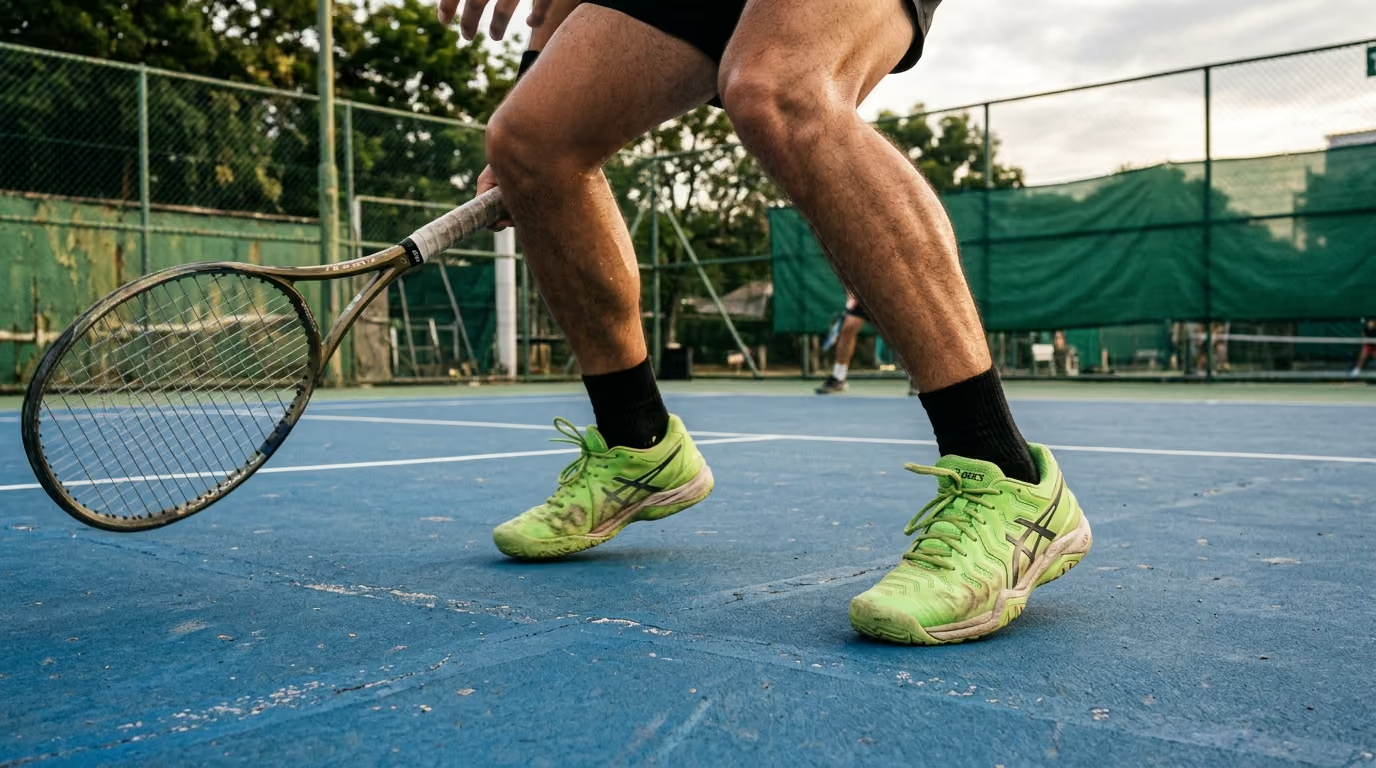
True agility in racquet sports involves a complex interplay of physical strength, deceleration mechanics, and cognitive decision-making, far beyond simple ladder drills.




Most tennis, pickleball, and padel players spend their warm-up time running through plastic agility ladders laid flat on the court. They believe these rapid, choreographed steps make them faster during a match. However, chasing a ball is never choreographed. True agility is not about how quickly you can tap your feet inside a plastic square. It is a highly integrated process of reading the court, reacting to a stimulus, and applying force to change direction.
True court agility is the ability to change direction rapidly and efficiently in response to an unpredictable ball or opponent. To improve this skill, you must combine physical strength, deceleration mechanics, and cognitive decision-making. Standard ladder work fails because it lacks the visual cues and heavy braking required in a real game.
To build a better movement program, you must understand the difference between change-of-direction speed and true agility. Change of direction is a planned movement where you know exactly where you are going before you start. For example, running a preplanned shuttle run on a court is a change of direction task. You do not have to think, react, or read any cues. You simply run to a cone, turn, and run back.
Agility is completely different. Agility is a rapid, whole-body movement with a change of velocity or direction in response to an unpredictable stimulus. This stimulus might be an opponent's racket angle, a sudden ball deflection off a net cord, or a tactical shift. In a real match, you never move without a stimulus. Your brain must constantly perceive what is happening, make a decision, and then execute the movement.
Research shows that these two qualities are not the same. Studies comparing preplanned movement tests with reactive agility tests show surprisingly low correlations, ranging from r = 0.17 to 0.54. This means a player who is incredibly fast during a preplanned cone drill might be slow and hesitant during a live point. The reactive condition is always slower because of the time it takes to process the visual information. Therefore, if you only train with planned drills, you are only training half of the movement equation.
To improve your performance, you must target both the physical qualities and the cognitive pathways. You can build your raw movement capacity by working on your strength and conditioning guides. Once you have the raw strength, you must learn to apply it under pressure. This requires transition drills that challenge your decision-making and visual processing on the court.
To understand how agility works in a live rally, we can break the cognitive process into four distinct steps. This loop occurs in a fraction of a second every time your opponent strikes the ball.
First, your brain receives sensory input. Your eyes track the flight of the ball and the movement of your opponent's racket. This visual data must be sent to your brain instantly.
Second, your brain processes this information. Based on your past court experience, you recognize patterns in the ball's spin, speed, and trajectory. This step allows you to anticipate where the ball will land before it even crosses the net.
Third, you make a decision. You choose the best tactical response, such as a defensive slice or an offensive drive. Finally, your brain signals your muscles to execute the movement. If any of these steps are slow or weak, your physical speed on the court will suffer.
Racquet-sport movement is a continuous, looping process rather than a series of isolated actions. We can break this loop down into six distinct phases. Understanding these phases helps you identify exactly where your movement patterns are breaking down. It also helps you select the right gym exercises and court drills to address your specific weaknesses.
The first phase begins before you even know your final destination. You must watch the opponent, read their body language, and time your split-step. A well-timed split-step allows you to store elastic energy in your tendons. It prepares your body to push off in any direction as soon as the ball leaves the opponent's racket.
Once you identify the ball's trajectory, you must project your center of mass toward it. In racquet sports, you rarely run in a straight line for long distances. Instead, you use a combination of lateral pushes, crossover steps, and short bursts. The goal is to gain useful horizontal velocity over just two to three steps.
Braking is where many recreational players struggle and lose valuable time. As you approach the ball, you must lower your center of mass and dissipate your forward momentum. This requires intense eccentric muscle action, particularly in your quads and glutes. If you cannot brake efficiently, you will run past the ball or hit your shot while off-balance.
You place your feet to establish a stable base for your stroke. During this brief ground contact, you convert your incoming momentum into a new direction. Your ankle, knee, and hip joints must remain stiff and stable to transmit force efficiently.
After striking the ball, you must push off forcefully to exit the stroke. This phase requires rapid hip extension and strong concentric force production. The faster you can transition from the plant to reacceleration, the more time you will have to recover.
Finally, you must return to a tactically useful position on the court. You might use a lateral shuffle, a crossover step, or a quick pivot. As you recover, you must immediately begin watching your opponent again, restarting the entire six-step loop.
Agility ladders are popular because they look impressive and make you feel fast. They are useful for warm-ups, basic coordination, and introducing youth players to foot control. However, they do not build high-level agility for adult racquet sports. Ladders fail to replicate the true demands of a competitive match in several key ways.
First, ladders offer zero perceptual uncertainty. You always know where your feet are supposed to land next. This completely removes the cognitive aspect of agility. In a match, your eyes must watch the ball and your opponent, not your feet. If you train yourself to look down at the ground, you develop poor habits that hurt your vision on the court.
Second, ladder drills do not require heavy braking or acceleration forces. You move your feet quickly, but you do not cover much physical ground. Your center of mass stays relatively still while your feet tap rapidly beneath you. This does not train the eccentric strength needed to stop a full-speed sprint at the baseline. It also does not train the horizontal power needed to explode toward a short ball.
Third, ladders do not involve racket preparation or stroke timing. Moving through a ladder does not teach you how to organize your upper body while your lower body is moving. To build real agility, you must practice coordinating your footwork with your swing. This is why we recommend moving away from passive ladder drills. Instead, focus on dynamic court drills that involve reactive cues, heavy stops, and immediate recoveries.
In sports science, a motor program is a specific sequence of muscle movements stored in your brain. Your brain develops highly specific programs for different activities. When you perform ladder drills, your brain creates a motor program for rapid, low-force vertical steps. This program does not help you when you need to make a high-force lateral cut on a wet clay court.
Because the movement demands are so different, training on a ladder has almost no transfer to court speed. To make your training transfer, you must practice drills that mimic the forces and visual demands of your sport. You need to feel the physical weight of braking, the stretch of a deep lunge, and the challenge of reacting to an opponent.
To move quickly on the court, you must first build the physical engine in the gym. Your ability to accelerate, brake, and redirect depends entirely on how much force your muscles can produce and absorb. A comprehensive physical preparation program should focus on three main areas: relative strength, eccentric braking, and plyometrics. You can find more detail on these principles in our mobility and movement resources.
Because racquet sports require you to push off one leg at a time, single-leg exercises are essential. Rear-foot-elevated split squats, step-ups, and lateral lunges are excellent choices. These movements build strength in your glutes, quads, and hamstrings while improving your pelvic stability. They also help balance any strength discrepancies between your dominant and non-dominant legs.
To perform a rear-foot-elevated split squat correctly, stand about two feet in front of a bench. Place the top of your back foot flat on the bench behind you. Lower your hips until your back knee is just above the floor, keeping your front knee aligned over your toes. Push through your front heel to return to the starting position. Perform three sets of eight repetitions on each leg, focusing on a controlled descent.
Another vital exercise is the lateral lunge with a stick or light weight. Stand with your feet together, then take a large step to the side with your right foot. Bend your right knee and push your hips back, keeping your left leg completely straight. Push off your right foot to return to the starting stance. This exercise directly replicates the lateral pushing forces required during court movement.
Next, you must train your muscles to absorb force. This is known as eccentric strength, and it is the foundation of good braking. You can train this by using slow, controlled eccentrics in the gym. For example, perform split squats where you take four to five seconds to lower your hips. Deceleration drops, where you step off a small box and land softly in a deep squat, also train this quality.
Recent research, including a 2026 meta-analysis, suggests that flywheel resistance training is another highly effective tool for improving change-of-direction performance. Flywheel devices use the inertia of a spinning disc to create resistance. The harder you pull during the upward phase, the harder the machine pulls back during the downward phase. This creates an overloaded eccentric phase, mimicking the intense braking forces you feel when stopping on the court.
Finally, you need plyometric training to translate your strength into speed. Plyometrics train your muscles and tendons to use the stretch-shortening cycle. A 2023 meta-analysis of fourteen studies found that plyometric training has a significant positive effect on power, sprint speed, and reaction time. For racquet sports, your plyometric work should progress from basic double-leg hops to single-leg lateral bounds.
Start with low-intensity pogo hops to build tendon stiffness in your lower legs. Stand tall and hop rapidly on the balls of your feet, keeping your ankles stiff. Your heels should barely touch the ground, and your knees should bend only slightly. This exercise trains your body to bounce off the court surface quickly, improving your first-step quickness.
Once you master pogo hops, progress to lateral bounds. Stand on your right leg, bend your knee slightly, and jump laterally to your left. Land softly on your left leg and hold your balance for two seconds before jumping back. This exercise teaches your body to absorb lateral forces and maintain balance under dynamic conditions. Refer to our injury prevention resources for more details on landing safety.
Having strong muscles is only useful if you know how to use them on the court. Good braking mechanics prevent you from sliding out of position and protect your joints from excessive stress. When you prepare to stop, your goal is to lower your center of mass and extend your braking foot. This foot must be placed far enough outside or ahead of your body to create a strong braking impulse.
As you plant your foot, try to land with a forefoot or midfoot footfall rather than a heavy heel strike. This allows your calf and ankle complex to absorb the initial impact. Your knee and hip should bend slightly to help dissipate the force. Avoid letting your knee collapse inward, a movement known as knee valgus. Keeping your knee aligned over your toes protects your ligaments and creates a stronger platform for your next movement.
Your trunk position is also critical during the braking phase. Keep your chest up and avoid leaning too far forward or backward. A slight lean in the direction you want to go next is ideal. This position, known as trunk inclination, helps you transition immediately from braking to reacceleration. According to a 2025 systematic review, athletes who maintain a lower center of mass and optimal trunk inclination show much faster change-of-direction times.
Many players believe that deceleration happens entirely on the final plant step. However, elite movement relies heavily on the penultimate step, which is the step just before the final plant. The penultimate step does a significant portion of the braking work, slowing your body down so the final step can focus on redirection.
If your penultimate step is weak, your final plant foot must absorb too much force. This often leads to knee pain, hip instability, and poor balance during your stroke. To train this, practice taking a long, low step with your trailing leg just before you plant your lead leg. This low step helps dissipate your momentum smoothly and keeps your body under control.
To practice these mechanics, try the two-step deceleration drill. Start in an athletic stance, then take two explosive steps forward. On the second step, plant your lead foot firmly and lower your hips into a deep, balanced position. Hold this final position for two seconds to check your balance and posture.
Your chest should be slightly forward, your knees should be aligned over your toes, and your feet should be wider than shoulder-width. If you find yourself wobbling or stepping forward to save your balance, you need to work on your eccentric control. Gradually increase your approach speed as your braking technique improves, ensuring you maintain a stable stance every time.
While all racquet sports share some basic movement principles, each sport has its own unique demands. You must tailor your agility training to match the specific court dimensions, distances, and patterns of your chosen game. Training for tennis is not the same as training for pickleball or padel.
Tennis is played on a large court and involves relatively long movement distances. Research shows that over 70 percent of professional tennis movements are lateral, with less than 20 percent being forward and less than 10 percent being backward. A 2024 analysis of matches at the Australian Open revealed that players perform about 1.6 changes of direction per point. These movements occur every 2.7 seconds for men and 3.1 seconds for women.
Interestingly, the analysis showed that nearly 90 percent of these directional changes are of medium intensity. However, players must still be prepared for extreme, high-intensity movements at the ends of the court. Elite tennis movement requires covering an average of 3.7 meters before hitting a wide ball, and 3.9 meters to recover afterward. To train for tennis, your drills should include longer lateral runs, crossover steps, and open-stance recovery slides along the baseline.
Pickleball is played on a much smaller court, which dramatically changes the movement requirements. You do not need to cover long distances at a full sprint. Instead, pickleball demands exceptional first-step quickness, lateral shuffling, and micro-adjustments. You must be able to move sideways along the non-volley zone line while keeping your body low and stable.
Your pickleball agility training should focus on short, explosive lateral steps. Practice the split-step to lateral push, ensuring you do not jump too high in the air. Keep your center of mass low to the ground so you can react quickly to fast-paced volleys. Because of the quick transitions, your ability to recover your balance after a reach is just as important as your first step.
Padel combines elements of tennis and squash, introducing unique movement challenges. The presence of the glass walls means you must frequently turn, run backward, and track the ball's rebound. Padel movement requires a high volume of short, multidirectional adjustments. You must be comfortable turning your back to the net, letting the ball pass, and then rapidly turning to strike.
In our experience, the physical demands of padel can be particularly tough on the lower back and hips. I remember finishing a tough two hour padel match on a cold Tuesday night and waking up the next morning feeling like my lower back was locked in concrete. For a long time, I just accepted this as the price of playing hard in my forties. But once I started spending just ten minutes on targeted hip mobility before heading to the club, the stiffness almost completely vanished.
It taught me that we do not have to accept pain as a default state of aging. By incorporating targeted hip and trunk mobility into your routine, you can protect your back while improving your rotational agility on the court. Check the Evercourts platform for more tips on managing the unique physical stresses of padel.
Badminton requires rapid movement from a central base to the front, side, and back of the court. The deep lunge is the signature movement of badminton. This action combines rapid acceleration with intense, single-leg braking. Biomechanical research shows that the left-forward lunge can produce a vertical impact force of 2.34 times your body weight.
Because of these high forces, you must train different lunge variations to prepare your joints. Research indicates that hop lunges produce greater joint loading and drive-off power compared to step-in lunges. Step-in lunges, on the other hand, show lower horizontal reaction forces and are easier to control. Your training should include both variations to build a robust, injury-resistant movement profile.
Squash is a game of continuous acceleration and deceleration inside an enclosed space. You must move into tight corners, strike the ball from very low positions, and immediately recover to the central T-position. Because you are playing close to the walls, you must avoid excessive chest rotation that could cause you to lose sight of the ball.
Squash agility drills should emphasize corner entries and exits. Practice lunging deep into a corner, keeping your hips low, and then pushing back to the center of the court. Your training must also focus on maintaining visual awareness of the ball while your body is turning and recovering.
To know if your training is working, you must test your movement qualities regularly. A complete testing battery should separate your physical change-of-direction speed from your reactive agility. By testing both, you can see if your bottleneck is physical strength or visual processing.
To measure your physical capacity, you can use standard, preplanned change-of-direction tests. The pro-agility shuttle and the 505 test are two excellent options. Research shows that these planned tests have high reliability, with typical errors of less than 2.4 percent. They are easy to set up with cones and a stopwatch.
The 505 test is particularly useful for measuring deceleration and acceleration. Set up a line of cones five meters away from a starting point, and another line ten meters away. Run forward ten meters, plant your foot on the far line, turn 180 degrees, and sprint back five meters. This test measures your pure physical ability to stop and restart without any cognitive confusion.
To measure your cognitive movement speed, you must use reactive agility tests. These tests require you to change direction in response to an unpredictable cue. You can set this up by having a partner stand in front of you. As you approach, they point left or right, and you must react instantly.
You can also use a randomized ball feed or a colored light system. If you have access to a video camera, record your reactive tests and compare them to your planned tests. The time difference between the two is your reactive agility deficit. A large deficit means you need to spend more time on reactive drills and less time on pure strength training.
When tracking your test results, it is important to keep the testing conditions identical. Use the same court surface, the same athletic footwear, and the same warm-up routine. Research in adolescent athletes has shown that test results can vary widely if the surface or equipment changes. Keeping your testing consistent ensures that any improvements you see are the result of your hard work rather than random variables.
Many recreational players make simple mistakes that limit their speed and increase their risk of injury. Recognizing these errors is the first step toward improving your movement efficiency.
The most common mistake is believing that fast feet equal fast movement. Players often take many tiny, rapid steps without actually moving their bodies very far. This looks impressive, but it is highly inefficient. True agility requires you to produce large horizontal forces against the ground. Instead of taking small tapping steps, focus on pushing the court away with your outside leg to cover more distance.
While a low athletic stance is important, some players crouch excessively. Crouching too low restricts your hip mobility and makes it difficult to take a quick first step. It also places immense strain on your quadriceps, causing your legs to fatigue quickly. Keep your knees bent and your body active, but maintain a posture that allows your hips to move freely in all directions.
The crossover step is highly efficient for covering long lateral distances, such as running down a wide ball in tennis. However, many players use it for short adjustments where a simple shuffle or chasse step would be better. Crossover steps turn your hips away from the net, making it harder to prepare your racket. For short adjustments of one to two steps, use a lateral shuffle to keep your body facing forward and ready.
Many players only work on their agility at the end of a hard practice session when they are already exhausted. While training under fatigue has its place, it is a poor way to learn new movement patterns. When you are tired, your braking mechanics degrade, and you are more likely to use poor technique. To build better agility, perform your high-intensity movement drills early in your session when your brain and muscles are fresh.
Improving your agility on the court places significant physical demands on your body. The heavy braking forces required to stop a sprint can strain your muscles, tendons, and joints if you are not prepared. Therefore, your training program must balance active movement with targeted recovery.
To protect your joints, you must gradually build your tolerance to deceleration forces. Do not jump immediately into high-intensity reactive drills. Start with controlled, preplanned movements and focus on soft, balanced landings. This gradual progression gives your tendons and ligaments time to adapt to the heavy loads.
Between your sessions, prioritize active recovery to keep your tissues healthy. Focus on maintaining flexibility in your hips, calves, and ankles. Adequate hydration and sleep are also essential for tissue repair and neurological recovery. By taking care of your body off the court, you ensure that you can continue playing the sports you love for years to come. Read through our articles on player health for more recovery guidance.
While some muscle soreness is normal after a tough workout, you should never ignore persistent pain or discomfort. If you experience any of the following signs, it is time to consult a qualified healthcare provider:
A physical therapist or sports medicine specialist can help you identify any biomechanical issues and design a safe path back to the court. For more information on staying healthy, check out our player health section.
By focusing on these principles, you can move more efficiently, protect your joints, and enjoy your time on the court for years to come. For more practical guides and expert advice, visit the Evercourts homepage or read through our mobility and movement resources.
Follow Evercourts for practical insights on tennis, pickleball and padel performance, movement, recovery and healthy ageing. Stay connected for new articles, research-led guidance and ideas to help you play well and keep playing for years.


Read practical guidance for better movement, smarter preparation and a game that keeps working for you.
explore the Blog