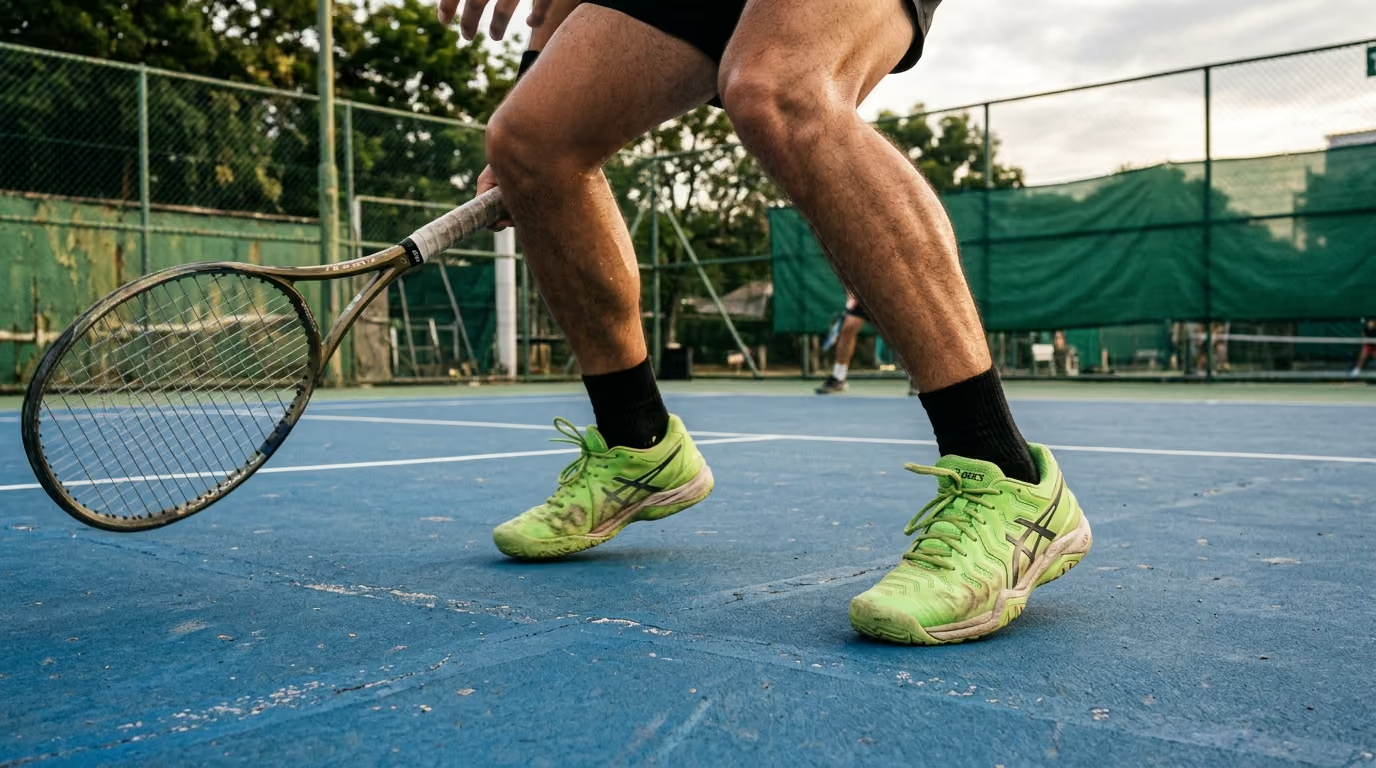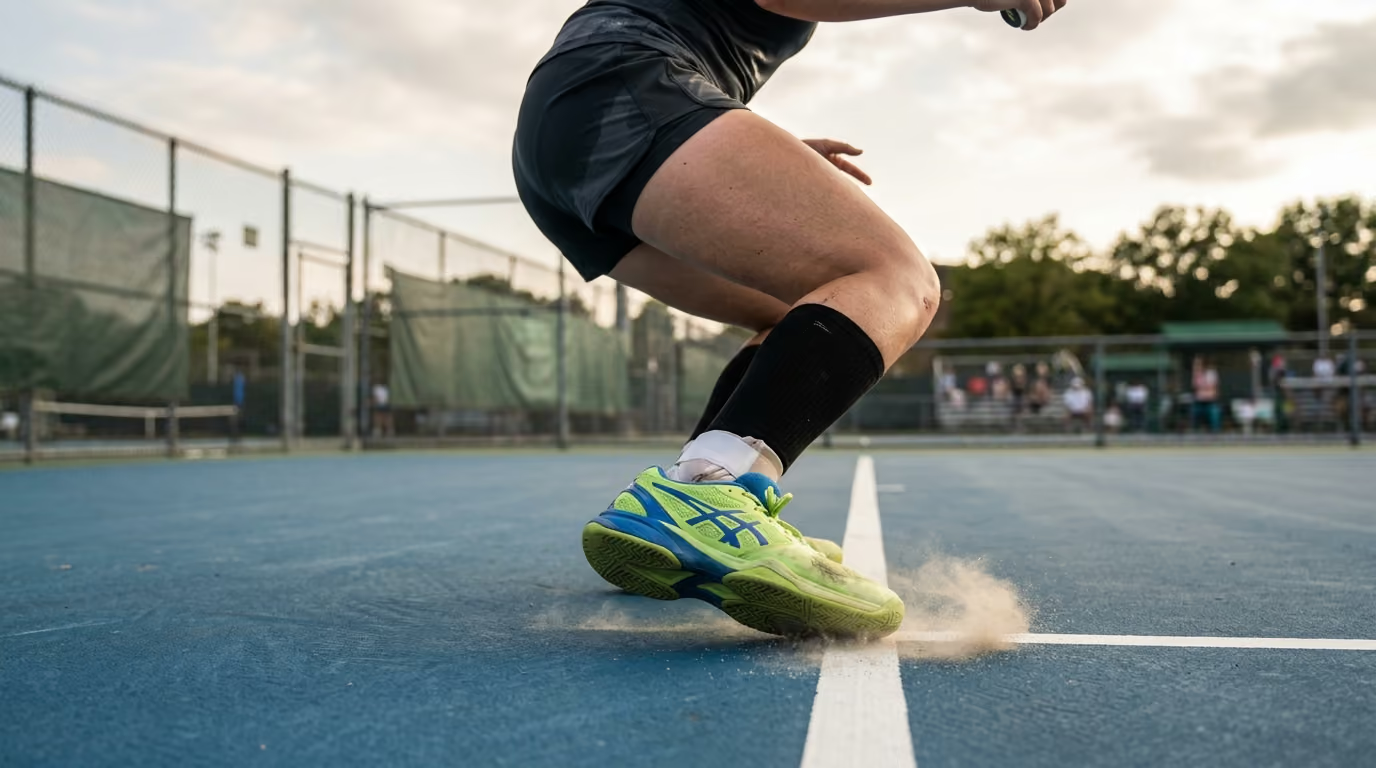

Court players can achieve perfect balance, execute cleaner shots, and recover faster by mastering the biomechanics of braking, stopping, and changing direction.




Most court players spend their training time trying to get faster. They buy lighter shoes, practice sprint starts, and perform ladder drills. However, the true mark of an elite mover is not how quickly they start, but how efficiently they stop.
High-quality court movement relies on your ability to reduce forward momentum before you strike the ball. By mastering the biomechanics of braking, you can arrive at the ball with perfect balance, execute a cleaner shot, and recover your position much faster. This complete guide breaks down the physical, technical, and practical elements of court deceleration to help you build athletic longevity.
To improve your court movement, you must first understand the physics of deceleration. In scientific terms, deceleration is the reduction of velocity over time. When you sprint across the court, your body builds momentum. Momentum is the product of your body mass and your velocity.
Because your body weight remains constant during a match, you must control your velocity to manage momentum. If you approach the ball at maximum speed without a plan to slow down, you will overrun your shot. This forces you to make emergency adjustments, which ruins your balance and reduces shot accuracy.
To slow your body down, you must produce a braking impulse. Impulse is the product of force and time. To reduce your momentum to zero or redirect it, you must apply force against the ground in the opposite direction of your travel. You can achieve this by applying a large force over a short time, or by distributing smaller forces over multiple steps.
The placement of your center of mass relative to your feet is critical during this process. Your center of mass is the central point of your body weight, located near your hips. If you plant your braking foot too far ahead of your center of mass, you create a harsh braking force. This can cause joint instability or a sticking action that stalls your movement. If you plant your foot too close to your body, you will fail to slow down and will run past the ball.
Stopping on a court is not a single event. It is a highly coordinated sequence of movements that occurs over several steps. To train this skill effectively, you must understand each phase of the sequence.
The braking sequence begins before your foot ever touches the ground. Your brain must first detect your destination by reading the ball flight, your opponent's movement, or the court boundaries. Once you recognize the need to slow down, your body prepares to accept force.
During this preparation phase, you must transition from ground-covering strides to shorter, quicker steps. This adjustment lowers your center of mass and increases your step frequency. This preparation prevents unnecessary vertical bouncing and stabilizes your trunk.
The penultimate step is the second-to-last step before you stop or change direction. Sports science research shows that this step is the most critical part of the braking process. For sharp turns of sixty degrees or more, the penultimate step absorbs the majority of your forward momentum.
Using the penultimate step to brake protects your final plant foot from taking the entire impact. During this step, you lower your hips, widen your stance, and orient your pelvis toward your target. This action ensures you do not rely on an emergency stop during the final step.
The final contact completes your deceleration and prepares you for the next movement. Your final foot plant must be strong, stable, and precisely aligned. You must maintain stiffness in your ankle while allowing your knee and hip to bend slightly to absorb the remaining force.
Your trunk must remain upright and stable during this final contact. Leaning too far forward or backward during the final step makes it difficult to swing your racquet or paddle. A stable final plant allows you to transfer your weight smoothly into your stroke.
Once you have controlled your momentum, you must rotate your body toward your next destination. This reorientation requires you to turn your hips, chest, and feet toward the center of the court.
The ultimate goal of braking is to transition smoothly into reacceleration. If you brake with good technique, you can push off your plant foot and return to position immediately. If your braking is sloppy, you will waste valuable seconds regaining your balance before you can move again.
Deceleration places massive physical demands on your muscles, joints, and connective tissues. The forces experienced during a sudden stop are significantly higher than those felt during acceleration. Research shows that horizontal deceleration produces high-impact ground reaction forces and rapid loading rates.
During high-intensity deceleration, peak vertical forces can reach up to 5.9 times your body weight. This is approximately 2.7 times greater than the peak forces recorded during maximal acceleration. These intense forces are concentrated into a tiny window of time, often lasting less than 50 milliseconds.
Because these forces arrive so quickly, your body must absorb them using eccentric muscle contractions. An eccentric contraction occurs when a muscle lengthens under tension, such as your quadriceps and calves during a deep landing. This type of muscle action causes micro-tears in the muscle fibers, which can lead to soreness and fatigue.
Repeated, poorly managed deceleration loading can accumulate stress in your joints and tendons. This stress is a primary contributor to patellar tendinitis, Achilles tendon pain, and lower back stiffness. It is also linked to ligament injuries, such as ACL tears, when players attempt to change direction with poor pelvic control.
To protect your tissues, you must learn to distribute these forces across multiple joints. By bending your ankles, knees, and hips together, you allow your large muscle groups to share the load. This prevents any single joint or tendon from taking the brunt of the impact. For deeper training on joint health, you can read our player health articles.
You cannot build braking skills simply by playing more matches. Generic fitness routines and agility ladder drills often fail to replicate the high-force demands of stopping. You need a structured, progressive program that teaches your body to absorb and redirect force safely.
To design a training routine that builds athletic longevity, you can check out our athletic longevity resources. Use the following five-stage progression to improve your deceleration technique.
Before you practice high-speed stops, you must master deceleration at slower speeds. Start with simple walk-to-stop and jog-to-stop drills. Focus on stopping completely within two steps, ensuring your front foot points forward and your hips are low.
Perform bilateral and unilateral holds at the end of each stop. Hold your final position for three seconds to test your balance. If you wobble or tip over, you are moving too fast or stepping too narrow.
Once you can stop with perfect balance at low speeds, increase your approach velocity. Sprint forward for five to ten meters, then use a planned three-step sequence to come to a complete stop.
Practice this drill using different stopping angles. Perform linear stops, lateral stops, and diagonal stops. Always focus on using the penultimate step to absorb the initial force before the final foot plant.
In this stage, you transition from a complete stop to a change of direction. Sprint toward a marker, decelerate, and immediately push off into a new direction.
Start with wide angles, such as forty-five-degree cuts, which allow you to preserve some momentum. Gradually progress to ninety-degree cuts and one-hundred-and-eighty-degree turns. Film your movement to ensure your knee tracks in the same direction as your foot.
Real matches do not allow you to plan your stops. You must respond to an unpredictable ball or opponent. Reactive drills help transfer your physical capacity into usable court skills.
Have a partner stand across from you and point left, right, forward, or backward. You must react to their signal by sprinting in that direction, then braking instantly when they yell stop. This teaches your body to manage forces under cognitive pressure and uncertainty.
The final stage of the progression tests your braking skills under simulated match conditions. Perform high-intensity court movement drills for thirty to forty-five seconds to induce mild fatigue.
Monitor how your stopping technique changes as you get tired. If your steps widen, your trunk sways, or your knees collapse, reduce the intensity. Training with degraded movement patterns increases your risk of injury and reinforces bad habits.
While the physical laws of momentum apply to all athletes, the way you brake depends on your specific sport. Tennis, pickleball, and padel each feature unique court sizes, surfaces, and tactical demands.
Tennis players cover the largest distances of the three sports. You must sprint across twenty-seven feet of court width for singles, often reaching very high speeds. This requires massive deceleration capacity to stop before hitting a wide groundstroke.
On clay courts, players use a controlled slide to brake. This sliding technique allows you to decelerate progressively over a longer distance, which reduces peak joint stress. On hard courts, however, high friction causes immediate stops. You must rely on a strong penultimate step and a wide final plant to avoid rolling your ankle.
Pickleball is played on a much smaller court, which limits your maximum sprint speed. However, the game demands rapid, short-distance adjustments. Your primary braking challenge occurs when rushing from the baseline to the non-volley zone, also known as the kitchen line.
You must stop your forward momentum completely before you reach the kitchen line. Stepping on or over this line during a volley is a rule violation. Because the ball travels incredibly fast, you must combine your stop with a balanced split step. This allows you to respond to low dinks or fast drives with equal ease.
Padel is played in an enclosed glass cage on a synthetic turf surface covered in sand. This surface offers less traction than a hard court, which can cause minor slipping. Padel players must master the art of turning around to chase balls off the back glass wall.
This movement requires you to sprint backward, brake your momentum, rotate your hips, and then sprint forward again. Because of the tight space, you cannot use long, looping strides. You must rely on short, rapid recovery steps and a low center of mass to maintain balance near the walls. To improve your court agility, check out our mobility & movement resources.
Many recreational players make consistent errors when trying to slow down on the court. These mistakes reduce your speed and put unnecessary strain on your body.
Many players believe that fast footwork on an agility ladder translates to better court movement. This is a common misconception. Ladder drills teach you to tap your feet quickly, but they do not teach you to absorb high-impact braking forces.
To stop effectively, you must learn to apply force deep into the court surface. High-intensity deceleration requires strong eccentric muscle actions, not just quick foot taps. If you only practice light, fast steps, your joints will struggle to manage the impact of a real match.
A very common mistake is waiting until the last possible second to stop. Players often sprint at full speed and try to absorb all their momentum in a single, massive final step.
This single-step strategy places extreme stress on the front knee, ankle, and hip. It also leaves you completely unbalanced, making a controlled stroke nearly impossible. You must train your body to start braking one or two steps before you reach your hitting position.
Coaches often tell players to stay low on the court. While a lower center of mass improves stability, crouching excessively can restrict your movement.
If you bend your knees too deeply during a stop, you lock your joints in a deep squat. This position makes it very difficult to push off and recover your position. Your knees should bend enough to absorb shock, but not so much that you lose your athletic posture.
Some players try to avoid joint pain by making their stops as quiet and soft as possible. While minimizing landing impact is generally good, you still need to apply force to slow down.
If you focus only on landing softly, you will take too long to decelerate. This delay gives your opponent more time to hit the ball away from you. You must strike a balance between force absorption and quick, decisive foot placement.
Because deceleration involves high forces and eccentric muscle actions, it causes significant physical fatigue. This fatigue can linger long after your session has ended. To maintain athletic longevity, you must prioritize your recovery.
I remember finishing a tough two hour padel match on a cold Tuesday night and waking up the next morning feeling like my lower back was locked in concrete. For a long time, I just accepted this as the price of playing hard in my forties. But once I started spending just ten minutes on targeted hip mobility before heading to the club, the stiffness almost completely vanished. It taught me that we do not have to accept pain as a default state of aging.
To recover from heavy braking sessions, you must give your muscles time to repair. Eccentric damage often peaks forty-eight hours after a hard workout, a condition known as delayed onset muscle soreness. Avoid scheduling intense deceleration practices on consecutive days.
You can learn more about managing muscle soreness by checking out our recovery science resources. Passive recovery, such as adequate sleep and hydration, is essential. Gentle movement, like walking or cycling, also helps flush out metabolic waste and reduce joint stiffness.
While some muscle soreness is normal after playing, you must learn to distinguish between fatigue and injury. Pushing through joint pain can lead to chronic damage that keeps you off the court for months.
You should consult a qualified healthcare provider if you experience any of the following warning signs:
A physical therapist can assess your movement mechanics and identify strength imbalances. They can also design a customized rehabilitation program to help you return to the court safely.
Mastering the art of stopping is the most effective way to improve your court performance and protect your body as you age. Spend time practicing your braking mechanics, and you will enjoy a faster, safer, and more controlled game.
Follow Evercourts for practical insights on tennis, pickleball and padel performance, movement, recovery and healthy ageing. Stay connected for new articles, research-led guidance and ideas to help you play well and keep playing for years.


Read practical guidance for better movement, smarter preparation and a game that keeps working for you.
explore the Blog