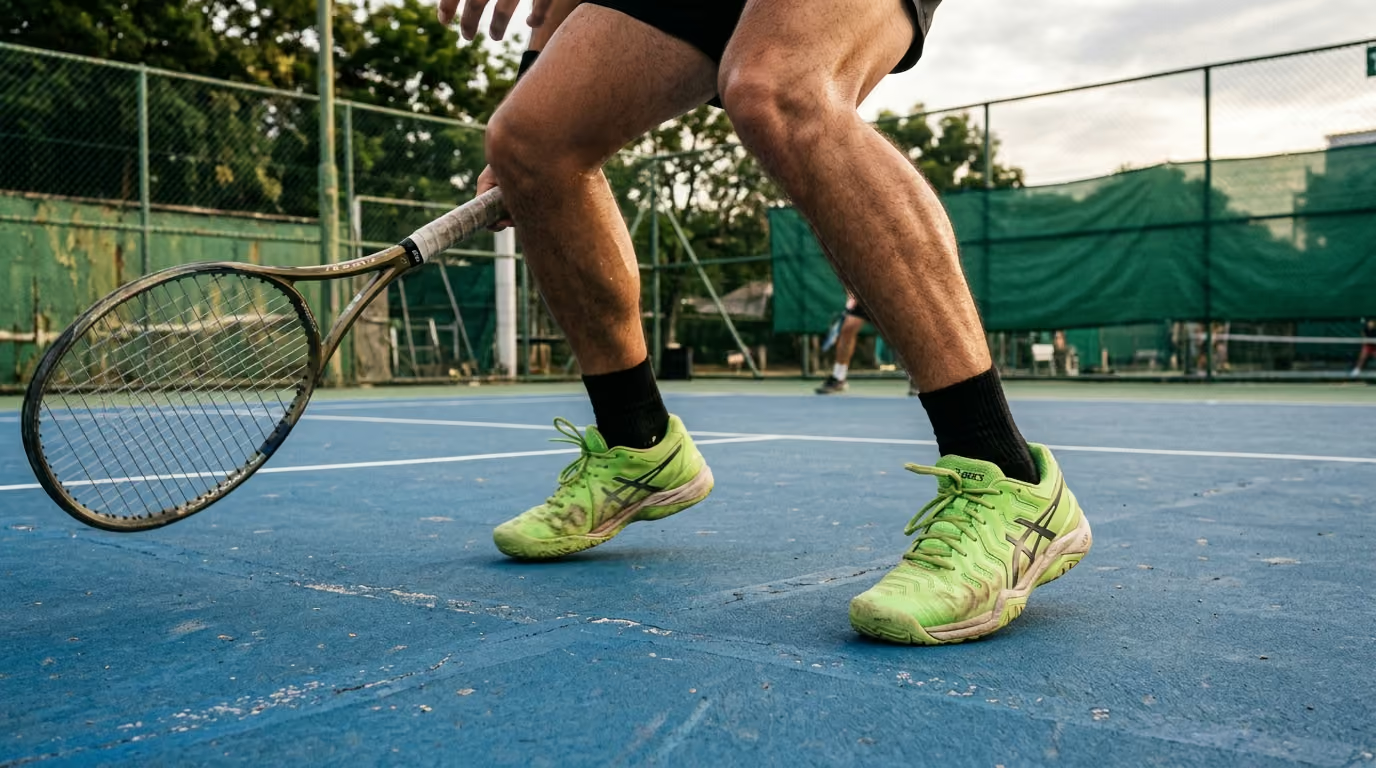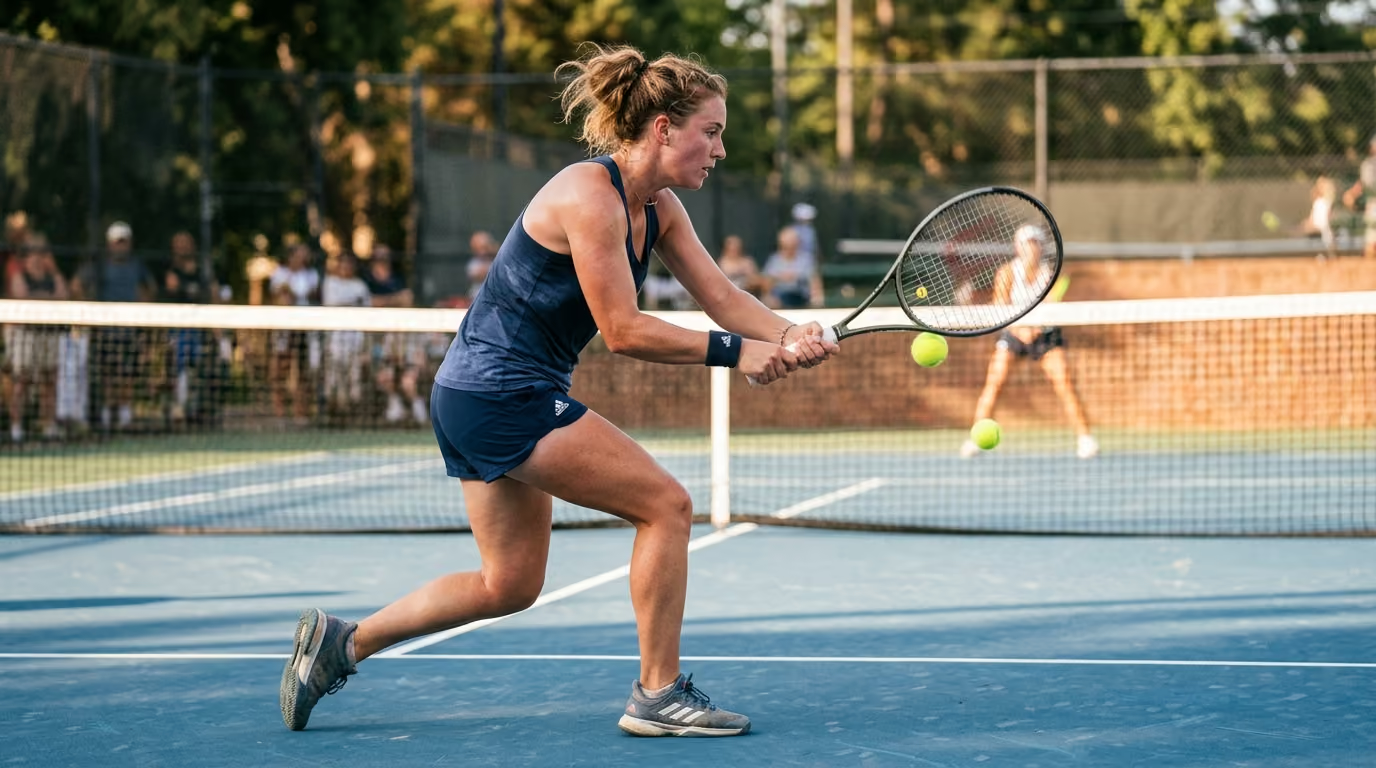

A dependable backhand in racquet sports is built on early recognition, clean spacing, a stable racquet face, and tactical flexibility for varied shots.




Many players believe a reliable backhand requires a perfectly clean, biomechanically pristine swing that mimics a professional player on television. In practice, reliability on the backhand side is actually a repeatable decision and movement system designed to manage varied incoming balls under pressure. A truly dependable backhand is built on early recognition, clean spacing, a stable racquet face, and the tactical flexibility to choose the right swing size for the moment.
Whether you play tennis, pickleball, or padel, having a backhand you can trust under pressure changes how you play. It stops your opponents from isolating your weaknesses and gives you the freedom to build points with confidence. This guide will show you how to build a dependable backhand using practical steps, solid research, and clear on-court strategies.
To make your backhand a stroke you can rely on, it helps to view it as a continuous cycle rather than a single physical action. We can break this cycle down into five distinct phases that happen during every rally.
Reliability begins before your swing even starts. You must read the ball the moment it leaves your opponent's paddle or racquet. Pay close attention to its height, speed, spin, and where it is likely to bounce on your side of the court.
As soon as you recognize the path of the ball, your preparation begins. You must turn your shoulders, establish the correct grip, and move your feet to create appropriate hitting space. Preparing early prevents you from having to rush your swing at the last second.
When hitting the ball, use the smallest and most controlled stroke that will produce your intended target. Your main focus during contact should be maintaining a stable wrist and keeping the racquet face facing your target. You do not need a massive swing to create depth and control.
A common error is watching your own shot instead of getting ready for the next one. After contact, complete a balanced follow-through and immediately start moving back to your recovery position. Keeping your balance during the finish is a great indicator of a stable swing.
Once you are back in position, split-step and prepare your body for the opponent's next shot. This returns you to the start of the cycle, ready to read the next ball.
By treating the backhand as a continuous cycle, you will start to see that mistakes are rarely caused by a bad swing alone. More often, errors happen because a player prepared late, stood too close to the ball, or lost their balance before contact. Improving these areas will naturally make your backhand much more consistent.
Choosing between a one-handed and a two-handed backhand is one of the most common debates in racquet sports. Biomechanical studies offer valuable insights into how these two styles actually function on the court. Understanding these differences can help you choose the best style for your physical capabilities.
A key comparative study published in 2002 analyzed the movement patterns of both styles. The researchers found that mature players generated very similar horizontal racquet speeds shortly before impact with either technique. This indicates that neither style is inherently more powerful than the other. Instead, the real differences lie in how your body rotates, how much preparation time you need, and how you space yourself from the ball.
The one-handed backhand relies on a larger turn of the shoulders during your backswing. The 2002 study showed that shoulder alignment at the end of the backswing measured about 119.1 degrees for one-handers, compared to 83.4 degrees for two-handers. Additionally, one-handers began accelerating their racquet forward much earlier. Horizontal racquet acceleration started roughly 0.13 seconds before contact for one-handers, but only 0.08 seconds before contact for two-handers. This means the one-handed backhand requires earlier preparation and a longer swing path to work effectively.
Your spacing from the ball also changes depending on your technique. The same study showed that the average forward contact point was about 0.59 meters in front of the body for one-handers, but only 0.40 meters for two-handers. The side-to-side contact distance was fairly similar, measuring 0.75 meters for one-handers and 0.70 meters for two-handers. This shows that if you use a one-handed backhand, you must contact the ball much farther out in front to avoid getting jammed.
From a physical standpoint, a 1995 biomechanical review looked at how much force is placed on the elbow during both strokes. The review found that one-handed backhands generated impact torques of 17 to 24 Nm that had to be absorbed by the muscles and tendons of the elbow. In contrast, the two-handed backhand transmitted these impact forces through both arms and into the trunk. The researchers concluded that the two-handed backhand is generally more effective for preventing lateral epicondylitis, which is commonly known as tennis elbow.
Understanding these biomechanical facts can help you make a more informed choice. If you want more reach and a natural transition into volleys, the one-handed backhand is an excellent option. If you prefer a more compact swing that handles heavy pace and protects your elbow, the two-handed backhand is a very reliable choice. For more details on protecting your body while playing, check out our injury prevention resources.
Regardless of the specific sport or stroke style you use, all reliable backhands share several core technical foundations. Mastering these basics will give you a highly consistent stroke, even when you are under pressure during a fast match.
The way you hold your racquet or paddle directly determines the angle of the face at contact. The United States Tennis Association, or USTA, emphasizes that the most important goal is controlling your racquet face rather than using one perfect grip. You should avoid holding the handle too tightly. On a scale of 1 to 10, where 10 is a tight squeeze and 1 is a loose hold, aim for a grip tension of about 3. A relaxed hand allows your wrist to move naturally and helps absorb shock.
For a one-handed backhand, a grip close to the Eastern backhand grip is a highly reliable starting point. If you use a two-handed backhand, try placing your bottom hand in a Continental grip and your top hand in an Eastern forehand grip. This combination gives you a great mix of support and control.
Your non-dominant hand is not just along for the ride. It plays a vital role in turning your shoulders and guiding your racquet during the backswing. It also helps you quickly change your grip from a forehand to a backhand during fast rallies. A common mistake is using only your dominant hand to change your grip, which often leads to late preparation and missed contacts.
Your very first movement on the backhand side should be a coordinated turn of your shoulders, hips, and racquet together. Do not simply pull your arm back by itself. A proper unit turn automatically prepares your racquet and loads your legs, allowing you to use your core to generate power. Keep your backswing compact when you are low on time to ensure you can still contact the ball out in front.
To hit a clean shot, you must move your feet so you can contact the ball in a comfortable, stable zone. If you stand too close to the ball, your arm will collapse and you will lose control of your racquet face. Focus on keeping your head stable and your chest upright throughout the entire swing. Maintaining your balance during contact ensures your shots land deep and allows you to recover quickly for the next ball.
Once you understand the basic foundations, you can start building your primary backhand stroke. Below are step-by-step progressions for developing both the one-handed and two-handed topspin backhands.
For more technical advice and training drills to help improve your court movement, take a look at our mobility and movement resources.
A truly reliable backhand requires more than just a great topspin drive. You also need to master several functional variations to handle different ball heights, speeds, and court positions.
The slice is an incredibly useful shot that uses an open racquet face and a high-to-low path to create underspin. It is best hit using a Continental grip. You can use the slice in three primary ways:
A common mistake with the slice is using a chopping motion that is too steep. This often causes the ball to float high or fall short. Instead, focus on moving your racquet forward through the ball to control its depth.
The roll is a moderate-speed topspin shot that prioritizes height, safety, and shape over raw power. It is highly useful when you receive a high, deep ball that is difficult to drive aggressively. To hit a roll, use a compact swing and brush upward quickly on the back of the ball. This creates a high-margin shot that dips safely into the court, pushing your opponent back and giving you time to recover.
The block is a very compact stroke that uses the pace of the incoming ball instead of a full backswing. It is especially useful when returning fast serves, defending body shots, or handling quick exchanges at the net. To hit a reliable block, shorten your backswing, keep your wrist firm, and focus on clean contact in front of your body. Think of it as a redirection of your opponent's pace rather than an active swing.
Returning a serve is one of the most challenging tasks in racquet sports. It requires quick reflexes, rapid decision-making, and highly adaptable movement under intense time pressure. Research shows that successful returners rely on a flexible set of skills rather than using the exact same swing every time.
To improve your return of serve, try using this structured on-court routine:
First, start in a balanced ready position with your knees slightly bent and your weight on the balls of your feet. Time your split-step to land just as your opponent contacts the serve. As soon as you read the direction of the ball, make a quick shoulder turn and shorten your backswing. If the serve is exceptionally fast, use a compact block or slice to keep the return deep.
Your choice of target is also critical for a successful return. Hawk-Eye tracking data from professional tennis matches shows that players hit more returns toward the center of the court than to the sides. While hitting returns wide can be highly effective, aiming for the deep middle is often a much safer choice. A deep middle return reduces your opponent's angles on their next shot and gives you plenty of time to get back into position.
Many players make the mistake of assuming they should always attack their opponent's backhand. While this can be a useful strategy, modern match-analysis data reveals that tactical decisions are rarely that simple.
An analysis of professional match data showed that 61% of all groundstroke errors occurred within the first four shots of a point. In contrast, only 39% of errors happened during longer rallies of five or more shots. Interestingly, in those longer rallies, players made twice as many forehand errors as backhand errors. This indicates that while the forehand is often a more powerful weapon, the backhand is frequently a more stable, consistent stroke during extended points.
When planning your rally strategy, consider these key tactical options:
The crosscourt backhand is your most reliable option during neutral rallies. Because the net is lower in the middle and the court is longer diagonally, hitting crosscourt gives you the highest margin of safety. Focus on hitting with good depth to prevent your opponent from stepping inside the baseline to attack.
Changing the direction of the ball to hit down-the-line is a great way to catch your opponent off guard. However, it is also a much riskier shot because you are hitting over the highest part of the net into a shorter section of the court.
Data compiled by Tennis Abstract shows that the average non-slice backhand results in about 10% winners and 10% unforced errors. The analysis also found a very weak relationship between how often a player hits down-the-line backhands and the total number of points they win. This suggests that you should only go down-the-line when you are balanced, inside the court, and have a clear tactical opening.
To refine your tactical play and overall court strategy, visit the Evercourts performance resources.
While the basic principles of balance, spacing, and racquet face control apply to all racquet sports, the specific demands of your backhand will vary depending on the game you play.
Tennis features a large court, a heavy ball, and high-velocity bounces. Because of this, you will need a larger swing, a distinct topspin path, and deeper court positioning to control the ball. You must prepare early to manage heavy spin and deep, high-bouncing shots.
Pickleball is played on a much smaller court with a lightweight plastic ball and a short, solid paddle. Due to the presence of the non-volley zone, or kitchen, your backhand will rely heavily on compact rolls, controlled dinks, and quick blocks. Your stance will often be more open, and your swings must remain very short to handle fast, close-range exchanges. To learn more about mastering these unique paddle skills, view our pickleball articles.
Padel is played inside an enclosed court surrounded by glass walls and metallic mesh. Since you must handle rebounds off the walls and fast, low-bouncing balls, your backhand needs to be exceptionally compact. The slice, the block, and the defensive lob are the most common backhand choices in padel. Keeping your swing short ensures you do not get caught out by fast, unpredictable bounces off the glass. To read more about court positioning and wall play, see our padel articles.
Even experienced players can fall into bad habits that limit the consistency of their backhand. Recognizing these common pitfalls is the first step toward fixing them.
The most common mistake on the backhand side is trying to hit a full, powerful swing when you are rushed or out of position. This often results in off-center hits and unforced errors. When you are low on time, prioritize a short backswing, stable contact, and a compact finish to keep the ball in play.
Failing to change your grip early in your preparation is a recipe for inconsistency. If you start your forward swing before your hands are in the correct position, you will struggle to control the angle of your racquet face. Use your non-dominant hand to guide the grip change the moment you realize the ball is coming to your backhand side.
Many players rely on their arms to reach for the ball instead of moving their feet to create space. This leads to hitting the ball too close to the body, which collapses the elbow and reduces control. Focus on taking small adjustment steps as you approach the ball so you can hit from a stable, comfortable position.
Hitting a backhand while standing completely upright makes it very difficult to use your legs for power. This forces your upper body to do all the work, which can lead to fatigue and muscle strain. Always keep a slight bend in your knees to maintain a low, solid center of gravity throughout your swing.
Maintaining a reliable backhand requires a body that can move freely and absorb the physical forces of the sport. Regular play can place significant stress on your hips, core, shoulders, and elbows.
I remember finishing a tough two hour padel match on a cold Tuesday night and waking up the next morning feeling like my lower back was locked in concrete. For a long time, I just accepted this as the price of playing hard in my forties. But once I started spending just ten minutes on targeted hip mobility before heading to the club, the stiffness almost completely vanished. It taught me that we do not have to accept pain as a default state of aging.
To keep your backhand comfortable and consistent, focus on these three recovery areas:
To find more research-backed tips on how to keep your joints healthy and extend your playing years, browse our recovery science resources.
While minor muscle tightness is a normal part of playing active sports, you should never try to play through persistent or sharp pain.
If you experience any of the following warning signs, it is time to consult a qualified healthcare professional, such as a physical therapist or sports doctor:
A qualified professional can help identify the root cause of your discomfort, suggest specific rehabilitation exercises, and ensure you can continue playing the sports you love safely and comfortably for years to come.
With a structured approach to your preparation, mechanics, and recovery, you can transform your backhand into a highly consistent, reliable asset that serves you well on the court for years to come.
Follow Evercourts for practical insights on tennis, pickleball and padel performance, movement, recovery and healthy ageing. Stay connected for new articles, research-led guidance and ideas to help you play well and keep playing for years.


Read practical guidance for better movement, smarter preparation and a game that keeps working for you.
explore the Blog