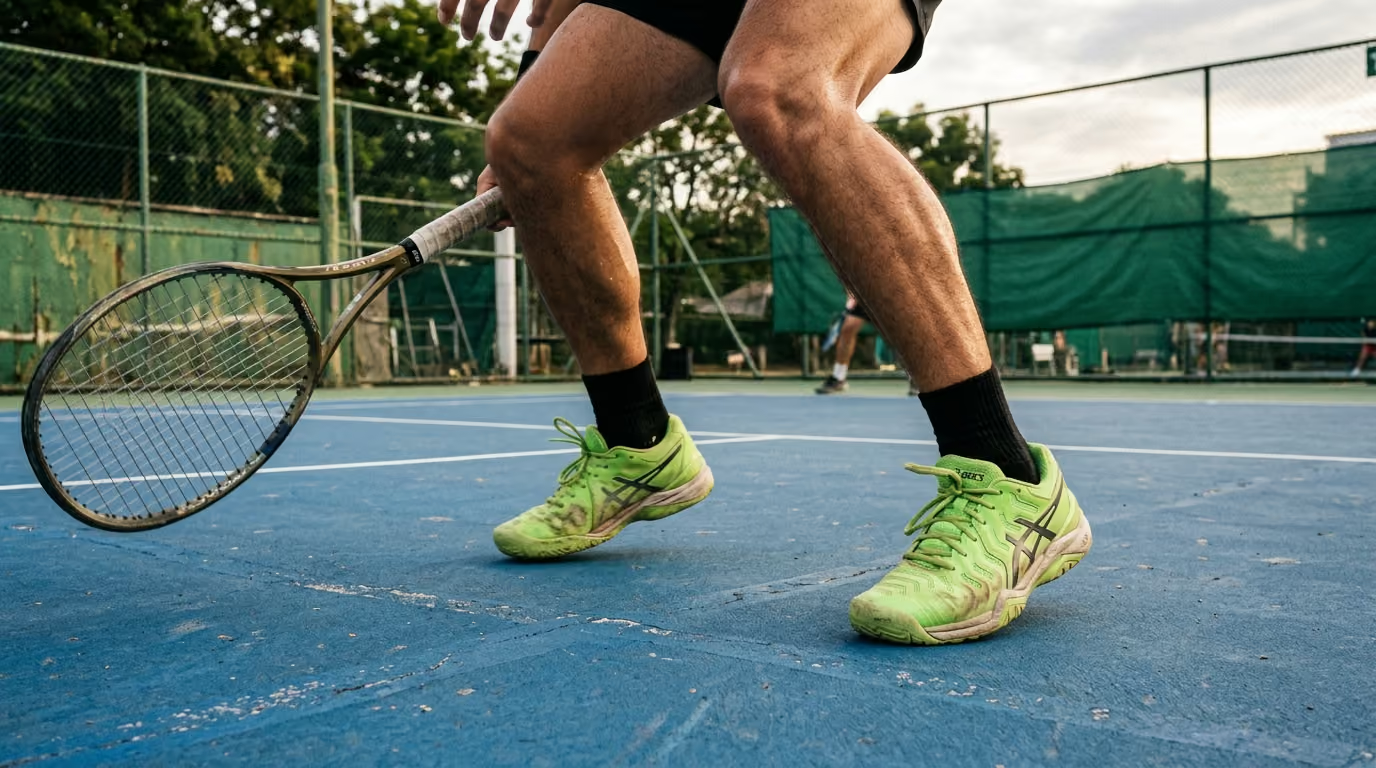

Players can effectively utilize both defensive and offensive lobs to manage court space, control the pace of play, and gain a tactical advantage.




Many recreational players view the high, arcing lob as a desperate panic button or a cheap trick. This perspective is a mistake that limits your competitive growth and puts unnecessary physical stress on your body. When used correctly, the lob is a highly sophisticated tool that manages court space, controls the pace of play, and forces your opponents into difficult physical positions.
The lob is a high, arcing shot designed to clear opponents at the net and force them toward the back of the court. To use it successfully, a player must balance sufficient clearance height with deep baseline placement. When executed with proper timing and recovery movement, the lob changes a vulnerable defensive position into an advantageous or neutral situation.
To understand why a lob succeeds or fails, you must first look at the mathematical realities of the court. In pickleball, the play area is relatively small, measuring exactly 20 feet wide by 44 feet long. The non-volley zone, often called the kitchen, extends 7 feet from the net on each side. These compact dimensions mean that players standing at the kitchen line can cover a massive percentage of the court with their outstretched paddles.
A standard athletic player standing at the kitchen line has a vertical reach of roughly eight feet when stationary. If they jump or stretch, that reach extends even higher. To clear an opponent who is established at the kitchen, your ball must rise rapidly above this reach zone. According to official guidelines from USA Pickleball, a defensive lob must clear the opponent's outstretched paddle while retaining enough downward angle to land inside the baseline.
The physics of a pickleball also differ significantly from a tennis ball. A plastic pickleball has holes that create substantial aerodynamic drag during flight. This drag causes the ball to slow down rapidly once it passes the peak of its arc. If you hit a lob too low, the drag will prevent it from penetrating deep into the court, leaving a slow, sitting ball that your opponent can easily smash.
Understanding these physical parameters helps you make better tactical decisions. You cannot rely on raw power to push a pickleball through the air. Instead, you must use precise paddle angles and lift to work with the natural drag of the ball. For more information on optimizing your spatial awareness on the court, you can read our comprehensive court performance guidelines.
A successful lob is not a single, static stroke. It is the result of five interacting variables that you must adjust based on your position and the movement of your opponents. If you ignore even one of these factors, your shot will likely become an easy target.
Height provides two essential assets during a rally: clearance and time. You must distinguish between clearance height, which is the minimum vertical space needed to bypass an opponent's paddle, and recovery height, which is the extra air time needed to rebuild your defensive position.
A high defensive lob gives you and your partner valuable seconds to run back to the center of the court. A lower, faster offensive lob reduces your opponent's reaction time but increases the risk of interception. If your lob is too high, your opponents will have ample time to run backward, communicate, and set up a balanced overhead smash. If it is too low, it will simply be volleyed out of the air.
Depth is the single most important factor in determining whether a lob is a tactical asset or an invitation to be attacked. If your ball lands short, you hand your opponents an easy opportunity to hit a downward smash.
The spin you apply to the ball alters its flight path and how it behaves after hitting the ground.
Topspin causes the ball to dip quickly at the end of its trajectory. This allows you to hit an offensive lob with more forward speed because the spin pulls the ball down into the court.
Backspin, or slice, creates a floating trajectory that keeps the ball in the air longer. This is useful when you are stretched wide and need maximum recovery time, though it gives your opponents more time to track the ball.
A flat lob travels fast but offers a very small margin of error. It is best used when your opponents are leaning forward and anticipating a soft dink.
Where you aim your lob is just as important as how deep it lands. Aiming for the deep middle of the court is an excellent defensive choice because it can cause confusion between partners.
Targeting the opponent's backhand shoulder is another highly effective tactic. Most players have a weaker backhand overhead and find it difficult to turn their shoulders while retreating.
You can also target the outside shoulder of a player who is already moving laterally. This forces them to change direction quickly, which tests their balance and footwork.
The lob does not end when the ball leaves your paddle. You must immediately move to an optimal court position based on the quality of your shot.
If you hit a deep, successful lob that forces your opponents to turn and run, you and your partner should move forward to the kitchen line. If your lob is short or mediocre, you must retreat or stay back to prepare for a smash.
Never stand still and watch your shot. Your movement after the ball is struck determines whether the lob actually improves your position in the rally.
To play smart racquet sports, you must select your shot based on your physical state and the position of your opponents. Lobs fall into three distinct tactical categories.
You use a defensive lob when you are in a weak position and need to buy time. Common triggers include being pulled wide past the sideline, reaching for a low ball, or recovering from an awkward volley.
The primary goal of this shot is survival. You want to lift the ball high into the air to give yourself time to recover your footing.
Do not worry about hitting a winner with this shot. A defensive lob is successful if it changes a losing, chaotic situation into a neutral, structured rally.
The transition lob occupies the middle ground between defense and offense. You use this shot when you are not in immediate trouble, but your opponents have established a strong position at the kitchen line.
By lifting a deep ball over their heads, you force them to retreat. This change in court geometry allows you and your partner to move forward and take control of the net.
The transition lob breaks up monotonous dinking patterns and resets the rhythm of the game. It is a highly effective way to escape the mid-court transition area when a hard drive would be easily blocked.
An offensive lob is a surprise weapon designed to win the point or force an immediate error. It is most effective when both of your opponents are crowding the kitchen line and leaning forward to anticipate a soft shot.
This shot uses a lower, faster trajectory than a defensive lob. It requires a clean, balanced contact point and is often hit with topspin to make the ball drop rapidly.
If your opponent has slow backward movement or a weak overhead, the offensive lob can exploit these weaknesses. However, you should only attempt this shot when you have stable balance and a clean look at the ball.
Executing a reliable lob requires sound biomechanics. You must focus on your preparation, your contact point, and your follow-through to ensure consistency under pressure.
First, establish a wide, balanced stance with your knees bent. Lowering your center of gravity allows you to get your paddle beneath the ball without relying solely on your wrists.
Second, keep your backswing short and compact. A large, looping backswing is difficult to control when you are rushed and often leads to mistimed contact.
Third, open your paddle face slightly before contact if you need height, or keep it more vertical if you are executing an offensive topspin shot. Keep your eyes locked on the ball and maintain a quiet, steady head throughout the entire swing.
You should always aim to contact the ball in front of your body. This positioning allows you to direct the ball upward and forward using your larger shoulder and leg muscles.
If you contact the ball behind your body, you will likely hit a short, high ball that sits up for an easy smash. When you are stretched wide and cannot get in front of the ball, prioritize getting the paddle face open and lifting the ball high to maximize your recovery time.
The speed and depth of the incoming ball should dictate your mechanics. Against a fast, hard drive, you do not need a full swing. Instead, use a compact block motion to redirect the opponent's pace upward.
Against a soft dink, you must generate your own lift by bending your knees and swinging from low to high. If the ball is wide, focus on hitting a crosscourt lob, which gives you a larger diagonal court area to target.
For more technical guides on court movement and stroke mechanics, explore our extensive pickleball tournament play resources.
A poor lob is one of the most dangerous mistakes you can make on the court. It turns a competitive rally into an easy point for your opponents and exposes you to high-velocity shots.
To keep your lobs useful, you must remember a simple tactical formula:
> Useful Lob = Clearance + Depth + Opponent Displacement + Team Recovery
If you leave out any of these elements, your shot becomes an invitation for a smash. For example, hitting a high ball with great clearance but poor depth allows your opponent to step forward and strike the ball downward.
Conversely, hitting a deep ball with insufficient height allows an athletic opponent to jump and intercept the ball before it can clear them. Even a technically perfect lob can fail if you and your partner do not use the ball's flight time to recover your positions on the court.
You must also consider the environmental conditions when playing outdoors. A strong headwind will shorten your lob, meaning you must swing harder to reach the functional deep zone.
A tailwind will carry your ball long, requiring you to reduce your swing speed or add topspin to keep the ball in play. Always adjust your targets based on the wind to avoid making simple errors.
Because lobs are a common tactic, you must also master the physical and mental skills required to defend against them. A structured defense keeps you safe and keeps the rally alive.
The best defense against a lob is early recognition. According to coaching manuals from USA Pickleball, you should watch your opponent's paddle face and body language carefully.
If you see their knees bend deeply, their paddle face open up, or their swing path change from low to high, prepare for a lob. The earlier you recognize these cues, the faster you can begin your retreat.
Never backpedal straight backward while facing the net. Backpedaling is slow, ruins your balance, and is a common cause of backward falls and head injuries.
Instead, turn your shoulders to the side and run backward using a sideways drop-step or a sprint. Keep your eyes on the ball over your shoulder as you move.
This athletic movement keeps you balanced and allows you to reach the deep court quickly. If you want to learn more about safe movement patterns, check out our injury prevention methods.
When a lob is hit over your head, you must make a quick decision. If the ball is short and floating, step forward and hit an overhead smash.
If the ball is deep and moving fast, do not try to hit a difficult overhead while falling backward. Instead, let the ball bounce, run behind it, and hit a soft drop shot to reset the point.
Letting the ball bounce is often the safest and most effective way to handle a well-placed lob.
Lobs can cause dangerous collisions and confusion in doubles play. You and your partner must establish clear communication rules for high balls.
If a lob goes over your partner's head, you should yell "mine" if you have a better angle to run back and cover it. Your partner should then cross over to cover the open side of the court.
Clear verbal signals prevent collisions and ensure that both sides of the court remain defended.
To build a reliable lob, you must practice the shot under controlled conditions. Use these five structured drills to improve your height, depth, and court movement.
Place three target markers on the court: one at the kitchen line, one in the middle of the service court, and one 18 inches inside the baseline. Have a partner feed you balls from the opposite kitchen line.
Your goal is to hit lobs that clear your partner and land consistently in the deep baseline target zone. Practice hitting ten lobs in a row, focusing on increasing your clearance height without pushing the ball past the baseline.
Start this drill by standing deep in the transition zone or wide past the sideline. Have your partner feed you a challenging, fast ball that forces you to stretch.
You must execute a high defensive lob and immediately run back to a balanced position at the center of the kitchen line. Score a point only if your lob lands in the functional deep zone and you reach your recovery position before the ball bounces on the other side.
Set up target cones in the deep backhand corner, the deep middle, and the deep forehand corner of the opposite court. Have a partner feed you balls from a stable position.
Before each feed, your partner should yell out a target, such as "backhand" or "middle." You must adjust your paddle face and swing path to hit the designated target. This drill teaches you to aim your lobs intentionally rather than hitting them randomly.
Stand at the kitchen line with your partner. Have a player on the other side of the net feed you a mix of short, medium, and deep lobs.
You must loudly call "smash" or "bounce" before you make contact. Your partner must react to your call by either staying at the net or retreating to cover the court. This drill improves your decision-making speed and builds team coordination.
Start a practice game where you and your partner are restricted to the transition zone, while your opponents start at the kitchen line. To win a point, you must use a transition lob to force your opponents back and claim the kitchen line.
This game teaches you how to use the lob as a spatial weapon to escape difficult court positions.
While the basic physics of a high ball remain the same, the tactical application of the lob varies significantly between tennis, pickleball, and padel. Understanding these differences is key to athletic longevity and court success.
In pickleball, the lob is deeply tied to the kitchen line. Because players stand very close to each other, a lob must rise quickly to clear their reach.
The plastic ball decelerates fast, meaning depth control requires precise touch. You can read more about these specific tactics in our pickleball tournament play resources.
Tennis courts are much larger, measuring 78 feet long. This extra space gives you a much larger target area for your lobs.
Tennis players often use heavy topspin to hit aggressive, high-velocity lobs from behind the baseline. They also use under-spin defensive lobs with a Continental grip to buy time when pulled wide. To learn how to apply these techniques on a larger court, check out our tennis court strategies.
Padel introduces a unique environmental element: the glass walls. A lob in padel must clear the opponents but land before hitting the back glass to remain in play.
If your lob bounces and hits the glass, your opponents can easily play the ball off the wall. A successful padel lob must be hit with a flat or slightly under-spin trajectory to keep the bounce low after it hits the glass. You can find more details on these wall-based tactics in our padel tactical approaches.
Playing racquet sports regularly requires significant physical effort. If you do not prepare your body for the physical demands of backpedaling and twisting, you risk developing chronic stiffness or acute injuries.
I remember finishing a tough two hour padel match on a cold Tuesday night and waking up the next morning feeling like my lower back was locked in concrete. For a long time, I just accepted this as the price of playing hard in my forties. But once I started spending just ten minutes on targeted hip mobility before heading to the club, the stiffness almost completely vanished. It taught me that we do not have to accept pain as a default state of aging.
To protect your back and shoulders when hitting or defending lobs, you must focus on your movement preparation. Backpedaling and reaching high overhead place sudden, intense loads on your calves, hamstrings, and lower back. Incorporating a dedicated warmup that targets hip and thoracic spine mobility is essential for healthy aging. You can find excellent routines for this in our guide on targeted movement preparation.
Many players make the mistake of using too much wrist to lift the ball. This habit puts excessive stress on the small tendons of the elbow, which can lead to chronic tendonitis.
Instead, generate lift using your legs and shoulder joint. Another common mistake is arching your lower back excessively to reach a high ball, which can strain your lumbar spine.
Instead of bending backward, turn your body sideways and use your legs to get behind the ball.
While minor stiffness is common after a long match, you must be able to recognize the signs of a more serious injury. You should consult a qualified healthcare provider if you experience any of the following:
Listening to your body and seeking professional care early ensures that you can continue playing the sports you love for many years to come. For more advice on managing your long-term physical health, check out our injury prevention methods.
Mastering the lob transforms it from a desperate survival tool into a sophisticated tactical weapon. By understanding court geometry, refining your mechanics, and moving with purpose, you can control the court and enjoy healthy, competitive play for years to come.
Follow Evercourts for practical insights on tennis, pickleball and padel performance, movement, recovery and healthy ageing. Stay connected for new articles, research-led guidance and ideas to help you play well and keep playing for years.


Read practical guidance for better movement, smarter preparation and a game that keeps working for you.
explore the Blog