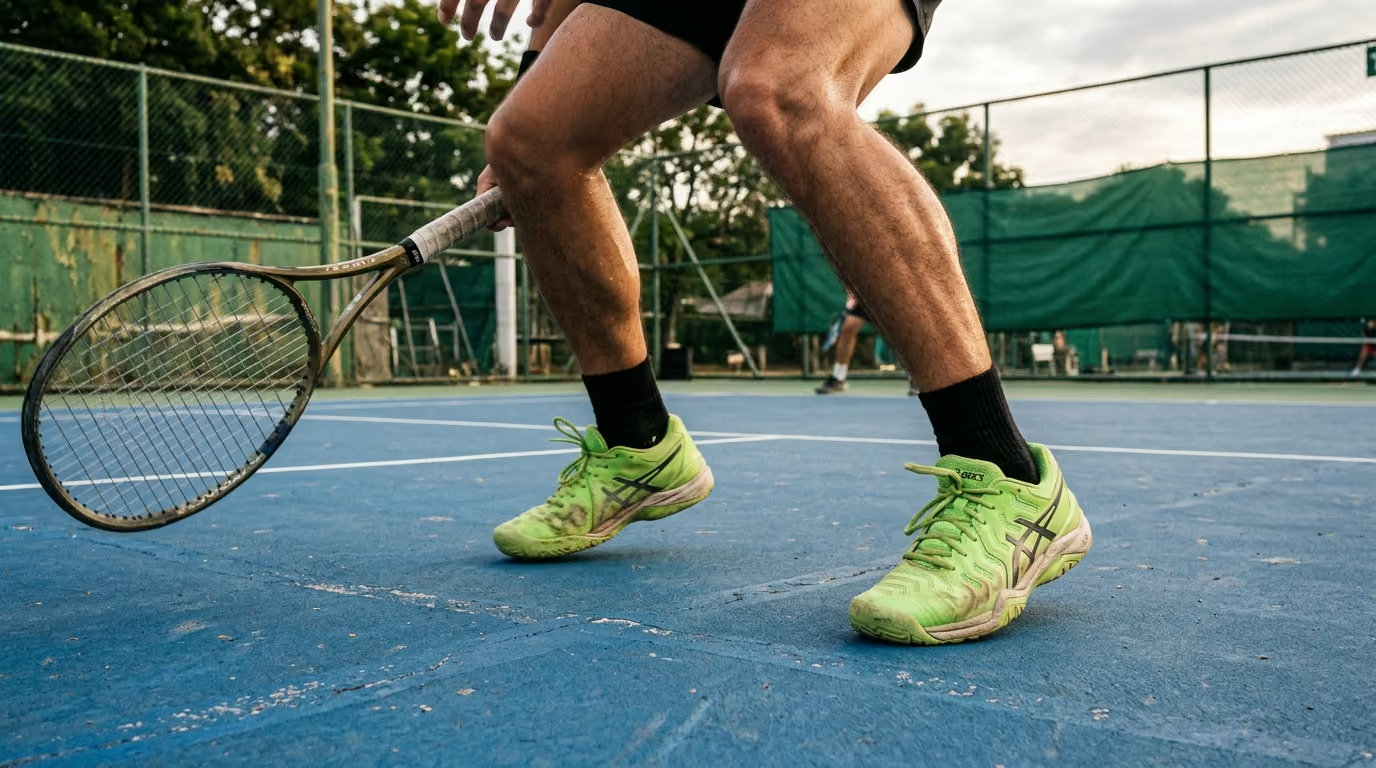
Designing transferable racquet sports practice involves progressing from static technical drills to dynamic, representative exercises that mimic game conditions.




Many racquet sports players struggle with a frustrating performance gap. They can hit fifty perfect groundstrokes in a row during a controlled drill. Yet, when a competitive match begins, those same strokes break down under pressure. This common issue is not a failure of talent or effort. Instead, it is a direct result of how we structure our training hours on the court.
We must design practice sessions so that the skills we learn actually transfer to the chaotic environment of a real match. To do this, we need to move beyond simple, repetitive feeding drills. We must build a system that prepares our minds and bodies for the unpredictable nature of competition. This guide will show you how to structure your training for long-term improvement.
Transferable practice is training that prepares your skills to survive the unpredictability, fatigue, and mental pressure of a real match. To achieve this, you must progressively transition from static technical drills to dynamic, representative exercises that mimic game conditions. This systematic progression helps your brain connect visual cues with physical movements, ensuring your technique remains reliable when the score matters.
To understand how skills transfer from practice to competition, we must look at current motor learning research. Scientists define skill transfer as the influence of past practice on performance in a new context. In racquet sports, this transfer is highly demanding. You must coordinate your visual perception, court movement, shot selection, and physical recovery in a fraction of a second.
Many traditional training methods focus purely on immediate performance. This means a player looks highly successful during a repetitive feeding drill. However, researchers distinguish between practice performance and long-term learning. Performance is what you can do during the training session itself. Learning is the relatively permanent capability to perform the skill later under different conditions.
To design better practices, we must understand the different forms of skill transfer. Near transfer refers to executing the same stroke under slightly different ball locations or speeds. Far transfer involves solving a related but substantially different tactical or perceptual problem. When previous practice improves your later performance, it is called positive transfer.
Conversely, negative transfer occurs when previous practice interferes with a new movement requirement. We also distinguish between low-road and high-road transfer. Low-road transfer happens automatically between highly similar contexts, like hitting a tennis ball on two similar clay courts. High-road transfer requires deliberate mental adaptation to a novel situation, such as adjusting your strategy against an unusual opponent.
Historically, researchers have studied skill transfer using the concept of contextual interference. This concept describes the disruption that occurs when you practice different skills in an unpredictable order. Traditional motor learning models suggest that high interference, like random practice, leads to better long-term retention. This happens because your brain must work harder to reconstruct the movement plan for each shot.
According to the forgetting hypothesis, when you change tasks, you temporarily forget the previous movement solution. You must then rebuild that solution from scratch on the next attempt. This cognitive effort strengthens the neural pathways associated with that skill. The elaboration hypothesis suggests that practicing different skills together helps you compare and contrast their unique mechanical features.
However, the modern scientific view of this effect is more balanced. A systematic review published in 2024 examined contextual interference across various learning environments. The researchers found a medium overall benefit for random practice during transfer tests. Interestingly, the effect was stronger in laboratory settings than in real-world sports applications.
Another systematic review focused specifically on sports training. This paper, titled The myth of contextual interference learning benefit in sports practice, found no significant difference between blocked and random practice in athletic settings. This suggests that we cannot simply declare random practice as the superior method for every player. The effectiveness of the training design depends heavily on the player's current skill level.
Instead of relying on simple random drills, we must focus on representative learning design. This theory, developed by sport scientists, emphasizes that practice must preserve the connection between perception and action. This means your training environment should contain the key visual cues that guide your movements in a match. In tennis, for example, research shows that ball speed, spin, and location are essential information sources.
When a ball is fed predictably from a basket, you do not practice reading the opponent's body language. You do not see the angle of their racket face before contact. Consequently, your brain misses the natural triggers that initiate movement on the court. Practice must preserve functional fidelity, which means the player uses the same information sources to control their movements as they would in a match.
By maintaining high action fidelity, we ensure that our training movements look and feel like real competition. If we remove the opponent from the drill, we sever the natural link between perception, decision, and movement. This makes the skill highly fragile and less likely to transfer to real matches. To achieve true transfer, players must learn to read the court while executing their technique.
Nicolai Bernstein, a pioneering neuroscientist, introduced the degrees of freedom problem. This problem explains how the human body coordinates its many muscles and joints to produce a smooth movement. In racquet sports, there are millions of possible muscle combinations to hit a single ball.
Blocked practice tries to solve this by freezing the degrees of freedom. The player keeps their wrist, elbow, and shoulder stiff to repeat a single motion. While this works in a static drill, it fails in a match because the incoming ball always requires a slightly different joint angle.
Representative learning design helps the body solve this problem naturally. Instead of freezing joints, the player learns to self-organize their movement based on what they see. This creates adaptable motor solutions that can survive changing wind, court surfaces, and opponent ball speeds.
To design effective court sessions, we must understand the four primary practice modes. Each mode serves a unique purpose in your athletic development. They are not mutually exclusive systems. Instead, they represent a spectrum of complexity that you can adjust based on your current needs.
Blocked practice involves repeating a single movement pattern from a predictable feed. For example, you might hit thirty crosscourt forehands from the same spot on the court. The incoming ball arrives at the same speed, depth, and height every time. This mode minimizes cognitive demand and allows you to focus purely on your physical coordination.
This structured approach is highly valuable when you are learning a brand-new technique. It is also useful when you are returning from an injury or making a major mechanical adjustment. Blocked practice helps you build a baseline level of physical confidence. It allows your nervous system to establish the basic motor pathways without the distraction of tactical decisions.
The primary risk of this mode is context dependency. If you only train in a blocked format, your technique becomes dependent on a predictable ball. You do not learn how to adjust your spacing, timing, or racket face angle for different incoming trajectories. This creates a false sense of mastery, as you perform beautifully in drills but struggle in matches.
Variable practice introduces parameter changes while keeping the core movement task the same. Instead of hitting the exact same ball, you practice hitting balls of varying heights, depths, and speeds. For instance, you might hit ten deep forehands, followed by ten short forehands, and then ten high-bouncing forehands. This variation forces your body to make constant, subtle adjustments.
Motor learning research supports the use of variable practice to build robust movement solutions. Schmidt's schema theory proposes that experiencing different movement parameters improves future adaptability. By practicing variations, you build a generalized motor program that can adapt to novel situations. Studies show that varied practice produces fewer errors during transfer tasks than constant practice.
However, the goal is not to introduce maximum chaos into every drill. Instead, you should focus on useful variation. You want to expose your body to the specific physical adjustments that occur most often in competition. This calibration helps your brain build a more flexible blueprint of the stroke, protecting your athletic longevity by distributing physical impact.
Random practice changes the sequence of tasks in an unpredictable order. During a random drill, you never hit the same stroke twice in a row. You might hit a deep backhand, then a short volley, followed by a defensive lob. The sequence is completely unpredictable, forcing you to treat each shot as a unique problem.
This mode mimics the constant decision-making required in a real match. It forces your brain to identify the incoming ball, select the appropriate response, and execute the movement under time pressure. You must continuously reset your attention and retrieve different movement patterns from your long-term memory. The immediate result of random practice is often a higher error rate on the court.
Your play may look messy and inconsistent during the session. However, this struggle is actually a sign of active learning. A simulation study showed that players using random practice had faster decision times during delayed retention tests. By forcing your brain to retrieve the movement plan repeatedly, you build a more durable skill that resists pressure.
Constraints-based practice shapes your behavior by altering the rules, space, or equipment of the game. Instead of telling you exactly how to hit the ball, the coach manipulates the environment. This manipulation forces you to find your own physical solutions. This approach is rooted in ecological dynamics, which views the player and court as an interconnected system.
We can manipulate three types of constraints during a training session. Individual constraints include your physical reach, current fatigue level, and joint mobility. Environmental constraints involve the wind, lighting, and court surface. Task constraints include court dimensions, scoring systems, and allowed strokes.
By changing task constraints, we can naturally guide a player toward better tactical decisions. For example, you can shrink the available court width to encourage deeper placement. This approach allows players to discover opportunities for action, which scientists call affordances. You learn to read the relationship between the ball, the opponent, and the open court.
You can read more about balancing physical preparation and match recovery in our player health articles.
To build training sessions that translate to competitive play, we must sequence these modes logically. We should avoid treating blocked and random practice as opposing philosophies. Instead, we can use a progressive framework to guide our development. This model helps you move systematically from technical mastery to match resilience.
In this initial phase, the goal is to establish a basic coordination pattern. You use blocked practice with highly predictable feeds. This low-stress environment allows you to focus on mechanical keys, such as grip changes and contact points. You should remain in this phase until you can execute the movement consistently without mental confusion.
An example of this is practicing a tennis slice backhand. The coach feeds slow, consistent balls to your backhand side. You focus entirely on the swing path, racket face angle, and weight transfer. There are no targets, no movement requirements, and no tactical decisions. The focus is purely on physical coordination.
Once the basic technique is stable, you introduce planned variability. You practice the same stroke while adjusting to different ball speeds, heights, and spin rates. The target on the opposite side of the court may also change. This calibration teaches your muscles to adjust to the minor variations of outdoor court play.
Using our tennis slice example, the coach now feeds balls of different depths and heights. Some balls bounce high, while others stay low. You must adjust your knee bend, racket preparation, and spacing before hitting. However, you still know that every ball is coming to your backhand. This isolates the physical adjustment from the decision-making process.
In this phase, you learn to identify which stroke is appropriate for the situation. You are no longer told which ball is coming. The feeder mixes different ball types, and you must make a quick decision. For example, you must recognize whether an incoming ball is short enough to attack or deep enough to defend.
Now, the coach feeds a mixture of deep balls, short balls, and wide balls. You must quickly decide whether to hit a slice backhand, a topspin backhand, or run around to hit a forehand. This step introduces decision-making under time pressure. You must read the ball's trajectory as early as possible to make the correct choice.
This step introduces a live opponent into the training environment. You transition from one-way drills to cooperative or semi-competitive rallies. Both players must respond to the unpredictable actions of the other. The focus shifts from executing a perfect swing to maintaining a functional rally.
You now play a rally with a partner where you are both restricted to the crosscourt backhand half of the court. You can choose to hit topspin or slice, but you must keep the rally going. The incoming ball is no longer fed by a coach; it is hit by an opponent who is also moving and recovering. This introduces realistic ball behavior and movement demands.
Skills must be able to survive the psychological stress of competition. In this phase, we add scoring systems, target boundaries, and performance consequences. You might play a game where unforced errors cost double points. This pressure forces you to manage your focus and anxiety while executing your technique.
For instance, you play a half-court game to eleven points against your partner. If you hit a slice backhand into the net, your opponent wins two points. If you hit a successful slice that lands past the service line, you earn a bonus point. This scoring system forces you to focus on depth and safety under pressure.
Matches are rarely played in a state of perfect physical freshness. Therefore, you must practice making tactical decisions while physically and mentally tired. We integrate short, intense movement sequences immediately before decision-making drills. This teaches your body to maintain precision when your muscles are fatigued.
Before each point in your training game, you must perform three rapid side-shuffles across the baseline. Immediately after the third shuffle, your partner feeds the ball, and the point begins. This simulated fatigue elevates your heart rate and tests your focus. It forces you to maintain physical balance and clean contact when you are tired.
The final step is to evaluate your progress in a novel environment. You play against unfamiliar opponents on different court surfaces or under challenging weather conditions. This test reveals whether your new skills have truly integrated into your default style of play.
To test your slice backhand, you play a full match against a new player at a different club. During the match, you record how often you use the slice and how effective it is. You analyze whether you made the correct tactical decisions under match pressure. This evaluation provides clear feedback for your next training cycle.
For more guidance on structured training design, you can read our better play articles.
While the principles of skill transfer apply to all racquet sports, each discipline has unique physical demands. We must tailor our practice design to the specific spatial and temporal realities of our chosen game. Let us examine how to apply these concepts in tennis, pickleball, and padel.
Tennis requires players to cover a massive physical space while managing a heavy yellow ball. The court dimensions demand significant lateral movement and explosive recovery steps. When designing tennis practices, we must preserve the relationship between court position and shot selection.
A common mistake in tennis is practicing groundstrokes while standing static behind the baseline. In a real match, you must constantly adjust your distance from the bouncing ball. To make your practice transferable, every baseline drill should require a recovery movement. You should hit a ball, recover to a neutral position, and then move to the next shot.
We must also integrate the split-step into our practice design. The split-step is the ultimate action-coupling trigger in tennis. If you do not practice timing your split-step with the exact moment the server contacts the ball, your training is not representative. You are practicing in a vacuum, which will fail to transfer to match play.
We can also use constraints to improve serve return performance. Instead of hitting random serves from a basket, have the server target specific zones. The returner must focus on reading the server's body alignment and shoulder rotation. This develops the fast visual processing needed to return high-velocity serves.
To locate more practical ideas for on-court structure, you can study our court performance resources.
Pickleball is played on a much smaller court, which dramatically reduces reaction times. The game is dominated by the transition from the baseline to the non-volley zone line. This transition requires unique physical control and delicate touch.
To build a transferable third-shot drop, we must avoid static drilling. A player should not stand at the baseline hitting fifty consecutive drops to a partner. Instead, use a variable drill where the partner alternates deep and short returns. The player must hit a drop, step forward, and then respond to the next ball.
We must also practice the transition from the drive to the drop. Many pickleball players rely too heavily on the third-shot drive, which gets easily blocked by advanced opponents. A great transferable drill requires the player to hit a third-shot drive, read the opponent's block, and then hit a fourth-shot drop. This teaches the player to transition their energy from aggression to touch based on visual feedback.
We can also set up task constraints at the kitchen line. For example, play a game where points can only be won after a minimum of four consecutive dinks. This constraint forces players to develop patience and recognize the correct moment to attack. It prevents the common recreational mistake of trying to speed up every low ball.
To learn more about the unique demands of the kitchen game, you can check our pickleball articles.
Padel introduces the unique challenge of playing balls off the back and side glass. This requires complex spatial awareness and precise footwork adjustments. In our experience, many players struggle with the glass because they only practice hitting balls before the bounce.
I remember finishing a tough two hour padel match on a cold Tuesday night and waking up the next morning feeling like my lower back was locked in concrete. For a long time, I just accepted this as the price of playing hard in my forties. But once I started spending just ten minutes on targeted hip mobility before heading to the club, the stiffness almost completely vanished. It taught me that we do not have to accept pain as a default state of healthy aging.
We can apply this lesson to our physical preparation and our court practice. To build confidence with the padel walls, you must set up representative scenarios. Instead of feeding simple, high balls, the coach should hit deep, low lobs that force you to run backward. You must learn to wait for the ball to rebound off the glass before initiating your swing.
We must also practice the Chiquita transition. The Chiquita is a soft, low shot hit to the feet of the incoming net players. It requires immense control and is highly context-dependent. A great transferable drill involves playing a lob, reading if the opponent's overhead is weak, and immediately moving forward to play a Chiquita off their short reply.
You can read more about balancing physical preparation and match recovery in our player health articles.
In the heat of competition, physical endurance and mental focus are tested simultaneously. If we only practice when we are fresh, our skills will fail us late in a match. We must deliberately integrate pressure and fatigue into our training sessions.
Mental fatigue has a massive impact on racquet-sport performance. A systematic review examined how cognitive exhaustion affects athletes on the court. The researchers found that mental fatigue reduces stroke accuracy, increases unforced errors, and delays reaction times. These declines occur even when physical markers like heart rate remain unchanged.
This means that cognitive stress can cause your technique to break down even if you are physically fit. To combat this, we must include cognitive challenges in our training. For example, you can practice tactical drills where you must call out the opponent's shot direction before the ball bounces. This forces your brain to maintain high visual attention under stress.
Another review focused specifically on professional tennis performance. The data showed that physical fatigue causes reaction-time delays of 47 to 68 milliseconds. This split-second delay can be the difference between a clean return and a framed ball. Interestingly, the study found that players often maintain their raw force output even as their precision and decision quality decline.
Because precision and decision quality overrule gross force, conditioning alone does not guarantee skill transfer under fatigue. Practice should therefore include decisions after repeated accelerations, court sprints, and long rallies. This teaches your nervous system to stay calm and focused during physical distress.
We can also simulate psychological pressure by manipulating task rewards and penalties. For instance, play a tiebreak where you start at a 2-5 deficit. Or, design a game where any serve that misses the target zone results in a lost point. These constraints recreate the emotional tension of a real match, helping you practice attentional control.
To understand how to manage your training load and protect your joints, you can read our mobility and movement training guides.
When designing a modern training program, it is easy to make mistakes that hinder long-term progress. Knowing these common errors can help you structure your sessions more effectively. Let us examine the most frequent pitfalls players encounter.
Some players read about contextual interference and decide to abandon all blocked drilling. They believe that every practice session must be completely random and chaotic. This is a misunderstanding of motor learning science.
As shown in the systematic review on sports practice, random training is not always superior. If you are learning a new technique or recovering from an injury, random practice will only cause frustration. It can lead to a high error rate that prevents you from developing a stable movement pattern. You must earn the right to train in a random environment through consistent physical mastery.
Another common error is using immediate success as the sole measure of learning. Coaches and players often prefer blocked drills because they make the player look highly skilled. The player hits twenty clean shots in a row, and everyone feels satisfied.
However, this visual fluency is often temporary. It does not mean the skill has been integrated into long-term memory. True learning is revealed during delayed retention tests and competitive matches. Do not be discouraged if your performance looks messy during a variable or random drill. That mental struggle is the exact process that builds permanent competence.
While randomness and constraints are useful, some players design drills that are far too complex. They combine too many changing variables, leading to cognitive overload. If a drill is so difficult that you cannot achieve any successful repetitions, learning will stop.
You should manipulate only one constraint at a time before combining them. For example, change the target zone first. Once that is comfortable, change the incoming ball speed. Finally, add an active opponent. This gradual introduction of difficulty allows your brain to adapt systematically.
Many recreational players believe that simply playing matches is enough to transfer their skills. While match play provides variability, it does not guarantee targeted development. In a match, you will naturally avoid your weaknesses to win points.
This means you do not get enough repetitions of the specific skills you need to improve. Match play should be supplemented with constrained games that increase the frequency of important situations. For example, play a practice set where you are rewarded with extra points for winning rallies at the net. This targets your net transition game within a competitive structure.
To see more structured guides for improving your court movement and game strategy, visit our court performance resources.
Your training structure does more than build skills; it also dictates your physical recovery. The way you sequence your drills can either protect your body or lead to chronic overuse injuries. Balancing physical stress is essential for long-term athletic longevity.
Blocked practice has a relatively low cognitive load, but it presents a high risk of physical overuse. When you repeat the exact same stroke fifty times, you apply identical stress to your joints. This repetitive loading can strain your tendons, muscles, and ligaments, leading to chronic joint irritation.
In contrast, variable and constraints-based practice distribute physical stress across different parts of the body. Because the ball arrives at different heights and angles, your body must adapt its movement patterns. This natural variation prevents the repetitive wear and tear of static drills, protecting your athletic longevity.
However, high-interference training significantly increases your cognitive fatigue. Your brain must work much harder to process visual cues and make rapid decisions. This neural fatigue can affect your sleep quality, reaction times, and mood after practice.
To protect your long-term health, you must balance these physical and mental demands. Always follow intense, high-decision sessions with dedicated rest and active recovery. This allows your nervous system to consolidate the learned skills while your muscles recover.
You can learn more about managing physical stress and athletic longevity by reading our player health articles.
While structured training can improve your performance and protect your joints, it cannot replace medical expertise. You must listen to your body and recognize when physical discomfort requires professional attention. Ignoring warning signs can turn a minor strain into a chronic injury.
If you experience sharp pain that does not resolve after 48 hours of rest, you should seek professional advice. Joint swelling, limited range of motion, and persistent morning stiffness are also clear warning signs. Do not try to push through pain during your dynamic on-court drills.
Consult a qualified healthcare provider, such as a physical therapist or sports physician. They can analyze your movement mechanics and provide a personalized recovery plan. Addressing physical limitations early is the best way to ensure you can continue playing the sports you love for years to come.
To help you apply these principles, here is a practical checklist you can use this week. You do not need to rewrite your entire training routine at once. Instead, make small, systematic changes to your existing sessions.
By following this structured approach, you will build robust skills that survive the pressure of competition. You will bridge the gap between practice and play, ensuring your best performance is always available when you need it most.
Follow Evercourts for practical insights on tennis, pickleball and padel performance, movement, recovery and healthy ageing. Stay connected for new articles, research-led guidance and ideas to help you play well and keep playing for years.


Read practical guidance for better movement, smarter preparation and a game that keeps working for you.
explore the Blog