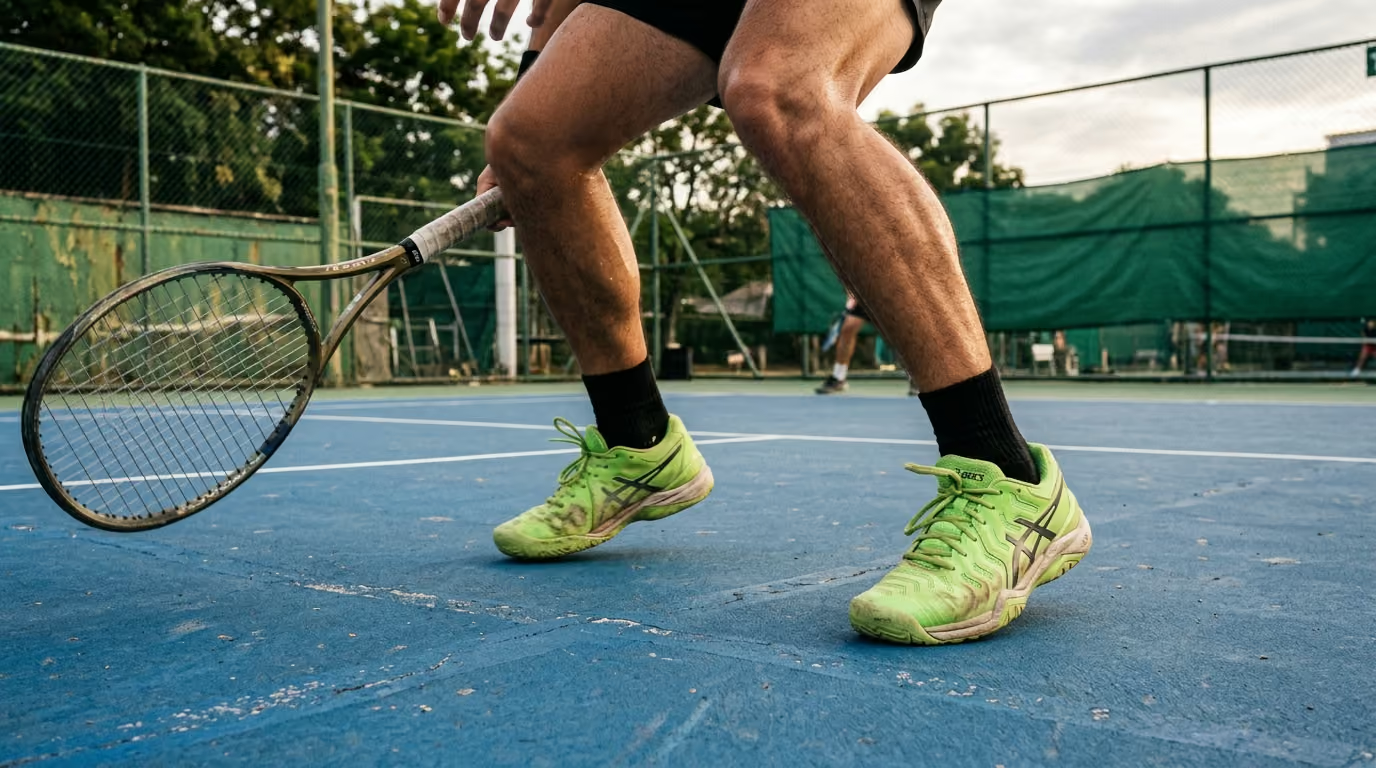
Effective forward movement and net transitions are achieved through a precise sequence of sensory recognition, controlled braking, and structured positioning.




If you have ever run forward to chase a short ball only to overrun the shot or find yourself completely off balance, you are not alone. Many players struggle with the physical demands of transitioning from the back of the court to the net. They often feel clumsy, rushed, or unable to stop their forward momentum in time to make a controlled volley.
Moving efficiently from the baseline to the net is not a matter of raw sprinting speed. Instead, a successful net transition relies on a precise sequence of sensory recognition, controlled braking, and structured positioning. By mastering these movement phases, you can arrive at the net in balance, ready to cover the court and protect your athletic longevity.
Many court athletes believe that the fastest player always wins the race to the net. In practice, tennis, pickleball, and padel rarely require straight-line sprint speed. Instead, court movement consists of short, explosive bursts followed by rapid deceleration.
According to a comprehensive movement speed research summary from the Sports and Play Construction Association, approximately 80% of tennis strokes are executed within a comfort zone of just three meters. Furthermore, over 70% of movements during a rally are lateral. Forward movements account for fewer than 20% of court actions, while backward movements make up less than 8%. This makes forward transition a highly specialized movement pattern.
The same research highlights that high-level players make approximately four directional changes per point on average. In long rallies, this number can rise to fifteen directional changes, with a change of direction occurring roughly every four meters. This high frequency of direction changes explains why your transition must prioritize balance and braking over absolute velocity.
An essential coaching rule of thumb summarizes this challenge. You must accelerate to the ball, decelerate before the shot, and split step before your opponent makes contact. This simple formula connects forward propulsion, controlled braking, and preparation for the next shot.
The split step is the physical foundation of court movement. A study published in the Journal of Sports Sciences defines the split step as a small vertical jump or hop used as preparation for a rapid lateral step. It is not a stationary pause or a decorative jump.
When performed with correct timing, the split step acts as a powerful movement accelerator. Research has shown that participants are 13.1% faster over a close-range distance of 2.7 meters when using a split step compared to starting from a static stance. This speed improvement is highly relevant to court sports, where most movements are short and reactive.
The biomechanical advantage of the split step comes from the stretch-shortening cycle of your muscles. As you land from the small hop, your knees and hips bend slightly. This action stretches the quadriceps and calf muscles, storing elastic energy. Your nervous system then releases this stored energy to help you push off explosively in any direction.
However, split-step timing is critical. If you land too early, you lose the stored elastic energy and must push off from a dead stop. If you land too late, the ball will already be past you. Ideally, you should be at the peak of your hop just as your opponent contacts the ball, landing your feet just as you read the flight and direction of the incoming shot.
To build a reliable transition, you must break the movement down into six distinct phases. Training these phases individually will help you move with greater fluidity during a match.
The transition begins before you even take a step. You must read the depth, height, and speed of your opponent's ball to determine if a forward transition is appropriate. If you run forward blindly on a ball that is too deep or too fast, you will find yourself caught in no-man's-land. Look for cues such as an opponent falling backward or a ball floating high and short.
Once you identify the opportunity, perform your split step. Keep your feet wider than shoulder-width apart and keep your weight on the balls of your feet. Your knees should be soft and slightly bent to absorb energy. In our experience, holding your hands in front of your body at chest height during this phase keeps your upper body quiet and responsive.
Explode forward using your first two or three steps to cover the maximum amount of ground. For an inside short ball, your inside foot will typically move first to create a direct path. For an outside short ball, you may need to use an outside-foot push to transition diagonally. Keep your trunk slightly tilted forward during these initial steps to assist with acceleration.
As you approach the ball, transition from long, powerful strides to shorter adjustment steps. This progressive braking lowers your center of mass and stabilizes your head. Sinking your hips helps transfer horizontal momentum into vertical stability. This change in posture ensures you can swing from a balanced base rather than hitting while falling forward.
Execute your shot while maintaining a stable spine and a quiet head. Depending on the ball, you may use a square stance for control or a dynamic hop-step to keep your forward momentum flowing toward the net. Avoid the temptation to look at your target too early. Keep your eyes focused on the contact point until the ball has left your strings or paddle face.
The transition is not complete when you hit the ball. You must continue moving forward to an advantageous net position and perform another split step just before your opponent strikes their reply. This final split step allows you to react to passing shots or lobs. It ensures you are not a stationary target at the net.
To build the physical capacity required for these explosive phases, consider incorporating targeted strength and conditioning resources into your weekly routine.
The physical dimensions of the court dictate your transition paths and your final net positioning. Understanding this geometry prevents you from running unnecessary miles.
In tennis, the court is 78 feet long, and the service line sits 21 feet from the net. When you hit an approach shot, your target net position is generally halfway between the service line and the net. If you stop too far back, you leave too much space for your opponent to hit short angles at your feet. If you rush too close to the net, you make yourself highly vulnerable to a simple lob over your head.
Your lateral positioning at the net should mirror the path of your approach shot. If you hit your approach shot down the line, you should position yourself slightly toward that same side of the court. This positioning cuts off the direct down-the-line passing route, which is the fastest and easiest shot for your opponent to hit. It forces them to try a high-risk, crosscourt pass over the highest part of the net.
If you hit your approach shot crosscourt, your transition path must be diagonal. You must move toward the center of the court to cover the wide angles. Understanding these geometric lanes allows you to move with anticipation rather than reaction. It ensures you are always in the highest-probability defensive position.
While the basic principles of movement remain constant, tennis, pickleball, and padel place distinct physical and tactical demands on your net transitions.
In tennis, the large court size and heavy ball require maximum acceleration and powerful braking. You must cover long distances quickly, often starting from well behind the baseline. Because tennis balls bounce higher and travel faster, your approach shots are often hit from waist height or higher. This height allows you to use a more aggressive, driving swing. You must also prepare for long-distance recovery runs if your opponent manages to lob over your head.
Pickleball transitions are highly compressed due to the small 44-foot court. The primary goal is to transition from the baseline to the Non-Volley Zone line, often called the kitchen line. Because you cannot step inside the kitchen to volley, your footwork must be incredibly precise.
You will often transition forward using a third-shot drop, which is a soft, looping shot designed to land in the opponent's kitchen. You must move forward quietly while the ball is in the air, often stopping mid-court to split step if your drop shot is slightly high. This transition zone is often called no-man's-land, and navigating it requires patience rather than speed. For detailed footwork drills tailored to this compact environment, you can read our mobility and movement resources.
Padel transitions are unique because of the surrounding glass walls and the constant threat of the lob. You will often transition to the net after hitting a deep, tactical lob that pushes your opponents to the back of the court.
Because the padel court is enclosed, your movement is highly multidirectional. You must be prepared to sprint forward to cover a short drop shot, but you must also be ready to run backward to play a ball off the glass. Keeping your paddle high and your elbows in front of your body is critical during padel transitions, as reaction times are incredibly short at the net.
You do not need a full court to improve your transition mechanics. Confined-space drills are highly effective because they isolate your posture, braking, and racket preparation without the distraction of a long sprint.
Stand in the center of a service box in a relaxed ready position. Have a practice partner stand across the net and point in a random direction: left, right, or forward.
As soon as your partner points, perform a quick split step. Land softly, then immediately take two explosive steps in the indicated direction. Finish in a low, balanced hitting posture and hold that position for two seconds. This drill teaches your nervous system to link the split-step landing with a rapid directional change.
Begin at the service line. Have a coach or partner stand near the net and toss a ball shortly in front of you.
On the toss, perform a split step and take two fast forward steps. As you near the ball, use small stutter steps to bring your momentum to a complete stop before shadow-swinging an approach volley. Hold your final balanced posture for two seconds. This drill prevents you from running through your shots and teaches your lower body how to absorb kinetic energy.
This drill is designed to perfect your split-step timing. Stand on the baseline while your partner stands on the opposite side of the court. Your partner will hit soft groundstrokes or tosses to you.
Your goal is to say the word "now" the exact moment your partner's racket makes contact with the ball. You must coordinate your split-step hop so that your feet land on the court just as you finish saying the word. Repeat this for three sets of ten balls. This exercise builds the visual-motor coordination required to time your movement in real-world matches.
Hold your racket or paddle in your standard ready position with your elbows positioned in front of your hips. Perform a split step, take two quick steps forward, and brake.
Throughout this movement, focus on keeping your racket below eye level but above your wrist. Do not let your hands drop to your sides or flail outward as you run. Keeping your upper body structured during movement dramatically reduces the time required to prepare your stroke once you reach the ball.
For more structured training ideas, our court performance resources offer comprehensive guides to optimizing your on-court movement.
Many recreational players waste energy and risk injury by making simple, repeatable movement errors during net transitions.
Your ability to play racquet sports for decades depends heavily on how you manage the physical stress of deceleration. While accelerating forward is relatively easy for the body, stopping suddenly places massive eccentric loads on your muscles, tendons, and joints.
When you brake, your quadriceps and patellar tendons must work eccentrically to slow your body weight down. This action can create significant stress on the knee joints. Sinking your hips and using several small adjustment steps, rather than one giant lunge, distributes this force safely across your larger hip muscles and glutes.
I remember finishing a tough two-hour padel match on a cold Tuesday night and waking up the next morning feeling like my lower back was locked in concrete. For a long time, I just accepted this stiffness as the price of playing hard in my forties. But once I started spending just ten minutes on targeted hip mobility before heading to the club, the stiffness almost completely vanished. It taught me that we do not have to accept pain as a default state of aging.
To protect your joints and maintain your agility on the court, focusing on your overall physical preparation is essential. You can find highly practical movement advice in our injury prevention resources to help you build a resilient body.
Additionally, understanding the relationship between muscular fatigue and joint stability is key to long-term health. Our recovery science resources explain how to manage muscle soreness and joint tissue stress between demanding court sessions.
While minor muscle soreness is a normal part of training, you should never ignore persistent joint discomfort or sharp pain. Your physical safety should always come first.
If you experience sharp pain in your knees, shins, or Achilles tendons during sudden braking, it is a sign that your connective tissues are overloaded. Similarly, persistent lower back pain that radiates down your legs, or a feeling of instability in your ankles, requires attention. These symptoms indicate that your body is not absorbing force correctly.
If you experience any of these red flags, consult a qualified physical therapist or sports medicine physician. They can analyze your movement mechanics, identify muscle imbalances, and design a customized rehabilitation plan. Addressing these issues early prevents minor strains from turning into chronic injuries that keep you off the court for months.
For more information about our commitment to helping court athletes move well and play longer, visit our about page.
To put these principles into practice this week, follow this simple progressive checklist:
By focusing on movement efficiency and body control rather than raw speed, you can transform your net transitions. You will arrive at the net in perfect balance, ready to execute your volleys and enjoy the game for years to come.
Follow Evercourts for practical insights on tennis, pickleball and padel performance, movement, recovery and healthy ageing. Stay connected for new articles, research-led guidance and ideas to help you play well and keep playing for years.


Read practical guidance for better movement, smarter preparation and a game that keeps working for you.
explore the Blog