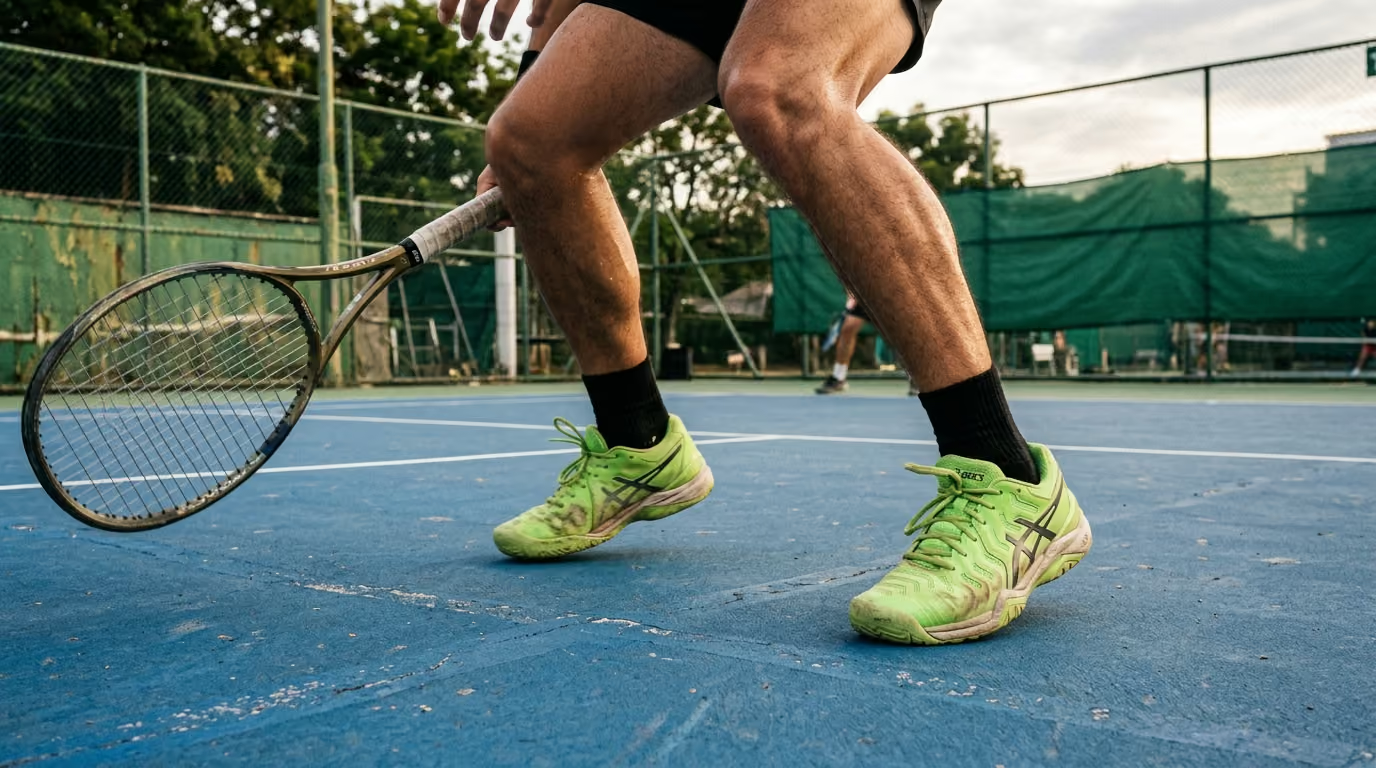
A 21 percentage point drop in winning probability on grass courts for second serves highlights the critical need for in-match tactical adjustments in racquet sports.




Many court athletes find themselves asking why their excellent practice form disappears during competitive matches. They watch their shots miss the lines, their positioning break down, and their frustration rise. The root cause is rarely a sudden loss of athletic ability. Instead, it is often a failure to adapt to the specific problems presented by the opponent.
An in-match tactical adjustment is a deliberate change to your shot selection, court positioning, targets, or speed of play based on patterns observed during a match. It differs from a pre-match strategy because it responds to live evidence rather than theoretical plans. Ultimately, a successful adjustment changes the physical problem your opponent must solve to win points.
Sports science research highlights why players must adapt their play based on real-time data. In competitive racquet sports, the opening exchange exerts an outsized influence on who wins the point. Research in elite singles matches reveals that first-serve points are won at a significantly higher rate than second-serve points. Specifically, starting a point with a second serve reduces the server’s probability of winning the point by approximately 14.6 percentage points on clay. This drop increases to 17 percentage points on hard courts and reaches 21 percentage points on grass.
These numbers demonstrate why adjusting your return of serve is a primary tactical priority. If you cannot neutralize the opponent's first serve, the rest of your tactical plan becomes irrelevant.
Furthermore, the structural advantage of serving does not last indefinitely during a rally. Research on rally outcomes indicates that the serving advantage is strongest in short exchanges. This advantage largely dissipates by the third or fourth shot. If you are returning, your main objective is to extend the rally past this critical threshold.
On faster surfaces, the value of early exchanges is even more pronounced. A study of matches at Wimbledon found that players who won more points in short rallies of zero to four shots won approximately 90% of the matches. This means that while long, dramatic rallies are exciting, matches are overwhelmingly decided by serve, return, and the immediate follow-up shot.
However, adjustments must be based on genuine patterns rather than emotional reactions to single errors. A study on player performance found no clear evidence that an unforced error predicted the outcome of the subsequent point. Additionally, making an error did not negatively affect serve accuracy on the next point. This means that a single mistake is not a trend. It is simply a statistical event that does not require an immediate, panic-induced tactical overhaul.
To make reliable adjustments under pressure, you need a repeatable process. You cannot rely on vague feelings or emotional reactions. The four-stage loop of observe, diagnose, adjust, and test provides a systematic way to solve court problems.
Observation is the act of collecting neutral, objective information during play. You must separate what is actually happening from how you feel about it. To build an accurate picture of the match, focus your attention on several specific elements:
The key to observation is looking for repetitions. A single exceptional winner by your opponent is not a pattern. Three consecutive backhand winners down the line when you hit a short ball is a pattern.
Once you have gathered observations, you must translate them into a concrete problem. A diagnosis explains exactly why you are losing points.
Avoid vague, useless diagnoses like "I am playing poorly today." Instead, frame the issue in actionable terms. For example, you might conclude that your second serve is landing too short, which allows the opponent to attack your backhand corner immediately. Another common diagnosis is that the opponent is highly consistent from the baseline, meaning you cannot win by simply playing neutral crosscourt rallies.
By defining the problem precisely, you narrow down the potential solutions. You transition from emotional frustration to logical problem-solving.
With a clear diagnosis, you can select a specific adjustment. A useful adjustment must target one of five variables: position, target, shape, tempo, or risk.
If your return is constantly under attack, you might adjust your starting position by taking two steps back. If the opponent is hurting you with low, slicing shots, you can adjust the shape of your ball by hitting with more height and clearance over the net.
Your adjustment should be formulated as a clear instruction. Instead of telling yourself to play better, say, "On the second serve, I will stand inside the baseline and target the deep middle of the court." This gives your brain a precise, physical task to execute.
Every tactical adjustment is a live experiment. You must run the adjustment for a specific period, usually one or two service games, to see if it works.
Evaluate the results based on the quality of the opponent's reply rather than the immediate score. Did your deeper return prevent them from attacking on the next shot? Did your high, heavy ball force them to hit a short reply?
If the adjustment improves your court position or reduces the opponent's comfort, keep using it. If the opponent easily counters the change, or if your error rate rises unacceptably, you must return to the observation stage.
The time between points is highly valuable for improving your performance on court. The rules of racquet sports generally allow between 15 and 25 seconds between rallies. You must use this brief window to reset physically and mentally. You can do this by asking yourself three simple questions.
First, ask yourself what happened on the previous point. Describe the physical event without self-criticism. For instance, you might note that the opponent served wide to your forehand and you missed the return in the net.
Second, ask why it happened. Identify the mechanical or positional cause of the outcome. You might realize that you were caught flat-footed because you did not expect the wide serve, leaving you late to reach the ball.
Third, ask what you will do on the next point. Choose a simple, physical correction that you can visualize immediately. You might decide to shift your starting position half a step to the right to protect against the wide serve.
By running this quick mental loop, you prevent frustration from building up. You keep your focus on the present moment and the next physical task.
Because the opening exchanges are so critical, you must be ready to adjust your serve and return patterns early in a match. If you are struggling to hold serve, or if you cannot break the opponent's serve, look for physical adjustments rather than technical swing fixes.
When facing a highly effective server, your first instinct might be to swing harder. This is usually a mistake. Instead, try changing your physical positioning on the court.
If the server has a fast, penetrating delivery, consider taking a step or two backward. This extra distance gives you more reaction time. It also allows the ball to drop to a more comfortable striking height.
Conversely, if the opponent has a slow, high-bouncing second serve, stand closer to the baseline. Taking the ball early prevents the spin from taking full effect and forces the server onto the defensive.
Additionally, reduce your directional ambition on the return. Trying to hit a return close to the lines is a high-risk strategy. Aiming for the deep center of the court is often much more effective. A central return limits the angle the server can use for their next shot, neutralizing their serve advantage.
If the receiver is returning your serve aggressively, you must alter your serving patterns. Do not rely solely on speed. Instead, focus on placement and variety.
A highly effective adjustment is the body serve. Hitting the ball directly at the receiver's chest or dominant hip prevents them from extending their arms. This simple change makes it very difficult for them to hit an aggressive, driving return.
You can also adjust your target based on the score. On critical points, such as break points, serve to the opponent’s weaker side with plenty of margin over the net. Do not try to hit an ace. Instead, focus on hitting a high-percentage spin serve that forces a defensive return.
Many players encounter opponents who relentlessly target their backhand. If you find yourself pinned in your backhand corner, you must adjust your tactics to escape this pattern.
Before you can defend your backhand, you need to understand how the opponent is attacking it. An opponent's attack is rarely uniform. You must observe which specific situations are causing you trouble.
Some players struggle when they have to hit a backhand while moving laterally. Others have no issue with lateral movement but cannot handle a high, heavy ball that bounces above shoulder height. Some players can hit consistent crosscourt backhands but make errors when they try to redirect the ball down the line.
Once you identify the exact problem, you can select the correct physical response.
If the opponent is successfully targeting your backhand, your positioning may be too predictable. You can counter this by shading slightly toward your backhand side.
Moving your starting position half a step toward the backhand alley makes it easier to cover that side of the court. It also allows you to run around your backhand and hit a forehand on slower shots.
However, you must be careful not to over-commit to this adjustment. If you stand too far to one side, you leave the entire forehand court open. Only adjust your position enough to neutralize the opponent's favorite angle.
When you are pinned in your backhand corner, hitting a flat, fast reply is highly risky. Instead, use height and spin to give yourself time to recover.
Hitting a high, looping backhand with plenty of topspin deep into the opponent's court is an excellent defensive option. The high trajectory gives you several seconds to run back to the center of the court. It also forces the opponent to hit their next shot from behind their own baseline, reducing their ability to attack.
Alternatively, you can use a low, spinning slice return. A low slice forces the opponent to bend their knees and lift the ball. This often prevents them from hitting another aggressive shot, allowing you to regain neutral positioning.
Facing a player who constantly rushes the net, or one who uses disruptive spin and pace changes, can be highly frustrating. To succeed, you must adjust your expectations and your shot selection.
When an opponent moves forward to the net, they reduce your reaction time. Your goal is to make their first volley as difficult as possible.
You do not need to hit a spectacular passing shot on the very first ball. Instead, aim your shot low, targeting the volleyer's feet as they move forward. Forcing them to volley from below net height is highly effective. It prevents them from hitting down on the ball, often forcing a weak, floating reply that you can easily pass on your next shot.
The lob is another highly useful tool against aggressive volleyers. If the opponent stands very close to the net to cut off your angles, hit a high, deep lob over their head.
This forces them to turn around and run backward, immediately shifting the advantage of the point to you.
Opponents who rely on slices, moonballs, and drop shots want to break your physical rhythm. They want you to become impatient and try to hit low-percentage winners.
The most effective response to a pace changer is to establish your own physical balance before striking the ball. Do not rush your swing when you receive a slow, floating ball. Instead, use extra adjustment steps to get into a stable physical position.
Additionally, avoid the temptation to hit every slow ball with maximum speed. Hitting a low, slicing ball with high speed is extremely difficult and often leads to unforced errors.
Instead, meet the slow ball with controlled pace and heavy spin. Target large areas of the court to maintain a high margin of safety.
While the core principles of observation and adjustment apply to all court sports, the physical implementation differs depending on whether you play tennis, pickleball, or padel. You can find detailed longevity and performance guides to help you adapt these ideas to your specific sport.
In tennis, the massive size of the court and the high bounce of the ball make space and time your primary concerns. Adjustments in tennis often focus on court depth and ball height.
If you are playing on clay, you must be prepared for longer rallies and higher bounces. Standing farther behind the baseline can give you the time needed to deal with heavy spin. On fast grass or hard courts, you must stand closer to the baseline to prevent the ball from sliding past you.
Furthermore, because tennis balls vary in speed depending on humidity and temperature, you must adjust your targets. On cold, damp days, the ball will travel slower, meaning you must use larger targets and prepare for longer physical exchanges.
In pickleball, the small court size and the presence of the non-volley zone, commonly called the kitchen, create a unique tactical landscape. The game is highly focused on paddle positioning and quick reactions.
If your opponents are successfully attacking you from the kitchen line, you must adjust your third-shot strategy. If your third-shot drops are landing too high, allowing the opponents to volley them down, switch to a third-shot drive.
Hitting a fast, low drive directly at the opponent can force a weak volley, which you can then drop softly into the kitchen on your fifth shot.
Additionally, if you are losing fast-paced hand battles at the net, adjust your paddle positioning. Hold your paddle higher and slightly toward your backhand side, as this is the quickest position from which to block fast body shots.
Padel is defined by the presence of glass walls and a metallic mesh fence. This means that tactical adjustments often involve utilizing the court geometry to neutralize the opponent's physical power.
If the opponents are hitting aggressive, smashing shots that bounce high off the back glass, you must adjust your defensive positioning. Do not try to volley these smashes from mid-court. Instead, let the ball pass you, watch it bounce off the back wall, and hit it on its downward path as it moves forward.
You can also use the chiquita, a soft, low shot directed at the opponents' feet as they stand at the net. This forces them to volley upward, giving you and your partner an opportunity to rush forward and take control of the net.
Even experienced players make mistakes when trying to adjust their tactics during a match. Recognizing these common errors will help you maintain a structured approach to your game.
One of the most common mistakes is making a major tactical change after losing a single point. If you miss one down-the-line forehand, it does not mean your down-the-line strategy is broken.
It may simply be a minor technical error or a well-played shot by your opponent. You must wait to see if the same error occurs three or four times under similar conditions before making an adjustment.
Sometimes, a player chooses the correct tactic but executes it poorly. For example, you might decide to hit a high ball to the opponent's backhand, but you mishit the ball, sending it short and allowing them to attack.
This is an execution failure, not a tactical failure. If you abandon a sound tactic because of one poor swing, you play right into your opponent's hands. Before changing your plan, ask yourself if the decision was correct even if the physical execution was flawed.
If you identify a weakness in your opponent's game, such as a fragile backhand volley, do not hit every single ball to that spot. If you do, the opponent will quickly realize your plan. They will start standing closer to their weakness, pre-positioning their body to defend it.
Instead, use the weakness as the final step in a pattern. Move the opponent out of position by hitting to their strong side first. Once you have created open space, then target their weak spot. This keeps them guessing and increases the effectiveness of your attack.
Making smart tactical adjustments is not just about winning more points. It is also an excellent way to protect your body from unnecessary wear and tear, supporting your long-term healthy aging and athletic longevity.
When you play with poor tactics, you often find yourself running cover-to-cover, scrambling to reach difficult balls. This high physical demand leads to rapid fatigue, which increases your risk of injury. By making early positioning adjustments, you reduce the physical distance you must run during a match.
For example, standing in the correct spot to receive a serve means you can reach the ball with two balanced steps rather than a desperate, lunging dive. This protects your knees, ankles, and lower back from high-impact stress.
I remember finishing a tough two hour padel match on a cold Tuesday night and waking up the next morning feeling like my lower back was locked in concrete. For a long time, I just accepted this as the price of playing hard in my forties. But once I started spending just ten minutes on targeted hip mobility before heading to the club, the stiffness almost completely vanished. It taught me that we do not have to accept pain as a default state of aging.
By combining physical preparation with smart, efficient tactics, you can keep playing the sports you love for many years to come. You can read more about establishing high-quality recovery science resources to keep your joints moving smoothly.
While learning to adapt your game is highly beneficial, you must always listen to your body. You must understand the difference between normal physical fatigue and signs of a genuine medical issue.
It is normal to experience mild, symmetrical muscle soreness in the day or two following a highly competitive match. This is simply your body adapting to physical work. However, sharp pain, swelling, or pain that is localized to a single joint is not normal.
If you experience sudden, sharp pain during a match, do not try to play through it by adjusting your tactics. This can lead to a much more severe injury that could keep you off the court for months.
Stop playing immediately and consult a qualified healthcare provider, such as a sports physiotherapist or orthopedic physician. For more information on safe playing practices, check out our injury prevention resources.
To begin applying these tactical adjustment skills to your game this week, use the following step-by-step checklist.
Follow Evercourts for practical insights on tennis, pickleball and padel performance, movement, recovery and healthy ageing. Stay connected for new articles, research-led guidance and ideas to help you play well and keep playing for years.


Read practical guidance for better movement, smarter preparation and a game that keeps working for you.
explore the Blog