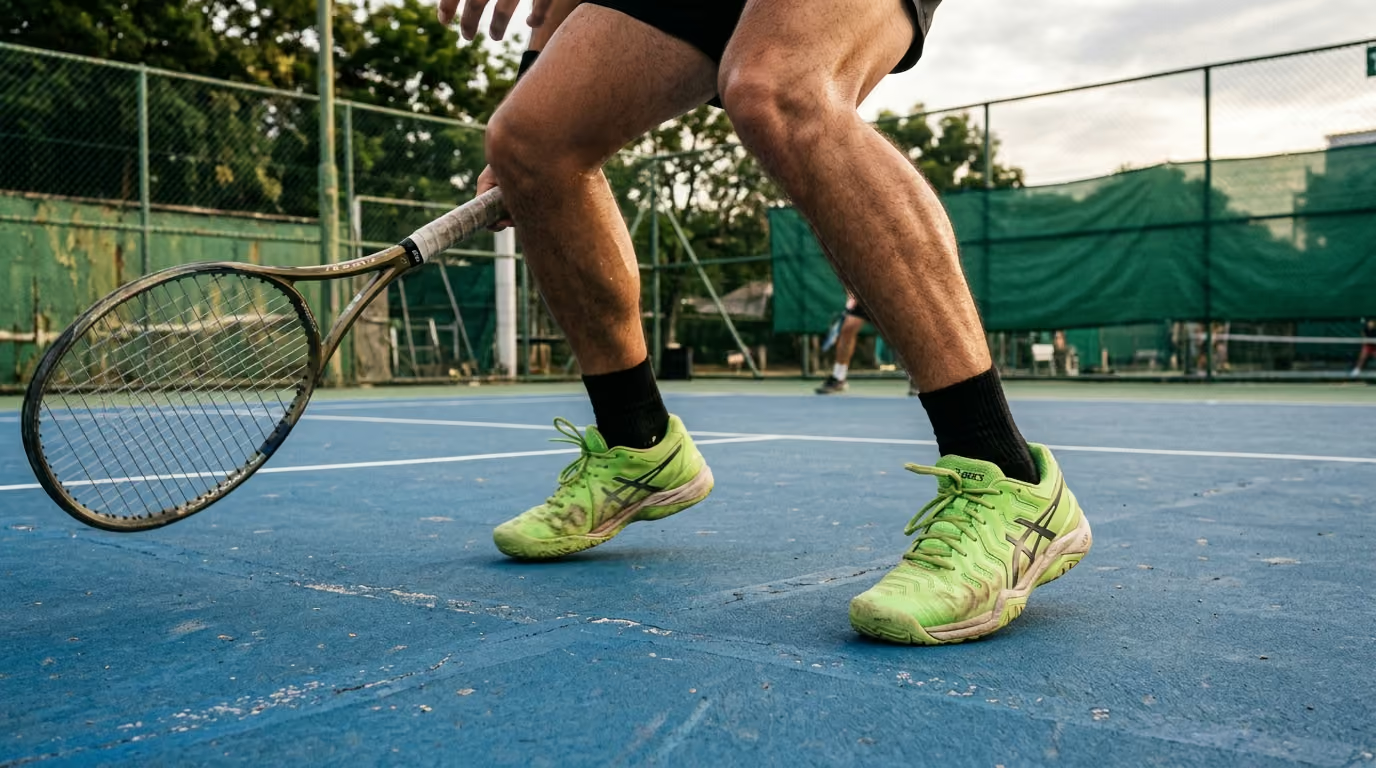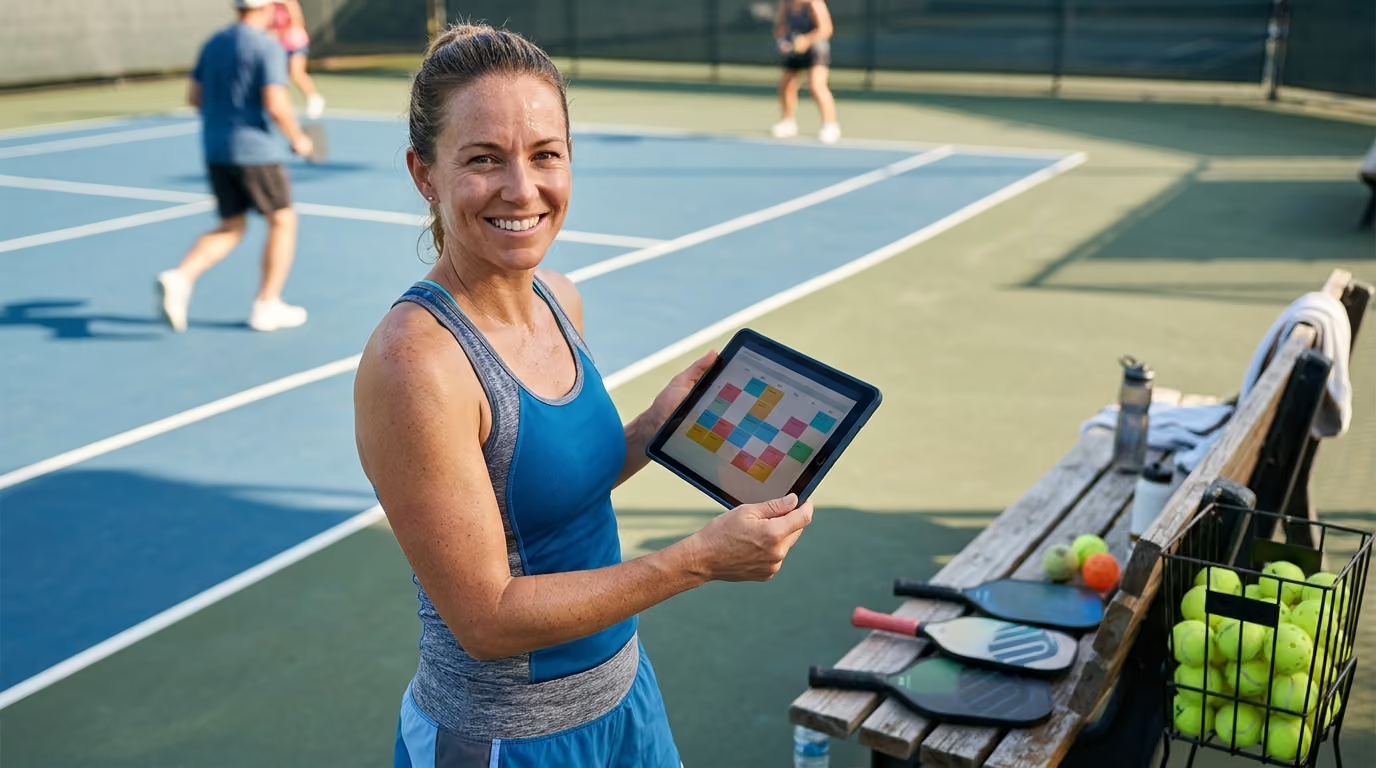

When managing a tennis, pickleball, or padel team, creating a strong roster and fostering cohesion are crucial for consistent success and player satisfaction.




Many captains believe that winning matches comes down to drafting the absolute best players and creating a perfect weekly lineup. In reality, sustainable team leadership depends on a repeatable, transparent operating system that balances performance with player satisfaction. By establishing clear guidelines, communicating early, and organizing your roster around reliable availability, you can navigate competitive matches with minimal friction.
Understanding the psychological and structural dynamics of a sports team can transform your leadership approach. For decades, researchers have analyzed what makes athletic groups perform at their peak. These findings show that team success relies on specific patterns of social and structural organization.
In sports science, cohesion is divided into two parts: task cohesion and social cohesion. Task cohesion represents a shared commitment to the team's competitive goals. Social cohesion represents the interpersonal attraction and sense of belonging among members.
A landmark meta-analysis published in the Journal of Sport and Exercise Psychology by Dr. Albert Carron and colleagues examined these dynamics. The researchers analyzed data across multiple sports levels. They found a significant, moderate-to-large relationship between team cohesion and competitive success.
A separate meta-analysis by Gully, Devine, and Whitney confirmed that task interdependence moderates this relationship. In racquet sports, players must coordinate movements, communicate on court, and support each other through intense matches. Because doubles play requires high interdependence, task cohesion is incredibly important for team success.
To build task cohesion, captains should focus on creating what researchers call a mastery climate. First identified by educational psychologist Carole Ames, a mastery climate focuses on individual improvement, effort, and process goals. Conversely, a performance climate focuses entirely on social comparison, status, and winning.
Research involving team sports shows that task-oriented environments improve player satisfaction. When players focus on controllable elements, their anxiety decreases. A performance-focused environment often increases selection anxiety and breeds resentment among team members.
Captains can build a mastery climate by practicing autonomy-supportive leadership. This framework, developed by researchers Marylène Gagné and Edward Deci, emphasizes supporting a player's sense of competence and relatedness. Leaders do this by explaining their decisions, listening to player feedback, and offering choices where possible.
Psychological safety is the shared belief that the team is safe for interpersonal risk-taking. In a psychologically safe environment, players can report injuries, admit uncertainty, or discuss mistakes without fearing humiliation.
Research in sport psychology suggests that high-performance environments thrive when athletes can communicate openly. A team that allows honest communication will always outperform a team built on fear of failure. When players feel safe, they are more proactive and collaborative during tight matches.
A strong roster is not merely a list of the highest-rated players in your club. It is a balanced pool of core competitors, reliable substitutes, and developmental players. To manage this pool, you need a repeatable administrative system.
Before the season begins, gather detailed information from each player on your roster. You can track this data in a simple spreadsheet or database. Avoid relying on memory to make selection decisions.
For each competitor, collect their official rating or competitive level. Note their preferred formats, such as singles, doubles, or mixed doubles. Track their weekly availability patterns and typical travel limitations.
Finally, document their preferred partner styles and any current physical limitations. Collecting this data early helps prevent scheduling conflicts later. You can access more competition and court lifestyle resources through our guides to streamline your roster management.
Publish a short team charter before the first ball of the season is hit. This charter should outline the operational rules, preferences, and areas of captain discretion. Clearly separating these categories prevents misunderstanding.
By setting these boundaries, you avoid the trap of treating every individual preference as an absolute right.
To keep your system running smoothly, establish a strict weekly timeline for availability. Avoid using scattered text messages or group chats to collect this data. Instead, use a single digital form or a shared calendar application.
Ask players to classify their availability into clear categories. They should mark themselves as confirmed available, available if needed, or completely unavailable.
Set your initial availability deadline seven to ten days before each scheduled match. This window gives you enough time to construct a balanced lineup. Confirm the final selections three to five days before the match to allow for personal planning.
Lineup selection is the most common source of friction in recreational racquet leagues. Captains often make decisions based on emotion or immediate pressure. Using a structured framework ensures your choices are objective and transparent.
Instead of choosing lineups by intuition, evaluate players across five key dimensions. Assign a mental weight to each category to guide your decisions.
Adjust these weights depending on the importance of the match. For a playoff, increase the matchup strength weight. For an early-season match, emphasize rotation and player development.
Never publish a lineup without a clear backup plan. Always draft a Plan A and a Plan B simultaneously.
Plan A represents your ideal tactical lineup for the week. Plan B details your immediate adjustments if a player gets stuck in traffic or sustains an injury.
Identify which players can swap positions without causing a cascade of changes across other lines. Ensure your backup plan complies with all local league regulations. Knowing exactly who will step in prevents panic during the pre-match warm-up.
A common captain mistake is looking only at the next match. A sustainable team requires a season-long perspective. You must protect player health, manage fatigue, and keep your deep roster engaged.
If you play your top performers every single week, your alternates will lose motivation. When an injury occurs, those cold substitutes will be unprepared to play.
Rotate your squad so that every player stays sharp and invested in the team's journey. This approach builds a more resilient roster for the playoffs.
While leadership principles remain constant, the rules and logistics vary by sport. A captain must adapt their approach to the specific demands of tennis, pickleball, or padel.
Tennis leagues, such as those governed by the USTA, operate under strict, formal regulations. Captains must simultaneously exchange written lineups before matches begin. If your team is short-handed, you cannot strategically default any line you choose.
Most local regulations require teams to default from the lowest position upward. For example, if you lack players for a singles line, you must default the lowest singles court. Placing an ineligible player in a top slot to save lower courts can result in team disqualification.
You must also consider singles versus doubles specialization. A great singles player might struggle with the fast net exchanges of doubles. Use our tennis articles to learn more about tactical placement and positioning rules.
Pickleball team formats often feature rapid partner rotation and mixed doubles rounds. Because of the court's compact dimensions, fast hands and quick reflexes are critical. However, team success relies heavily on partnership communication.
When selecting pickleball pairings, prioritize third-shot drop discipline and dink patience over raw power. Left-handed and right-handed partnerships require careful coordination to avoid collisions in the middle. Ensure your players agree on who covers middle balls and who initiates poaching.
Roster depth is key to avoiding defaults in pickleball leagues. Platforms often allow captains to make roster changes up to the match day. Keep a deep bench of players who are comfortable playing with multiple partners. Explore our pickleball articles to master these doubles dynamics.
Padel is almost exclusively a doubles sport, requiring highly specialized positioning and teamwork. Under the International Padel Federation (FIP) regulations, captains must submit team formations before each round. Opposing captains often have a brief window to review and object to formations if rules are violated.
Padel requires absolute clarity on side selection. Players usually specialize as either left-side (drive) or right-side (reves) players. Swapping sides during a match can cause defensive chaos, especially when defending rebounds off the glass walls.
Your lineup must pair players who communicate well in enclosed spaces. A player with an excellent smash is ineffective if their partner cannot defend the back-glass. For more in-depth strategies, check our padel articles for court movement and structural guides.
Clear communication is the primary tool for preventing team conflict. A captain must establish structured channels to deliver information without overwhelming the players.
Effective captains structure their communications to avoid messages getting lost. Use three distinct channels to keep information organized.
First, use team-wide messages for schedules, deadlines, weather updates, and general logistics. Keep these broadcast messages concise and action-oriented.
Second, use small-group chats for specific pairings or travel arrangements. This prevents players from being spammed with messages that do not apply to them.
Third, use one-to-one conversations for private matters. Never discuss non-selection, performance issues, or personal behavior in a group setting.
When a player is left out of a major match, deliver the news privately and promptly. Use a constructive, observation-based formula to structure the talk.
Start by stating objective facts rather than opinions. For example, say, "We have three players available for this single line, and we are rotating positions this week."
Next, outline the plan for their next appearance. This keeps the focus on improvement and future contribution. Give the player a clear pathway to get back on the court, which preserves their motivation.
A successful team culture allows players to voice their limitations without fear. Encourage players to report minor strains or high stress levels early.
If a player feels pressured to compete while injured, they risk long-term damage. Create an environment where saying, "I am not ready to play this week," is met with support. This openness protects both the individual and the team's overall season health.
A smooth match day is won in the days leading up to the event. Follow a structured timeline to eliminate last-minute chaos.
To run a stress-free match day, break your duties down into simple temporal steps.
Seven days out, verify court reservations and confirm details with the opposing captain. Check the local weather forecast and review any specific league rules.
Three days out, publish the provisional lineup to your team. Confirm each player's arrival time individually and secure your alternates.
One day out, send a single, consolidated message with directions, parking instructions, and uniform requirements. Remind players to bring water and recovery snacks.
Gather your team for a brief, five-minute meeting before matches begin. Avoid giving long, complex tactical lectures right before play.
Instead, focus on simple, actionable reminders. Remind players of court assignments, warm-up protocols, and post-match score reporting. Keep the emotional tone calm, optimistic, and focused on effort.
Once the final ball is hit, the captain's work is not quite finished. Collect the scores from each court immediately and verify them with the opposing captain.
Most leagues require scores to be entered within 24 to 48 hours. Report any disputes or unusual incidents to your league coordinator promptly. Finally, thank your alternates and supporters for their contribution to the match day.
As a captain, you have a responsibility to look out for your players' physical well-being. Modern research highlights the unique physical demands of each racquet sport.
A systematic review published in the International Journal of Environmental Research and Public Health compared injury patterns in tennis, padel, and squash. The review noted that while all three sports involve high rates of muscle and tendon strains, padel players show a high prevalence of upper-limb injuries, particularly in the elbow. Tennis players, conversely, experience more lower-limb ligament issues, especially in the ankle joints.
Pickleball safety is also an important consideration, especially for older adult athletes. An analysis presented by the American Academy of Orthopaedic Surgeons (AAOS) looked at two decades of national injury data. The researchers reported a 90-fold increase in pickleball-related fractures over that period, with the majority occurring in players aged 60 to 69.
Another analysis of emergency department data projected over 17,000 pickleball-related emergency room visits in a single year, with 87% of those patients over the age of 50. These studies emphasize the absolute necessity of structured warm-ups and sensible workload management.
I remember finishing a tough two hour padel match on a cold Tuesday night and waking up the next morning feeling like my lower back was locked in concrete. For a long time, I just accepted this as the price of playing hard in my forties. But once I started spending just ten minutes on targeted hip mobility before heading to the club, the stiffness almost completely vanished. It taught me that we do not have to accept pain as a default state of aging.
As captains, we must encourage our players to prioritize their player health and longevity. Never pressure a teammate to play through severe pain or acute stiffness just to avoid a default. Encourage a proper dynamic warm-up before stepping onto the court, and allow adequate recovery time between competitive events.
Even experienced captains fall into common operational traps. Recognizing these patterns helps you steer clear of unnecessary team friction.
Many captains try to coach every point from the sidelines. This constant stream of instruction usually distracts and confuses players.
Instead, keep coaching interventions minimal during matches. Offer quiet, supportive encouragement during changeovers. Focus on one or two simple tactical adjustments, such as target areas or court positioning, rather than correcting stroke mechanics.
Relying solely on player ratings to build lineups is a major mistake. A rating is a historical average, not a guarantee of current form.
A lower-rated player who is match-fit and highly motivated can easily defeat a higher-rated player who is returning from an injury. Evaluate players based on their current physical readiness, partner compatibility, and mental resilience under pressure.
Alternates and injured teammates are the backbone of a successful season. If you ignore them, they will lose interest and may refuse to play when you face a roster crisis.
Involve non-playing team members in match-day activities. Ask them to help with scouting, tracking statistics, or organizing post-match social events. Recognizing their value builds a cohesive, supportive team culture that lasts for years.
While a captain can support player health, they must never try to diagnose or treat injuries. Encourage your players to seek professional medical advice if they experience persistent joint pain, swelling, or numbness.
If a player suffered a fall and experiences sharp, localized bone pain, they must be evaluated by a healthcare professional. Any signs of dizziness, chest pain, or shortness of breath during play require immediate medical attention. Protecting long-term health should always take priority over winning a league match.
Leading a team with clarity and structural organization ensures your players can enjoy competitive racquet sports for many seasons to come.
Follow Evercourts for practical insights on tennis, pickleball and padel performance, movement, recovery and healthy ageing. Stay connected for new articles, research-led guidance and ideas to help you play well and keep playing for years.


Read practical guidance for better movement, smarter preparation and a game that keeps working for you.
explore the Blog