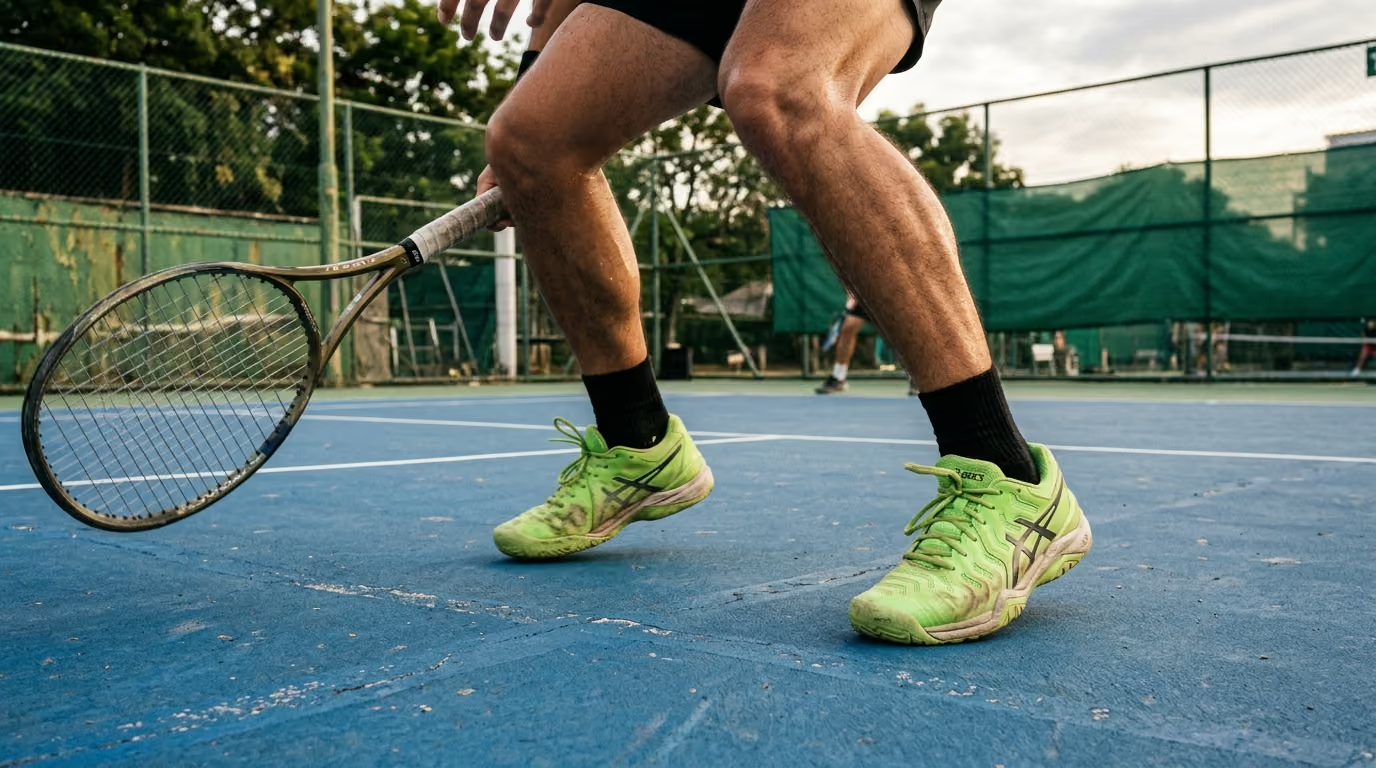

Waking up with stiff joints or a sore back after playing matches can be avoided by effectively balancing physical stress with recovery to maintain peak performance.




Many court athletes find themselves searching for ways to play more matches without suffering from persistent joint stiffness or physical fatigue. Waking up with tight Achilles tendons, sore shoulders, or a lower back that feels like concrete is a common experience for dedicated players. Managing court load and training volume is the process of balancing physical stress with recovery to maintain high-quality movement across consecutive matches and practices.
To achieve long-term success on the court, you must balance your training volume to build physical capacity while avoiding excessive fatigue that degrades your movement quality. This means you should prioritize high-value training that improves your skills while reducing the low-value physical strain that leads to movement compensation and tissue breakdown. By tracking your training metrics and scheduling your matches deliberately, you can continue playing your favorite racquet sports at a high level.
Court performance depends on your ability to produce high-quality movements repeatedly. You must accelerate, decelerate, change direction, jump, and execute precise technical strokes. Doing this requires your body to manage significant mechanical forces while your brain makes fast decisions under pressure.
Load management is not a simple recommendation to play less or reduce your effort. It is the structured organization of physical and psychological stress to build your capacity to tolerate demanding play. According to the International Olympic Committee consensus statement on load management, athletic load is a broad concept. It includes your on-court training, match play, sudden changes in training schedules, tournament congestion, travel, sleep quality, and everyday life stressors.
Understanding this definition is important because your body does not separate court stress from life stress. You might experience a very taxing week even if your court time remains moderate. This often occurs when intense matches coincide with work pressure, poor sleep, or inadequate nutrition.
Scientific research distinguishes between external load and internal load. External load refers to the physical work you perform on the court. This includes the duration of your session, the number of accelerations, decelerations, jumps, and total distance covered. Internal load represents your individual physiological and psychological response to that physical work. Your heart rate, perceived exertion, muscle soreness, and stress levels determine your internal load.
The relationship between these two types of load explains why the same training session can affect two players differently. A ninety-minute singles match might feel comfortable for a highly conditioned athlete. However, that same match could cause severe fatigue and muscle soreness in a player returning from a break. For more information on maintaining your physical well-being, you can read our player health articles designed for court sports.
Physical stress triggers adaptations that make your body stronger and more resilient. However, if the stress accumulates faster than your tissues can repair, performance declines and injury risk increases. Research on the Acute to Chronic Workload Ratio shows that rapid spikes in weekly training volume relative to your longer-term preparation are associated with an increased risk of tissue irritation.
A comprehensive meta-analysis published in the British Journal of Sports Medicine examined this relationship. The researchers found a small to moderate association between elevated workload ratios and injury risk, though they noted significant differences across various sports. This finding indicates that while tracking workload ratios is highly valuable, it should be used as a general warning system rather than a strict mathematical calculator.
To manage your court load effectively, you must understand which actions impose the greatest physical cost on your body. Treating all court time as equal is a common mistake. A slow technical practice does not stress your joints the same way a competitive match does.
We categorize court movements into four distinct load categories to help you evaluate your training.
This category includes sprinting, accelerating, decelerating, and changing direction. These actions place a high demand on your muscles and tendons. Deceleration is particularly expensive because your muscles must contract while lengthening to slow your body down. This eccentric strain is a primary cause of post-match muscle soreness.
Impact load consists of jumps, landings, and repeated split-steps. Every time you land on the court, your body absorbs forces that are multiple times your body weight. Your ankles, knees, patellar tendons, and lower back bear the brunt of these forces. In sports like volleyball and padel, the intensity of jumps is often more critical to monitor than the total jump count.
This includes your serves, overheads, forehands, backhands, and repetitive hitting drills. Repetitive striking can place localized stress on your shoulder, elbow, wrist, and trunk muscles. High-volume serving sessions or hitting off-center shots can quickly strain these areas if your technique begins to break down.
This category covers long rallies, tactical decision-making, and high-stakes matches. Psychological stress raises your heart rate, increases muscle tension, and alters your perception of fatigue. A stressful tournament match requires more recovery time than a friendly practice game of the same duration.
By identifying these high-cost actions, you can design your training sessions with greater precision. If you plan a session with high locomotor and impact loads, you should reduce the technical volume to protect your joints. Conversely, a high-volume hitting session should feature controlled footwork to minimize overall physical strain.
You do not need expensive laboratory equipment or wearable sensors to track your court load. A simple and effective method is the Session Rating of Perceived Exertion. This approach allows you to estimate your total workload by multiplying the intensity of a session by its duration.
To use this method, you rate the overall intensity of your practice or match on a scale from one to ten. A rating of one represents extremely light activity, while ten represents a maximal, exhausting effort. You then multiply this rating by the total duration of the session in minutes.
For example, if you play a moderately intense singles match for seventy-five minutes and rate the intensity as a six, your workload score is 450 arbitrary units. If you complete a light thirty-minute technical practice and rate it as a three, your workload score is 90 units. By recording these scores in a notebook or spreadsheet, you can track your weekly training volume.
To build an accurate picture of your physical capacity, you should establish a baseline by tracking your ordinary training for three to four weeks. Note your typical session duration, average intensity ratings, weekly match volume, and baseline soreness levels. Once you understand your normal workload, you can identify unusual spikes in training that might require extra recovery.
I remember finishing a tough two hour padel match on a cold Tuesday night and waking up the next morning feeling like my lower back was locked in concrete. For a long time, I just accepted this as the price of playing hard in my forties. But once I started spending just ten minutes on targeted hip mobility before heading to the club, the stiffness almost completely vanished. It taught me that we do not have to accept pain as a default state of aging.
This personal experience highlights the importance of matching your training volume to your body's daily readiness. When you track your daily workloads, you can make informed decisions about when to push your limits and when to rest. To understand the science behind physical recovery and adaptation, you can review our dedicated recovery science resources.
The physical demands of racquet sports vary significantly depending on the court size, equipment, and movement patterns. Understanding these differences allows you to tailor your load management strategies to your specific sport.
Tennis is characterized by a large court area, explosive lateral sprints, and violent decelerations. Players must cover significant distances, often sliding or braking abruptly on hard courts or clay. The weight of the tennis racquet and ball also places a substantial demand on the shoulder and elbow during groundstrokes and serves.
In tennis, a two-hour match can lead to temporary reductions in explosive power, repeated-sprint ability, and leg stiffness. Research indicates that these performance markers often take up to twenty-four hours to return to pre-match baselines. Tennis players must prioritize lower-body strength and trunk stability to handle these rotational and braking forces. If you want to integrate specific preparation drills, consider using our injury prevention resources to design a routine.
Pickleball features a smaller court and a lighter paddle, which reduces the need for long-distance sprinting. However, the game demands incredibly fast reaction times and a high volume of rapid, short steps. Players must frequently bend low to play kitchen dinks, placing unique structural demands on the knees, quadriceps, and lower back.
The primary risk in pickleball is the sheer volume of matches players often complete in a single session. Because games are relatively short, players may stay on the court for several hours without realizing the accumulated strain. Pickleball players should monitor their total court time and maintain adequate lower-body mobility to prevent knee and back stiffness.
Padel is played on an enclosed glass court, resulting in continuous rallies and multi-directional movement patterns. The presence of walls means players must rotate, turn, and change direction constantly. Padel also features a very high volume of overhead strokes, such as lobs, trays, and smashes, which can strain the shoulder complex.
Because padel rallies are long and tactical, players often experience high cognitive fatigue alongside physical strain. The continuous rotational movements require exceptional hip mobility and core control. Focusing on rotating through your hips rather than twisting your lower back is essential for longevity in this sport. If you need practical guidance, we recommend reviewing our mobility and movement practices to improve your court rotations.
Recreational and competitive players often make several predictable errors when managing their training volume. Recognizing these pitfalls can help you avoid unnecessary fatigue and keep your movement quality high.
Many players believe that as long as their total weekly court hours remain constant, their load is managed. However, a week containing seven identical moderate sessions can create more accumulated strain than a week that alternates hard and easy days. This repetitive stress is known as training monotony.
To prevent monotony, you should design your training week with clear variations in intensity. Pair your high-intensity match days with light technical practices or dedicated recovery days. This variation allows your muscles and tendons to repair while still maintaining your skills.
A short practice session is not automatically a low-load session. If you spend forty-five minutes performing maximal jumps, rapid changes of direction, or competitive tiebreakers, the physical cost is extremely high.
You must evaluate your sessions by the intensity of the movements rather than the minutes on the clock. If you perform high-cost movements, you must plan for appropriate recovery afterward, regardless of how short the session was.
Many athletes wait until they experience pain before they adjust their training volume. Pain is a late-stage warning sign that your tissues have already been overloaded.
Instead of waiting for discomfort, you should monitor earlier indicators of fatigue. These include a decline in your technical precision, slower reaction times, difficulty decelerating under control, or a general lack of enthusiasm for playing. Modifying your training when these subtle signs appear can prevent minor fatigue from turning into a persistent issue.
Recovery is the biological process through which your body repairs tissue damage, replenishes energy stores, and adapts to the physical stress of training. Without adequate recovery, training simply breaks your body down without allowing it to grow stronger.
The recovery process requires both time and specific nutritional support. For example, when you complete a demanding court session, your muscle glycogen stores are depleted. If you have another match or practice scheduled within eight hours, replenishing these carbohydrate stores quickly is essential.
Sports nutrition research recommends consuming approximately 1.0 to 1.2 grams of carbohydrate per kilogram of body weight immediately after your first session. You should repeat this intake hourly for up to four hours if your recovery window is short. This targeted nutritional strategy ensures your muscles have the fuel required to perform well in the subsequent session.
In addition to nutrition, managing training strain is critical for tissue health. Training strain is a mathematical concept that combines your overall training volume with the monotony of your schedule. When your training strain is consistently high, your immune system can become compromised, and your soft tissues may lose their structural resilience.
Allowing adequate time between high-intensity sessions is the simplest way to manage this strain. While some physical markers may recover within twenty-four hours after a match, your nervous system and tendons often require more time to restore completely. Respecting this biological timeline is the key to athletic longevity.
Tournament play and congested match schedules represent some of the most challenging environments for load management. When you must play multiple matches in a short period, your focus must shift from building physical fitness to preserving your current readiness.
Research from professional basketball highlights the value of adjusting training volume during congested schedules. Researchers found that when teams reduced their training loads during multi-match weeks, players reported better overall well-being and lower levels of fatigue. This demonstrates that you can tolerate high competitive demands if you reduce non-essential training stress.
To manage congested schedules successfully, you can utilize a simple traffic-light decision model to assess your daily readiness.
This status means you feel rested, your movement is crisp during your warm-up, and your technical execution is stable. You can proceed with your planned competitive play or high-intensity training.
This status indicates you are experiencing moderate muscle soreness, mild fatigue, or slightly sluggish movement during your warm-up. You should modify your session by reducing the total volume, removing unnecessary conditioning drills, and focusing on tactical positioning rather than high-speed sprints.
This status represents significant physical exhaustion, persistent joint discomfort, or a clear deterioration in your movement mechanics. In this state, you should stop or substantially modify your high-load training. You should focus on light mobility work, video analysis, or complete rest until your readiness improves.
By applying this structured framework to your scheduling, you can protect your body during intense tournament weeks. Remember that resting when your body is in a red state is not a sign of weakness; it is a tactical decision to preserve your long-term performance.
While managing your training volume can prevent many common physical issues, there are times when you should consult a qualified healthcare provider. Knowing when to seek professional care can prevent minor tissue irritation from developing into a long-term problem.
You should consult a physiotherapist, sports physician, or other qualified healthcare professional if you experience any of the following warning signs:
A qualified professional can perform a comprehensive physical assessment to identify any underlying structural issues. They can also help you design a customized rehabilitation program that addresses your specific physical limitations, allowing you to return to the court safely and confidently.
To apply this load management framework to your routine, you can use this simple checklist over the next seven days:
Taking these practical steps will give you a clear, data-driven understanding of how your body responds to court stress. This knowledge is your most valuable asset as you work to maintain your athletic longevity and continue enjoying your sport for many years to come. For more resources on optimizing your performance and recovery, visit Evercourts, your dedicated platform for racquet sports longevity.
Follow Evercourts for practical insights on tennis, pickleball and padel performance, movement, recovery and healthy ageing. Stay connected for new articles, research-led guidance and ideas to help you play well and keep playing for years.


Read practical guidance for better movement, smarter preparation and a game that keeps working for you.
explore the Blog