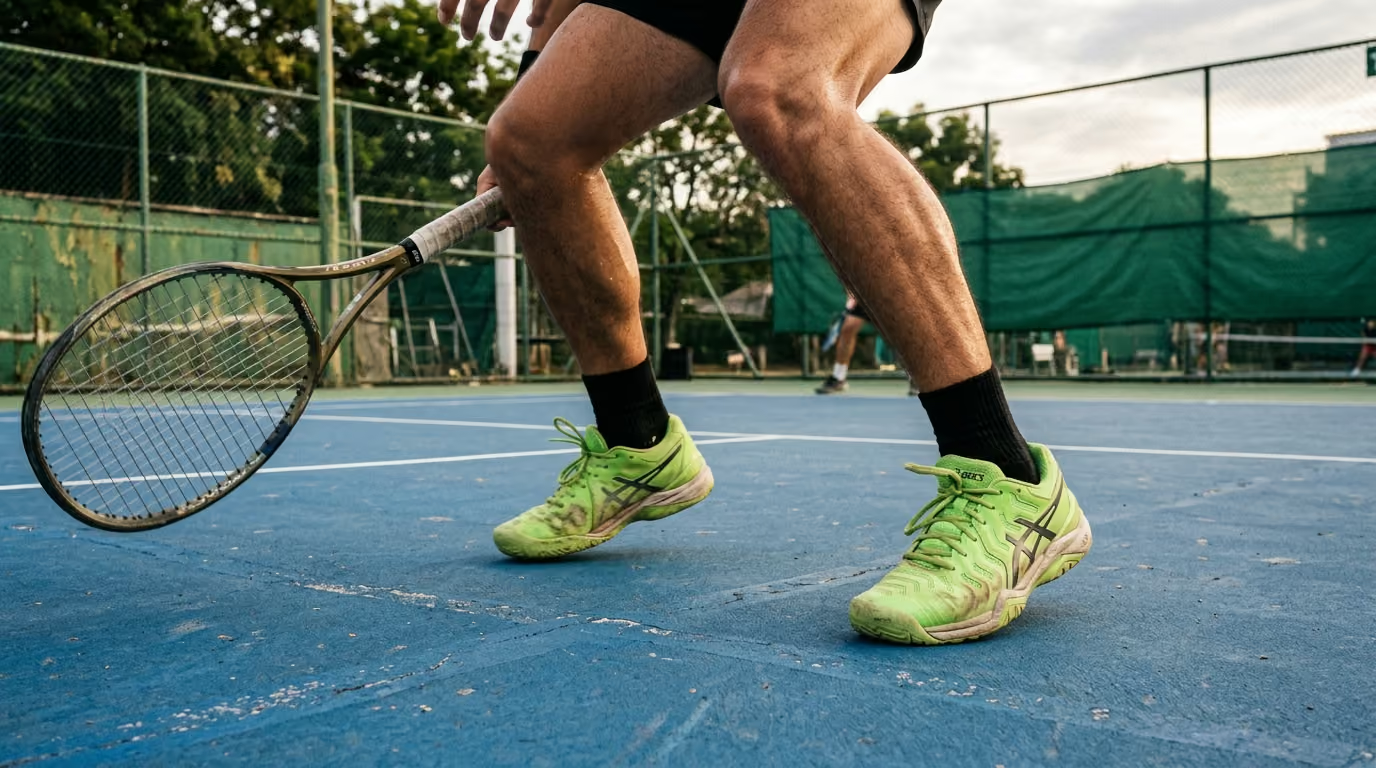
While many believe maximum effort defines success in racquet sports, strategic pacing actually ensures peak performance throughout long matches.




Many racquet sports players believe that match-play success is built on maximum effort. They step onto the court and play every point at maximum intensity, running down every lost ball and swinging with full force from the opening serve. While this aggressive approach is admirable, it often leads to a sudden physical and mental collapse during the second or third set.
Pacing is frequently misunderstood as a form of laziness or passivity. In reality, pacing is the strategic management of your finite physical and mental resources to ensure you can perform at your best when the match is on the line. Managing your energy is just as important as your forehand or your serve.
To pace yourself effectively during a long racquet sports match, you must deliberately distribute your physical effort, tactical choices, decision-making, and emotions across the entire session. This involves identifying and stopping energy leaks, simplifying your choices as fatigue increases, and utilizing structured routines to recover between individual points. By treating the match as a series of intermittent effort cycles rather than one continuous sprint, you can maintain high performance during the most critical points.
Understanding the deep relationship between effort, fatigue, and recovery is the key to healthy aging and athletic longevity on the court. This comprehensive guide details the physical and psychological processes that occur during long matches. It provides a practical framework to manage your physical and cognitive resources, avoid common energy drains, and sustain your performance from the warm-up to the final point.
Pacing in racquet sports is not simply playing slowly or waiting for your opponent to make a mistake. It is the deliberate distribution of physical effort, attention, tactical risk, and emotional arousal across the duration of a match. Sports science research defines pacing as the regulation of effort or exercise intensity across an activity in response to internal and external circumstances. The primary goals are to manage fatigue and avoid premature exhaustion.
To master pacing, you must first understand the difference between external load and internal load. External load refers to the objective work you perform on the court. This includes the distance you cover, the number of accelerations and decelerations, your swing volume, and your changes of direction. Internal load refers to how demanding that work feels to your body.
Internal load is represented by your heart rate, breathing difficulty, muscle discomfort, and mental effort. These two forms of load do not always match. For example, playing on a very hot day might limit your running distance, resulting in a low external load. However, the heat and humidity can cause a massive increase in your heart rate and perceived exertion, creating a very high internal load.
To protect your athletic longevity, you must also recognize that fatigue is not a single condition. It presents itself in two distinct ways during a match. Temporary fatigue is a short-term reduction in output that can improve after a brief recovery period, such as the rest interval between points. Terminal fatigue is a deeper, systemic decline in your physical and cognitive systems.
Terminal fatigue can manifest as neuromuscular decline, which reduces your acceleration and braking power. It can also appear as metabolic fatigue, making it difficult to sustain repeated high-intensity sprints. Finally, mental fatigue degrades your attention, decision quality, and mechanical precision. By recognizing these signs early, you can adjust your playing style before your performance collapses completely.
A long tennis, padel, or pickleball match is best understood as a sequence of repeated performance cycles rather than one continuous effort. Each cycle includes preparation, movement, striking, recovery, and a brief opportunity to restore your resources. Research shows that racquet sports place highly intermittent demands on the human body.
In a physiological profile of tennis match play published by Kovacs and colleagues, the average game-level oxygen uptake was approximately 51.1 percent of VO2max. However, individual games ranged from 20.4 percent to 86.8 percent of VO2max. This wide variance illustrates the sharp contrast between moderate average demand and the intense, near-maximal passages of play that occur during long rallies.
During a match, your body relies on an interaction of different energy systems. Short, explosive movements like sprints and overheads are powered primarily by the ATP-phosphocreatine system. Longer rallies that extend past ten seconds draw on anaerobic glycolysis, which produces lactic acid and causes muscle burning. The aerobic energy system is particularly relevant during the longer recovery periods between points and games.
The aerobic system helps clear metabolic byproducts and restores your readiness for the next point. If your aerobic capacity is underdeveloped, your ability to repeat high-intensity efforts will decline as the match progresses. This is why a player can feel strong and powerful in the first game but quickly fade once the rallies become extended.
Cognitive fatigue also plays a major role in late-match declines. A controlled study on tennis players found that acute mental fatigue significantly impaired attention and groundstroke targeting performance. Participants took longer on attention tests, made more errors, and achieved lower targeting scores when mentally fatigued. A systematic review of mental fatigue in racquet sports similarly reported negative effects on perceptual-cognitive performance and stroke execution, including reduced second-serve accuracy.
To manage your resources effectively during a match, you must view pacing through a four-layer model. Each layer represents a different category of energy expenditure that you must consciously regulate.
Physical output is the most visible layer of energy expenditure. It includes your acceleration, deceleration, lateral movement, jumping, and stroke speed. To manage this layer, you must learn to glide into position rather than sprinting unnecessarily. Avoid using maximum muscle contraction when a controlled, technically sound stroke will achieve the same tactical result.
Tactical expenditure involves choosing when to attack, defend, or maintain a neutral rally. High-risk, high-speed shots require more physical effort and focus than deep, high-margin placement. By choosing high-margin patterns on neutral balls, you conserve the physical energy needed to execute explosive movements when an opportunity arises.
Cognitive expenditure refers to the mental work of making decisions. Decision density rises when you treat every shot as a brand-new tactical problem. To conserve cognitive energy, you should simplify your shot selection and rely on a small number of repeatable patterns. This reduces the mental load and prevents decision fatigue late in the match.
Emotional expenditure is the energy lost to frustration, anxiety, and over-excitement. Reacting emotionally to a missed shot or an opponent's celebration raises your heart rate and muscle tension. Regulating your emotions and maintaining a calm, focused state saves a massive amount of physical energy.
A successful pacing plan requires you to adjust your intensity and focus as the match moves through different stages. This structured approach prevents you from burning through your energy reserves too early. You can find more tactical guidance on structured play in our player blog.
The goal of the warm-up and the first few games is to gather information, not to prove your athletic superiority immediately. Use this time to assess the court speed, the ball bounce, and the wind conditions. Pay close attention to your opponent's movement, their preferred patterns, and their weaknesses.
A common opening mistake is to play with match-point intensity from the very first rally. This creates unnecessary muscular tension and drains your emotional reserves before you understand the tactical structure of the match. Instead, start with high-margin, consistent shots that allow your body to warm up naturally.
Once you have gathered basic information, transition into the stabilization phase. Your objective here is to establish a repeatable, low-energy pattern of play. For example, you might decide to play deep crosscourt shots to your opponent's weaker wing.
By committing to a default pattern, you drastically lower your decision density. You no longer have to invent a new plan for every single ball. You should only depart from your default pattern when you have clear evidence that it is not working.
The middle of the match is where energy leaks most frequently accumulate. Players often begin to chase low-percentage winners, rush their routines, or become distracted by the score. To manage this phase, you must make a deliberate distinction between different types of points.
I remember finishing a tough two hour padel match on a cold Tuesday night and waking up the next morning feeling like my lower back was locked in concrete. For a long time, I just accepted this as the price of playing hard in my forties. But once I started spending just ten minutes on targeted hip mobility before heading to the club, the stiffness almost completely vanished. It taught me that we do not have to accept pain as a default state of aging.
In the competitive middle of a match, your physical preparation and movement efficiency are tested. Having a physical buffer through mobility and movement training prevents you from making awkward, energy-wasting movements to compensate for stiffness. During this phase, focus on maintaining depth and consistency. Do not invest maximum physical effort into points where your opponent has already earned a decisive advantage.
As you enter the final games of a match, mental and physical fatigue will naturally be high. Because fatigue reduces your precision, you must simplify your play rather than expanding it. Reduce your tactical options to one or two highly reliable serve and return patterns.
Use higher-margin rally balls that clear the net with plenty of height and spin. This reduces the risk of unforced errors while keeping your opponent pinned behind the baseline. Maintain a strict, unhurried routine between points to keep your breathing and heart rate under control.
While the core principles of pacing apply to all court sports, the specific physical and cognitive demands differ. Understanding these sport-specific nuances is essential for managing your energy. You can read more about these differences in our specialized court performance guides.
Tennis is characterized by a large playing area, long running distances, and high physical movement costs. The sport allows for relatively long recovery intervals, with up to 25 seconds between points and 90 seconds during changeovers. Pacing in tennis requires you to manage explosive lateral sprints and utilize the full recovery window between points.
Because of the court size, running speed and court coverage are major physical drains. You must learn when to let a high-quality winner go rather than sprinting fruitlessly and exhausting yourself. Focus on deep, heavy groundstrokes that allow you to control the center of the court.
Pickleball is played on a much smaller court, which reduces the absolute running demand. However, the game features incredibly high decision density and rapid-fire hand battles at the kitchen line. The intervals between points are very short, leaving little time for physical recovery.
Pacing in pickleball is heavily focused on cognitive and emotional control. The fast pace of play can easily trigger rushed decisions and panic. You must focus on hitting unhurried dinks and deep, controlled return of serves. Use your paddle to slow the game down and force your opponents into long, patient rallies.
Padel combines explosive movement with complex tactical decisions due to the glass walls and mesh fencing. The rallies are often very long, requiring a high volume of overhead shots and rapid decelerations on the artificial turf. Padel requires immense tactical patience.
You must resist the urge to end points early with high-risk, powerful smashes from deep in the court. Instead, use controlled lobs and angled chiquitas to move your opponents out of position. Pacing in padel is about physical efficiency in transition and waiting for the right ball to attack.
Even highly experienced court athletes make critical mistakes when trying to manage their energy during a match. Identifying these pitfalls can help you preserve your resources.
Many players believe that a fast start is the key to victory. While taking an early lead is valuable, playing at 100 percent intensity during the first three games is highly inefficient. It creates rapid lactic acid accumulation and premature muscle fatigue. Instead, aim to start with high-margin consistency and gradually build your intensity as your body adapts to the match.
Pacing does not mean pushing the ball softly down the middle of the court or refusing to attack. Passive play actually invites your opponent to dictate the rallies, forcing you to do more defensive running. Efficient pacing means maintaining a solid, aggressive depth with high-margin shots. This keeps your opponent on the defensive while allowing you to conserve your explosive energy for short ball opportunities.
Not all points carry the same tactical weight. Spending maximum physical effort to chase down an impossible ball when you are down 40-0 on your opponent's serve is a massive waste of energy. Save your maximum physical output and deep concentration for high-value points, such as break points, deuce games, and the closing stages of a set.
When players become tired, they often lose emotional control and abandon their game plan after a single missed shot. This leads to tactical chaos, which dramatically increases decision density and cognitive fatigue. Make tactical adjustments based on repeated, objective evidence of a pattern failing, not on a single unforced error.
The 20 to 25 seconds between points represent the most valuable recovery window in racquet sports. If you spend this time berating yourself, rushing your preparation, or staring at the ground, you miss a crucial opportunity to lower your internal load. A structured, four-step routine can help you maximize this recovery window.
The first step is to physically release the previous point. Walk slowly away from the net, turn your back to the court, and focus on your breathing. Take three deep, diaphragmatic breaths, exhaling slowly to help lower your heart rate and muscle tension.
The second step is to objectively evaluate what just happened. Avoid using emotional words like "terrible" or "stupid." Instead, use simple, descriptive terms like "late contact," "good depth," or "wrong target." This objective labeling removes the emotional sting of an error and helps you stay mentally balanced.
The third step is to select your intention for the next point. This should be a simple, actionable cue, such as "target the backhand" or "clear the net." Limit yourself to a single tactical focus to keep your decision density low.
The final step is to execute your physical preparation routine. This could involve bouncing the ball a set number of times, adjusting your racquet strings, or setting your feet. This consistent physical sequence signals to your brain and body that you are calm, focused, and ready to compete.
Reviewing common match-play energy profiles can help you identify your own pacing struggles. These case patterns illustrate how different energy leaks present themselves on court.
This player typically wins the first four or five games with ease. They use maximum-power groundstrokes and run aggressively for every ball. However, by the middle of the second set, their movement quality deteriorates, their reaction time slows, and they begin making a high volume of unforced errors.
The primary energy leaks here are high emotional arousal, unnecessary physical acceleration, and excessive shot risk. To fix this pattern, the player must learn to start the match at a controlled, sustainable intensity. They should use high-margin spin and depth in the opening games, saving their maximum-power shots for critical moments.
This athlete possesses exceptional cardiovascular endurance and can run for hours without breathing heavily. However, as the match progresses, they begin changing their tactics after every single point. They try drop shots, serve-and-volley, and extreme angles in rapid succession, eventually losing to a more consistent opponent.
The issue here is cognitive and emotional fatigue rather than a lack of physical fitness. The player is overloading their brain with decision density. The intervention is to implement a strict "default plan plus exception" model, forcing the player to stick to a simple, high-percentage pattern unless it is proven to be failing.
This competitor plays well during short, straightforward games but struggles when games extend past three deuces. During these long games, they arrive late to the ball, lose technical precision, and make rushed, impulsive returns on game points.
This pattern indicates a failure of temporary recovery and carbohydrate depletion. The player is likely wasting energy between points with emotional agitation and rushing their service routine. To address this, they must implement a strict between-point recovery routine and consume small, frequent doses of carbohydrates and fluids during changeovers.
This player's physical and mental performance collapses rapidly when competing in hot, humid conditions. They experience a massive rise in heart rate, feel lightheaded, and struggle to focus on basic tactical patterns.
This collapse is caused by high thermal strain and improper hydration. The intervention requires an individualized hydration plan, the active use of ice and shade during changeovers, and a tactical shift. In the heat, the player must shorten rallies by using high-percentage attacking patterns and avoid unnecessary defensive running.
Your physical pacing strategy will fail if your body runs out of water, electrolytes, or carbohydrates. Hydration and fueling plans must be individualized based on your sweat rate, body size, and the environmental conditions.
Tennis nutrition research emphasizes that dehydration of just two percent of body weight can impair court performance. In mild-to-moderate conditions, consuming approximately 200 mL of fluid at changeovers is a solid starting point. When competing in hot and humid weather, this volume should be increased to match your personal sweat loss.
United States Tennis Association guidelines suggest that light-to-medium sweaters consume 4 to 8 ounces of fluid per changeover. Heavy sweaters should target 8 to 16 ounces. These fluids should contain a balance of sodium and other key electrolytes to support muscle function and prevent cramping.
Carbohydrate replenishment is also essential for matches that exceed one hour. Sports nutrition guidelines recommend consuming 30 to 60 grams of carbohydrates per hour of play. To avoid gastrointestinal distress, you should consume these carbohydrates in small, repeated doses during changeovers. Liquid sports drinks, energy gels, or easily digestible fruits like bananas are excellent choices.
A common misconception is that drinking as much water as possible is always beneficial. However, consuming excessive amounts of plain water can dilute your blood sodium levels, leading to a dangerous condition called hyponatremia. The American College of Sports Medicine warns that athletes should only drink enough to balance their fluid losses. You should never drink fluid volumes that exceed your sweat rate.
The way you manage your energy during a match has a direct impact on your recovery time and athletic longevity. When you play with poor pacing, you subject your body to unnecessary physiological stress.
Running with maximum intensity on every point leads to high eccentric loading on your joints and muscles. This rapid acceleration and deceleration causes micro-tears in your muscle fibers, leading to severe post-match soreness and stiffness. Over time, these micro-injuries can accumulate, increasing your risk of chronic tendon issues and joint wear.
Poor pacing also causes rapid glycogen depletion and elevated levels of stress hormones, such as cortisol. High cortisol levels delay muscle repair and impair your sleep quality after a tough match. By pacing yourself, you reduce the physical and biochemical damage inflicted on your tissues.
This lower physical toll allows you to recover much faster between competitive sessions. It preserves your joint health and muscle function, helping you maintain a consistent training schedule without chronic aches. Ultimately, smart pacing is one of the most effective injury prevention strategies available to court athletes.
While normal physical fatigue is a natural part of competitive sports, you must be able to distinguish it from serious medical issues. Pushing through certain symptoms can lead to severe injury or medical emergencies.
You should stop playing immediately and seek medical attention if you experience any of the following red flag symptoms:
If you experience persistent joint stiffness, muscle aches, or recurring pain that does not resolve with rest, consult a qualified physical therapist or sports medicine specialist. A professional can help identify underlying movement compensations and design a program to protect your physical longevity.
Pacing is a skill that must be trained and developed. You cannot expect to manage your energy perfectly during a high-pressure match if you only practice maximum-intensity drills.
Your conditioning work should mimic the intermittent structure of racquet sports. Instead of performing long, steady-state runs, use high-intensity interval training. Alternating short, explosive sprints with brief recovery periods improves your aerobic recovery system. This training helps your heart rate and breathing return to baseline faster between rallies.
To maintain your precision late in a match, you must practice technical skills under physical and cognitive stress. A useful drill involves performing 30 seconds of high-intensity movement, such as lateral shuttles. Immediately following the movement, execute a target-based drill, like hitting consecutive deep groundstrokes.
Research shows that combining high-intensity intervals with cognitive load impairs stroke accuracy more than physical fatigue alone. Training this combined demand prepares your brain to make smart, high-margin decisions when you are physically tired.
Use practice matches to train specific pacing strategies by adding constraints to your play. For example, you can play a practice set where you are only allowed to hit high-margin crosscourt shots. Alternatively, you can play a set where you must take a deep, conscious breath before every single serve. These constraints force you to focus on movement efficiency and emotional control rather than relying solely on raw power.
Use this practical checklist on match day to organize your energy management from the warm-up to the post-match review.
By shifting your mindset from maximum effort to strategic resource management, you can sustain your performance through the longest matches. Pacing yourself on court is not a sign of weakness. It is a powerful tool that protects your physical health, improves your decision-making, and supports your athletic longevity.
Follow Evercourts for practical insights on tennis, pickleball and padel performance, movement, recovery and healthy ageing. Stay connected for new articles, research-led guidance and ideas to help you play well and keep playing for years.


Read practical guidance for better movement, smarter preparation and a game that keeps working for you.
explore the Blog