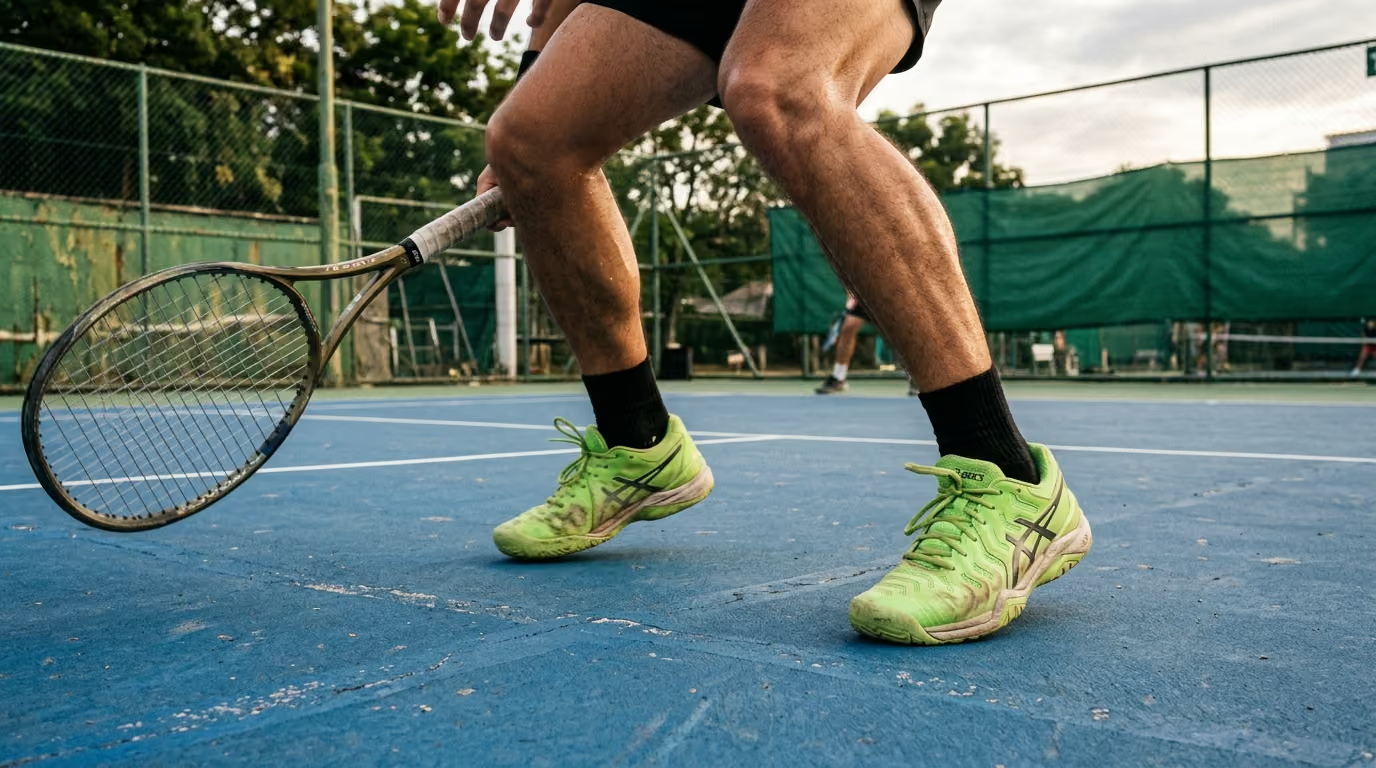
Performing well under pressure in racquet sports involves focusing on controllable actions and understanding how stress alters attention and information processing.




Most players believe that performing well under pressure requires achieving a state of complete mental calmness. This assumption is incorrect. Match pressure is an unavoidable reality of competitive play, and attempting to fight it only creates more internal tension.
We perform best not by trying to feel completely relaxed, but by directing our focus to specific, controllable actions. Under stress, your brain naturally shifts from planned decisions to emergency reactions. Understanding this shift is the first step toward managing your performance on the court.
To perform under pressure, you must redirect your attention away from the outcome of the match and toward immediate, physical actions. By using structured pre-performance routines, stabilizing your visual focus, and selecting simple tactical targets, you prevent your brain from overthinking movement mechanics. This process allows your trained, automatic strokes to execute naturally even when anxiety is high.
When you face a crucial point, your mind naturally drifts toward the consequences of the play. This drift is the difference between outcome pressure and process control.
Outcome pressure is centered on results you cannot fully control. Phrases like "I must win this game" or "I cannot afford to lose this service point" are classic examples of outcome focus. This mindset increases physical tension and disrupts your natural timing.
Performance pressure represents a slightly better focus, but it still targets the quality of the execution. Thinking "I must hit a perfect kick serve" places too much demands on your body. It encourages you to micromanage your movements instead of letting your muscles work.
Process control is the most useful level for match play. It converts an uncertain result into a sequence of controllable behaviors.
Instead of focusing on the score, you focus on choosing a target, committing to the swing, and recovering to a balanced position. This shift keeps your mind in the present moment. It also prevents your brain from wasting energy on worries about the future.
By focusing on what you can control, you free up mental capacity. You can find more foundational ideas on managing your match play by visiting our resources for court athletes.
Choking under pressure is defined in sports science as performing below your established skill level despite being highly motivated to win. Research shows that pressure does not directly destroy your physical technique. Instead, it alters where you place your attention and how you process information.
Scientists divide choking theories into two main categories. These are the distraction model and the self-focus model.
The distraction model suggests that pressure draws attention away from task-relevant information and toward irrelevant thoughts. Under stress, you might worry about the score, the crowd, or the consequences of losing a point. These thoughts consume your working memory, which is the mental system you use to hold and manipulate information.
Because your working memory is full of worry, you have less mental space to judge ball speed, read spin, or select targets. In open-skill sports like tennis or padel, things happen very fast. When your mind is distracted, your brain cannot process this changing information in time.
The solution is to replace uncontrolled internal distraction with a small number of task-relevant anchors. These anchors can include ball trajectory, contact height, or your first movement after contact.
The self-focus model offers a different explanation. This theory suggests that pressure causes you to consciously monitor movements that should be automatic.
According to reinvestment theory, skilled players often try to use conscious rules to control their swings when they feel anxious. This attempt to micromanage your body leads to paralysis by analysis.
A highly technical player is often more vulnerable to this type of choking. The very knowledge that helps you during practice can disrupt your movement during a tight match.
Attentional Control Theory explains that anxiety weakens your goal-directed attention. At the same time, it increases your stimulus-driven attention. This means it becomes harder to focus on your target and easier to get distracted by threats, noise, or negative thoughts.
Research has shown that anxious players must exert much more mental effort to maintain their performance. Even if your score remains stable, the cognitive cost of playing under pressure can leave you mentally exhausted. A study on anxiety and anticipation found that processing efficiency drops significantly under high stress, making athletes more vulnerable as the match goes on.
When pressure rises, many players try to fix their strokes by thinking about mechanics. They might tell themselves to keep their wrist firm, bend their knees more, or rotate their shoulders to a specific angle. While these cues are helpful during practice, they are highly disruptive during a match.
Your brain cannot easily focus on body mechanics and ball tracking at the same time. If you are thinking about your elbow position, you will struggle to read the ball spin. This delayed perception leads to late contact and poor timing.
Automated movements are stored in your brain as complete, fluid sequences. When you try to control individual parts of the swing, you break this fluid chain. This fragmentation makes your strokes feel stiff, cautious, and unfamiliar.
To play well under pressure, you must replace mechanical instructions with helpful process goals. A helpful process goal is external and action-oriented.
For example, telling yourself to hit the ball deep crosscourt is an external process goal. Telling yourself to drop your racquet head before contact is a mechanical instruction.
The first goal keeps your attention on the court, while the second goal locks your attention inside your body.
Here are a few examples of helpful process goals versus harmful mechanical instructions:
To apply these concepts during a match, we use a structured five-stage protocol. This protocol helps you transition from an emotional reaction to a focused action.
First, you must recognize the signs of pressure without judging them. Physical signs include a fast heart rate, shallow breathing, and a tight grip on the racquet.
Behavioral signs include rushing between points, looking at the scoreboard, or replaying past mistakes. Simply note these feelings as signs of high physiological arousal. Do not view them as evidence of impending failure.
Once you recognize the pressure, perform a brief physical reset. Turn away from the net, release your racquet grip, and drop your shoulders.
Exhale slowly to help settle your nervous system. This physical release prevents tension from building up in your neck and arms.
Next, direct your attention to a single, external cue. You might focus on the seam of the ball, the opponent's position, or a specific spot on the court.
This step counteracts the brain's tendency to focus on worries and threats. It grounds your mind in the immediate physical environment.
Before you play the point, make a clear tactical decision. Commit fully to this decision, even if you are not sure it is the perfect play.
For instance, decide to serve deep to the backhand and stick to it. A committed choice prevents second-guessing during your swing.
After the point is over, evaluate your decision rather than just the outcome. If you made the right decision but missed the shot, accept the error and move on.
Use the exact same reset routine whether you won or lost the point. This structured recovery keeps your mind clear for the next rally.
Pre-performance routines are consistent sequences of thoughts and behaviors. A meta-analysis of sports performance studies found that routines have a strong positive effect on performance under pressure. Another study of tennis players serving under pressure showed that a four-week routine training program prevented the usual drop in serve accuracy.
An essential part of any routine is visual stability, often called the quiet eye. The quiet eye is the final, stable gaze you hold on a target before initiating a movement.
Research in precision sports shows that longer quiet-eye periods are directly linked to better performance under stress. In table tennis, players who maintained a stable gaze on the ball had a much higher success rate during high-pressure points.
A reliable serving routine should be simple and repeatable.
Step up to the line and consciously turn your back to the net to clear your head. Bounce the ball a set number of times, such as three, to establish a rhythm.
Exhale fully, look at your target area, and say a single cue word like "through." Begin your motion without thinking about how to swing.
Because the returner must react quickly, your return routine must be brief.
Assume a balanced ready stance and keep your weight on the balls of your feet. Take one deep breath and focus your eyes on the server's hand or racquet.
Commit to a broad target, such as hitting the ball deep and crosscourt. Perform your split step just as the server makes contact with the ball.
Slow diaphragmatic breathing is a popular tool for anxiety control. However, the scientific evidence regarding its impact on sport performance is nuanced.
Systematic reviews show that slow breathing significantly improves cognitive performance, such as decision-making speed. Yet, the same studies show that breathing alone does not always improve physical execution.
Therefore, use breathing as a mental reset tool, not as a magic cure for poor technique. Rehearse your breathing during practice so it does not feel awkward during a match.
While the psychology of pressure remains the same, the practical application changes depending on your sport.
Tennis points are often longer, and the court is much larger. This spatial scale means you have more time to think between shots, which can increase the risk of overthinking.
Under pressure, tennis players tend to decelerate their swings to avoid errors, which actually reduces control. Focus on maintaining your racquet head speed and hitting to safe, high-percentage targets.
If you need to improve your competitive focus, you can check out our articles in the tennis articles category.
Pickleball is played on a much smaller court, and exchanges at the non-volley zone are incredibly fast. Under pressure, pickleball players often rush their dinks or speed up the ball too early out of anxiety.
The key to pickleball pressure performance is patience and visual tracking. Keep your gaze fixed on the ball as it bounces, and resist the urge to look at your opponent's body.
Focus on a simple process goal, such as keeping your dinks unattackable and below the net. For more tips on refining your strategy under pressure, visit our pickleball articles section.
Padel is a highly tactical game where rallies can last for many shots. The glass walls add a layer of complexity that can cause anxiety when you are rushed.
Under pressure, padel players often make the mistake of playing too aggressively from the back of the court. Instead, focus on defensive consistency and using high lobs to regain the net.
Commit to letting the ball hit the wall first rather than rushing your stroke. Read more about tactical patience in our padel articles archive.
Many players make critical mistakes when they try to improve their performance under pressure.
The most common error is believing you must feel perfectly calm to play well. Research shows that slow breathing and relaxation techniques can reduce mental worry, but they do not guarantee better physical execution.
If you try to force yourself to be completely calm, you will become frustrated when your heart continues to beat fast. Accept that physical activation is a normal part of competition, and focus on directing your attention rather than lowering your heart rate.
Another frequent mistake is building a routine with too many steps. If your routine takes fifteen seconds and requires absolute silence, it will break down during a noisy match.
An overly complex routine becomes just another task for your working memory to manage. Keep your routine short, simple, and flexible so you can use it in any environment.
Some research suggests that squeezing a tennis ball in your left hand can help right-handed players reduce overthinking. This technique, known as unilateral left-hand contraction, is thought to activate the right hemisphere of the brain.
While this can be an interesting experiment, it is not a cure-all. Do not rely on physical tricks as a replacement for solid pre-performance routines and clear tactical decisions.
The mental strain of playing under pressure does not just affect your performance during the match. It also has a major impact on your physical recovery afterward.
When you play with high anxiety, your body remains in a fight-or-flight state. This state causes your muscles to contract more tightly than usual, which wastes energy and increases muscle fatigue.
This prolonged tension can lead to severe muscle stiffness and soreness in the days following a match. To protect your joints and muscles, it is helpful to explore our injury prevention resources for post-match care.
I remember finishing a tough two hour padel match on a cold Tuesday night and waking up the next morning feeling like my lower back was locked in concrete. For a long time, I just accepted this as the price of playing hard in my forties.
But once I started spending just ten minutes on targeted hip mobility before heading to the club, the stiffness almost completely vanished. It taught me that we do not have to accept pain as a default state of healthy aging.
By combining physical preparation with mental resets, you can play for years without wearing down your body. You can find more helpful advice on this in our mobility and movement resources.
Playing under pressure is mentally exhausting because of the high demands on your working memory. This mental fatigue can lower your pain tolerance and make physical recovery feel slower.
If you do not actively manage match stress, you may find yourself feeling drained for several days. For detailed guidance on optimizing your physical rest, refer to our recovery science resources.
While match pressure is normal, there are times when performance anxiety becomes a deeper issue. If you experience severe anxiety that prevents you from stepping onto the court, you should consult a professional.
Other warning signs include regular panic attacks, chest pain, or chronic sleep issues before matches. A qualified sports psychologist or healthcare provider can help you develop safe coping strategies.
If physical tension from match stress is causing persistent joint or muscle pain, seek advice from a physical therapist. Learn more about our dedication to evidence-based health in the about Evercourts page.
To perform well under pressure, you must practice under pressure. Research in motor learning shows that practicing skills under mild stress helps preserve your performance during high-pressure competition.
Here is a simple four-week plan to help you build pressure resilience.
During the first week, focus on defining and practicing your pre-performance routines. Write down your serving and returning routines on a piece of paper.
Practice these routines during every drill and friendly match. The goal is to make the physical sequence automatic before you add any external stress.
In the second week, introduce score-related pressure to your practice matches. Play games that start at 30-30, deuce, or with one player serving under a penalty.
For example, if you miss your first serve, you lose the point immediately. Use your pre-performance routine to reset before every single point.
During week three, add real-world consequences to your training. Set up a match where the loser must buy the winner a drink or clean the court.
Invite other club members to watch your practice session. This public observation mimics the psychological threat of a real tournament.
In the final week, practice your routines under physical fatigue. Perform a high-intensity movement drill, such as side-to-side court runs, for one minute.
Immediately afterward, step up to the line and hit five consecutive serves. This drill teaches you to regulate your breathing and stabilize your gaze when your heart is racing.
Evaluating your match based solely on the final score is a mistake. To build long-term confidence, you need a process-based measurement system.
After every match, ask yourself these diagnostic questions to grade your mental performance.
By mastering these habits, you can protect your performance and enjoy the competitive challenge for years to come.
Follow Evercourts for practical insights on tennis, pickleball and padel performance, movement, recovery and healthy ageing. Stay connected for new articles, research-led guidance and ideas to help you play well and keep playing for years.


Read practical guidance for better movement, smarter preparation and a game that keeps working for you.
explore the Blog