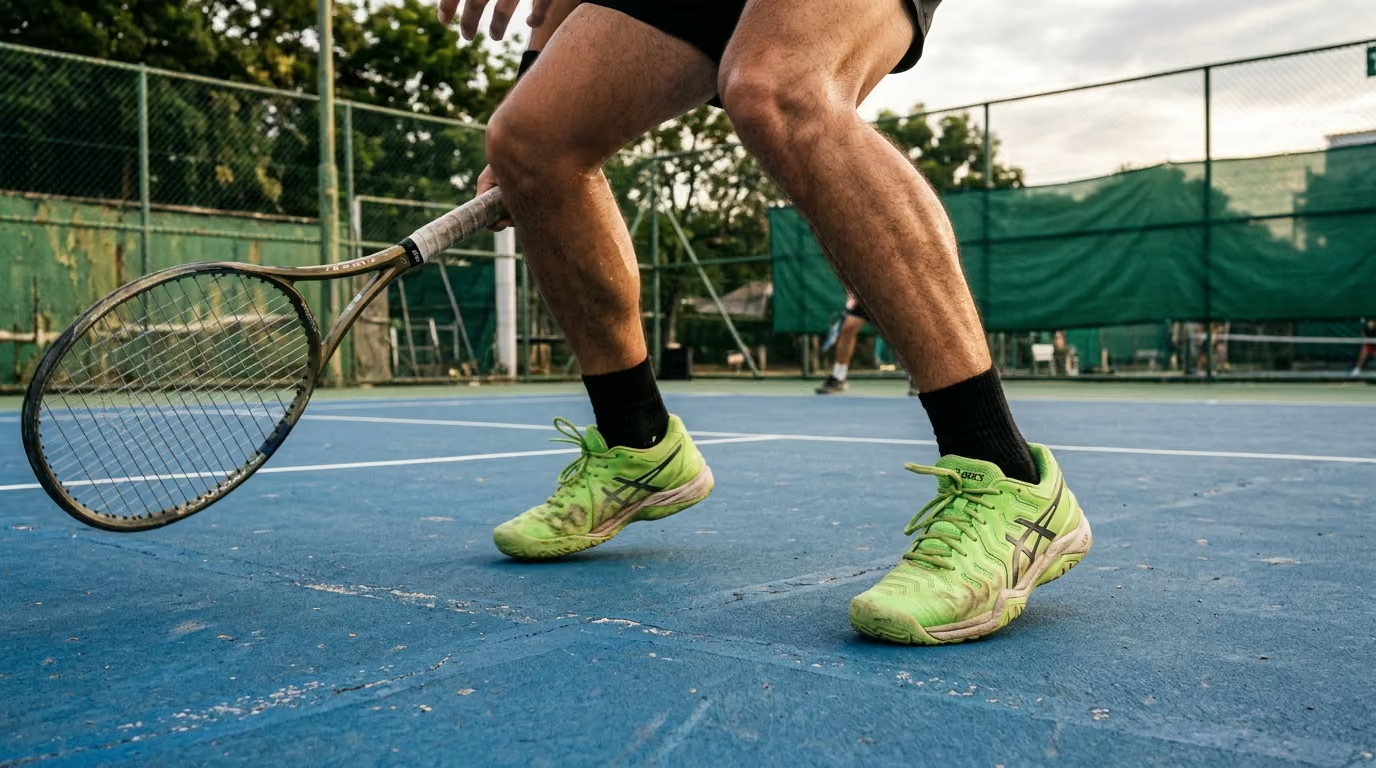
A pickleball player gains the ability to control the pace, height, and depth of the ball by mastering dinks, drops, and resets.




Many players believe that winning pickleball requires hitting the ball with maximum power at every opportunity. In reality, the true margin of victory belongs to those who control the pace, height, and depth of the ball. Mastering the soft game of pickleball involves using dinks, drops, and resets to neutralize the opponent's pace, manage ball height, and safely transition to the kitchen line. By shifting the rally from defense to neutrality, you can restrict aggressive attacks and force your opponents to hit upward, which eventually creates high-percentage opportunities to win the point.
The soft game is not merely a collection of slow shots designed to keep the ball in play. Instead, we should view it as a precise equation involving time, height, court position, and risk. When you hit a dink, drop, or reset, you are not trying to hit an immediate winner. You are buying time to improve your physical position on the court while removing the opponent's ability to strike downward.
To understand this tactical equation, we must analyze four distinct components of every shot. The first component is shot purpose, which represents the specific tactical problem you are trying to solve. The second is shot origin, which is the physical location on the court where you make contact with the ball. The third is shot trajectory, which refers to the arc, speed, and height of the ball as it travels over the net. Finally, the fourth is the rally result, which measures whether your shot successfully neutralized the play, kept you in a defensive state, or set up an attack.
This structured view helps players move away from high-risk, impulsive shots. Instead of trying to manufacture an attack from a difficult position, you focus on returning the ball to a neutral state. A neutral ball is a shot that does not give the opponent a clear, high-percentage attack and allows both teams a reasonable chance to continue the rally.
To implement this on the court, you can use our four-state rally model to guide your decisions. State one is the advantage state, where your team is balanced at the kitchen line and you have time to see the ball clearly. In this state, your goal is to maintain pressure and wait for an attackable ball. State two is the neutral state, where both teams are exchanging controlled dinks at the kitchen line. Here, you want to change location, spin, or pace slightly without forcing an error.
State three is the transition state, which occurs when you are moving forward from the baseline or transition zone. Your primary task during transition is to hit soft drops or blocks that land in the opponent's kitchen. State four is the defensive disadvantage state, where you are pulled wide, off-balance, or dealing with a hard ball hit at your body. In this state, your immediate priority is survival and neutralization, which is best achieved through a controlled reset.
By categorizing every moment of a rally into one of these four states, you remove the emotional urge to hit low-percentage drives. You accept that when you are disadvantaged, your only job is to lower the opponent's attacking options.
While coaching advice often relies on intuition, scientific research provides concrete data on how these soft shots behave. A numerical aerodynamic study published in SportRxiv examined the precise flight paths of successful third-shot drops. The researchers calculated that down-the-line drops require an initial speed range of 10.9 to 13 meters per second. These same down-the-line shots perform best with an initial launch angle between 15.5 and 22.5 degrees.
For cross-court drops, the requirements change because the ball must travel a longer distance over the net. The model estimated that cross-court drops require an initial speed of 13.3 to 16 meters per second. The optimal launch angle for these cross-court shots is slightly lower, ranging from 12.5 to 18 degrees. Interestingly, the aerodynamic model concluded that spin plays a secondary role compared to the initial speed and angle of the launch. This means that focusing on a clean, consistent contact point is far more important than trying to load the ball with heavy spin.
Beyond aerodynamics, kinematic research sheds light on how advanced players physically execute these soft shots. A kinematic study compared higher-level players and beginners during the execution of dink shots. The researchers used advanced pose-estimation methods to track joint angles and movement patterns. They found significant differences in lower-body biomechanics, particularly in the femur angle.
High-level athletes demonstrated much greater femur flexion, meaning they bent their knees and lowered their hips to get down to the ball. Beginners, by contrast, tended to bend at the waist, which reduced their stability and control. Additionally, the study revealed that advanced players maintained continuous, controlled wrist motion after making contact with the ball. Beginners often tried to freeze their wrists completely or flicked them impulsively. This scientific insight shows that a soft touch is not about absolute stillness. Instead, it requires a coordinated, fluid extension of the arm and body through the hitting zone.
To understand the practical importance of these soft shots, we can look at professional match statistics. An analysis of a gold-medal match from Pickleball Alberta revealed that dinks made up 35.5 percent of all shots played. In contrast, fast drives accounted for only 15.7 percent of the total shots. The same match analysis showed that the average rally length was 10.2 shots, with the longest exchange lasting 39 shots.
One top player in that match hit 58 consecutive dinks without committing a single error. Another player missed only one dink out of 112 total attempts. These statistics confirm that at the highest levels, the soft game is the foundation of competitive success. An independent match-analytics database across broader professional matches shows a similar pattern.
In their database, dinks accounted for 53 percent of all recorded shots. Serves made up 11.6 percent, while drives represented 9.8 percent of the total. Speed-ups occurred 8.6 percent of the time, and third-shot drops made up 3.5 percent. These numbers highlight that while fast exchanges are exciting, the majority of your time on the court will be spent managing the soft game.
A dink is a soft, arcing shot hit from at or near the kitchen line that lands in the opponent's non-volley zone. This zone, measuring seven feet deep on each side of the net, is commonly referred to as the kitchen. To hit a reliable dink, you must first establish a stable physical foundation. We recommend using a continental or eastern grip, which allows for a neutral paddle face.
Keep your knees bent and your weight balanced on the balls of your feet. Your swing should mimic a simple pendulum, with the movement originating from the shoulder rather than the wrist or elbow. Always make contact with the ball in front of your body. Avoid a large backswing, as this creates timing errors and makes it difficult to control the depth of the ball. Instead, use a compact forward motion and follow through slightly upward to lift the ball over the net.
When choosing where to place your dink, you have three primary tactical options. The first option is the cross-court dink, which is generally the safest choice. Because the net is lower in the middle, and the diagonal distance is longer, you have a much larger margin of safety. This diagonal path also moves your opponent laterally, which can open up spaces in their court geometry.
However, cross-court dinks carry some strategic risks. If you hit a cross-court dink with too much height, you expose the middle of your court to a fast attack. It can also become highly predictable if you use it on every single ball. A poorly controlled cross-court dink can sit up near the sideline, giving your opponent a comfortable angle to attack.
The second option is the straight-ahead dink. This shot travels a shorter distance, meaning you have a smaller margin for error over the net. However, it is highly effective when your opponent is leaning toward the cross-court angle. It allows you to challenge their backhand or forehand directly and can disrupt their rhythm.
The third option is the middle dink. Aiming for the center of the kitchen creates immediate uncertainty between doubles partners. It often forces them to communicate quickly, which can lead to a late or awkward swing. The middle dink also reduces the opponent's ability to hit sharp, angled shots off the court.
To maximize the value of your dinks, you must view them as movement tools rather than passive returns. Your goal is to stretch your opponent wide, force them to reach on their backhand side, or jam them by hitting close to their body. By constantly changing the location of your dinks, you will eventually force a poor lift or a high pop-up that you can attack. Always evaluate the opponent's likely contact point, not just the ball's location over the net, to judge if your dink succeeded.
While a dink is hit from the kitchen line, a drop is hit from deeper in the court, such as the baseline or the transition zone. The primary goal of a drop is to land softly in the opponent's kitchen, giving you and your partner time to walk forward and establish your position at the net. The most famous version of this shot is the third-shot drop, but you can use transition drops on any shot where you are stuck in the back court.
Determining whether to use a drop or a drive depends on several key factors. You should prefer a drop when the opponent's return is deep, leaving you with very little room to take a full swing. It is also the ideal choice when your opponents are already established at their kitchen line, waiting to block a hard shot. If you drive the ball from a deep, low position, a skilled opponent will easily volley it downward at your feet.
On the other hand, you might consider a drive when the return is short and bounces high. This higher contact point allows you to strike the ball with downward force, putting pressure on the opponents as they move. You can find more tactical advice in our pickleball articles to help you decide between power and placement.
If you do choose to drive the third shot, you should often view it as part of a two-shot sequence. Analysis from the PPA Tour examined 309 fifth-shot opportunities that followed a third-shot drive. The researchers found that players chose a fifth-shot drop on 66 percent of those opportunities. In contrast, players hit a firm fifth-shot volley on 31 percent of those plays.
Drives off the bounce and lobs were extremely rare, accounting for only 3 percent. Crucially, only 17 percent of professional rallies involving third-shot drives ended immediately on the third or fourth shot. This data proves that a third-shot drive is rarely an outright winner. Instead, the drive is used to force a weaker, shorter block from the opponent.
Once that weaker ball is produced, the hitting team uses a fifth-shot drop to complete their transition to the net. If you want to blend these two concepts, you can use a hybrid third shot. This is a firm ball hit with moderate arc, aimed directly at the opponent's feet as they stand at the kitchen. It is not a full-power drive, nor is it a soft drop.
It forces the opponent to volley upward from their shoe laces, which often gives you an easy fifth-shot opportunity. For players who struggle with deep, late balls, a standard drop can be very difficult. If the ball gets behind your body, you can use a specialized shovel or scoop drop. This shot uses a locked wrist and a lifting motion driven entirely by your legs and shoulders to guide the ball safely into the kitchen.
A reset is a soft, neutralizing shot used to take the speed off an opponent's attack and drop the ball into their kitchen. It is one of the most critical defensive skills in pickleball, as it allows you to stop a fast, aggressive exchange and return the rally to a neutral state. Without a reliable reset, you will remain trapped in a defensive position, constantly blocking hard shots until you commit an error.
To execute a successful reset, you must focus on your grip pressure and body mechanics. Official coaching materials from USA Pickleball suggest maintaining a very loose grip, around a two or three on a scale of one to ten. This soft grip acts like a sponge, absorbing the kinetic energy of the incoming ball rather than bouncing it back with speed. Keep your paddle face slightly open and positioned directly in front of your chest.
Keep your knees bent to lower your center of gravity, and use a stable, wide base with your feet. Avoid taking any backswing at all; the speed of the incoming ball will provide all the power needed to return it over the net. Instead of swinging, simply let the ball hit your paddle and guide it gently upward and forward. Your follow-through should be extremely short and controlled.
Think of the reset as a soft block rather than a stroke. When choosing a target for your reset, we suggest aiming for the middle of the opponent's kitchen. This central zone offers several tactical benefits. First, it provides you with the largest physical margin of error, reducing the chance that you will hit the ball wide of the court.
Second, it reduces the angles available to the attacking player, making it harder for them to hit a sharp winner on their next shot. Third, it creates instant confusion in doubles, as both opponents may reach for the same ball. However, you must adapt your reset strategy based on your location on the court. If you are at the kitchen line and facing a sudden speed-up, your reset must be a soft, downward block.
The goal is to keep the ball from popping up, forcing the attacker to reset their own posture. If you are in the transition zone, which is the middle of the court, the reset requires slightly more push. You must lift the ball high enough to clear the net, but keep the trajectory downward as it crosses the tape.
If you are pulled wide off the court, your balance will be compromised. In this scenario, trying to hit a perfect kitchen reset is highly risky. Instead, focus on hitting a high, deep, neutral ball that gives you enough time to run back to the center of the court.
Understanding the theory of the soft game is only the first step. To see real improvement, you must apply these concepts systematically during your matches and practice sessions. Our team has spent years studying court performance, and we have found that structured training is the fastest way to build muscle memory. In our experience, the best way to develop these skills is through a progressive six-stage training cycle.
Stage one focuses on stationary soft hands. Stand just behind the kitchen line while a partner feeds you firm, fast balls from the opposite side. Keep your feet planted, hold your paddle in front of your body, and practice absorbing the pace so the ball lands softly in the kitchen. Focus entirely on maintaining that loose, two-to-three grip pressure.
Stage two introduces targeted kitchen resets. Place physical targets, such as plastic cones or chalk marks, in different areas of the opponent's kitchen. Practice hitting dinks and resets that land precisely on these targets. Divide your practice between the middle kitchen, the cross-court kitchen, and the opponent's backhand side.
Stage three transitions into movement. Start at the baseline and have your partner hit deep balls to you. Practice moving forward after each shot, stopping to establish a balanced base, and resetting the ball into the kitchen. Do not run while hitting; you must stop and set your feet before making contact.
Stage four is the dink decision drill. Stand at the kitchen line and exchange continuous dinks with your partner. You must follow three strict rules: continue the soft dink if the ball is low, change the direction of the ball if your partner leans, and speed up the ball only when it rises above your shoulders. This teaches your brain to read ball height and make rapid tactical decisions.
Stage five is the attack-reset-repeat cycle. Begin with a standard dink exchange at the kitchen line. At any moment, one player can speed up the ball, triggering a fast-hands volley exchange. The defending player must attempt to absorb the pace and hit a soft reset back into the kitchen, returning the rally to a slow dink exchange.
Stage six is the third-shot choice drill, which is excellent for improving your decision-making. Have your partner feed a variety of returns to your side of the court. Some returns should be deep and low, others short and high, and some pulled wide. You must instantly analyze the incoming ball and choose whether to hit a third-shot drop, a drive, a hybrid, or an emergency reset.
By working through these stages, you will train your body to react automatically during matches. You will no longer panic when a hard ball is hit at your feet. Instead, your hand pressure will soften, your knees will bend, and you will calmly drop the ball into the kitchen. For more detailed guides on movement and positioning during these drills, you can read our court performance materials.
While this guide focuses on pickleball, it is helpful to look at how these soft-game concepts compare to other racquet sports like tennis and padel. Each of these sports requires players to manage pace and court position, but the physical tools and rules create very different tactical landscapes.
In tennis, the court is much larger, and the ball bounces with significantly more velocity and spin. The concept of a drop shot exists in tennis, but it is typically used as an offensive weapon to catch an opponent resting deep behind the baseline. Tennis players rarely use a soft game to transition slowly to the net; instead, they rely on heavy, deep approach shots. Furthermore, tennis has no non-volley zone, meaning players can stand as close to the net as they like to volley the ball. This changes the risk profile of soft shots, as any short, floating ball will be immediately smashed by a net player.
Padel presents a different set of challenges due to the glass walls and metal mesh surrounding the court. In padel, players use a soft, controlled shot called a chiquita to drop the ball at the feet of opponents who are established at the net. This is highly similar to the pickleball third-shot drop, as its primary purpose is to force the net players to volley upward, allowing the hitters to transition forward. However, because padel allows players to let the ball hit the back glass before playing it, the soft game is highly focused on angles and patience. A slow ball that bounces too high in padel can be easily smashed out of the court or off the glass.
Pickleball is unique because of the strict rules governing the non-volley zone. The presence of the kitchen line means that players cannot simply rush the net and volley every ball out of the air. It forces a distinct separation between the hard game of drives and speed-ups and the soft game of dinks and resets. The small size of the pickleball court also means that reaction times are incredibly fast during kitchen exchanges. This high-speed environment makes the ability to hit a soft, neutralizing reset even more valuable than it is in padel or tennis.
Understanding these cross-sport differences can help multi-sport athletes adapt their mental frameworks. If you transition from tennis to pickleball, you must learn to suppress the urge to drive every single ball. You must accept that patience, height control, and soft hands are the keys to dominating the kitchen.
Even experienced players frequently make mistakes that undermine their soft game. Recognizing these errors is the first step toward correcting them and improving your consistency on the court.
One of the most common errors is the automatic hard-hitting reflex. When players receive a fast, aggressive ball, their natural instinct is to hit it back just as hard. This reaction usually plays directly into the opponent's hands, as it maintains the fast pace that they prefer. To break this habit, you must train your mind to view a fast ball as an invitation to slow the game down. Instead of matching your opponent's power, focus on softening your grip and absorbing the ball into the kitchen.
Another frequent mistake is maintaining a rigid body while using a frozen wrist. While it is true that you should avoid excessive wrist flicking, trying to freeze your wrist completely can lead to stiff, jerky movements. As the kinematic dink study demonstrated, advanced players maintain a continuous, fluid wrist motion after making contact with the ball. Your wrist should be relaxed and stable, allowing for a smooth follow-through rather than an artificial, abrupt stop.
Many players also fall into the trap of ignoring ball trajectory over the net. They focus entirely on making sure the ball lands short in the kitchen, without realizing that the ball is traveling in a high, floating arc. A slow ball that clears the net by several feet is highly attackable, even if it eventually lands in the kitchen. Your goal should be to combine sufficient net clearance with a downward trajectory, ensuring that the ball is descending as it reaches your opponent.
Finally, many players make the mistake of forcing a drop shot on every single third shot, regardless of the situation. If you receive a short, high return, driving the ball is often the superior tactical choice. Forcing a drop from an easy, short ball simply wastes an opportunity to apply pressure. By avoiding these common pitfalls, you will quickly see a dramatic reduction in your unforced errors. You will become a much more difficult player to play against, as your opponents will struggle to find weaknesses in your defense.
The repetitive bending, lunging, and lateral movement required by the soft game can place a significant physical strain on your body. Lower back stiffness, knee aches, and shoulder tension are common complaints among dedicated court players.
I remember finishing a tough two hour padel match on a cold Tuesday night and waking up the next morning feeling like my lower back was locked in concrete. For a long time, I just accepted this as the price of playing hard in my forties. But once I started spending just ten minutes on targeted hip mobility before heading to the club, the stiffness almost completely vanished. It taught me that we do not have to accept pain as a default state of athletic longevity.
To maintain your physical health and support healthy aging, you must prioritize proper recovery and conditioning. The deep femur flexion identified in advanced dink techniques requires excellent hip mobility and quadriceps strength. If your hips are tight, your body will compensate by bending at the lower back, which leads to chronic spinal strain. Spending a few minutes on hip flexor stretches and deep squats before your matches can protect your spine and improve your court movement. You can examine our joint mobility and movement guides to find specific exercises designed for racquet athletes.
Additionally, the continuous, low-intensity movement of the soft game demands great muscular endurance in your calves and thighs. After a long session of dinking and resetting, your leg muscles will accumulate metabolic waste and experience micro-tears. To support tissue health and reduce muscle soreness, we recommend engaging in active recovery, such as light walking or gentle swimming, on your off days. Proper hydration and targeted stretching of the hamstrings and calves will also accelerate your recovery time. For more evidence-based recovery strategies, you can read our recovery science articles.
By taking care of your body off the court, you ensure that you can continue playing the sport you love for years to come. Remember that physical preparation is just as important as shot mechanics when it comes to maintaining your performance.
While mild muscle soreness and temporary fatigue are normal parts of athletic activity, you should never ignore persistent or sharp pain. Racquet sports place unique rotational and repetitive stresses on your joints, which can sometimes lead to chronic overuse injuries.
If you experience sharp, localized pain in your knees, hips, elbows, or lower back that does not improve after a few days of rest, it is time to seek professional help. Other warning signs include joint swelling, a reduced range of motion, or pain that worsens during everyday activities.
Consulting a qualified physical therapist, sports physician, or orthopedic specialist can provide you with an accurate diagnosis and a targeted rehabilitation plan. A physical therapist can also identify any muscular imbalances or movement compensations that may be contributing to your discomfort. For resources on finding the right medical support and understanding common court injuries, please visit our player health resources.
Taking a proactive approach to your physical health is the best way to protect your long-term athletic longevity. Do not wait for a minor ache to turn into a major injury before seeking guidance from a healthcare provider.
By integrating these tactical and physical principles into your routine, you will transform your approach to pickleball and enjoy many more years of high-level play.
Follow Evercourts for practical insights on tennis, pickleball and padel performance, movement, recovery and healthy ageing. Stay connected for new articles, research-led guidance and ideas to help you play well and keep playing for years.


Read practical guidance for better movement, smarter preparation and a game that keeps working for you.
explore the Blog