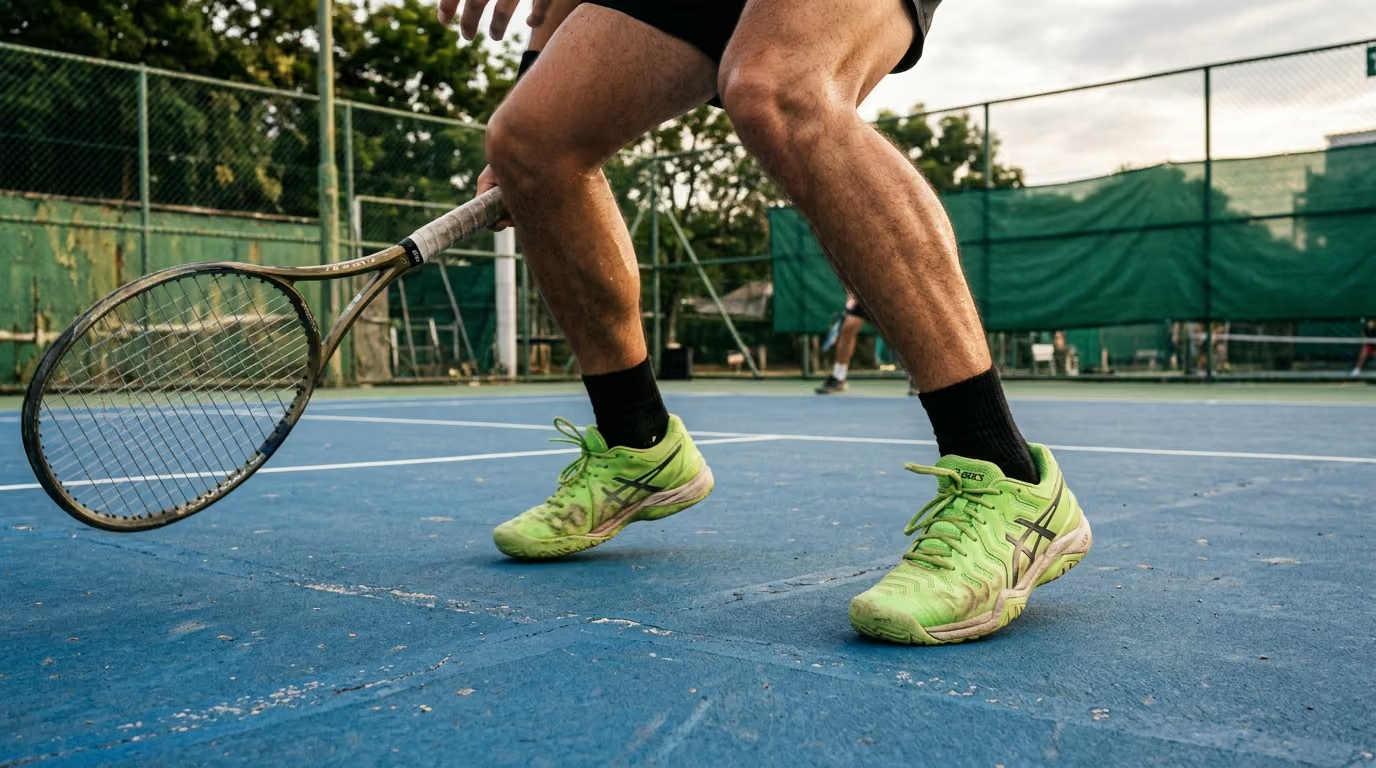
While many players assume medical clearance signals full recovery, returning to court after an injury actually requires a structured, performance-based transition.




Many players believe that the moment a doctor says they are cleared to play, their recovery is complete. In reality, getting medical clearance is merely the first step of a much longer, performance-based transition back to active play. Returning to the court without a structured plan often leads to recurring stiffness, secondary strains, or a complete loss of confidence.
To successfully return to court after an injury, you must transition gradually from simple rehabilitation to structured practice and full competition. True recovery is not defined by a calendar date, but by your body’s ability to repeatedly tolerate sport-specific demands with high movement quality and stable recovery. By tracking clinical status, physical capacity, and psychological confidence, you can protect your long-term athletic longevity without recurring setbacks.
In this guide, we break down the essential steps to rebuild your court performance safely. We look at the scientific progression of tissue healing, movement demands, and structured court exposure. This guide is designed to help you make informed, rational decisions alongside your healthcare team.
Many athletes view clearance as a simple toggle switch. You are either injured and sitting on the sidelines, or you are healthy and playing at maximum intensity. Sports medicine research shows that this binary view is inaccurate and often dangerous.
Instead, returning to the court is a continuous spectrum that requires different levels of physical and mental readiness. According to a landmark international consensus statement published by Ardern and colleagues, there are three distinct phases in this journey. Understanding these phases helps you set realistic expectations and avoids the temptation to rush your recovery.
The first phase is the return to participation. During this stage, you resume modified rehabilitation, practice, or training. You are active, but you are performing well below your target level of play. For example, a tennis player might practice stationary groundstrokes without running, or a padel player might perform light volleys.
The second phase is the return to sport. In this phase, you are back on the court playing your sport, but you have not yet regained your pre-injury performance level. You might play a practice set with friends but avoid competitive club matches. Your movement is safe, but your speed, power, and court coverage are still limited.
The final phase is the return to performance. This is the ultimate goal of any court athlete. It means you can perform at or above your pre-injury standard with full intensity, volume, speed, and competitive pressure. You can play consecutive matches without lingering pain or excessive fatigue the next day.
A successful comeback is not just about completing a single match. It is about your ability to repeatedly tolerate the physical demands of your sport while maintaining excellent movement quality. Medical clearance, participation, and performance readiness are separate decisions that require different markers of success.
To navigate this spectrum successfully, you must recognize that tissue healing does not automatically restore sport-specific skills. When you spend weeks or months away from the court, your nervous system also undergoes changes. Your coordination, reaction time, and spatial awareness can deteriorate during a layoff.
This neurological deconditioning can alter your movement biomechanics when you return to play. If you try to play a high-intensity match immediately, your brain may fail to coordinate your muscles quickly enough to protect your joints. Therefore, your transition plan must focus on retraining both your physical tissues and your nervous system.
By approaching your recovery as a progressive continuum, you minimize the risk of secondary injuries. This structured mindset allows you to enjoy playing for decades. To do this, you must first understand the specific physical forces your body must tolerate.
Before you can return to performance, you must understand the specific forces your body must tolerate. Court sports are highly demanding environments that require rapid transitions between different movement patterns. Your muscles, tendons, and joints must absorb and produce force in multiple directions simultaneously.
In our experience, players often underestimate how much stress a simple court game places on the lower limbs. I remember finishing a tough two hour padel match on a cold Tuesday night and waking up the next morning feeling like my lower back was locked in concrete. For a long time, I just accepted this as the price of playing hard in my forties. But once I started spending just ten minutes on targeted hip mobility before heading to the club, the stiffness almost completely vanished.
It taught me that we do not have to accept pain as a default state of aging. By preparing the body for the precise demands of the court, we can enjoy our sport for years. To do this, you need to create a demand profile for your specific sport and playing style.
A complete demand profile includes several key physical actions. First, you must consider acceleration and deceleration. Stopping quickly on a hard court requires immense eccentric strength in your quadriceps and calves. If your muscles cannot absorb these forces, the stress shifts to your patellar tendons and knees.
Second, you must analyze lateral shuffling and crossover movements. Unlike running in a straight line, court sports require continuous side-to-side transitions. These movements put unique lateral demands on your ankles, hips, and lower back.
Third, think about cutting, pivoting, and rotational forces. Returning to play requires your hips and trunk to rotate under load. If you lack mobility in your hips, your lower back will twist excessively to compensate, which often leads to discomfort.
Finally, consider your stroke volume, serving actions, and overall match duration. Re-entering court play means hitting hundreds of balls under fatigue. Your shoulder, elbow, and wrist joints must be strong enough to handle repeated impacts without losing form.
Epidemiological studies in court sports show that lower-limb injuries are highly prevalent. For example, systematic reviews of basketball injuries show that lower-limb issues represent over sixty percent of all recorded cases. Ankle sprains and knee ligament strains are particularly common among court athletes. This highlights why your return plan must focus heavily on landing control, deceleration, and joint stability.
Understanding these demands helps you see why general fitness is not enough. You might be able to ride a stationary bike or run on a treadmill for an hour without any discomfort. However, these linear, low-impact activities do not replicate the chaotic, multi-directional forces of a court game.
Your physical preparation must mirror the actual demands of your sport. This means incorporating lateral movements, rotational exercises, and impact training into your routine before you attempt to play. By doing so, you build a resilient body that is truly prepared for court action.
Navigating an injury layoff requires a collaborative approach. You should never have to guess whether an activity is safe or harmful. Establishing clear communication with your physiotherapist, physician, or athletic trainer is a vital skill.
When speaking with your healthcare provider, you should ask specific, performance-focused questions. Avoid vague questions like "when can I play again?" Instead, ask what activities are currently allowed, restricted, or prohibited. This gives you clear boundaries for your daily training.
You should also ask which symptoms should trigger a pause or reassessment. Understanding what constitutes a normal player health response versus a warning sign is crucial. For example, mild muscular soreness is common after a layoff, but joint swelling or sharp pain requires attention.
Ask your clinician which specific measures they are using to judge your progress. Is your current limit tissue protection, muscle strength, joint mobility, or coordination? Knowing this allows you to focus your rehabilitation efforts on your actual weaknesses.
To make these conversations more productive, we recommend keeping a simple communication log. This log serves as a shared record between you and your healthcare team. It removes the guesswork and provides objective data for your next appointment.
Your log should track the date and type of each session you complete. Note the duration, intensity, and key movements or drills. Record any symptoms you felt during the activity and how you felt later that day.
Crucially, write down your physical status the following morning. Note any morning stiffness, swelling, or changes in how you walk. Also, record your confidence levels and any apprehension you felt during lateral or explosive movements.
Sharing this detailed record with your clinician makes their job much easier. It helps them adjust your program based on real-world data rather than memory. This collaborative process ensures your recovery is tailored to your unique rate of healing.
It is also important to clarify who has the final authority to clear you for unrestricted play. In some settings, a team physician or sports medicine specialist makes this decision. In recreational settings, it is often a shared decision between you and your physical therapist.
Having a clear understanding of this authority structure avoids confusion. It prevents you from returning to play prematurely based on subjective feelings. By respecting this professional guidance, you ensure your body is truly ready for the demands of the court.
To safely rebuild your performance, you need a systematic framework. A calendar-based approach, which relies solely on the passage of time, is highly discouraged by modern sports medicine. Instead, you should use a graded, criterion-based progression where each stage must be earned.
Below is a practical five-stage model designed to guide court athletes back to full play. It progresses from basic information gathering to unrestricted, high-intensity competition.
This stage begins before you even step on the court. Your primary objective is to confirm your clinical status with a qualified professional. You must clarify your exact restrictions, healing milestones, and who has the authority to advance your activity.
During this time, define your actual target of play. Are you aiming for casual, cooperative rallying with a partner, or do you need to prepare for intense tournament play? Having a clear target helps you and your clinician design a relevant pathway back to the court.
Before performing explosive court movements, you must restore your general physical capacity. This involves general strength training, cardiovascular conditioning, balance work, and coordination drills. These exercises must stay strictly within the safety limits set by your clinician.
Many players make the mistake of assuming that being pain-free in daily life means they are ready to sprint. Walking up stairs or carrying groceries does not prepare your joints for the high-impact forces of a hard stop. Use this phase to build a solid physical foundation in a controlled gym environment.
Once you have sufficient general strength, you can reintroduce court-specific movements. This phase should be highly controlled and predictable. You should separate technical stroke work from physical conditioning whenever possible.
Start with stationary technical drills where a coach feeds balls directly to you. This allows you to focus on your technique and swing mechanics without having to run. Gradually introduce slow, planned movements, such as walking through a lateral shuffle or performing light, linear jogging.
In this stage, you begin transitioning toward complete, unstructured training sessions. You will introduce greater speed, volume, and complex direction changes. This is where you transition from predictable, closed drills to open, reactive drills.
For example, have a partner hit balls to random areas of the court, forcing you to react and adjust. You should complete several full-length practice sessions before attempting any match play. Sports medicine consensus panels, including the Panther Symposium ACL group, emphasize that structured practice must always precede competition.
The final stage focuses on returning to your full pre-injury playing standard. You will test your repeated-effort capacity, fatigue resistance, and ability to execute skills under psychological pressure. This is also where you monitor your recovery between consecutive playing days.
You should evaluate whether your performance remains stable during late-game situations. If your movement quality deteriorates when you get tired, you are not yet fully reconditioned. Continue to monitor your body's response as you gradually return to your normal playing schedule.
When moving through these stages, you must adjust specific exposure variables. Changing these variables allows you to increase the physical demand of a session without changing the exercise.
First, manage your session duration. Start with short, fifteen-minute sessions and gradually build up to your normal play time. Second, control your volume by tracking the total number of hits, runs, or sets.
Third, adjust intensity by changing your movement speed, jump height, or swing force. Fourth, monitor density, which refers to the amount of rest you take between drills or points. Taking longer rests reduces the physical stress on your cardiovascular and muscular systems.
Fifth, progress complexity by moving from simple, pre-planned patterns to unpredictable, reactive movements. Sixth, adjust space by playing in restricted areas, such as half-court drills, before expanding to full-court play.
Seventh, modify direction by mastering linear forward and backward movements before introducing lateral cuts or sharp pivots. Eighth, control fatigue by performing complex mobility and movement drills early in the session when you are completely fresh.
Finally, manage psychological pressure by practicing cooperative rallying before introducing competitive scoring or match play. By adjusting only one or two of these variables at a time, you can isolate what triggers any negative responses.
To make accurate adjustments to your progression, you must monitor how your body responds to training. The most effective way to do this is by tracking both external and internal workloads. These terms help us distinguish between what you did on the court and how your body perceived that effort.
External load refers to the objective, measurable work you completed during a session. This includes metrics like total minutes played, number of swings, distance run, or number of lateral shuffles. Tracking external load allows you to see exactly how much mechanical stress you placed on your tissues.
Internal load measures your body’s physiological and psychological response to that external work. This is commonly tracked using a scale of perceived exertion, heart rate data, or subjective ratings of fatigue. For example, a thirty-minute practice session might feel easy during week one, but feel highly fatiguing during week four if you are under-recovered.
In addition to tracking training load, you must pay close attention to your delayed physical response. It is common to feel excellent during a highly stimulating court session due to adrenaline and warm joints. However, the true test of tissue tolerance occurs twelve to twenty-four hours later.
When you wake up the morning after a session, perform a quick self-assessment. Check for morning stiffness in the affected joint or muscle group. Note whether you can walk or perform daily activities without compensating.
Compare this response to your baseline levels. If you experience an increase in stiffness or mild discomfort that resolves within an hour, your load was likely appropriate. However, if you wake up with throbbing pain, visible swelling, or a noticeable limp, you have exceeded your current capacity.
Keep in mind that no single workload metric can perfectly predict an injury. Popular concepts like the acute-to-chronic workload ratio can be helpful guides, but they are not flawless. You must use these metrics as part of a wider, personalized monitoring system that respects your individual symptoms and fatigue levels.
Tracking this data allows you to identify trends over time. If your morning stiffness is gradually decreasing week by week, you can confidently advance to the next stage. If your fatigue levels are rising while your performance is dropping, it is time to schedule a recovery week.
This proactive monitoring helps you avoid the cycle of chronic irritation and setbacks. It ensures you are loading your tissues in a way that promotes healthy adaptation. By respecting your body’s signals, you support your long-term athletic development.
Returning to court should never be a guessing game based on how you feel. Instead, you and your healthcare team should use a comprehensive testing battery to measure your readiness. This battery should look at multiple physical and psychological factors rather than relying on a single test.
A complete court performance testing battery includes several distinct domains. First, you must assess your clinical status, which includes joint range of motion, swelling, and localized tenderness. Your clinician will perform specific physical exams to ensure your tissues have healed sufficiently.
Second, measure your muscle strength and force production. This often involves comparing your injured side to your uninjured side. While perfect symmetry is not always necessary or achievable, aiming for a high level of balance helps prevent compensatory patterns.
Third, evaluate your balance, coordination, and neuromuscular control. You can test this using single-leg balance stands or dynamic reach tests. Having good balance ensures your brain and muscles can coordinate movements quickly to protect your joints.
Fourth, analyze your movement quality during sport-specific tasks. Watch how you land from a jump, decelerate from a sprint, or plant your foot during a lateral cut. Look for any compensation patterns, such as your knee collapsing inward or your trunk leaning excessively.
Fifth, assess your repeated-effort capacity and cardiovascular conditioning. You must prove that you can maintain high-quality movement even when you are physically tired. Fatigue often causes a breakdown in technique, which increases the stress on vulnerable tissues.
Sixth, do not ignore your psychological readiness. Mental confidence is just as important as physical strength when returning to a reactive sport. You must trust your body to handle rapid changes of direction without hesitation or fear of reinjury.
You can measure psychological readiness using validated sports questionnaires or simple self-reflection. Ask yourself if you feel hesitant when planting your foot, or if you find yourself overthinking your movements. If you feel physically capable but mentally anxious, you may need more graded, non-competitive court exposure to build confidence.
Remember to distinguish between capacity and performance during testing. Capacity asks if your body can perform a movement in a controlled, predictable setting. Performance asks if you can execute that same movement while reacting to an opponent, making split-second decisions, and managing match fatigue.
Using a multi-domain testing battery removes the subjectivity from the return decision. It provides clear, objective evidence that your body is prepared for the specific demands of your sport. This evidence-based approach is supported by leading sports medicine consensus groups worldwide.
It also helps identify any lingering deficits that need to be addressed. If you pass your strength tests but fail your balance test, you know exactly where to focus your training. This targeted approach ensures a safer and more efficient path back to performance.
Even the most dedicated athletes can fall victim to common recovery mistakes. Understanding these pitfalls allows you to avoid them and keep your progression on track.
One of the most frequent errors is assuming that the absence of pain means you are fully healed. Pain is often the first symptom to disappear as tissue healing begins. However, being pain-free does not mean you have restored your muscle strength, power, or reaction time. Returning to high-intensity play based solely on the absence of pain often leads to secondary strains.
Another classic mistake is returning to full match play immediately after receiving medical clearance. Clearance simply means your tissues are safe enough to begin sport-specific training. It does not mean your cardiovascular system or muscles are conditioned for the chaotic demands of a competitive match. Always transition through structured practice sessions before playing a real game.
Relying strictly on a calendar date is another common pitfall. While tissue healing times are relatively predictable, everyone heals and adapts at different rates. Your progression must be based on meeting objective criteria, such as strength benchmarks and movement quality, rather than a specific number of weeks.
Additionally, avoid testing your readiness with a single maximal effort. Sprinting as hard as you can once down the court does not prove you can handle a two-hour match. True readiness is demonstrated by your ability to repeat high-quality movements and recover well on subsequent days.
To clarify these principles, let us examine a few common case patterns we see on the court.
An athlete recovers from a minor knee strain and reports feeling no pain during light warm-ups. They pass a basic physical screen and decide they are ready to play. However, forty minutes into a competitive match, their leg muscles fatigue, and their landing mechanics become disorganized.
The lesson here is that being pain-free at the start of a session does not guarantee stamina. This player lacked the muscular endurance to maintain safe movement patterns under fatigue. They should have spent more time rebuilding their practice volume before playing a competitive match.
A player completes a highly successful first practice session on the court and feels incredibly encouraged. Believing they are fully recovered, they sign up for a competitive club tournament the following weekend. By the second match, they experience a sharp recurrence of their original symptoms and are forced to sit out.
This case illustrates why you must progress gradually through practice before entering competition. One good session does not mean your tissues are ready for repeated, high-intensity matches. A slower, staged progression would have allowed their body to adapt safely.
A highly motivated player feels mentally ready to play and is eager to return to the court. However, physical testing reveals that their injured leg is still thirty percent weaker than their uninjured leg. Despite their high confidence, they cannot control their knee alignment during lateral cuts.
This pattern highlights why subjective confidence must always be balanced with objective physical assessment. Mental readiness is valuable, but it cannot override actual strength deficits. This player needs focused strength training to bridge the gap before playing.
An athlete passes every physical test with flying colors, showing excellent strength, balance, and agility. However, when they step on the court, they actively avoid planting weight on their previously injured leg. They hesitate during lateral recoveries and look visibly anxious.
This player is physically capable but lacks psychological readiness. Treating this apprehension as a performance barrier, rather than a character flaw, is essential. They need gentle, progressive court exposures in a low-pressure environment to rebuild their movement trust.
An athlete's localized pain remains low during their return progression, which they view as a success. However, as they increase their training volume, they notice their sleep quality, overall fatigue, and next-day joint stiffness are deteriorating. They ignore these systemic signs because their specific injury site does not hurt.
This pattern demonstrates why you must monitor your global recovery alongside localized pain. High systemic fatigue often precedes a breakdown in tissue tolerance and movement quality. Paying attention to these broader recovery markers helps prevent overtraining and secondary issues.
While all court sports share common movement patterns, they place distinct physical demands on the body. Understanding the specific biomechanics of your sport allows you to tailor your return plan. Below, we examine the unique profiles of tennis, pickleball, and padel.
Tennis is played on a large court, which requires athletes to cover significant distances. This means you must tolerate longer sprint distances, high-velocity decelerations, and repetitive open-stance braking. The large court dimensions also lead to longer rallies, which places a high demand on your aerobic and anaerobic energy systems.
Additionally, tennis involves a high volume of overhead serving actions. This movement requires exceptional rotational power in your hips and thoracic spine, along with shoulder and elbow stability. If you are returning from an upper-limb or core injury, you must gradually rebuild your serving volume and velocity.
Your return progression should start with short-court rallies to minimize running distance. Gradually increase your court coverage by practicing deep baseline hitting. Ensure you can comfortably perform lateral recoveries before reintroducing the explosive movements required to chase down wide balls.
Pickleball is played on a much smaller court, which changes the movement profile dramatically. There are fewer long sprints, but there is a massive volume of short, explosive steps. You must frequently drop into low-profile lunges, especially when playing near the non-volley zone, commonly known as the kitchen.
This continuous low-stance play puts significant stress on your knees, quadriceps, and lower back. The rapid, reflex-driven nature of pickleball also requires split-second reactions and fast hand-eye coordination.
When returning to pickleball, focus heavily on rebuilding your lower-body endurance and lunge mechanics. Practice dropping into a deep, balanced squat without letting your knees cave inward. Start your court transition with simple, cooperative dinking drills before progressing to deep groundstrokes or fast-paced kitchen battles.
Padel is unique because it is played in an enclosed glass court, resulting in continuous, fast-paced play. Because the ball can rebound off the walls, you must perform frequent rotational movements and sudden changes of direction. You must also manage a high volume of overhead smash strokes, as the game involves frequent lobbing.
Padel is typically played on a synthetic turf surface with a concrete base. This surface can be unforgiving on your joints, particularly if you are returning from a lower-limb or back injury. The constant twisting and turning can also aggravate hip and lower-back stiffness.
To return safely to padel, your physical preparation must include multi-directional agility drills and thoracic rotation work. Start your court work by practicing groundstrokes off the walls in a predictable manner. Gradually introduce overhead smash movements at a reduced speed before participating in full, unstructured match play.
The first four weeks after you return to play are often the most critical. Research shows that this early post-return period is when recurrence rates are at their highest. For example, studies on soft-tissue injuries show that a significant portion of recurrences occur within the first month.
This high risk exists because your tissues are still adapting to the high-velocity demands of competitive play. Even if you passed your physical tests, your body needs time to rebuild its chronic workload tolerance. Think of your first month back as an extension of your rehabilitation process.
During this initial month, you should implement several key strategies to protect your joints. First, avoid playing back-to-back matches on consecutive days. Give your tissues at least forty-eight hours of rest between intense court sessions to allow for proper recovery.
Second, continue your targeted warm-up and physical conditioning routines. Many players make the mistake of stopping their rehabilitation exercises once they are back on court. Continuing these exercises helps maintain the strength and mobility gains you made during your layoff.
Third, keep a close eye on your session volume and intensity. Resist the temptation to play extra sets or participate in impromptu games. Stick to your pre-planned training schedule, even if you feel completely healthy and energized.
Finally, prioritize your sleep, hydration, and nutritional habits. Your body requires additional resources to repair tissues and adapt to the increased physical stress of court play. By supporting your recovery off the court, you protect your athletic longevity on it.
While a structured, performance-based progression is highly effective, it does not replace professional medical care. You must remain vigilant and recognize when your symptoms require an evaluation by a qualified healthcare provider. This ensures you do not aggravate an existing issue or cause a secondary injury.
If you experience any clear warning signs, or red flags, during your return to play, pause your progression immediately. These signs include persistent joint swelling that does not subside after twenty-four hours of rest. Swelling is a clear indicator of tissue irritation or joint overload.
You should also seek professional guidance if you feel structural instability, such as your knee or ankle giving way. This can indicate a ligamentous issue or a severe coordination deficit that requires targeted rehabilitation. Sharp, localized pain that worsens during movement is another signal to stop and seek advice.
Neurological symptoms, such as numbness, tingling, or radiating pain down your legs or arms, require prompt medical evaluation. These symptoms often stem from nerve compression in your spine or extremities and should never be ignored.
Additionally, consult a professional if you experience a sudden loss of joint range of motion or if your joint locks up. If you find yourself consistently compensating or limping to avoid pain, your body is telling you that it is not ready. A qualified clinician can diagnose the underlying issue and help you adjust your path forward.
Remember that seeking professional help is a sign of a smart, committed athlete. It is the best way to protect your physical health and ensure you can continue playing the sports you love for years to come. Your long-term racquet sports longevity is always worth the investment of time and care.
A successful comeback is built on patience, objective tracking, and clear communication with your medical team. By taking a structured, performance-first approach, you can return to the court with complete confidence and play the sports you love for years to come.
Follow Evercourts for practical insights on tennis, pickleball and padel performance, movement, recovery and healthy ageing. Stay connected for new articles, research-led guidance and ideas to help you play well and keep playing for years.


Read practical guidance for better movement, smarter preparation and a game that keeps working for you.
explore the Blog