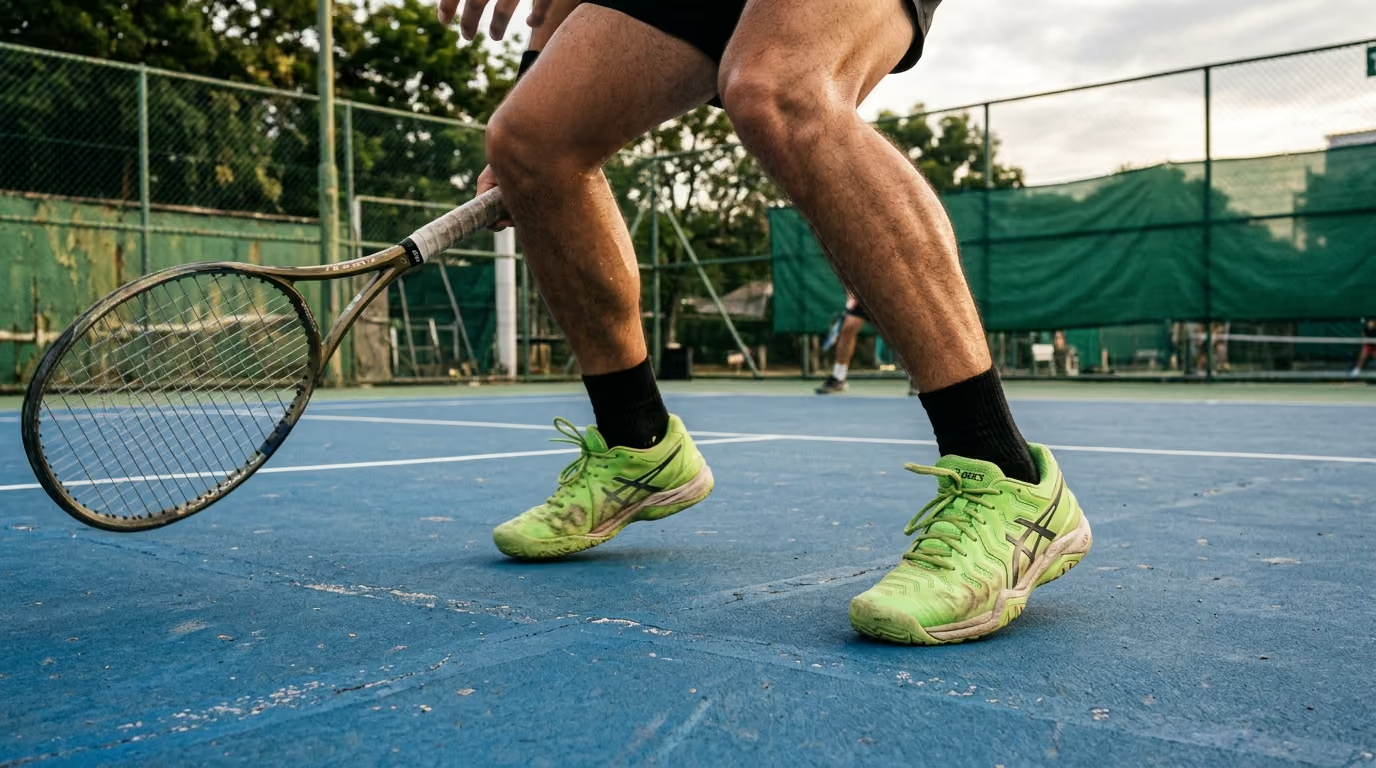
A successful serve return in racquet sports becomes a tactical stroke that neutralizes the server's opening advantage by targeting deep, high-margin zones of the court.




The serve return is often misunderstood as a simple act of defense. Many players view it as a reactive block or a wild attempt to hit a fast winner. In reality, the return of serve is the most critical transition shot in any racquet sport. It is your first opportunity to neutralize the server's starting advantage and tilt the rally in your favor.
A successful serve return is a controlled tactical stroke that neutralizes the server's opening advantage by targeting deep, high-margin zones of the court. Rather than chasing low-percentage winners, effective returners prioritize consistent depth and immediate physical recovery to transition smoothly into the ensuing rally. This systematic approach shifts pressure back onto the serving side from the very first ball.
To build a reliable return, you must understand what this stroke is and what it is not. It is not an invitation to take a massive swing at a high-velocity ball. Instead, it is a disciplined exercise in early recognition, compact preparation, and smart target selection. By mastering these elements, you can transform the return from a vulnerable defensive moment into a reliable asset.
Anticipating a high-velocity serve requires your brain to process information in incredibly tight windows. This is not about guessing where the ball will land. True anticipation is a structured cognitive process that combines past patterns with real-time physical cues.
Research published in Frontiers in Psychology examined how professional tennis players anticipate serves. The study, conducted by researchers Vernon, Farrow, and Reid, analyzed how elite players use different types of information before and during the serve. They found that players rely on distinct informational windows that change as the server's motion unfolds.
The first window occurs before the server even starts their motion. During this time, the brain gathers contextual information. This includes the score, the importance of the point, and the server's favorite targets on big points. The researchers found that elite players can often identify an unfamiliar opponent's serving patterns within the first two or three games. They use this mental map to establish an early probability of where the serve might go.
The second window opens during the service action itself. Here, the brain transitions from contextual probabilities to physical cues, known as kinematic information. The study identified the server's ball toss as the most frequently cited visual cue. Other important cues include torso rotation, shoulder alignment, and the starting angle of the racket. This kinematic data either confirms or rejects the player's early contextual expectation.
The final window begins the moment the racket makes contact with the ball. After contact, actual ball-flight information overrides all previous predictions. Even if you expected a wide serve, your brain must rapidly adjust if the ball travels toward your body. The researchers emphasized that high-level returners do not commit blindly to a guess. Instead, they predict early, confirm late, and commit only at the point of contact.
A reliable return starts with dynamic preparation. You cannot return a fast serve from a completely static stance. Your body must be in a state of active readiness that allows for explosive movement in any direction.
The foundation of this readiness is the split step. The split step is not a vertical jump. It is a light, timed hop that lands just as your opponent makes contact with the ball. As your feet touch the ground, your knees bend and your weight distributes onto the balls of your feet. This stores elastic energy in your muscles, which helps you spring toward the ball.
Once you land and read the direction of the ball, your next step is a compact unit turn. Against a fast serve, you do not have time for a long, looping backswing. Instead of pulling your racket back with your arm, turn your shoulders and hips together. This rotation naturally brings the racket into a short, prepared position without destabilizing your wrist.
Keep your hands relaxed and positioned in front of your body during this preparation. Your racket face should remain stable and controlled throughout the turn. If you allow the racket to drift behind your torso, you will struggle to meet the ball in front of your body. A short, stable preparation allows you to redirect the server's incoming pace with high precision.
Finally, ensure your grip remains relaxed until the moment of contact. Squeezing the handle too tightly before the swing limits your wrist mobility and slows your reaction time. A relaxed grip allows for quick micro-adjustments as the ball bounces. It also helps your muscles absorb the heavy impact of a powerful serve.
Your starting position on the court is a major tactical decision. Standing in the exact same spot for every return makes you highly predictable. To keep the server off balance, you must adjust your position based on the server's patterns and the court conditions.
Adjusting your court position is a highly effective way to manage probability. You do not need to cover every square inch of the service box equally. Instead, position yourself to take away the server's most dangerous or frequent target. For example, if an opponent consistently serves wide on the deuce court, you should stand slightly wider to take away that angle.
A statistical model developed by Kovalchik and Albert analyzed professional return patterns. By looking at thousands of return points, they identified six unique return impact styles among elite players. This research shows that top players do not use one single return position. Some prefer to stand deep to buy reaction time, while others stand close to the baseline to take the ball early.
Your physical positioning can also function as a psychological tool. By moving forward, backward, or laterally just before the server starts their motion, you can create doubt. This movement forces the server to second-guess their target under pressure. For further strategies on dynamic court movement and positioning, you can consult our detailed court performance resources.
When returning a serve, target selection should prioritize safety and court geometry over raw power. Trying to hit a spectacular winner off a fast serve is a low-percentage strategy. Instead, aim for large targets that force the server to play a difficult second shot.
The highest-margin target on the court is almost always cross-court. Returning the ball cross-court sends it over the lowest part of the net. This direction also utilizes the longest diagonal distance of the court, giving you more physical space for error. A deep, cross-court return naturally keeps the ball away from the server's partner in doubles and limits the server's recovery angles.
While cross-court is the safest default, central returns also have significant strategic value. Aiming down the center of the court reduces the angles the server can use on their next shot. A deep, heavy return down the middle often jams the server's footwork and forces an error. This is a highly reliable option when you are stretched wide or running out of reaction time.
Data from a multi-year Hawk-Eye study at Wimbledon provides fascinating insights into target selection. The researchers analyzed over 40,000 professional serve returns. They found that both male and female players returned to central zones far more frequently than wide zones. This confirms that even the best players in the world prioritize safety on the return.
However, the Wimbledon study also revealed an interesting detail. Although wide returns were less common, they actually had a higher point-winning percentage when successfully executed. This indicates that wide returns are highly rewarded, but they require precise timing and early recognition. When playing on pressure points, the safest path remains the deep, central target.
While the core principles of anticipation and compact preparation apply to all racquet sports, the specific rules and court geometries create unique tactical demands for each game.
In tennis, the returner must deal with extreme ball speeds and heavy topspin or slice. Because the serve can travel at over 120 miles per hour, your reaction time is highly limited. The tennis return requires an exceptionally short backswing and an immediate split step. Your primary goal is to neutralize the server's pace and get the ball deep into the opponent's territory.
If you want to read more about refining your baseline tactics, check out our selection of tennis articles.
The tactical objective in pickleball is entirely different because of the two-bounce rule. The receiving team must let the serve bounce, but they also want to establish themselves at the non-volley zone line as fast as possible. Therefore, your primary return objective is depth and height, not speed. A high, deep return keeps the serving team pinned behind their baseline.
This depth buys you the necessary time to run forward and establish a strong position at the kitchen line. For more tactical guides on mastering this transition, you can explore our library of pickleball articles.
Padel introduces the unique challenge of glass walls and metal mesh surrounds. The serve must bounce in the service box and can then hit the glass. This means the returner must often let the ball pass them, wait for the rebound off the glass, and strike the ball as it moves forward.
The lob is the ultimate return weapon in padel. A high lob over the serving team forces them off the net and allows you to transition forward to take the offensive position. To learn more about mastering the walls and court positioning, you can read our specialized padel articles.
Even experienced players frequently fall into bad habits when returning serve. Identifying and correcting these errors can quickly improve your consistency on the court.
The most common technical mistake is using a massive backswing against a fast serve. When you see a fast ball coming, the natural instinct is to swing harder to match the pace. This causes your racket to travel too far behind your body, leading to late contact. Instead, use the server's own pace against them by keeping your swing short and compact.
Another frequent error is standing completely still after hitting your return. A serve return is never truly complete until you have recovered your physical position on the court. In tennis, this means recovering toward the center of the baseline. In pickleball, it means moving immediately to the non-volley zone line. If you hit a great return but remain stationary, you hand the advantage right back to your opponent.
Many players also suffer from overcommitting to a guessed direction before the ball is hit. While it is helpful to look at contextual patterns, you must never move so early that you cannot adjust. If a server notices you shifting early, they can easily slide the ball into the open space. Keep your weight centered and balanced until the ball leaves the server's racket.
Finally, do not assume that your opponent's backhand is always their weakest wing. While this is a common rule of thumb, some players have highly reliable backhands and struggle on their forehand side. Take the first few games of a match to observe your opponent's actual comfort levels. Adjust your targets based on real evidence rather than generic assumptions.
The physical demands of returning a serve are highly intense. The stroke requires sudden deceleration, explosive lateral movement, and rapid rotation under physical tension. Over time, these repetitive forces can place a significant load on your knees, hips, and lower back.
Our team has felt these physical demands first hand. I remember finishing a tough two hour padel match on a cold Tuesday night and waking up the next morning feeling like my lower back was locked in concrete. For a long time, I just accepted this as the price of playing hard in my forties. But once I started spending just ten minutes on targeted hip mobility before heading to the club, the stiffness almost completely vanished. It taught me that we do not have to accept pain as a default state of aging.
To protect your joints during the rapid changes of direction required by the return, you must focus on hip and ankle mobility. When your hips are tight, your lower back is forced to rotate excessively to compensate. This extra rotation can lead to chronic stiffness and micro-tears in the spinal muscles. Developing a dedicated pre-match routine is essential for maintaining your physical capabilities on the court.
Incorporating dynamic stretching before you play helps prepare your joints for these sudden movements. Focus on leg swings, deep lunges, and gentle trunk rotations to lubricate your joints. For a collection of evidence-based routines, explore our mobility and movement techniques. Supporting your body with targeted conditioning is the best way to ensure healthy aging and athletic longevity. You can find more structured advice on this topic in our healthy aging and athletic longevity guides.
While minor muscle soreness is a normal part of playing competitive sports, you must be able to distinguish between safe fatigue and potential injury. Ignoring warning signs can turn a minor strain into a chronic issue that keeps you off the court for months.
You should consult a qualified healthcare provider, such as a physical therapist or sports medicine physician, if you experience any of the following symptoms:
A professional can help identify the root cause of your discomfort and design a personalized rehabilitation plan. Addressing these issues early allows you to return to the sport safely. For more information on staying healthy and injury-free, browse our injury prevention strategies and read through our player health articles.
You should utilize both cues at different times. Before contact, look at the server's body alignment, shoulder turn, and ball toss to gather physical clues about the serve's direction. The moment the racket makes contact, shift your visual focus entirely to the flight path of the ball. Ball-flight information is the ultimate truth and must override any early predictions.
The body serve is highly effective because it jams your arms and limits your swing space. To handle this, your first step must be a rapid lateral adjustment with your feet to clear your hips. Do not try to take a full swing. Instead, use a very compact blocking motion to redirect the ball back down the center of the court.
Against an exceptionally fast first serve, a chip or slice return is usually the safer option. The chip return uses a short, descending path that is easy to time under pressure. It also allows you to use the server's high speed to send the ball deep. Save the aggressive drive returns for slower second serves where you have ample time to prepare.
The absolute priority for a pickleball serve return is depth. A deep return forces the serving team to stay behind their baseline for their next shot. This distance makes their third shot highly difficult and gives you plenty of time to run forward and establish a strong defensive position at the non-volley zone line.
Follow Evercourts for practical insights on tennis, pickleball and padel performance, movement, recovery and healthy ageing. Stay connected for new articles, research-led guidance and ideas to help you play well and keep playing for years.


Read practical guidance for better movement, smarter preparation and a game that keeps working for you.
explore the Blog