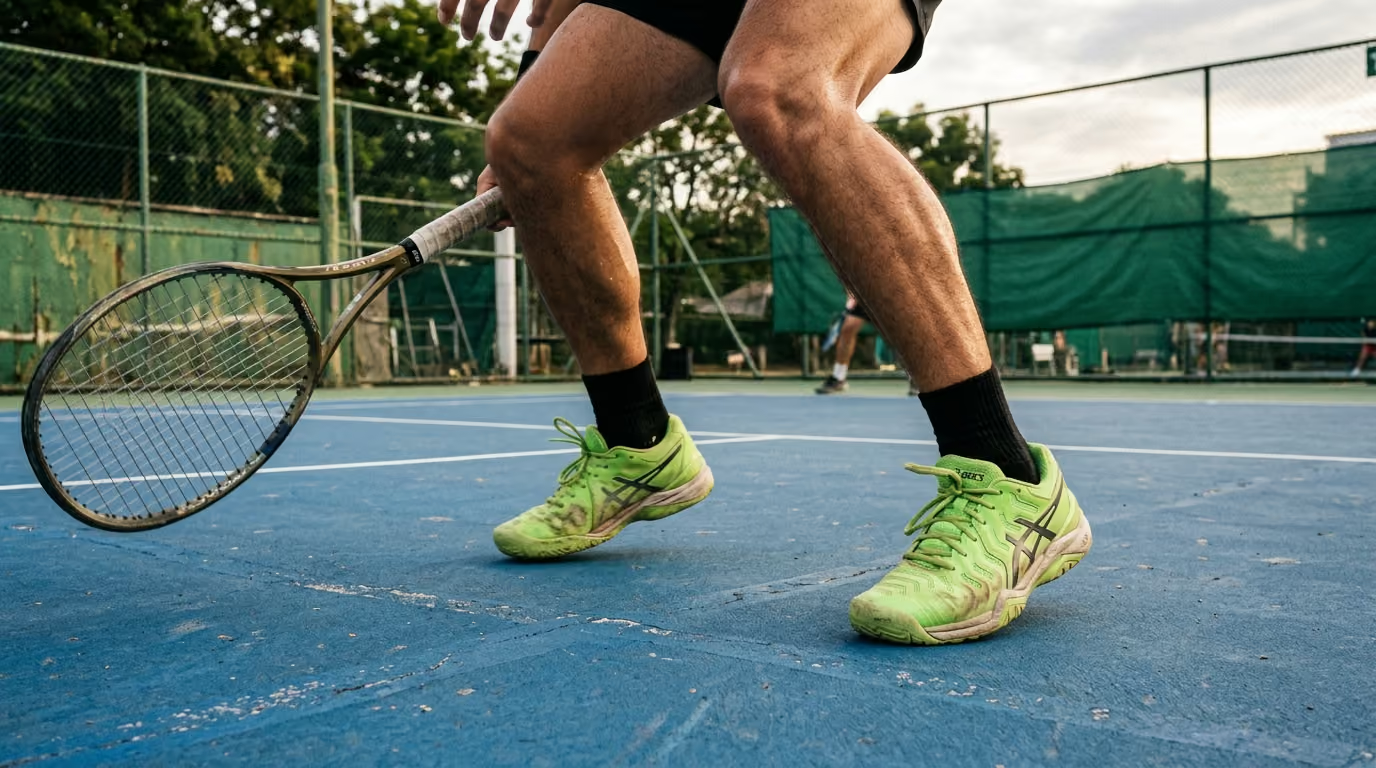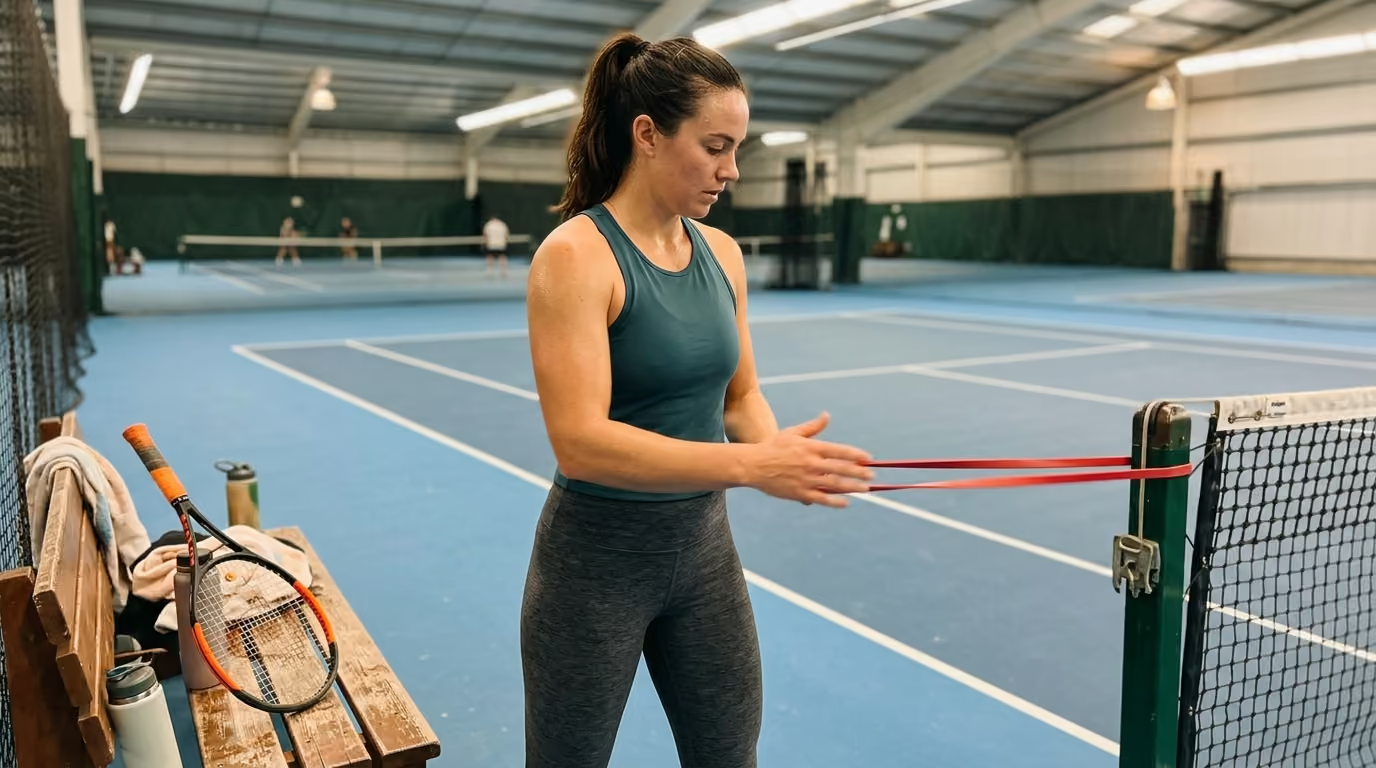

Players can achieve lasting shoulder health and continue excelling in racquet sports by adopting a comprehensive injury prevention strategy.




You finish a long weekend tournament or a competitive morning of play. The next day, you reach for a cup of coffee on a high shelf and feel a sharp, familiar pinch deep in your shoulder. Many players assume this discomfort is just an unavoidable part of playing racquet sports. However, shoulder issues are not an inevitable tax you must pay for staying active on the court.
Effective shoulder injury prevention requires balancing the physical demands of play with technical efficiency, localized rotator cuff endurance, and planned recovery. Rather than relying on a single stretch or a magic exercise, players must treat the shoulder as part of a connected system that transfers power from the ground up. Taking this comprehensive approach helps maintain athletic longevity and keeps you playing without interruption.
To protect the shoulder, we must first understand why it is so vulnerable during racquet sports. The shoulder joint is built for mobility rather than stability. The main joint, the glenohumeral joint, is a ball and socket system. The socket of the shoulder blade is very shallow, often compared to a golf ball sitting on a tee. This design allows you to swing your arm in almost any direction, but it also means the joint relies heavily on active muscles and ligaments to stay centered.
The rotator cuff is the primary system responsible for this active control. The rotator cuff is not just a single muscle, but a group of four distinct muscles. These are the supraspinatus, the infraspinatus, the teres minor, and the subscapularis. They wrap around the head of your upper arm bone, the humerus, to form a supportive cuff. When you swing a racquet, these muscles contract to keep the ball of the humerus centered within the shallow socket.
Overhead strokes place unique physical demands on this dynamic stabilizing system. During a serve or an overhead smash, your arm moves through extreme ranges of motion at high speeds. The acceleration phase requires your chest and shoulder muscles to produce rapid forward force. However, the deceleration phase after ball contact is often where the highest mechanical stress occurs.
Once you strike the ball, the arm must slow down quickly. The muscles in the back of your shoulder must contract eccentrically, meaning they must produce force while they are lengthening. A systematic review published in 2025 found that tightness in the posterior shoulder during this deceleration stage is strongly associated with injury risk. When the muscles and tissues in the back of the shoulder become stiff, they restrict normal joint movement and increase the shear stress on the rotator cuff.
The shoulder does not work in isolation. Every groundstroke, volley, and serve relies on the kinetic chain. The kinetic chain is the coordinated transfer of energy from your feet through your legs, hips, trunk, shoulder, elbow, and finally into the racquet. Biomechanical research shows that more than half of the force in a tennis serve comes from the lower body and the core. If your leg drive is weak or your trunk rotation is restricted, your shoulder must work much harder to generate power. This arm-dominant swing style is a common cause of chronic shoulder strain.
The shoulder experiences different patterns of stress depending on whether you play tennis, pickleball, or padel. Understanding these distinct demands allows you to tailor your prevention strategies.
Tennis places high-velocity, high-range demands on the shoulder. The tennis serve is the most demanding stroke on the court. Biomechanical studies break the serve down into five phases: loading, early cocking, late cocking, acceleration, and deceleration. During late cocking, the shoulder is forced into extreme external rotation, which stretches the front of the joint. During deceleration, the muscles must work hard to absorb the leftover energy of the swing.
Shoulder injuries account for roughly 4% to 17% of all recorded tennis injuries. Research shows that this risk is influenced by several factors, including your age, body mass, height, and weekly playing volume. For tennis players, serving power is not dangerous on its own. The risk rises when a player suddenly increases their weekly serving volume, or when fatigue causes their technique to break down. When you get tired, your legs stop driving, your ball toss drops, and your shoulder takes on the entire mechanical burden of the serve.
Pickleball is often viewed as a low-impact sport because the court is small and the paddle is short. This perception can lead players to underestimate the physical load on the shoulder. Recent institutional data shows that rotator cuff injuries are actually the most common upper-limb diagnosis in pickleball, accounting for about 11% of reported cases.
While pickleball does not feature the high-velocity serves of tennis, it involves a massive volume of rapid, repetitive strokes. A typical match requires constant paddle preparation, quick volleys, and low-to-high paddle paths. Players often flick the wrist or snap the shoulder to generate power because the paddle lacks strings. This high-repetition demand at moderate intensity can easily fatigue the rotator cuff. The risk is especially high for players who suddenly transition from playing once a week to playing five times a week without giving their tissues time to adapt.
Padel is a fast-growing sport that combines elements of tennis and squash. It is played on an enclosed court with solid, perforated paddles. Research indicates that shoulder injuries make up about 12% of the overall injury distribution in padel. The game is highly dynamic, with frequent defensive plays off the glass walls and constant overhead exchanges at the net.
The most common overhead strokes in padel are the smash, the vibora, and the bandeja. The bandeja is a defensive overhead strike with lateral spin. It requires you to contact the ball out to the side of your body at shoulder height. This wide, repetitive position puts unique rotational strain on the rotator cuff. Furthermore, defending balls that rebound off the back walls often forces you to make late, awkward contacts behind your body, which places immediate stress on the anterior shoulder.
To manage your injury risk, it is helpful to look at a practical framework. We can think of your overall shoulder risk as a balance between the stress you place on the joint and your body's ability to tolerate that stress.
This relationship can be described as:
Shoulder Risk = (External Workload × Mechanical Inefficiency × Fatigue) − Physical Capacity − Recovery
This is not a strict mathematical formula, but a practical way to understand how different factors interact. Let us look at each part of this equation.
External workload represents your total exposure on the court. This includes the number of sessions you play each week, the total hours, and the volume of specific high-load strokes like serves and overheads. If you double your playing hours in a single week, your external workload spikes.
Mechanical inefficiency refers to technique errors that overload the shoulder. If you serve with a stiff torso or hit your forehands with late contact, you are raising your mechanical inefficiency. This increases the amount of force the shoulder joint must absorb for every single hit.
Fatigue is the physical decline that happens during a long match or a tough practice session. When your shoulder muscles tire, they lose their ability to stabilize the joint. This allows the ball of the upper arm to slide slightly out of place, which can pinch nearby tendons.
Physical capacity is your body’s baseline strength, endurance, and mobility. It includes the strength of your rotator cuff, the control of your shoulder blade, and the flexibility of your thoracic spine. A higher physical capacity acts as a shield against injury.
Recovery represents the steps you take to help your tissues repair. This includes getting enough sleep, allowing rest days between heavy sessions, and maintaining proper nutrition. Excellent recovery keeps your physical capacity high, while poor recovery causes it to drop.
Using this framework, we can see why two different players might have very different experiences. A player with highly efficient technique and great physical capacity might tolerate a high workload without any issues. On the other hand, a player with poor mechanics and low endurance might experience pain even with a low workload. To protect your shoulder, you must work on improving every variable in this equation.
Players often hear different medical terms when discussing shoulder pain. Understanding these terms can help you make informed decisions about your health.
Rotator-cuff tendinopathy is the most common cause of shoulder pain in racquet sports. It refers to irritation, swelling, or wear of the tendons that connect your rotator cuff muscles to your arm bone. This condition usually develops gradually due to repetitive overload. It is not a sudden tear, but rather a sign that the tendon's capacity has been exceeded. It typically causes a dull ache on the outside of the shoulder that worsens during or after play.
A tear is a structural change where the tendon fibers are partially or completely separated. It is crucial to know that structural findings on an MRI do not automatically equal pain. A key study in tennis research found that 40% of asymptomatic overhead athletes had partial or full-thickness rotator cuff tears on their MRIs. These players had no pain and were performing at a high level. This means you should never treat an MRI report as a final diagnosis on its own; it must always be evaluated alongside your actual pain, strength, and movement.
GIRD occurs when the dominant throwing or hitting shoulder loses internal rotation compared to the non-dominant side. This is a very common adaptation in tennis and padel players. As you perform thousands of overhead strokes, the back of your shoulder joint capsule can become thick and tight. While a small amount of asymmetry is normal, a large difference in internal rotation can alter how your shoulder moves. This increases the risk of impingement and labral tears.
To get a complete picture of shoulder mobility, we must look at the total rotational arc. This is the sum of your internal rotation and your external rotation. Often, a player will lose internal rotation but gain external rotation. If the total arc of motion is similar on both sides, the shoulder is usually functioning well. However, if your total range of motion on your dominant side is significantly lower than on your non-dominant side, it indicates a structural restriction that needs attention.
Your shoulder blade, or scapula, is the platform that supports your entire shoulder joint. When you raise your arm, your shoulder blade must rotate upward and tilt backward to make room for your arm bone. If the muscles that control the shoulder blade are weak or uncoordinated, the platform cannot tilt properly. This can cause the arm bone to pinch the rotator cuff tendons against the bone above them. This issue is often called scapular dyskinesis, and it is a major focus of modern sports physical therapy.
Improving your physical capacity is only half the battle. You must also apply this knowledge directly to your play on the court. There are several ways to reduce shoulder load during training and matches.
First, take a close look at your equipment. Using gear that matches your physical level is a simple way to protect your joints. For tennis players, choosing a racket with a slightly larger grip can prevent you from squeezing too tightly. Squeezing the grip with maximum force limits the natural rotation of your forearm and shoulder, which increases localized strain. You can also lower your string tension by a few pounds to allow the strings to absorb more of the ball's impact.
If you play pickleball or padel, pay attention to paddle weight and composition. A paddle that is too heavy will quickly fatigue your shoulder during fast volley exchanges. Conversely, a paddle that is too light might force you to swing much harder to generate power, which also increases joint stress. Look for a paddle with a comfortable grip and a core that dampens vibration.
Second, focus on your court positioning and preparation. The later you contact the ball, the more your shoulder must work to salvage the stroke. In padel, when a ball rebounds off the back wall, try to move your feet quickly to get behind the ball. This allows you to strike the ball in front of your body, where your chest and trunk can assist with power production. In tennis and pickleball, early preparation is the key to maintaining a smooth, efficient kinetic chain.
Our team often emphasizes the importance of managing your ego on the court. A few years ago, I realized my tennis serve speed was dropping, and my shoulder was constantly throbbing after matches. Instead of pushing through the pain, I took a month to rebuild my mechanics and focus on rotator cuff endurance. I stopped trying to hit flat aces and developed a much heavier kick serve. My win rate actually went up, and my shoulder stopped hurting. Sometimes longevity means outsmarting your own ego on the court.
The most common trigger for shoulder pain is a sudden change in workload. Your tendons and muscles adapt slowly to physical stress. If you keep your playing volume steady, your shoulder stays strong. If you spike your volume, you risk overloading the tissue.
To manage your workload effectively, start tracking your court exposure. You do not need a complicated system. Simply note the total playing time, the number of matches, and the number of consecutive days you play each week. You should also keep track of your overall physical exertion. For tennis players, it is especially useful to note how many hard serves you hit during a practice session.
A great practical rule for tracking load is the next-day check. How does your shoulder feel the morning after a tough match? If you wake up with deep stiffness or an ache that lasts for several hours, your workload likely exceeded your current tissue capacity. This is a clear signal that you need to reduce your playing volume or intensity for a few days. You should wait to increase your court time until you can play a session and wake up the next morning with no shoulder discomfort.
Be cautious during tournament weekends or holidays when you might play multiple matches in a short period. If you plan to play a tournament, do not go from playing twice a week straight into a three-day event. You should gradually build your playing volume over four to six weeks before the competition. This progressive preparation gives your rotator cuff and posterior shoulder tissues time to build the necessary endurance.
To build a resilient shoulder, you should perform targeted conditioning exercises off the court. A complete routine should focus on rotator cuff strength, scapular control, and thoracic mobility. Here is a progressive framework you can easily integrate into your training.
If your shoulder is currently sensitive or recovering from a long session, isometric exercises are an excellent starting point. Isometrics involve producing force without any movement. This helps build baseline muscle activation and can help reduce mild tendon pain.
To perform a standing external rotation isometric, stand next to a wall or a door frame. Bend your elbow to 90 degrees and place the outside of your wrist against the wall. Gently press your wrist outward into the wall, as if you were trying to rotate your arm away from your body. Hold this press with moderate effort for 30 to 45 seconds. Repeat this process three to five times on each side, ensuring you do not feel any sharp pain.
Once isometric exercises feel comfortable, transition to active movement. Side-lying external rotation is a highly effective exercise for targeting the infraspinatus and teres minor. These muscles are critical for decelerating your arm during a swing.
Another excellent option is the standing band external rotation. Attach a resistance band to a door handle at elbow height. Stand sideways to the door, hold the band with your outer hand, and bend your elbow to 90 degrees. Keep your shoulder blade relaxed and rotate your hand outward away from your stomach. Control the pull of the band as you return to the starting position.
A stable shoulder blade provides a solid foundation for your rotator cuff. To improve scapular performance, perform exercises that target the lower trapezius, middle trapezius, and serratus anterior.
Prone Y-T-W raises are a fantastic option for building upper back endurance. Lie face down on a comfortable mat or floor. To perform the "Y" position, extend your arms forward at a 45-degree angle with your thumbs pointing toward the ceiling. Gently lift your arms and chest a few inches off the floor by squeezing your shoulder blades down and together. Hold for two seconds, then lower. Repeat this in a "T" position with your arms straight out to the sides, and a "W" position with your elbows bent and pulled down toward your ribs.
Scapular push-ups are another great way to build strength in the serratus anterior, which helps wrap the shoulder blade around your rib cage. Start in a standard plank or a push-up position from your knees. Keeping your elbows completely locked, slowly lower your chest by letting your shoulder blades pinch together behind you. Then, press through the floor to push your upper back toward the ceiling, spreading your shoulder blades wide. Perform 2 sets of 12 to 15 small, controlled repetitions.
Targeted mobility work should focus on the posterior shoulder and the thoracic spine. If you have an identified restriction in internal rotation, the sleeper stretch can help restore normal range of motion.
To improve thoracic spine rotation, perform the open book stretch. Lie on your side with your knees bent at 90 degrees to protect your lower back. Extend both arms straight out in front of you, with your palms touching. Slowly lift your top arm up and rotate it over to the opposite side, opening your chest toward the ceiling. Let your eyes follow your hand as your upper back rotates. Hold this open position for a deep breath, then return to the start. Complete 10 smooth repetitions on each side.
A dynamic warm-up prepares your shoulder for the high speeds of court play. Avoid long, static stretches right before you hit the court. Instead, use this quick progression to prime your body for action.
Even well-intentioned players can fall into habits that increase their risk of shoulder injury. Recognizing these common mistakes can save you from unnecessary setbacks.
The first mistake is static stretching right before a match. Holding a deep stretch for a long time relaxes your muscles and temporarily reduces their ability to produce power. This can make your rotator cuff less stable during high-speed play. Save deep, static stretching for after your matches, and focus on dynamic movements during your warm-up.
The second mistake is focusing entirely on chest and front shoulder exercises. Many players spend their gym time on bench presses and push-ups. This strengthens the pectorals and anterior deltoids, which are already highly active during racquet swings. Over time, this focus can pull the shoulder forward and decrease the space available for your rotator cuff tendons. To prevent this, ensure your training program includes plenty of rowing, pulling, and posterior cuff exercises to balance the shoulder.
The third mistake is trying to keep your shoulder blades pinned down and back during your strokes. Some coaches and players believe that locking the shoulder blades in place creates a more stable position. However, your shoulder blades must move freely to allow your arms to reach overhead safely. If you try to immobilize them, your arm bone will pinch the surrounding tissues at the top of your swing. Focus on controlled, natural movement of the shoulder blade rather than rigid fixation.
Finally, do not make the mistake of ignoring your lower body. The moment you stop driving with your legs because you are tired, your arm must take on the entire load of your swing. If you want to protect your shoulder, you must build lower body endurance. Keep your knees bent, engage your hips, and let your core transfer power up into your arm.
For more information on managing early court soreness, you can read our guide on injury prevention resources.
Reviewing real-world scenarios can help show how these prevention principles apply to different players.
A 45-year-old recreational tennis player normally plays once a week. With a local tournament coming up, they add two extra serving practice sessions to their weekly routine. After the second practice, they develop a sharp pain in the front of their shoulder during the acceleration phase of their serve.
The main issue here is a sudden spike in external workload. The player's rotator cuff did not have the baseline endurance to tolerate three times their normal serving volume in a single week. To address this, the player should temporarily reduce their serving practice and focus on pain-free isometric external rotations. They can gradually rebuild their serving volume over several weeks, using the next-day check to ensure their shoulder is adapting well.
A 50-year-old padel player visits a doctor for a minor elbow issue and ends up getting a shoulder MRI as part of a general checkup. The scan reveals a partial-thickness tear in their supraspinatus tendon. The player is deeply concerned and believes they must stop playing padel immediately to avoid further damage.
This is a classic example of treating a scan rather than the actual player. The player has no shoulder pain, full strength, and excellent court mobility. As research shows, asymptomatic rotator cuff tears are very common in older court athletes. The player should be reassured that they do not need to stop playing. Instead, they should continue their regular play while incorporating a consistent routine of rotator cuff strengthening and scapular control to maintain their high function.
To explore more about healthy court habits and player longevity, visit our healthy aging resources.
An active 60-year-old starts playing pickleball and quickly falls in love with the game. They begin playing for two to three hours every single morning. Within a month, they develop a constant, aching pain in their dominant shoulder that keeps them awake at night.
This player is suffering from an overuse issue caused by high repetition and insufficient recovery. Playing daily leaves no time for the rotator cuff tendons to repair between sessions. The player should temporarily reduce their play to three times a week, ensuring they have rest days in between. They should also focus on using more trunk rotation during their drives to reduce the demand on their arm, and begin a gentle rotator cuff endurance routine.
While proactive conditioning and load management can prevent many shoulder issues, some symptoms require professional care. It is important to know when to seek help from a qualified physical therapist or sports medicine physician.
You should consult a professional if your shoulder pain has lasted for more than two to three weeks without improvement. Chronic pain is often a sign of an underlying issue that needs a targeted rehabilitation plan. You should also seek professional evaluation if you experience significant weakness in your shoulder, such as an inability to lift your arm or a sudden loss of swing power.
Night pain that disrupts your sleep is another key warning sign. Healthy shoulders should not ache constantly when you are resting. Finally, if you experience clicking, catching, popping, or a feeling that your joint is slipping out of place during your swings, you should have your shoulder examined by a professional. These symptoms can indicate a labral tear or joint instability that requires specialized care.
For more updates on court wellness and player health, check out the Evercourts blog.
When building a shoulder prevention program, we must acknowledge that sports science research is constantly evolving. The vast majority of biomechanical studies on racquet sports focus on tennis players, particularly their serve mechanics. We have excellent data on how tennis serves load the shoulder, but we have much less research on the specific joint demands of pickleball and padel.
The available statistics for padel and pickleball often come from small, localized studies or single-hospital databases. These numbers show us common injury trends, but they might not represent the entire playing population. Furthermore, research on court athletes often focuses on younger, elite, or professional players. There is still a significant gap in our understanding of how older recreational players adapt to these sport-specific loads.
Despite these limitations, the core principles of tissue adaptation, kinetic chain contribution, and progressive load management apply to all court athletes. By treating your shoulder as part of a connected system and monitoring your weekly volume, you can dramatically reduce your risk of injury and enjoy many years of active play.
You should review this guide whenever you plan to make a significant change in your court routine, such as preparing for a tournament, purchasing new equipment, or returning to play after a break.
Taking a progressive, informed approach to your shoulder health is the best way to ensure athletic longevity on the court.
Follow Evercourts for practical insights on tennis, pickleball and padel performance, movement, recovery and healthy ageing. Stay connected for new articles, research-led guidance and ideas to help you play well and keep playing for years.


Read practical guidance for better movement, smarter preparation and a game that keeps working for you.
explore the Blog