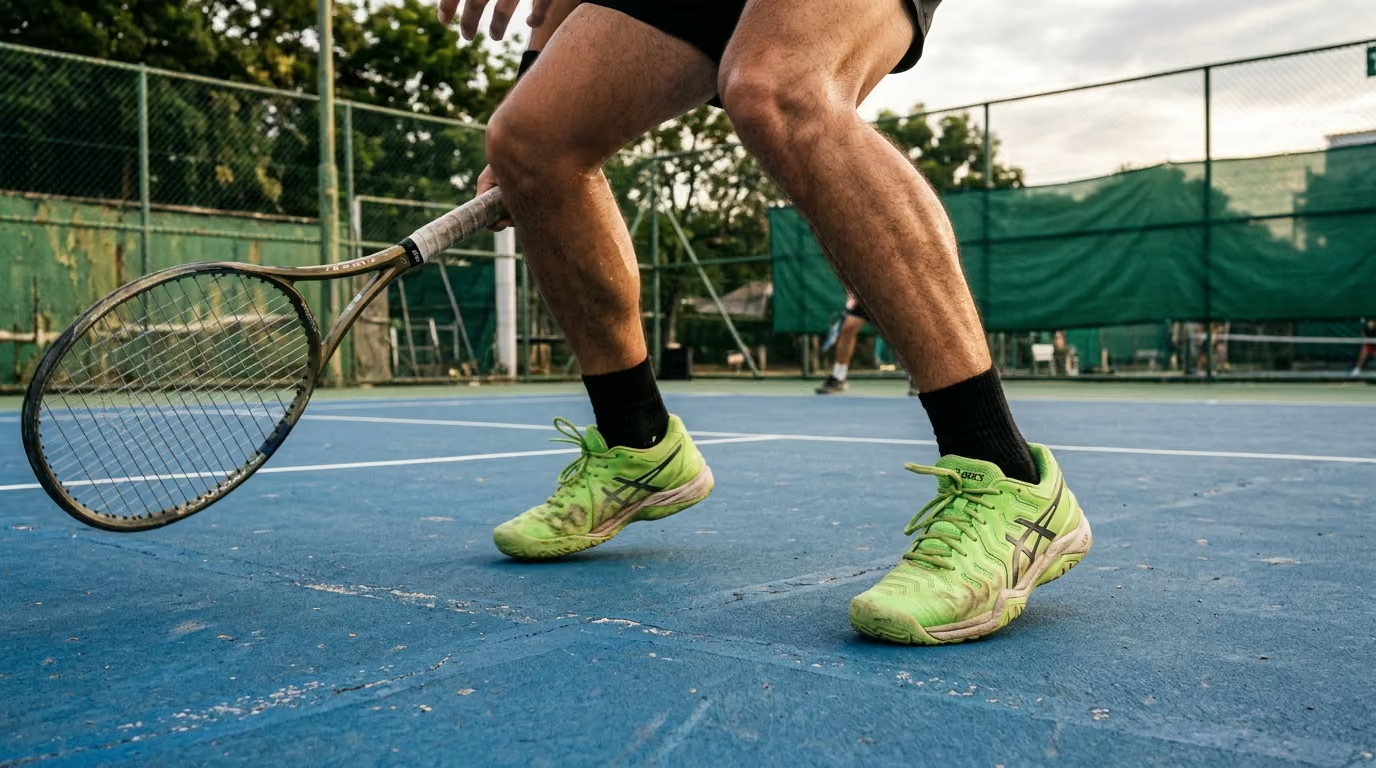
High-level timing in racquet sports relies on a sophisticated visual strategy, with studies showing skilled players react faster to live opponents than to ball machines.




Many players struggle with clean ball contact when an opponent alters the pace, spin, or depth of their shots. You might find yourself framing the ball, hitting late, or constantly lunging in a desperate attempt to make contact. These issues are rarely caused by a faulty swing mechanic alone.
Timing in racquet sports is the precise coordination of visual tracking, physical movement, and racket acceleration around the future point of contact. It is not a matter of reacting faster or swinging harder. Instead, it relies on reading opponent cues and adjusting your spacing before the ball bounces.
To improve your play, you must understand what timing actually means on a court. Many players assume timing is simply the speed of their swing. They believe that a faster reflex will resolve their contact errors. In reality, timing is the ability to organize your preparation, movement, and racket action around the ball's future contact point rather than reacting only to its current location.
When you play against an opponent who varies their shots, you must answer four questions continuously:
The traditional advice to simply watch the ball is incomplete. If you only look at the ball after it leaves the opponent's racket, you have already lost valuable preparation time. Expert performers do not stare at the ball in a continuous loop throughout the entire rally. Instead, they extract predictive cues from the opponent's body kinematics before the ball is even struck.
This predictive approach allows players to get in position early. It changes timing from a frantic reaction into a controlled sequence. By understanding these visual and physical relationships, you can build athletic longevity and keep playing without unnecessary physical strain.
Current sports science research reveals that high-level timing relies on a sophisticated visual strategy. It is not about having superior raw reflexes. In fact, studies show that club-level players often make faster initial movements that result in errors because they move before collecting accurate information.
A key study published in the Journal of Sports Sciences examined tennis players during live and video-based play. The researchers compared 13 skilled and 12 novice players to see how they anticipated different shots. Both groups could predict shot direction above chance, but the skilled players were significantly more accurate.
More importantly, the researchers found that expert players reacted much faster to balls hit by a live opponent than to balls shot from a cloaked ball machine. This difference proves that skilled players use the opponent's body movements to prepare. Without those physical cues, their reaction times delayed.
This relationship is known as perception-action coupling. Your vision and your movement are locked in a continuous loop. In expert padel players, eye-tracking research shows that players focus on two main sources of information. They watch the ball's flight trajectory, but they also spend significant time fixating on the opponent's upper body, including the trunk, shoulders, arm, hand, and racket.
These visual fixations are not random. Eye-tracking reviews indicate that elite players use fewer visual fixations than novices. However, their fixations are longer, more stable, and targeted at highly relevant information. In sports science, a fixation is defined as holding your gaze on a target for at least 100 milliseconds. Elite athletes maintain a highly stable gaze, often referred to as the quiet eye, during the critical moments before they execute their stroke.
Research also shows that you do not need to look at the ball continuously up to the point of impact. In catching and interception studies, participants often stop looking at the object about 0.12 seconds before contact. Their brains have already calculated the path of the ball, allowing them to focus on stabilizing their head and body.
To systematically improve your timing, you can organize your on-court decisions into a repeating four-stage loop. This loop runs continuously during every single rally.
Your timing begins before your opponent strikes the ball. During the read phase, you must observe the opponent's body posture, shoulder rotation, and racket path. Look at their balance and their court position. A player who is stretched wide and off-balance is highly unlikely to hit an aggressive, fast shot.
Conversely, an opponent who is balanced and set up early has multiple tactical options. By reading these physical indicators, you can eliminate half of the possible target zones before the ball even leaves their racket. This early reading is the foundation of athletic anticipation.
Once the ball is struck, you must immediately transition to the predict phase. Use the early ball flight, launch angle, speed, and spin to estimate where the ball will land. You must also project how the ball will behave after it bounces.
Do not treat your prediction as a permanent decision. It is a provisional estimate that you must continuously update as you gather more visual information. If you notice the ball has heavy topspin, you must predict a higher, faster bounce and adjust accordingly.
The third stage requires you to translate your prediction into physical movement. You must use your feet to position your body at an ideal distance from the ball's projected bounce. This phase relies on your agility and movement patterns to establish balance.
The International Tennis Federation coaching material emphasizes that split-stepping, maintaining a low center of gravity, and footwork are deeply connected to ball-flight judgment. You cannot have good timing if your movement does not place you in a stable position to swing.
In the final stage, you make minor adjustments as the ball approaches your hitting zone. If your initial prediction was slightly incorrect, you must use short adjustment steps to fix your spacing.
Once your spacing is correct, you accelerate your racket through the contact zone. Keep your head remarkably still during this final execution phase. After you complete the stroke, you immediately recover your court position and start the loop again.
Most recreational players complain about their timing when they are actually suffering from poor spacing. Spacing is the lateral and vertical distance between your body and the ball at the moment of contact. If you stand too close to the ball, your arm is cramped and your racket face cannot rotate. If you stand too far away, you must reach, which ruins your balance and control.
To master spacing, you must treat your contact point as a three-dimensional target zone rather than a single moment in time. This contact zone has three main components:
You should aim to contact the ball between your waist and chest whenever possible. This is your strike zone, where your muscles have the greatest leverage. If the ball is too high or too low, you must adjust your knee bend or use a different swing path to compensate.
You need enough physical space to let your arm and racket extend naturally. Think of this as a comfortable pocket of air beside your body. If you choke this space, you will lose power and accuracy.
For most groundstrokes, your contact point should be slightly in front of your lead hip. Contacting the ball behind your body is the primary cause of late, weak, and inaccurate shots.
Your feet are the tools that control this spacing. You must transition through a sequence of steps to arrive at the ideal hitting location. Use large crossover or running steps to cover long distances across the court. As you get closer to the ball, transition into short, rapid adjustment steps to fine-tune your position.
Finally, use a solid stabilization step to brace your body before you begin your swing. This biomechanical sequence is highly recommended by coaching professionals to protect your joints and improve your stroke consistency.
A common challenge on the court is maintaining timing when your opponent changes the speed, spin, or depth of their shots. Each variation requires a specific adjustment to your timing loop.
When an opponent hits a fast, flat ball, your primary enemy is time. You do not have the luxury of a long, elaborate backswing. To adjust, you must shorten your racket preparation and make your movement pattern highly compact.
Use the incoming speed of the ball to power your return instead of trying to swing harder. Turn your shoulders early, keep your swing path short, and focus entirely on making clean contact in front of your body.
Slow, floating balls present a different timing trap. Many players see a slow ball, run to it quickly, stop their feet, and wait. By the time they swing, the ball has dropped too low, or they have lost their physical momentum.
When facing a slow ball, you must keep your feet active. Use small adjustment steps to track the ball as it falls, and delay your final racket acceleration until you are perfectly spaced. Do not allow your feet to freeze simply because the ball is traveling slowly.
Spin alters how the ball behaves after it hits the court. Topspin causes the ball to dive quickly and kick upward and forward after the bounce. Slice causes the ball to float through the air, skid low, and slow down upon bouncing.
To time these shots, you must avoid committing to your final swing path before the bounce. Keep your knees bent, stay low to the ground, and use your adjustment steps to match the ball's post-bounce height.
A ball that lands deep in your court forces you to retreat or hit on the rise. A short ball requires you to move forward aggressively to catch it before it drops.
Classify the ball's depth while it is still crossing the net. If you recognize a deep ball early, you can take a step back or turn your shoulders immediately to prevent the ball from pushing you backward into an awkward, late contact position.
To improve your timing, you must avoid drills that are entirely predictable. If you always know exactly where the ball will land, you are not training your visual system or your decision-making processes. The following drills preserve the connection between perception and action, making them highly effective for improving your performance.
This drill trains your ability to classify depth and adjust your footwork accordingly.
This drill helps you break the habit of using a single, rigid swing rhythm.
This drill is designed to train your early visual reading of your opponent's body.
This drill demonstrates the value of human movement cues for timing.
While the core principles of timing and visual tracking apply to all racquet sports, the practical application differs depending on your sport of choice. The court size, ball characteristics, and tactical demands shape your timing strategy.
Tennis features a large court, a heavy felt ball, and significant space behind the baseline. This environment allows for long ball flights and high, looping trajectories.
Because tennis balls can bounce high and carry heavy topspin, your timing must account for significant post-bounce movement. You have more time to prepare your swing, but you must cover larger physical distances.
To excel in tennis, your primary focus should be on early unit turns and using your movement to establish a clean, consistent contact point.
Pickleball is played on a much smaller court with lightweight plastic balls and solid paddles. The ball does not bounce as high, and the exchanges at the non-volley zone line are incredibly fast.
In this fast-paced setting, you do not have time for a traditional backswing. Your timing must rely almost entirely on compact, open-loop preparation.
At the kitchen line, you must rely heavily on reading the opponent's paddle angle and shoulder turn to anticipate fast drives. Keeping your paddle up and out in front of your body is essential for clean contact.
Padel presents a unique tracking challenge because of the surrounding glass walls and metallic fences. The court is enclosed, and many points involve the ball bouncing off the walls.
Your timing cannot rely solely on tracking the ball's forward path. You must calculate how the ball will behave after it strikes the glass.
In padel, expert players look at the opponent's upper body to identify the type of spin, then use specific footwork to stay behind the ball as it rebounds off the back wall. You must often delay your swing, letting the ball pass your body before striking it after the rebound.
These differences highlight why a player who transitions from tennis to pickleball or padel often struggles with timing. The physical space, ball speed, and rebound mechanics require you to adapt your visual search and movement preparation to match the constraints of each game.
Recreational players often fall into predictable traps that destroy their timing and lead to frustration on the court. Recognizing these mistakes is the first step toward fixing them.
Many players take the instruction to watch the ball too literally. They attempt to track the ball continuously with their eyes from the opponent's racket all the way to their own strings.
This is visually impossible during fast exchanges. Trying to do this causes excessive head movement, which ruins your balance.
Instead, focus on early tracking, locate the bounce, and then stabilize your head. Let your peripheral vision and spatial awareness handle the final split-second before contact.
Anticipation is a powerful tool, but it should not turn into reckless guessing. Some players move before their opponent has even started their swing, leaving themselves vulnerable to disguised shots.
Other players wait until the ball has crossed the net before they start to move, which makes them chronically late.
The solution is to time your split-step precisely with your opponent's contact. This ensures you are light on your feet and ready to push off in any direction the moment the ball is struck.
Many players take one or two large steps toward the ball and then stop. If the ball bounces slightly shorter or kicks wider than they expected, they are forced to reach and bend awkwardly.
You must continue taking short, rapid adjustment steps until you are ready to stabilize and swing.
These small footwork adjustments are what separate players with clean timing from those who constantly struggle with spacing.
Poor timing is not just a tactical issue; it also places a significant physical burden on your body. When you hit the ball late or with poor spacing, your biomechanical chain breaks down.
Instead of transferring power smoothly from the ground through your legs, hips, and trunk, you are forced to muscle the ball using only your arm. This compensation leads to localized overload on smaller joints and tendons.
If you contact the ball behind your body, your wrist and elbow must flex excessively to stabilize the racket face. Over time, this repetitive strain can lead to lateral epicondylitis, commonly known as tennis elbow, or shoulder rotator cuff irritation.
In our experience, these injuries are rarely caused by a single bad swing. Instead, they are the result of hundreds of late, poorly-spaced impacts over weeks of play.
I remember finishing a tough two hour padel match on a cold Tuesday night and waking up the next morning feeling like my lower back was locked in concrete. For a long time, I just accepted this as the price of playing hard in my forties. But once I started spending just ten minutes on targeted hip mobility before heading to the club, the stiffness almost completely vanished.
It taught me that we do not have to accept pain as a default state of aging. By improving your movement preparation and timing, you can protect your joints and support your athletic longevity for years to come.
When your timing is correct, you contact the ball in your strike zone with a stable wrist and a aligned shoulder. This allows the large muscle groups of your lower body and core to absorb the impact and generate pace.
Your arm simply acts as a guide, reducing the wear and tear on your joints. Good timing is the ultimate injury-prevention tool for the aging court athlete.
While practicing tracking drills and improving your footwork can resolve most timing issues, you must listen to your body when physical pain arises. You should consult a qualified healthcare provider, such as a physical therapist or orthopedist, if you experience any of the following warning signs:
Do not try to play through pain. Early intervention from a medical professional can help you address underlying movement limitations or joint irritation before they turn into chronic issues that force you off the court.
To apply these concepts on the court this week, use this simple checklist during your practice sessions and matches:
Follow Evercourts for practical insights on tennis, pickleball and padel performance, movement, recovery and healthy ageing. Stay connected for new articles, research-led guidance and ideas to help you play well and keep playing for years.


Read practical guidance for better movement, smarter preparation and a game that keeps working for you.
explore the Blog