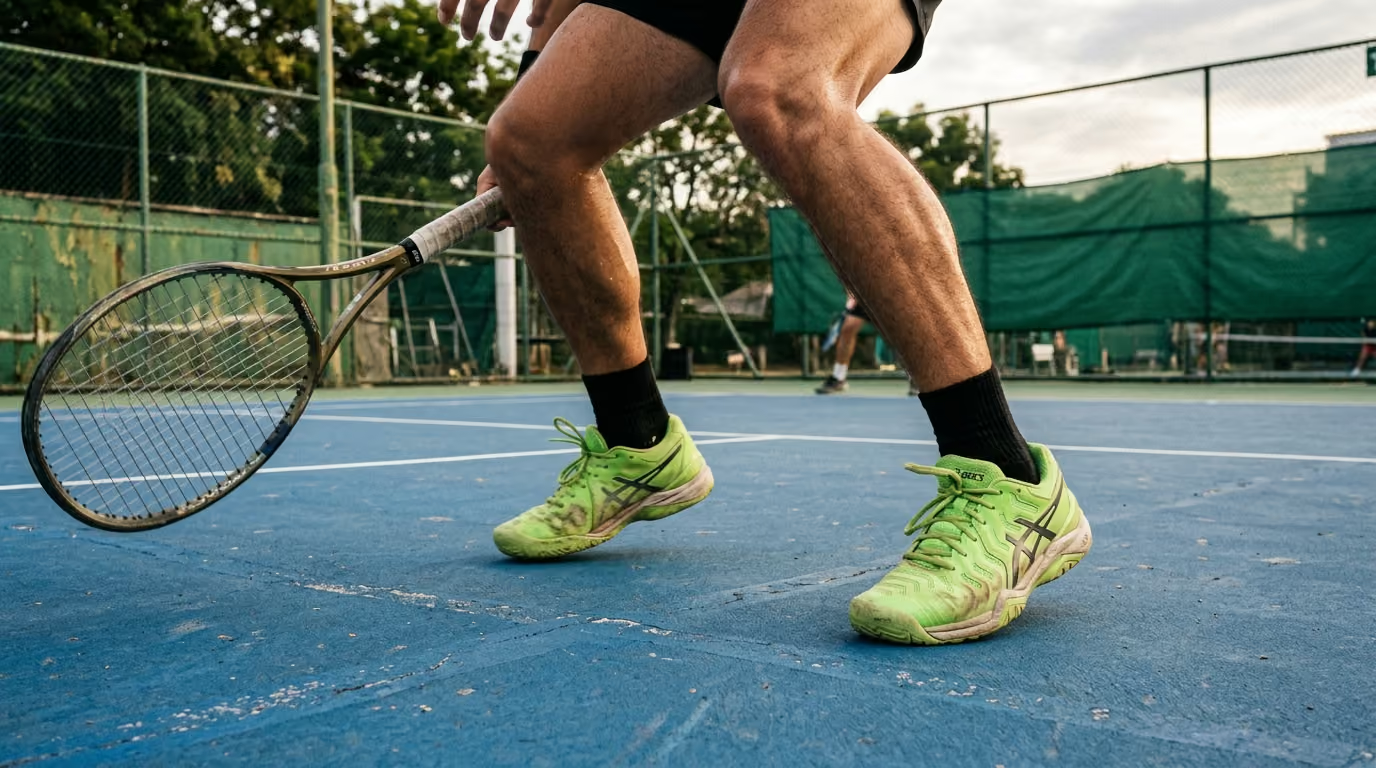
A 16% reduction in all-cause mortality risk is associated with regular participation in racquet sports, which can be supported by a minimalist home training setup.




You finish a demanding session on the court, gather your gear, and head home. The next morning, you roll out of bed and notice your lower back feels stiff. Your knee aches when you walk down the stairs. You look at a corner of your home filled with expensive fitness gadgets that promise rapid recovery, yet none of them seem to make a lasting difference on the court.
Designing a home training setup for racquet sports does not require replicating a commercial fitness center. A minimalist, function-first layout prioritizing resistance bands, a single adjustable weight, and clear floor space provides everything needed to support strength, mobility, dynamic balance, and physical conditioning. This approach protects joints and preserves athletic longevity without unnecessary financial or spatial costs.
General physical activity guidelines provide a baseline for healthy aging and athletic longevity. The World Health Organization recommends that adults accumulate 150 to 300 minutes of moderate-intensity aerobic activity per week. Alternatively, you can perform 75 to 150 minutes of vigorous physical activity. For older adults, the guidelines emphasize adding multicomponent physical activity on three or more days per week. These sessions must emphasize functional balance and strength to enhance physical capacity and prevent falls.
The Centers for Disease Control and Prevention also supports these recommendations. They emphasize combining aerobic work with strength training on at least two days weekly. To learn more about how to structure these activities, you can view the Evercourts home page for updated guidelines.
A major cohort study of 272,550 older adults published in JAMA Network Open examined the health impacts of different activities. The researchers found that participating in racquet sports was associated with lower all-cause mortality. Specifically, playing racquet sports for 7.5 to 15 metabolic equivalent hours per week showed a hazard ratio of 0.84. This indicates a sixteen percent reduction in all-cause mortality risk compared to non-participation.
However, we must interpret these findings as observational associations. They do not prove that racquet sports alone cause a longer life. Players who participate in these sports often differ in other ways. They may have better overall health, higher income, greater social connection, or better access to healthcare.
To support this active lifestyle, we must look at the physical demands of play. A racquet stroke is a whole-body event. Force travels from the feet, through the legs, hips, trunk, shoulder blade, shoulder, elbow, forearm, and wrist. This sequence is known as the kinetic chain.
Research on the tennis serve illustrates this connection. Studies show that dominant-shoulder rotation strength and internal-rotation range of motion are linked to injury risk. Other risk factors include weekly training volume, age, body mass, and height. To protect the upper body, we must build a system that strengthens the entire kinetic chain.
This scientific reality supports a logical training model: move well, build capacity, express capacity quickly, recover, and repeat. Attempting advanced agility drills before establishing basic strength, balance, and landing control often leads to overload. A home training setup should target each stage of this model systematically. You can find more details in our healthy aging and athletic longevity resources.
You do not need to spend thousands of dollars to create an effective training area. Let us divide the setup into three practical tiers based on your space and goals.
A highly effective apartment training space requires very little square footage. You can store all necessary tools in a small closet or under a bed. Your primary tool is a high-quality resistance band set. Look for bands with multiple resistance levels and a secure door-anchor attachment. This allows you to perform pulling, pressing, and rotational exercises without drilling holes in your walls.
Add one or two adjustable dumbbells or kettlebells to your setup. These weights allow you to progress your lower-body strength over time. A thick, non-slip exercise mat protects your joints during floor work and keeps you stable. Finally, a sturdy household chair or low step provides a platform for split squats and balance exercises. If noise is not an issue for your neighbors, a soft medicine ball can be used for light rotational work. This setup provides a complete foundation for strength and conditioning resources at home.
If you have a dedicated garage, basement, or spare room, you can expand your options. Consider adding a full set of adjustable dumbbells or a compact barbell system. An adjustable training bench allows you to perform chest presses, rows, and seated shoulder exercises. A pull-up bar or a wall-mounted cable-pulley system offers excellent upper-body pulling angles.
You can also add a low plyometric box or a sturdy step-up platform. This tool is excellent for building power and practicing controlled landings. For conditioning, consider a stationary bike, rowing machine, or compact treadmill. These machines allow you to build an aerobic base when the weather prevents outdoor training. Make sure your flooring is slip-resistant and thick enough to absorb impact. A wall mirror or a simple video setup can help you check your form during complex movements.
While a home setup is highly convenient, a commercial gym offers specific advantages. You may want to transition to a gym if you need heavier progressive loading for your lower body. Gyms provide specialized machines like leg presses and hack squats. These machines allow you to load your legs heavily without stressing your lower back.
Cable machines offer smooth, adjustable resistance from any angle, which is ideal for shoulder health. Gyms also provide long turf areas that are perfect for sled pushes, medicine ball throws, and lateral agility work. However, consistency is more important than equipment variety. A home training setup used three times a week is far better than a gym membership you rarely use. Choose the setup that best fits your daily routine and budget.
Many players waste money on complex gadgets that offer little value. You do not need multiple unstable balance devices like wobble boards or soft domes. While these tools have a place in early rehabilitation, they do not translate well to court performance. Avoid expensive recovery tools like vibration plates or specialized massage guns. These devices may feel pleasant, but they do not replace quality sleep, hydration, and progressive strength training.
Do not buy large, single-use strength machines that take up your entire room. Instead, focus on multi-joint movements using free weights and bands. Skip the excessive agility-ladder drills. While they look impressive on social media, they do not build the force-production or braking capabilities required on the court. Buy tools only when they serve a specific training need that your current equipment cannot meet.
Let us look at the essential exercises you should perform with this equipment. Focus on control, full range of motion, and gradual progression.
Knee-dominant exercises build the quadriceps strength needed for deep court stances. Start with the basic sit-to-stand from a chair to master the mechanics. Once this is easy, transition to the goblet squat by holding a dumbbell at your chest. Focus on keeping your chest upright and your knees tracking over your toes.
To target each leg individually, perform split squats with your back foot flat on the floor. For a greater challenge, progress to the rear-foot-elevated split squat. This exercise targets the quadriceps and glutes while improving hip flexibility on the trailing leg. Include lateral step-downs from a low platform. This movement mimics the braking action required when chasing a wide ball.
Hinge movements target the hamstrings, glutes, and lower back. These muscles are your engine for acceleration and deceleration. Begin with the bodyweight hip hinge to learn how to bend from your hips without rounding your spine. Progress to the Romanian deadlift using dumbbells or a kettlebell.
Keep the weights close to your thighs and push your hips backward until you feel a stretch in your hamstrings. To challenge your balance, perform single-leg Romanian deadlifts. This variation replicates the single-leg loading that occurs during running and hitting. Add glute bridges or hip thrusts to build isolated glute strength.
Court sports require constant movement from side to side. You must train your hips to produce and absorb force laterally. The lateral lunge is an essential exercise for all court players. Step wide to one side, bend that knee, and keep the opposite leg straight.
Push off the bent leg to return to the starting position. Progress to the Cossack squat to build strength through a larger range of motion. You can also use a mini-band around your ankles for lateral band walks. This exercise targets the gluteus medius, which stabilizes your pelvis during rapid direction changes.
Your lower legs absorb tremendous impact every time you step, sprint, or jump. Weak calves and stiff ankles are major contributors to Achilles tendon issues. Perform double-leg calf raises on a flat floor to build initial endurance. Progress to single-leg calf raises on the edge of a step to use a full range of motion.
To target the deeper soleus muscle, perform calf raises with your knees slightly bent. Do not neglect the muscles on the front of your shin. Perform tibialis raises by leaning your back against a wall and lifting your toes toward your shins. This simple exercise helps absorb ground forces and protects your knees.
Pulling exercises balance the repetitive rotational striking actions of racquet sports. They support the shoulder blade and improve posture. Perform band rows by anchoring your band to a door and pulling toward your ribs. Focus on squeezing your shoulder blades together at the end of the movement.
One-arm dumbbell rows allow you to train each side independently. If you have a pull-up bar, perform active hangs and pull-up progressions. For a gentler option, use a suspension trainer or perform inverted rows under a sturdy table. Keep your trunk rigid throughout the entire movement.
Pushing exercises build chest, shoulder, and arm strength. Start with incline push-ups against a wall or counter if standard push-ups are too difficult. As you build strength, move to floor push-ups, keeping your elbows at a forty-five-degree angle from your body. Dumbbell bench presses provide a stable way to load your chest without straining your shoulders.
To improve shoulder stability, perform the half-kneeling one-arm press. Pressing a dumbbell overhead from a kneeling position forces your trunk to stabilize your entire spine. Avoid overhead pressing if you have active shoulder symptoms or limited mobility.
The rotator cuff stabilizes the shoulder joint during high-speed strokes. Focus on high repetitions and light weights for these exercises. Perform band external rotations with a towel tucked under your elbow. This keeps your shoulder blade in an optimal position.
Face pulls with a resistance band target the rear deltoids and upper back muscles. Use prone Y, T, and W lifts on your exercise mat to strengthen the lower trapezius. These small muscles help decelerate your arm after a powerful serve or smash. Consistent training here is key for injury prevention resources.
Your wrist and forearm transfer the final force into the racquet. Strengthening these areas reduces the risk of tennis and golfer's elbow. Perform wrist flexion and extension using a light dumbbell. Sit with your forearm supported on your thigh and move your wrist through its full range.
Include pronation and supination exercises by holding a dumbbell by its end and rotating your forearm. You can also perform grip holds or use finger-extension bands to balance your hand muscles. Perform these exercises slowly and avoid heavy weights that cause joint pain.
A strong trunk acts as a bridge, transferring power from your legs to your upper body. Rather than endless sit-ups, focus on resisting movement. Perform the dead bug exercise to train anti-extension. Lie on your back and slowly lower opposite arms and legs without letting your lower back arch.
Use the Pallof press with a resistance band to build anti-rotation strength. Stand sideways to the band anchor, hold the band at your chest, and press it straight out. Suitcase carries involve walking slowly while holding a heavy dumbbell in only one hand. This exercise trains anti-lateral flexion and grip strength simultaneously. Include controlled rotation exercises like medicine ball chops to build safe rotational power.
In our experience, addressing minor joint stiffness early prevents larger performance drops later. I remember finishing a tough two hour padel match on a cold Tuesday night and waking up the next morning feeling like my lower back was locked in concrete. For a long time, I just accepted this as the price of playing hard in my forties. But once I started spending just ten minutes on targeted hip mobility before heading to the club, the stiffness almost completely vanished. It taught me that we do not have to accept pain as a default state of aging. Incorporating simple mobility and movement resources into your weekly routine can completely change how your body responds to the demands of court play.
To build an effective schedule, you must balance your training sessions with your play days. A general template should provide structure while allowing time for recovery.
A practical weekly structure might look like this:
This structure can be adjusted around playing frequency. The objective is to avoid stacking the most demanding lifting, sprinting, and match-play sessions without recovery.
A player with only 20 to 30 minutes can use a three-part session:
Two or three such sessions can preserve a broad base when combined with regular playing and walking.
The older player should begin with:
The National Institute on Aging recommends beginning gradually, warming up and cooling down, using stable footwear, keeping a sturdy chair or wall nearby for balance work, and stopping or seeking guidance when symptoms such as dizziness, chest pain, pressure, or nausea occur. The progression should prioritize confidence, consistency, and control before intensity.
A competitive player may need:
The player should not treat every court session as equivalent. A relaxed doubles session, a high-intensity singles match, a serve-specific practice, and a tournament day can produce very different stresses.
Now, let us look at how to customize your home training setup based on your specific sport. While tennis, pickleball, and padel share many qualities, their unique demands require different training focuses.
Tennis is played on a larger court, requiring longer sprints and harder decelerations. The balls are heavier, and the racquets are longer, which increases the torque on your shoulder and elbow. Your home setup should emphasize lower-body power and decelerating capacity. Prioritize lateral lunges and single-leg Romanian deadlifts to handle wide defensive shots.
You need excellent thoracic spine mobility to support the rotational demands of groundstrokes. Focus on band pull-aparts and thoracic rotation stretches during your warm-up. Include progressive calf work to prepare your Achilles tendons for the hard-court surfaces. Tennis players should also focus on rotator cuff endurance to handle high-velocity serving. You can read more about these strategies in our tennis articles section.
Pickleball is played on a smaller court, but it requires extreme quickness and prolonged low stances. You must stay in a deep squat position during long dink rallies. Your home setup should prioritize knee-dominant endurance and quad capacity. Rear-foot-elevated split squats and long-hold wall sits are highly valuable for pickleball players.
Since the ball travels fast over a short distance, you need exceptional reaction time and hand speed. Use light tennis ball reaction drills against a wall to sharp-tune your coordination. Add wrist and forearm strengthening to handle the rapid paddle manipulations at the kitchen line. Focus on lateral agility and quick lateral shuffles to cover the wider angles of the court. Learn more about tailored training on our dedicated pickleball articles page.
Padel involves constant rotational changes as you play the ball off the back and side glass walls. The sport also features a high volume of overhead strokes, such as bandejas and viboras. Your training setup must focus on shoulder health and thoracic mobility to support these overhead actions. Prioritize face pulls, band external rotations, and diagonal pulling movements.
Because padel requires frequent low defensive turns off the glass, you need strong, mobile hips. Include Cossack squats and rotational trunk work to handle these awkward positions. Perform single-leg landing drills to prepare your knees for the impact of jumping for overhead smashes. Explore more specialized advice on our padel articles section.
Many players make predictable mistakes when setting up their home routine. Avoiding these errors will save you time and prevent unnecessary injuries.
Many recreational players believe that playing matches is enough to maintain their physical health. While playing is excellent cardiovascular exercise, it does not build balanced muscle strength. The repetitive nature of racquet sports can lead to muscle imbalances and overuse injuries. You must perform structured strength and balance work off the court to protect your joints.
Public health guidelines recommend performing muscle-strengthening activities at least twice a week. Do not rely on your weekend matches to preserve your athletic longevity. For a complete list of helpful habits, visit the Evercourts blog to stay updated on best practices.
It is tempting to buy an agility ladder and start performing rapid footwork drills immediately. However, if you lack basic leg strength and landing control, fast agility drills can increase your injury risk. You must build a strong foundation before adding speed. Master the split squat and the single-leg Romanian deadlift before attempting high-velocity jumps or sudden cuts.
Focus on controlling your landings during slow-tempo movements first. Once you can hold a single-leg stance stably, you can gradually introduce faster movements.
A player may accumulate balance boards, rollers, bands, machines, and gadgets without possessing a clear progression system. A better approach is to identify missing movement patterns and buy only the least expensive tool that solves the problem.
Muscle soreness is not a reliable measure of training quality. For lifelong sport, consistency, progressive overload, joint tolerance, and performance transfer matter more than being exhausted after every session.
Racquet sports are asymmetrical. The program should not attempt to erase that asymmetry, but it should maintain sufficient capacity on both sides through bilateral strength, unilateral work, non-dominant-side training, and balanced mobility.
A restricted movement may reflect weakness, poor control, joint irritation, or lack of confidence rather than short muscles. Mobility work should be paired with strength through the newly available range.
Standing on one leg is useful, but racquet-sport balance is dynamic. It includes reaching, stopping, rotating, recovering, and reacting. Progress from stable positions to movement-based tasks.
Repeated high-intensity points are easier to tolerate when the player has an adequate low-intensity aerobic base. Easy walking, cycling, swimming, or similar activity can support recovery without adding excessive orthopedic stress.
Progress only when you can complete the current variation with consistent technique, controlled range, stable breathing, and no meaningful symptom increase. Add load, repetitions, speed, complexity, or instability, but do not add all of them at once.
An organized home training setup plays a critical role in how your body recovers between sessions on the court. It is not just about lifting weights, it is also about restoring normal movement patterns and reducing systemic fatigue.
Active recovery is far more effective than sitting on the couch after a hard match. Use your home setup for light, low-impact movement the day after a long session. Spend ten minutes performing gentle mobility drills for your hips, spine, and shoulders. You can read more about managing training fatigue on our recovery science resources page.
This gentle movement increases blood flow to your muscles, which helps clear metabolic waste and reduces muscle stiffness. A stationary bike or a brisk outdoor walk can also support cardiovascular recovery without adding joint stress.
Your warm-up prepares your nervous system and muscles for the specific demands of court play. Use a simple four-step process before heading to the courts. First, raise your body temperature with light movement like marching or cycling. Second, mobilize your ankles, hips, and thoracic spine with dynamic stretches.
Third, activate your glutes, trunk, and shoulder blade muscles using light resistance bands. Finally, perform low-volume jumps or short accelerations to prime your power. After play, spend five minutes cooling down with deep breathing and gentle static stretching. This helps transition your nervous system from a high-stress state to a recovery state.
Maintaining your routine while away from home or in a restricted space is entirely possible with a few simple adjustments.
For noise-sensitive or space-limited environments:
A travel kit can include:
A travel session can be organized as five rounds of:
The goal while traveling is usually maintenance, not maximal progression.
Quiet options include:
The player should verify that furniture is stable before using it for support or loading.
To help visualize how to apply this training, consider these common player profiles and program setups.
Profile: Plays doubles twice weekly, has limited space, and wants better movement without disturbing neighbors.
Setup: Bands, adjustable dumbbell, mat, stable chair, and small step.
Program: Two 25-minute strength sessions, one quiet conditioning session, and brief balance work three times weekly.
Emphasis: Split squats, hinges, rows, push-ups, Pallof presses, calf raises, controlled lateral steps, and single-leg balance.
Profile: Wants to resume tennis but has reduced confidence with lunges and quick changes of direction.
Setup: Chair, bands, light dumbbells, step, walking route, and optional stationary bike.
Program: Begin with walking, sit-to-stands, supported balance, band rows, wall push-ups, bridges, calf raises, and gentle mobility.
Progression: Move from supported to unsupported balance, from bilateral to unilateral strength, and from slow step-ups to controlled lateral steps. NIA guidance supports gradual progression, stable support during balance work, and seeking professional guidance when uncertain about safety.
Profile: Plays frequently and adds high-volume serving before tournaments.
Setup: Full resistance-training access, bands, dumbbells, cable system, and workload log.
Program: Reduce abrupt serve-volume spikes, add forearm flexion/extension and pronation/supination work, maintain scapular and rotator-cuff endurance, and strengthen the lower-body and trunk kinetic chain.
Key Lesson: The solution is unlikely to be a single forearm gadget. Equipment, technique, training load, and whole-body conditioning should be considered together.
Profile: Has 20 minutes on most weekdays and one longer session on weekends.
Setup: Adjustable dumbbell, bands, mat, and jump rope or bike.
Program: Alternate two full-body circuits during the week and use the weekend for longer aerobic work, mobility, and power training.
Key Lesson: A short, repeatable program that covers the major movement patterns is more valuable than an elaborate routine that is rarely completed.
While home training is highly effective for maintaining health and longevity, you must know when to seek professional medical guidance.
Do not attempt to push through sharp or persistent pain. If you experience joint swelling, sharp radiating pain, or a sudden loss of normal strength, consult a physician or physical therapist. Night pain that keeps you awake is another clear indicator that you need a professional assessment.
If you experience dizziness, chest pain, pressure, or shortness of breath during exercise, stop immediately and seek medical attention. A qualified physical therapist can help you identify specific weaknesses and design a safe, customized rehabilitation plan. Do not let minor aches develop into chronic injuries that keep you off the court for months.
Revisit this guide whenever you plan to update your training setup, transition to a new racquet sport, or modify your weekly routine. It is also useful to read these guidelines when returning to play after a period of inactivity. If you have any questions or need to reach out to our team, you can visit our contact page or read more about Evercourts to see our editorial standards.
Maintaining your physical capacity is a lifelong journey that requires constant adjustments. By focusing on simple, high-quality movements and progressive strength training, you can continue to enjoy the sports you love for decades to come.
Follow Evercourts for practical insights on tennis, pickleball and padel performance, movement, recovery and healthy ageing. Stay connected for new articles, research-led guidance and ideas to help you play well and keep playing for years.


Read practical guidance for better movement, smarter preparation and a game that keeps working for you.
explore the Blog