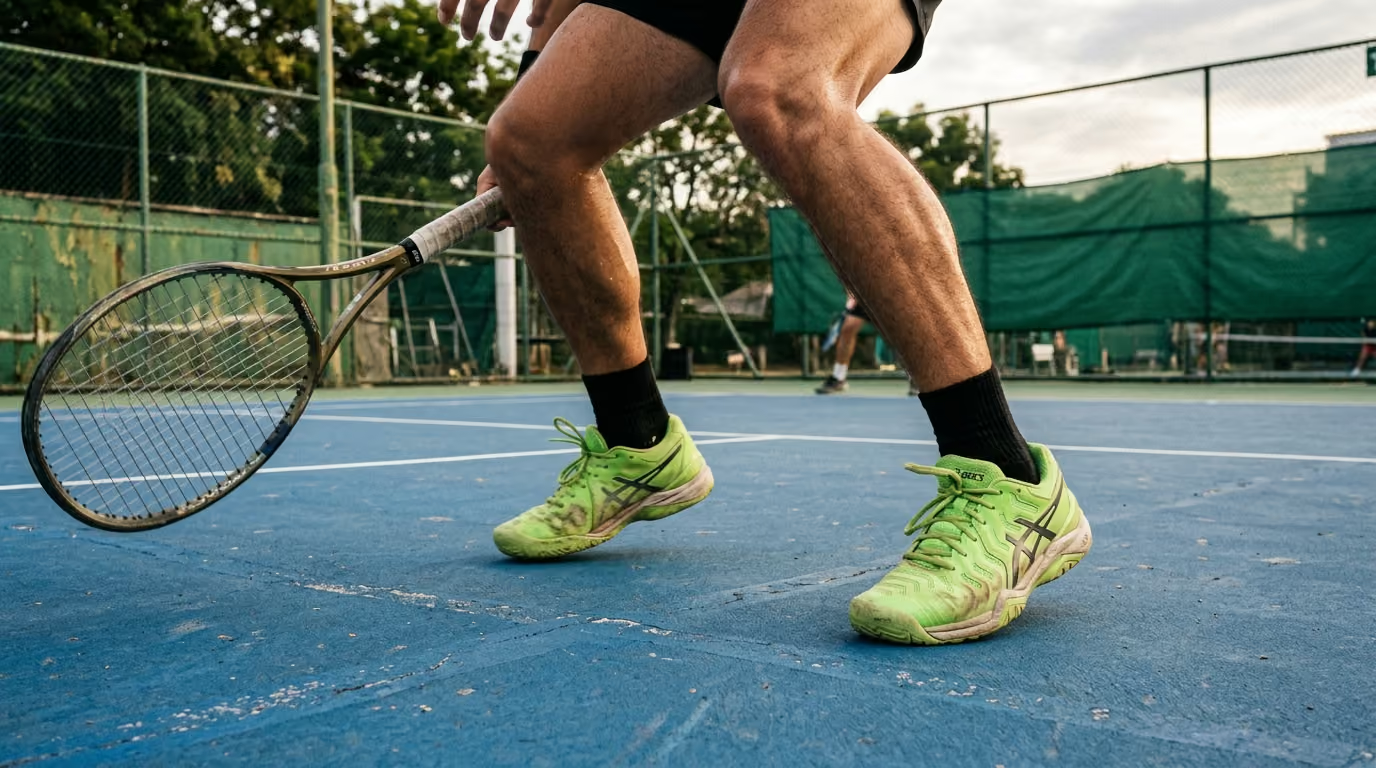
Mental skills in racquet sports are essential for managing focus and emotions under pressure, allowing players to perform at their true technical level.




You are serving for the set at five games to four. Your first serve clips the tape and lands wide. A sudden wave of heat rushes to your neck, and your grip tightens on the handle. Before you even toss the second ball, your mind has already played out the disaster of a double fault.
This scenario is familiar to anyone who plays racquet sports. The difference between winning and losing rarely comes down to a lack of technical skill in these high-pressure moments. Instead, it is a matter of how you manage your focus when the pressure rises.
Mental performance in racquet sports is not about forced positive thinking or trying to eliminate nerves entirely. It is the practical ability to regulate your attention and emotions so you can make high-quality, controllable decisions on the very next point. By establishing repeatable physical and mental routines between exchanges, players can consistently perform at their true technical level regardless of score pressure.
Many players assume that mental toughness is an innate trait. They believe some athletes are simply born calm, while others are destined to struggle under pressure. Modern sports psychology paint a far more optimistic picture. Mental performance is a trainable skill, much like a backhand volley or a spin serve.
The International Tennis Federation defines mental toughness as a developed or natural psychological advantage. This advantage helps an athlete cope with the intense demands of competition, training, and lifestyle. It allows the player to remain determined, focused, confident, and in control under pressure.
In our experience, the most useful definition of court psychology is highly practical. Mental skill is the ability to regulate your attention, emotion, interpretation, and behavior. This regulation ensures you can execute your very next controllable decision.
The goal is not to live in a state of perfect confidence. It is to respond effectively when confidence wavers. The objective is to build a reliable toolkit of behaviors that keep your focus anchored to the present moment.
To build an effective mental strategy, we must look at what current research reveals about the brain and body under competitive stress. A systematic review of forty-seven empirical studies on choking interventions published in Frontiers in Psychology examined how athletes protect their performance. The researchers found that several specific interventions consistently protect athletes from performance drops under pressure.
Among the most effective methods identified were pre-performance routines, quiet-eye training, and pressure acclimatization. Interestingly, the review also showed that dual-task interventions, which involve training with a secondary focus, can help performance under pressure. However, these dual-task methods were harmful when used during the initial stages of learning a skill. This supports a clear division between training your attention flexibly and adding too much mental workload while trying to acquire a technique.
Physical responses to competitive stress are both real and measurable. A study of youth tennis players published in the Journal of Sports Science and Medicine showed that somatic and state anxiety were significantly higher before competition than before normal practice sessions. Another tournament study involving both male and female players documented clear anticipatory cortisol responses before matches began. Interestingly, female players displayed higher somatic anxiety, while male players reported higher self-confidence.
These findings do not mean we should make rigid assumptions based on gender. Rather, they confirm that competition is a distinct physiological environment. Athletes must rehearse their coping skills in conditions that look and feel like actual tournament play.
Momentum is another area where research provides useful clarity. An analysis of over sixty-seven thousand professional tennis matches published in the Journal of Quantitative Analysis in Sports examined the impact of momentum. The researchers found evidence of both strategic and psychological momentum in best-of-three matches.
However, a separate study published in the journal PLOS ONE suggested that psychological momentum effects are highly conditional. These effects tend to be stronger later in matches and among players with lower relative ability. Crucially, the researchers noted that regular rest periods, such as changeovers, often terminate the observed momentum effect. This means momentum is not an unstoppable mystical force. It is simply a temporary pattern of play that can be interrupted and reset.
To manage pressure during a match, we must first understand how it operates on our system. Pressure does not strike all at once. It follows a predictable four-part sequence that begins with an external event and ends with your physical action.
The first stage is the Trigger. This can be a double fault, a poor line call, an opponent's lucky net cord, or serving at match point. The trigger itself is often completely out of your control. It is simply an event that occurs on the court.
The second stage is Interpretation. This is how your brain processes the trigger. For instance, if you are serving at 5 to 4 and 30 to 30, you might interpret the situation as a dangerous threat. You might think that missing the next shot will ruin the entire set. Alternatively, you can interpret the situation as a challenge. You can view it as an opportunity to test your patterns under pressure.
The third stage is the physical and emotional Response. When you interpret a situation as a threat, your nervous system responds. Your heart rate rises, your muscles tighten, your breathing becomes shallow, and your focus narrows. These somatic sensations are your body's natural way of preparing for action.
The fourth stage is Behavior. This is where the physical performance drops. Tight muscles lead to a rushed ball toss, a shortened racket swing, or a passive shot selection. The primary target of mental training is to interrupt this sequence before it dictates your behavior.
Attentional control is the ability to deliberately choose what to notice and what to ignore. In racquet sports, attention must move fluidly between different types of information. You must read external cues like ball trajectory, and you must also monitor your internal state.
High anxiety can make your attention sticky. This means your focus gets trapped on negative thoughts or past errors. Research involving adolescent tennis players published in the journal of psychology examined this visual bias. The researchers found that highly anxious athletes had great difficulty disengaging their gaze from negative visual cues. Conversely, low-anxiety players showed a natural bias toward positive or neutral cues.
To counter this sticky attention, players must practice disengagement. You need a reliable method to pull your focus away from a missed shot and return it to the court. An attention-reset drill is a highly effective tool for this transition.
Between points, use a simple three-step visual cue. First, look at your racket strings to anchor your eyes on a neutral object. Second, take one slow, deep exhalation. Third, direct your gaze to a specific target on the court, such as the service box or the opponent's backhand side.
A pre-performance routine is a consistent sequence of physical and mental actions. It regulates your arousal and centers your concentration before you begin a point. These routines should be short, simple, and highly repeatable.
A classic study on tennis pre-performance routines examined their impact on high-pressure serves. Over a four-week intervention period, researchers tracked players who used structured routines. The results showed that these players did not suffer the performance drops typically seen in high-pressure conditions. The routine acted as a psychological shield, keeping the players focused on preparation rather than the score.
To design a routine, you must answer three questions. First, when does the routine begin? Second, what exact physical actions does it include? Third, how does each action help your focus?
For a serve routine, you might start by turning your back to the net to physically separate yourself from the last point. Then, turn around, bounce the ball exactly three times, and choose a specific target. Take a deep breath, say a simple cue word like "target," and begin your motion.
For a return routine, start by finding a stable, balanced stance. Bounce lightly on your toes to prepare your feet for movement. Take one deep breath to release upper-body tension. Finally, focus your eyes on the ball in the opponent's hand and say a cue word like "react."
Self-talk is the internal language you use to direct your mind and body. A major meta-analysis published in the journal of sport psychology evaluated the performance-enhancing effects of self-talk across thirty-two studies. The researchers reported a moderate positive effect, confirming that the words you use shape how you play.
The most effective self-talk is short, instructional, and focused on immediate actions. Judgmental self-talk, such as "do not miss this," keeps your focus on the potential negative outcome. Instructional self-talk, such as "smooth swing," gives your brain a clear movement plan.
To build a self-talk vocabulary, create cues for different match situations. If you feel rushed, use a regulation cue like "breathe and balance." If you are struggling with court positioning, use a movement cue like "active feet."
Ensure your cues are believable. If you are trailing 0 to 5, telling yourself "I am easily winning this" creates mental conflict. Instead, use a realistic, process-focused phrase like "play this single point."
Competitive matches are filled with mental obstacles that can quickly derail your performance. To maintain your focus, you must learn to recognize these hazards early.
Pre-match nerves can manifest in several distinct ways. Understanding your personal early-warning signs allows you to intervene before your play suffers.
Your thoughts may drift toward avoidant patterns, such as "I hope I do not embarrass myself." This perspective often leads to tentative, defensive play. To counter this, replace outcome thoughts with a specific target cue, such as "aim deep."
Your physical body may experience a tight forearm, shallow breathing, or a racing heart. These sensations lead to a shortened swing and poor timing. The best response is to exhale slowly, making the breath out longer than the breath in, and gently loosen your grip on the handle.
You may find yourself rushing through your service routine or walking quickly between points. This urgency disrupts your natural physical rhythm. When you notice this, force yourself to complete your full pre-performance routine.
Your eyes may wander to the spectators, the referee, or the opponent's emotional reactions. This distraction takes your focus away from the ball. Return your attention to a physical target on the ball itself, such as the yellow felt or the spinning seams.
You may feel rapid irritation over a bad bounce, a missed line call, or a gust of wind. This frustration often triggers low-percentage, aggressive shots. Use a quick physical reset, such as adjusting your shoelaces, to clear your mind.
Impatience often arises when players want to end rallies quickly. This is especially true when they feel physically tired or anxious about losing a lead. The key to managing impatience is to separate physical speed from mental speed.
You should move your feet as quickly as possible, but you must keep your decisions calm and methodical. A useful cue is "fast feet, clear decision." When you feel the urge to end a point with a high-risk shot, force yourself to hit one high-margin ball to a deep target.
Fear of losing narrows your focus toward future consequences, such as rankings or social expectations. This mindset causes you to play against an imagined future rather than the ball in front of you. To combat this, construct a mental "Controllables Map" during changeovers.
Categorize your thoughts into three groups. First, identify what is directly controllable, such as your physical effort, your body language, and your between-point routine. Second, list what is influenceable but not guaranteed, such as the depth of your shots or your opponent's comfort level. Third, acknowledge what is completely uncontrollable, such as the weather, lucky bounces, or the final score. Force your attention back to the first category.
Momentum is a real psychological experience, but it is highly fragile. Players often make the mistake of treating negative momentum as an invisible force that cannot be stopped. If your opponent wins several points in a row, do not view it as a collapse.
Instead, look for the specific physical pattern that has changed. Is your opponent stepping closer to the baseline? Are you hitting your second serve too short? Once you identify the practical tactical change, make a simple adjustment, rebuild your physical routine, and play the next point as a completely independent event.
The mental demands of competition vary depending on the sport you play. Each court environment presents unique psychological challenges that require tailored strategies.
Tennis is characterized by vast physical space and long, structured matches. Players must maintain their focus over two or three hours, often with significant periods of downtime between games. This makes pacing and emotional endurance critical.
In tennis, the long changeovers offer a perfect opportunity to step away from the emotional intensity of the match. You can use these breaks to read through your tactical notes, drink water, and reset your heart rate. For in-depth guidance on handling tennis matches, you can read our specialized tennis articles to refine your preparation.
The physical distance between players in tennis also means you have more time to process information. However, this extra time can lead to overthinking. Tennis players must be highly disciplined with their between-point routines to prevent their minds from replaying past mistakes. Utilizing competition and court lifestyle resources can help you design a routine that keeps your mind quiet during these long matches.
Pickleball is a game of rapid-fire exchanges, played on a compact court with very high reaction speed demands. The game is often played to eleven points, meaning there is very little room for extended mental lapses. A single bad game can cost you the match.
At the non-volley zone line, known as the kitchen, players must manage extreme visual and physical speed. Under pressure, the temptation is to speed up the ball unnecessarily. This impatience often leads to unforced errors.
Pickleball players must develop a high level of patience during soft dink rallies. The mental skill here is to wait calmly for the right ball to attack rather than trying to force a winner from a defensive position. To learn more about managing these fast-paced dynamics, check out our pickleball articles for specific tactical advice.
Padel is played within an enclosed glass court, which alters how players perceive space and time. Because the ball can bounce off the walls, rallies are generally much longer than in other racquet sports. Players must accept that a well-struck shot may not win the point immediately.
This "second-chance" dynamic requires a high degree of defensive patience. If you get frustrated when an opponent retrieves your smash off the glass, you will struggle to maintain tactical discipline. Padel players must learn to stay calm during long, defensive exchanges, waiting for a genuine opening.
The physical closeness of the walls and the constant communication with your partner also create a unique social dynamic. Padel is strictly a doubles sport, meaning your mental state directly influences another person. For strategies on managing this specific environment, browse our padel articles to build a stronger court partnership.
Doubles play introduces a variety of social demands that do not exist in singles. You are no longer just managing your own emotions. You are also responsible for how your reactions impact your partner.
Under pressure, many players experience a fear of letting their partner down. This worry can make your play tentative and defensive. To combat this, establish clear communication rules before the match begins.
Never offer technical corrections during a match. If your partner misses a volley, telling them to "keep your racket up" will likely increase their self-consciousness and frustration. Instead, focus entirely on tactical choices and positive body language.
Use brief, physical contact, such as a high-five or a paddle tap, after every single point. This physical connection helps maintain a sense of unity, regardless of the score. Use simple, future-focused phrases like "we go again" or "next ball" to keep both of your minds moving forward together.
Many players make predictable mistakes when trying to improve their mental game. Recognizing these errors will save you time and prevent unnecessary frustration.
Even the most experienced professional athletes experience anxiety before a major match. The difference lies in how they interpret those feelings.
Weak mental preparation involves fighting your nerves, which only increases your physical tension. Strong mental preparation involves accepting those feelings as a sign that your body is preparing to compete.
Forced positive thinking often backfires because your brain does not truly believe the message. If you are struggling with your serve, telling yourself "I am the best server in the world" creates mental friction.
Instead, use neutral, action-oriented self-talk. Focus on concrete cues like "high toss" or "smooth follow-through" that you can actually execute.
If you wait until you feel perfectly confident before you play well, you will rarely perform at your best. Confidence is often the result of good play, not the cause of it.
You can behave confidently even when you feel uncertain. Keep your posture upright, walk with purpose, and complete your pre-performance routines before every shot.
After missing a shot, some players spend the entire next point analyzing their technique. They wonder about their wrist angle, their weight transfer, or their racket path.
This technical focus belongs in practice, not in competition. During a match, extract one simple tactical lesson, reset your focus, and move immediately to the next point.
When players feel anxious, they often try to relieve the pressure by hitting high-risk winners. They call this "playing aggressively," but it is actually a form of mental avoidance.
True aggression means moving your feet with intensity, preparing early, and targeting high-margin areas of the court to build pressure systematically.
Your mental state on the court does not just affect your decision-making. It also has a direct, physical impact on your body's tissues and overall longevity.
When you play in a state of chronic frustration or anxiety, your nervous system remains in a fight-or-flight state. This state triggers a continuous release of stress hormones, which keeps your skeletal muscles in a state of constant tension. This physical guarding pattern increases joint wear and tear, makes your movements less efficient, and accelerates physical fatigue.
Over time, this mental tension can lead to chronic musculoskeletal stiffness. I remember finishing a tough two hour padel match on a cold Tuesday night and waking up the next morning feeling like my lower back was locked in concrete. For a long time, I just accepted this as the price of playing hard in my forties. But once I started spending just ten minutes on targeted hip mobility before heading to the club, the stiffness almost completely vanished. It taught me that we do not have to accept pain as a default state of aging.
This experience highlights how closely our physical preparation, mental state, and long-term health are connected. By learning to release mental tension on the court, you reduce the physical strain on your muscles and joints.
To support this physical side of your athletic longevity, explore our recovery science resources to optimize your post-match habits. Additionally, integrating targeted exercises from our mobility and movement resources will help keep your joints healthy, fluid, and ready for your next competitive match.
To keep your attention anchored to the present moment, you need a structured routine to use between every single point. This five-phase routine takes only fifteen seconds to complete, but it will dramatically improve your focus consistency.
The moment the previous point ends, lower your racket to your non-dominant hand. Turn away from the net, take a deep breath, and let your shoulders drop. This physical release signal tells your nervous system that the struggle of the last point is over.
Take exactly three seconds to analyze what occurred. Ask yourself a simple question: what is the practical lesson?
Use neutral language to describe the play. Instead of saying "I hit a terrible volley," say "I contacted the ball late."
Choose your tactical plan for the upcoming point. If you are serving, decide on your target and the spin you will use. If you are receiving, identify your opponent's serve tendencies and choose your return target.
Select a single cue word that represents your plan. If your plan is to hit a deep return, your cue might be "depth." This word should be the last conscious thought in your head before you begin your physical motion.
Begin your pre-performance routine and play the point. Once the ball is in play, do not change your mind or analyze your execution. Accept the result of the exchange, and immediately return to Phase 1.
Building a resilient mental game requires consistent, structured practice. This six-week template will help you integrate mental skills into your weekly training schedule.
During this first week, focus entirely on gathering information about your current mental habits. Keep a simple journal in your gear bag. After every practice session or match, record your primary pressure triggers, physical sensations of stress, and common self-talk phrases. Do not try to change anything yet; simply notice your patterns.
Using the information you gathered, design your custom pre-performance routines. Write down your exact steps for serving, returning, and resetting between points. Practice these routines during your warm-ups and friendly matches. Keep them brief, simple, and repeatable.
Develop a list of specific, action-oriented cue words for different match situations. Practice using these cues during target drills on the court. Work on shifting your attention from internal worries to external targets, such as the seams of the ball or a specific area of the court.
To make your routines reliable, you must test them under stress. During practice games, introduce specific pressure rules. For example, start every game at 30 to 30, or play matches where second serves are not allowed. Use these high-stakes scenarios to practice completing your routines under pressure.
Work on coordinating your mental state with your tactical decisions. If you notice you are feeling anxious, choose simple, high-margin targets to rebuild your confidence. If you feel impatient, force yourself to hit a specific number of shots before attempting a winner. Learn to adjust your tactics based on your emotional state.
Evaluate your progress over the past five weeks. Have you consistently used your pre-performance routines? Have you noticed changes in your physical tension or your decision-making under pressure? Use this information to refine your routines and self-talk cues for future matches.
While self-guided mental training can significantly improve your performance and enjoyment on the court, there are times when professional guidance is highly beneficial. It is important to recognize the signs that indicate you should consult a qualified healthcare provider or a licensed sports psychologist.
If you experience persistent, severe anxiety that extends beyond the court and affects your daily life, seek professional support. Chronic sleep disruptions, physical panic symptoms like hyperventilation, or a complete loss of joy in activities you once loved are important signs.
A licensed professional can provide personalized support to help you manage these challenges. If you are dealing with chronic, unresolved physical pain that does not respond to rest or standard recovery strategies, consult a physician or physical therapist. To learn more about our commitment to healthy play, read our about page to understand our evidence-led approach. You can also contact us directly if you need assistance finding qualified resources in your area.
You should return to this guide whenever you notice persistent changes in your competitive performance. If you find yourself rushing your routines, feeling unusually anxious before matches, or struggling to recover after errors, take a few minutes to review these core mental skills.
Competitive racquet sports are a beautiful test of physical skill, tactical intelligence, and emotional resilience. By treating your mental game as a trainable skill, you can protect your performance and enjoy the sport for years to come.
Follow Evercourts for practical insights on tennis, pickleball and padel performance, movement, recovery and healthy ageing. Stay connected for new articles, research-led guidance and ideas to help you play well and keep playing for years.


Read practical guidance for better movement, smarter preparation and a game that keeps working for you.
explore the Blog