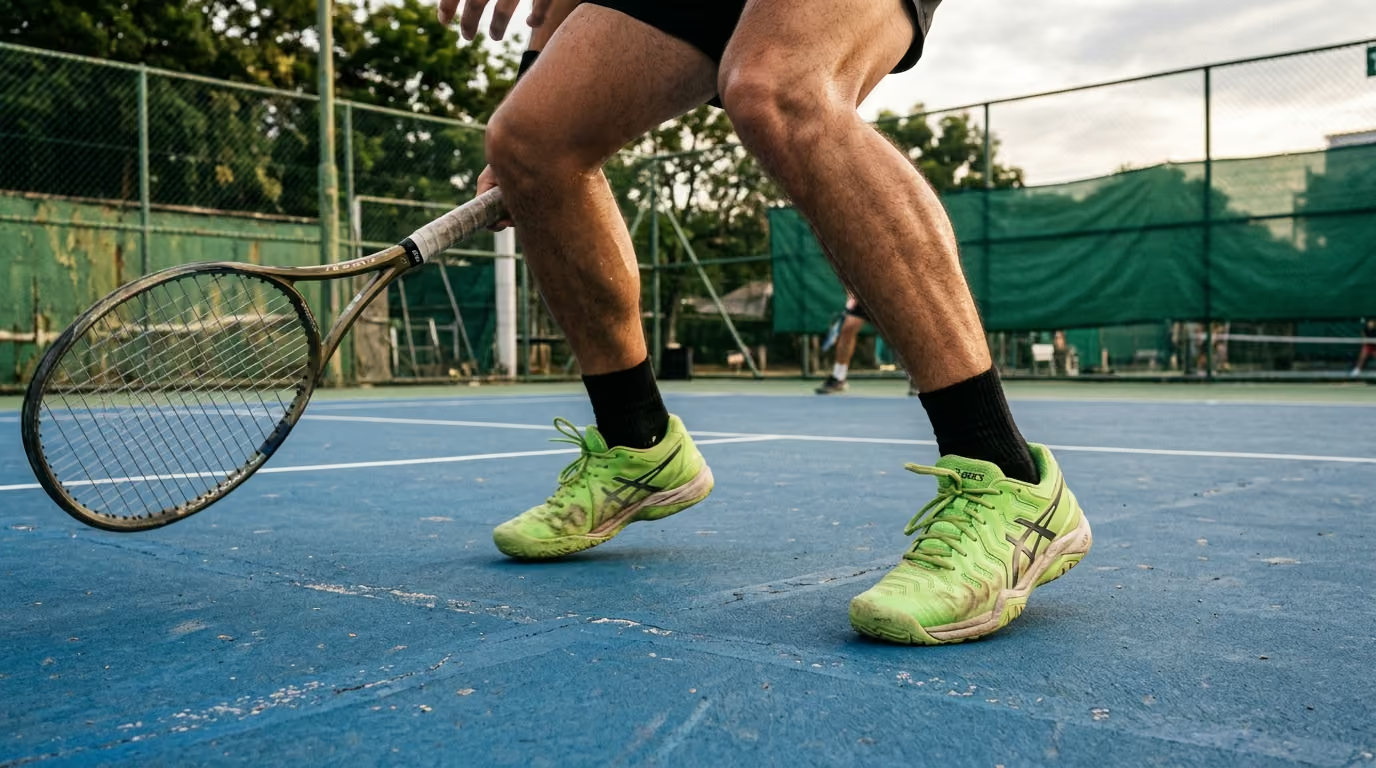
While many believe physical preparation for racquet sports involves extreme stretching, athletic longevity truly requires a different approach to movement.




Court sports demand a unique blend of speed, endurance, and precise physical coordination. To play these sports well for decades, you must maintain your physical capabilities. Many players believe that physical preparation requires bending into extreme positions or spending hours on a stretching mat.
In reality, athletic longevity requires a different approach to movement. True court mobility is not about how far you can stretch under passive conditions. It is about how well you can control your joints during dynamic, high-speed play.
Lifelong racquet sports performance relies on active mobility, which is usable and controllable range of motion. While passive flexibility allows a muscle to stretch, court performance requires the strength and coordination to control those joints under rapid load. True mobility ensures you can serve, lunge, rotate, and recover without overloading your tissues. This guide explains how to build usable range of motion that directly improves your court performance.
To build a reliable body for racquet sports, you must understand the difference between flexibility and mobility. Flexibility refers to the passive length of your muscles and tendons. It is the range of motion you can reach with external assistance, such as a partner pushing your leg or using a strap to pull your shoulder back.
Mobility is your active, task-specific, strength-supported movement capacity. It represents your ability to move a joint through a range of motion using your own muscles. On the court, passive flexibility is rarely useful on its own. If you have a large passive range of motion but cannot control it, your risk of joint irritation increases.
We can understand active movement capacity through a simple conceptual framework:
Mobility = range × control × strength × coordination × tolerance
If any single component of this formula is missing, your movement on the court will be compromised. For example, you may have the passive range to reach a low volley. However, if you lack the strength to push back up from that deep position, your brain may restrict your movement to protect the joint.
A key indicator of your movement profile is the gap between your passive and active range of motion. A large gap means you can stretch into a position but cannot actively hold or control it. When this gap is wide, you do not need more static stretching. Instead, you need targeted joint-control work and end-range strength training to make that passive space usable.
To learn more about the basic principles of moving well on the court, explore our comprehensive mobility and movement resources.
Every stroke you hit is a whole-body event that relies on a linked kinetic chain. The force of a stroke begins in the ground, travels up through your legs, rotates through your trunk, and exits through your arm. If one joint in this chain lacks adequate mobility or control, the surrounding joints must overcompensate to complete the movement.
The serve is the most complex, high-velocity movement in racquet sports. Biomechanical research shows that a high-level tennis serve involves extreme rotational speeds across multiple body segments. During a serve, the trunk tilts at approximately 280 degrees per second. The upper torso rotates at 870 degrees per second, while the pelvis rotates at 440 degrees per second.
The arm segments move even faster. The elbow extends at 1,510 degrees per second, the wrist flexes at 1,950 degrees per second, and the shoulder internally rotates at a staggering 2,420 degrees per second. In the late cocking phase of the serve, the shoulder must reach roughly 170 degrees of external rotation before rapidly accelerating forward.
If your thoracic spine cannot extend or rotate, your shoulder must work harder to position the racquet. This lack of thoracic mobility forces the shoulder joint to shoulder a disproportionate amount of the physical load. Over time, this compensation pattern can lead to tissue irritation in the rotator cuff or the labrum.
To hit a ball that is far away from you, you must lower your center of mass and extend your reach. Many players make the mistake of reaching with only their arm and shoulder. This technique places the shoulder joint at its absolute physical limit under high load.
A mobile player uses their ankles, knees, and hips to slide their entire body closer to the ball. This lateral movement allows you to strike the ball closer to your center of mass. By moving your body first, you preserve your shoulder and elbow joints from unnecessary strain.
Racquet sports are highly rotational activities. To generate power, you must rotate your upper body while keeping your lower body stable. If your thoracic spine lacks rotation, your body will seek that movement from other areas.
Typically, the lower back or the shoulder joint will twist excessively to make up for the stiff mid-back. The lower back is designed for stability rather than large amounts of rotation. Forcing the lumbar spine to rotate under load is a common cause of back stiffness among court players.
Lunging is a fundamental movement for returning low, short, or wide balls. A successful lunge requires adequate ankle dorsiflexion, which allows your shin to tilt forward over your foot. It also requires deep hip flexion and abduction to absorb the impact of your forward step.
Epidemiological data shows that lower-extremity injuries are the most common issues among tennis players. Studies indicate that lower-limb injuries account for 31% to 67% of all tennis-related injuries. The ankle and the thigh are the most frequently injured areas.
When your ankles or hips lack the mobility to absorb the force of a landing, that energy travels directly into your knees and lower back. Improving your lower-body mobility helps distribute these forces safely across your entire muscular system. To safeguard your body against these common patterns, check out our injury prevention resources.
Before starting any mobility routine, you must understand your specific movement patterns. Rather than assuming a muscle is tight, you can use a systematic, two-step process to identify your physical limitations.
Begin by identifying the specific court movements that feel restricted. Ask yourself the following questions:
Once you have identified the restricted movement, you can categorize the limitation into one of five areas.
You cannot physically access the required joint position, even when you are relaxed or assisted by someone else. Your joint capsule or the surrounding muscles are structurally restricted. This limitation requires gentle flexibility work, joint mobilization, and a slow, progressive exposure to deeper ranges of motion.
You can easily reach a deep position when you are supported by a strap or gravity, but you cannot hold that position actively. Your nervous system does not know how to stabilize the joint in that specific space. To address this issue, you should focus on end-range isometrics, slow eccentrics, and motor-control drills.
You can reach and control the joint position, but you cannot produce force or decelerate your body from that angle. For example, you can step into a deep lunge, but you cannot push yourself back up quickly. This limitation requires progressive resistance training, unilateral leg work, and targeted strength drills.
Your individual joints have adequate range and strength, but they do not work together smoothly during a stroke. Your brain is not sequencing the movement correctly. You can address this limitation by practicing slow shadow swings, split-step-to-lunge drills, and medicine-ball throws.
Your movement feels excellent during the first twenty minutes of a match, but it deteriorates as you get tired. The muscles stabilizing your joints are fatiguing too quickly, causing your body to revert to stiff compensation patterns. This issue requires better overall conditioning, sensible workload management, and proper post-match recovery.
A recent systematic review of competitive players showed that rapid increases in training volume are major risk factors for physical issues. This highlights the importance of managing how often and how hard you play. While this research focused on competitive athletes, recreational players must also manage their weekly court time carefully.
These routines are designed as practical templates to help you build active joint control. All exercises should be performed within a pain-free range of motion. If you experience sharp pain, joint instability, or radiating sensations, stop immediately and consult a healthcare provider.
Our team has experienced the consequences of ignoring these movement principles firsthand. I remember finishing a tough two hour padel match on a cold Tuesday night and waking up the next morning feeling like my lower back was locked in concrete. For a long time, I just accepted this as the price of playing hard in my forties.
But once I started spending just ten minutes on targeted hip mobility before heading to the club, the stiffness almost completely vanished. It taught me that we do not have to accept pain as a default state of aging. We can take control of our movement and maintain our athletic longevity.
The hips are the power center of your body on the court. They must flex deeply for low volleys, extend fully for running recovery, and rotate smoothly for open-stance groundstrokes.
Sit on the floor with your right leg bent at 90 degrees in front of you. Bend your left leg at 90 degrees to your side. Keep your torso upright and slowly rotate your hips to transition your legs to the opposite side. Do not force your knees to touch the floor if it feels uncomfortable. Perform 5 slow repetitions per side.
Kneel on your left knee with your right foot flat on the floor in front of you. Squeeze your left glute to tuck your pelvis under your torso. Gently shift your weight forward an inch or two until you feel a light stretch in the front of your left hip. Avoid arching your lower back as you slide forward. Hold for 30 seconds, then switch sides.
Get onto your hands and knees on the floor. Extend your right leg straight out to your side with your foot flat on the ground. Slowly rock your hips backward toward your left heel until you feel a stretch along your inner right thigh. Keep your back flat throughout the movement. Perform 8 slow rock-backs per side.
Stand with your feet twice as wide as your shoulders. Hold onto a sturdy post, fence, or door frame for balance. Keep your left leg straight and bend your right knee to sink your hips down and back to the right. Keep your right foot flat on the floor. Use your hands on the support to control your depth. Perform 6 repetitions per side.
Sit in the 90/90 position with your right leg forward. Lean your torso slightly forward over your front thigh until you feel a mild stretch in your right hip. Gently press your right ankle and knee down into the floor. Hold this downward pressure for 10 seconds, then relax. Repeat 3 times per side.
Step forward into a shallow lunge position. Pause for 2 seconds to stabilize your body, then push back forcefully to your starting position. Focus on keeping your front foot completely flat and your knee aligned over your toes. Perform 8 controlled repetitions per leg.
Stiff ankles limit your ability to bend your knees and lower your body. Restoring ankle movement improves your landing mechanics and protects your knees from impact.
Stand facing a wall with your toes about three inches away from the baseboard. Keep your heel firmly on the floor and bend your knee to touch the wall. If your heel lifts, move your foot slightly closer to the wall. If your knee easily touches the wall, slide your foot back half an inch. Perform 10 controlled touches per side.
Stand on the edge of a step with your heels hanging off the back. Hold onto a wall or handrail for balance. Lower your heels below the level of the step to find a light stretch in your calves. Press up onto your toes, pause for 1 second, and then lower down slowly over 3 seconds. Perform 12 controlled repetitions.
Stand facing a wall with your knees bent slightly. Keep this slight bend in your knees as you raise your heels off the floor. Lower your heels back down slowly without straightening your legs. This targets the deeper soleus muscle, which is crucial for absorbing court impact. Perform 12 slow repetitions.
Sit on the floor with your legs straight in front of you. Loop a light resistance band around the ball of your foot. Anchor the band to a table leg to create tension. Slowly turn your foot inward against the band, pause, and then return to the starting position. Repeat by turning your foot outward against the band. Perform 10 repetitions in each direction.
Perform a small, soft jump into a wide split step. As your feet land, immediately shift your weight to your right leg, stabilize your knee, and push back to your left. Focus on landing quietly and controlling the lateral motion. Perform 6 side-to-side repetitions.
A mobile mid-back allows you to turn your shoulders fully during a groundstroke and reach comfortably overhead for serves.
Get onto your hands and knees on the floor. Place your right hand gently behind your head. Slowly rotate your right elbow down toward your left wrist, then reverse the movement to point your elbow toward the ceiling. Keep your hips still so that the rotation occurs in your upper back. Perform 8 slow repetitions per side.
Lie on your left side with your knees bent at 90 degrees and resting on a foam roller or pillow. Extend both arms straight out in front of your chest. Slowly lift your right arm up and open it to the right, tracing a wide arc in the air. Keep your knees pinned to the roller to ensure your lower back does not twist. Perform 8 smooth repetitions per side.
Kneel on the floor in front of a chair or bench. Place both elbows on the edge of the bench and bring your hands together behind your head. Gently sink your chest toward the floor while keeping your belly button pulled in to prevent your lower back from arching. Hold the stretch for 3 deep breaths, then release. Perform 5 repetitions.
Attach a light resistance band to a wall anchor at chest height. Kneel on your right knee with your left side facing the anchor point. Hold the band with both hands in front of your chest. Keep your pelvis pointing straight ahead as you rotate your chest away from the wall against the resistance. Perform 8 controlled repetitions per side.
Hold your racquet with a relaxed grip. Perform 10 slow, exaggerated forehand and backhand swings. Focus on rotating your shoulders fully while keeping your feet grounded and your lower body stable. This connects your thoracic rotation directly to your racquet mechanics.
Rather than stretching your shoulder joint aggressively, you should focus on stabilizing your shoulder blades and building strength at the end of your reach. To build a robust upper body, integrate these drills with our strength and conditioning resources.
Stand with your back, hips, and head resting flat against a wall. Place your elbows and the back of your hands against the wall at shoulder height. Slowly slide your arms upward into a "Y" position without arching your lower back. Reach up at the top, then slide your elbows back down to your sides. Perform 8 controlled repetitions.
Get into a push-up position on your hands and toes, or on your knees. Keep your elbows completely straight. Let your chest sink down toward the floor by sliding your shoulder blades together. Push through your hands to round your upper back toward the ceiling, spreading your shoulder blades apart. Perform 10 slow repetitions.
Stand with your elbows tucked against your ribs, bent at 90 degrees. Hold a light resistance band between both hands with your palms facing up. Keep your elbows pinned to your sides as you slowly pull your hands apart, rotating your forearms outward. Return to the starting position under control. Perform 12 repetitions.
Lie on your side with a small rolled towel tucked under your upper arm. Bend your elbow to 90 degrees and hold a light dumbbell or water bottle. Keep your elbow resting on the towel as you slowly rotate your forearm up toward the ceiling. Lower the weight back down over 3 seconds. Perform 10 repetitions per side.
Hold a light kettlebell upside down by the handle, so the heavy bell points toward the ceiling. Bend your elbow to 90 degrees and hold the weight at shoulder height. Walk forward slowly for 20 paces while keeping your wrist straight and your shoulder blade stable. Switch sides and repeat twice.
Stand with your dominant arm raised in the trophy position of a serve. Hold a light resistance band anchored in front of you to pull your hand forward slightly. Resist this pull by holding your hand and shoulder blade steady in the cocked position. Hold for 15 seconds, then relax. Repeat 3 times.
Your wrists and forearms must absorb high-velocity impacts while controlling the angle of your racquet face. Building strength in these areas is a powerful way to manage overuse stress in your elbow joints.
Extend your arms in front of you with your hands open. Slowly rotate your wrists in a large circle, moving through their full available range of motion. Spend 30 seconds rotating clockwise, then switch to counterclockwise. Keep your forearms still during the circles.
Sit in a chair with your forearm resting flat along your thigh. Hold the handle of a light hammer, tool, or racquet with your hand hanging off the edge of your knee. Slowly rotate your forearm to turn your palm down, then turn your palm up under control. Perform 10 slow rotations in each direction.
Place your forearm flat on a table with your palm facing down and your wrist hanging over the edge. Use your opposite hand to press down on your knuckles. Resist this downward pressure by keeping your wrist completely still. Hold this active contraction for 10 seconds, then relax. Perform 5 repetitions.
Hold a light dumbbell in your hand with your forearm resting on a table, palm facing down. Use your opposite hand to help lift the dumbbell up into full extension. Remove the supporting hand and lower the weight back down slowly over 4 seconds. Perform 10 controlled repetitions.
Hold a tennis ball, squeeze-ball, or soft trainer in your hand. Squeeze the ball with moderate effort for 5 seconds, then release completely for 5 seconds. Repeat this on-and-off pattern for 1 minute per hand. Avoid squeezing as hard as possible; aim for a steady, controlled contraction.
Hold your racquet and practice slow, easy groundstroke swings. Focus on keeping your hand and forearm relaxed during the swing, only tightening your grip slightly at the imaginary point of contact. This teaches you to avoid holding excessive tension in your hand during play.
While all racquet sports require dynamic movement, each sport places different physical demands on your body. Understanding these differences allows you to tailor your mobility training to your specific sport.
Tennis is characterized by large court dimensions, high ball velocities, and explosive lateral movements. Players must cover significant distances, which requires deep, wide lunges and rapid deceleration from high speeds.
Padel is played on a smaller, enclosed court and features a high volume of overhead strokes, such as the bandeja and víbora. The presence of glass walls requires constant turning, pivoting, and reacting to unpredictable rebounds.
Pickleball is played on a compact court with a lightweight paddle and plastic ball. The game features fast, short-distance reactions, particularly during quick volleys at the kitchen line.
Many players spend significant time on physical preparation but fail to see improvements on the court. This is usually due to a few common movement misconceptions.
Many players believe that the ultimate goal of mobility training is to become as flexible as possible. However, passive flexibility without matching strength is a major risk factor for joint instability.
If you stretch your joints into positions you cannot actively control, your nervous system will feel threatened. It will often respond by tightening your muscles even more to protect the joint. Your goal should be to build strength and control within the specific ranges of motion you actually use on the court.
Sitting on the court and holding deep, static stretches immediately before a match is a common routine. However, sports medicine research indicates that long, intense static stretching right before explosive play can temporarily reduce your muscle power and speed.
Your pre-match routine should focus on dynamic mobility, which uses active movement to raise your body temperature and prepare your nervous system. Save your static stretching for separate mobility sessions or as part of your post-match recovery.
When a movement feels restricted, most players immediately assume they need to stretch the area. However, a restriction can be caused by joint capsule stiffness, structural bone shapes, or protective muscle guarding due to underlying weakness.
Stretching a joint that is already unstable or irritated will often make the problem worse. If a muscle feels chronically tight despite daily stretching, it is highly likely that the muscle is actually weak and needs to be strengthened.
Racquet sports are inherently asymmetrical. You swing with one arm, step forward with one leg, and rotate your body in a preferred direction thousands of times a week.
Your body will naturally adapt to these specific demands by structural changes in your joints and muscles. Trying to force your dominant shoulder or hip to match your non-dominant side perfectly is unnecessary and can sometimes disrupt your natural movement mechanics. Focus on maintaining functional, pain-free movement rather than perfect symmetry.
Understanding how mobility work fits into your overall recovery strategy is essential for athletic longevity. Many players use post-match stretching to prevent muscle soreness, but the relationship between stretching and recovery is often misunderstood.
Holding gentle stretches after a hard match can feel highly therapeutic. This practice helps lower your heart rate, shifts your nervous system into a relaxed parasympathetic state, and reduces general muscle tension.
However, systematic research reviews show that stretching does not significantly reduce post-exercise muscle soreness or accelerate structural tissue repair. It is a fantastic tool for mental relaxation and maintaining joint range, but it cannot replace the recovery benefits of proper hydration, nutrition, and quality sleep.
To keep your joints and muscles healthy between playing sessions, prioritize active recovery over passive resting. Light movement, such as a casual walk, easy cycling, or gentle mobility drills, promotes blood flow to your working muscles.
This circulation delivers essential nutrients to your tissues and helps clear metabolic waste products from your muscles. To build a comprehensive recovery plan that supports your playing schedule, read through our recovery science resources.
While general stiffness and fatigue are normal parts of playing racquet sports, certain symptoms require professional evaluation. Knowing when to see a physical therapist or sports medicine physician is crucial for protecting your health.
Consult a qualified healthcare provider if you experience any of the following symptoms:
Many players make the mistake of trying to "stretch out" a painful joint or muscle. If an area is inflamed or injured, aggressive stretching can aggravate the tissue and delay your recovery. A physical therapist can provide an accurate diagnosis, identify the root cause of your movement limitation, and design a safe, personalized rehabilitation plan.
To build lasting movement capacity without overloading your body, you need a structured weekly routine. This template balances active play, strength training, and dedicated mobility work.
Do not step onto the court and start hitting immediately. Begin with 3 minutes of light jogging or sidestepping to raise your body temperature. Follow this with 5 minutes of dynamic mobility:
Finish with 2 minutes of shadow swings and short, progressive accelerations to prepare your nervous system for the speed of the game.
Perform these sessions on your non-playing days or in the evening. Focus on slow, controlled movements and breathing:
Building active mobility requires strengthening your muscles through their full range of motion. Include unilateral exercises, such as lunges and step-ups, along with targeted core, rotator cuff, and calf strengthening. For older players, the World Health Organization recommends including balance-focused activities on at least three days per week to support joint stability and fall prevention.
When improving your physical capacity, only adjust one variable at a time. If you decide to increase your playing time, keep your training intensity and volume the same. This gradual approach allows your tendons and joints to adapt safely to the physical work, ensuring you can stay active on the court for years to come.
To see how these mobility concepts apply in real life, let us examine four common player profiles and how to improve their movement.
Tennis elbow is typically an overuse injury of the forearm tendons, often caused by poor stroke mechanics, an incorrect grip size, or sudden increases in playing volume. Static stretching of the wrist extensors can provide temporary pain relief, but it does not address the root cause.
To manage tennis elbow, focus on progressive eccentric wrist extension exercises, find the right racquet grip size, and ensure you are using your hips and torso to generate power rather than relying solely on your arm.
Yes, you can absolutely improve your functional movement with arthritis. Joint cartilage relies on movement to stay lubricated and healthy.
Focus on gentle, active joint movements within a completely pain-free range of motion. Avoid aggressive stretching or forcing a joint through sharp pain. Strengthening the muscles around the arthritic joint is one of the most effective ways to reduce stress on the joint capsule.
Use dynamic mobility drills before your match to raise your heart rate and prepare your nervous system for explosive play. Save your static stretching for after the match or during a dedicated evening session, when your muscles are warm and your body is ready to transition into a relaxed recovery state.
You will often feel an immediate, temporary increase in your range of motion after a single mobility session due to your nervous system relaxing.
To create lasting structural changes in your muscles, tendons, and joint capsules, you need consistent, long-term training. Dedicate 10 to 15 minutes to active mobility work three times a week, and you will begin to see sustainable improvements in your court movement within four to six weeks.
Follow Evercourts for practical insights on tennis, pickleball and padel performance, movement, recovery and healthy ageing. Stay connected for new articles, research-led guidance and ideas to help you play well and keep playing for years.


Read practical guidance for better movement, smarter preparation and a game that keeps working for you.
explore the Blog