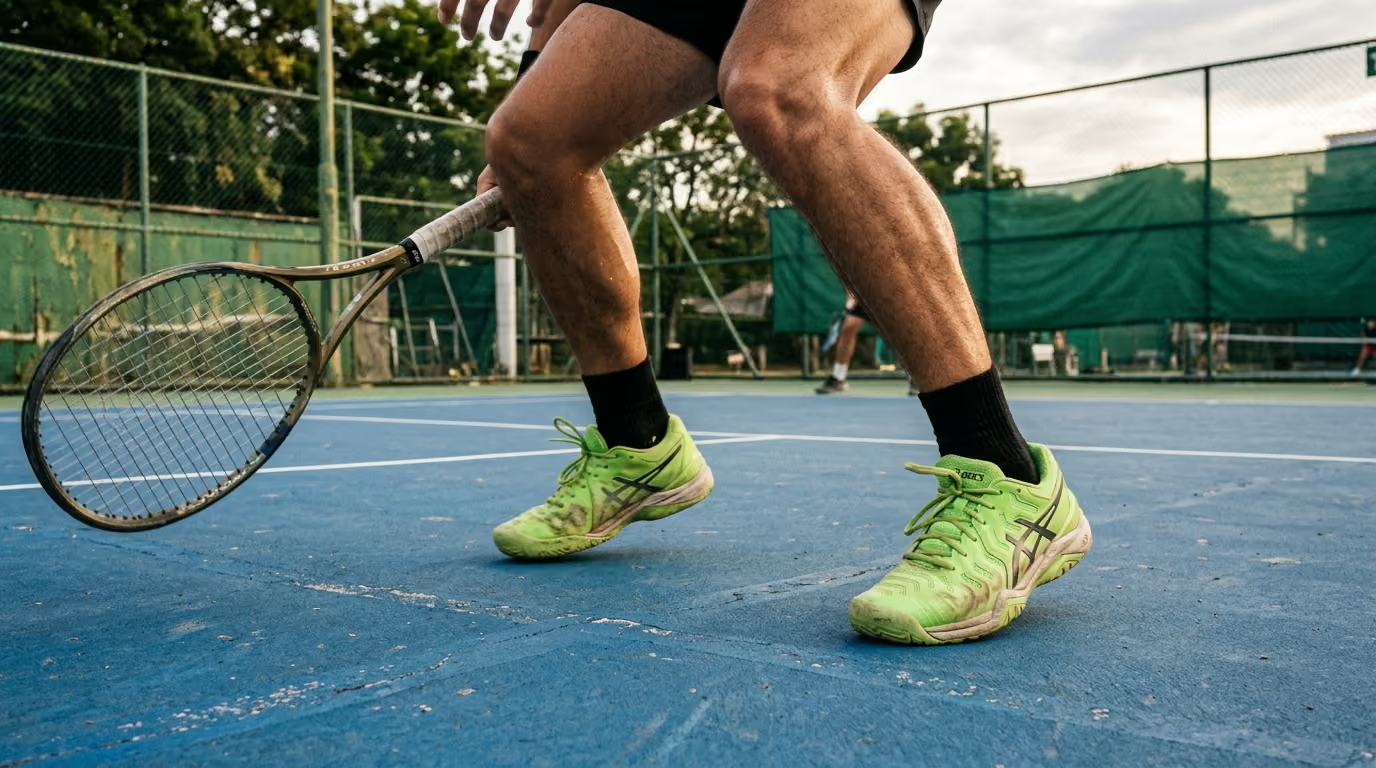
While many players focus only on match dates, a successful racquet sports competition calendar actually balances physical demand with planned recovery to protect health.




How do you organize league matches, weekend tournaments, practices, and strength workouts without wearing your body down? To coordinate a successful schedule, you must treat your playing calendar as a comprehensive system that balances physical demand with planned recovery. By organizing your events into clear priority levels and scheduling rest days based on your actual capacity, you can protect your physical health and play at your best. This structured approach allows you to enjoy competing for years to come while supporting your long term athletic goals.
To build a sustainable court schedule, you must first understand the difference between a competition calendar and a capacity calendar. A competition calendar simply records the dates and times of your scheduled matches. A capacity calendar, however, assesses whether you have the physical recovery, preparation time, and mental energy required to perform well.
In our experience, looking only at event dates is the most common reason players experience sudden performance drops. We must look at the complete picture of physical and mental stress to understand how our bodies respond. This complete picture is known as total load. The International Olympic Committee recommends monitoring total load to help athletic populations balance performance and health.
According to sports science consensus, total load is divided into five distinct categories. Each category places a specific demand on your physiological and mental systems.
External load refers to the objective physical work you perform on and off the court. This includes the number of matches you play, your total hours of court time, and your sprint repetitions. It also tracks the volume of your strength training sessions and the total distance you travel.
Measuring external load helps you identify when your weekly physical volume has increased too quickly.
Internal load describes how your unique body perceives and responds to physical work. The same two hour practice can feel entirely different depending on your current fatigue, sleep quality, and stress levels.
To measure internal load, researchers often use subjective tools like the session rating of perceived exertion. By tracking how hard a session felt, you can make smarter decisions about your recovery.
Competition load is distinct from regular practice load because of the emotional and tactical demands involved. Matches require maximal physical efforts, rapid changes of direction, and sustained mental focus.
The psychological pressure of a close match increases your heart rate and muscle tension. For this reason, one hour of match play is often much more demanding than one hour of drilling.
Travel places a hidden physical demand on court athletes. Sitting in a car or airplane for long periods can cause joint stiffness and muscle tightness.
Travel also disrupts your normal sleep patterns, meal times, and hydration habits. These disruptions reduce your body's ability to recover from previous matches or prepare for upcoming play.
Life load includes your professional work, family obligations, and personal stress. Your body does not separate the physical stress of playing from the mental stress of a difficult work week.
High mental stress reduces your physical recovery rate and increases your susceptibility to fatigue. A complete calendar must account for these personal demands to remain realistic.
I remember finishing a tough two hour padel match on a cold Tuesday night and waking up the next morning feeling like my lower back was locked in concrete. For a long time, I just accepted this as the price of playing hard in my forties. But once I started spending just ten minutes on targeted hip mobility before heading to the club, the stiffness almost completely vanished. It taught me that we do not have to accept pain as a default state of aging. We can make small, intentional adjustments to support our long term physical health.
A successful playing schedule is built from the top down. You should start with your major annual commitments and work down to your daily training details. This planning hierarchy prevents you from overcommitting and helps you balance your athletic goals.
Begin by entering the dates that cannot be altered. These include regional championships, league playoff dates, and major work deadlines.
You should also block out family holidays, pre booked travel, and scheduled medical appointments. These dates form the rigid boundaries of your playing year.
Once your fixed dates are set, categorize your potential events using a three tier priority system. This ranking helps you decide where to direct your energy and when to rest.
Once your events are prioritized, you can structure your training into organized blocks. Do not add practices indiscriminately throughout the year.
Instead, alternate between periods of high physical development and periods of reduced training volume. This systematic approach allows your tissues to adapt to physical stress before you enter high stakes matches.
The final layer is your weekly schedule. This plan should organize your high intensity court sessions, strength workouts, and active rest days.
The primary goal of weekly design is to avoid placing high demand days back to back. You must ensure that every heavy playing day is followed by a lower demand period.
For comprehensive resources on structuring your playing schedule, view our Competition & Court Lifestyle Resources.
You do not need an expensive sports science laboratory to monitor your training demand. You can track your court stress using a simple mathematical formula.
To calculate your daily load score, multiply the duration of your session by your perceived physical effort. Rate your effort on a simple scale from 1 to 10, where 1 is extremely light and 10 is maximal exertion.
> Session Load = Session Duration (in minutes) × Perceived Exertion Score
For example, a demanding 90 minute singles match that you rate as an 8 produces a load score of 720 units. A light 60 minute technical practice rated as a 3 produces a score of 180 units.
By tracking these daily numbers, you can easily identify unusually heavy weeks and catch sudden spikes in volume.
Sports medicine research shows that rapid increases in your physical volume are closely linked to joint and muscle issues. Specifically, researchers look at the relationship between your short term load and your long term capacity.
A 2025 systematic review published in tennis performance literature highlighted this relationship. The review reported that sudden increases in the acute-to-chronic workload ratio were strong predictors of physical issues.
For young players, a ratio above 1.3 was linked to higher risk, while adult players saw increased risk when the ratio exceeded 1.5. Because this evidence comes from competitive research groups, recreational players should use these numbers as general helpful guardrails rather than strict mathematical laws.
To maintain a safe progression, aim to keep your week-to-week volume increases below 10 percent. This gradual escalation allows your tendons, muscles, and joints to adapt safely to the physical demands of play.
When planning your monthly schedule, do not simply write down the tournament dates. You must prepare for a range of physical demands based on how far you progress in the draw.
Recovery is not simply the absence of playing. It is an active, scheduled component of your weekly routine that protects your tissues and supports your athletic longevity.
You should write recovery sessions into your calendar with the same commitment as your matches. These sessions can include deliberate mobility work, gentle walking, and targeted physical therapy.
Scheduling these blocks ensures that you do not fill your open afternoon hours with stressful errands or extra chores. To learn more about the biology of tissue repair, read through our recovery science resources.
Quality sleep is the most powerful physical recovery tool available to court athletes. It supports tissue healing, mental focus, and immune system function.
A systematic review of athletic sleep recommendations suggest a general target of 7 to 9 hours of sleep per night. During periods of intense competition or two-a-day workouts, this requirement can increase to 8 to 10 hours.
Your playing calendar should flag schedule items that threaten your sleep windows. Late night league matches, early morning travel, and consecutive hotel stays are major risk factors for sleep loss.
After a demanding competition, use a simple checklist to determine your physical needs for the following day.
To support your physical durability on the court, you must integrate strength work into your calendar. Research shows that structured resistance training is highly effective for reducing sports-related physical issues.
A comprehensive systematic review and meta-analysis demonstrated that strength training programs reduced sports injury rates significantly, showing a relative risk of 0.338. To organize your strength sessions effectively, you must understand the different types of physical preparation.
To avoid physical fatigue before important matches, divide your strength work into four distinct categories.
For detailed guidelines on physical conditioning, check out our strength and conditioning advice.
Tapering is the practice of reducing your physical training volume before a major competition. This reduction allows your body to recover from accumulated fatigue so you can perform at your best.
A comprehensive meta-analysis of 27 athletic studies evaluated different tapering methods. The analysis found that a two week taper period was associated with improved physical performance.
The most effective approach reduced total training volume by 41 to 60 percent. Crucially, athletes maintained their normal training intensity and session frequency during this time.
A tennis-specific monitoring study described a simpler, stepwise taper. In this model, players reduced their weekly on-court volume and training frequency by approximately 50 percent during the single week before a major event.
When designing your personal taper before an A-priority tournament, follow these practical rules.
Official sports rules are designed to protect player safety and ensure fair play. You can use these rules to help forecast the physical demands of your upcoming tournaments.
The 2026 Grand Slam Rulebook states that players should normally receive at least 12 hours of rest between the completion of one match and the start of the next. It also limits players to one singles and one doubles match per day under normal conditions.
The 2026 International Table Tennis Federation regulations require a similar 12 hour gap between qualifying matches and main draw play. They also state that players should receive one full rest day when traveling between sequential tournaments.
However, these official minimums do not guarantee that your body will recover fully. A 12 hour rest window can be easily consumed by court travel, late night dining, physical therapy, and delayed sleep. You must distinguish between official rules and your actual recovery needs.
To manage the physical strain of playing away from home, structure your travel into three distinct phases.
Treating your arrival day as a dedicated readiness assessment day helps prevent physical strain on unfamiliar courts.
While all racquet sports require agility and hand-eye coordination, each discipline places a unique physical demand on your body. Your calendar must reflect these specific demands.
Tennis matches are characterized by long, unpredictable durations and explosive lateral movements. The heavy rotational torque required for groundstrokes places high demands on the shoulder, core, and hips.
Because tennis is often played on hard concrete courts, it subjects your joints to high impact forces. Your tennis calendar must include sufficient recovery buffers to protect your lower back and lower extremities.
To learn more about preserving your body during a long tennis season, read our Tennis Articles.
Pickleball requires rapid lateral steps, deep knee flexion, and explosive lunges near the kitchen line. Because pickleball tournaments often feature multi-match schedules in a single day, players are exposed to a high density of physical work.
The frequent starting and stopping places exceptional stress on the Achilles tendon and the knees. Your pickleball schedule must track the total number of games played per day rather than just the number of tournament entries.
For practical advice on managing your tournament load, see our Pickleball Articles.
Padel is played on a synthetic turf court enclosed by glass walls, which requires constant physical adjustments. The game features a high volume of overhead smashes, quick change-of-direction movements, and short acceleration phases.
The repetitive overhead swinging places high physical demands on the shoulder girdle and thoracic spine. Your padel calendar should prioritize rotator cuff strength and thoracic mobility to prevent shoulder irritation.
For specialized padel physical preparation guides, read our Padel Articles.
Even the best planned calendar will face unexpected changes during the season. You must build flexible contingency plans to handle these common challenges.
Rain or extreme heat can quickly disrupt a tournament schedule. These disruptions can force you to play multiple matches in a single afternoon or wait at the venue for hours.
To manage weather delays, carry extra dry clothing, packed snacks, and mobility bands in your court bag. Be prepared to adjust your post-tournament training volume to account for these compressed playing schedules.
If you must play qualifying matches to enter a main draw, your physical load will rise quickly. You may have to play consecutive matches with very little rest before facing fresh opponents.
If you make a deep run through qualifying, proactively reduce your training volume for the following week to allow your body to recover.
Playing both singles and doubles events significantly increases your daily court time and mental fatigue.
Make sure your planning calendar records each appearance as an individual physical block. If you choose to enter both divisions, you must reduce your training volume before the tournament begins to avoid early physical fatigue.
Team events involve unique physical and psychological demands. Cheering for teammates, attending team meetings, and dealing with uncertain match times can make these events exhausting.
Because the mental strain of team play is high, you should treat team weekends as high-load blocks. Schedule a dedicated recovery day immediately following any major team competition.
Returning to play after a physical issue is not a single event. It is a gradual, multi-stage physical process.
According to a 2025 systematic review of athletic return-to-play guidelines, you should progress through three distinct physical stages.
Your calendar should track these milestones using realistic targets rather than fixed dates.
When you experience early symptoms of illness, use a conservative protocol to protect your health and your teammates.
Even experienced players make predictable mistakes when organizing their schedules. Avoiding these common blind spots will protect your physical health and support your athletic longevity.
Many players schedule two tournaments a month without considering how many matches they might actually play. A deep run in a tournament can result in three times the physical demand of an early exit.
Always estimate your potential match volume using worst case, typical, and best case scenarios. This approach ensures you are prepared for the physical demands of reaching a tournament final.
It is easy to view a weekly league match as a casual activity that does not require physical preparation or recovery. However, these recurring competitive matches accumulate physical stress over time.
Track your rolling four week match load to ensure that weekly league play is not causing chronic physical fatigue. For helpful tips on balancing league play with personal life, check out our Court Life Articles.
When players lose early in a tournament, they often feel frustrated and schedule a hard training session the following day. This response ignores the physical travel, warm-up, and mental stress they just experienced.
Instead of rushing back to hard training, use the extra time to rest and complete your scheduled recovery work.
Players often assume that doubles play is physically easy because they cover only half of the court. However, doubles requires rapid lateral movements, explosive lunges, and constant mental focus.
Your calendar must treat doubles matches as significant physical efforts that require proper recovery time.
An afternoon without scheduled matches is not automatically a recovery block. If you spend your free hours completing heavy yard work, running errands, or traveling, your body is not recovering.
You must schedule dedicated rest periods to allow your tissues to repair and rebuild.
The International Olympic Committee advises against sudden increases in physical load because they raise the risk of tissue strain. Examples of abrupt changes include playing three consecutive tournaments after a long break, or adding intense speed drills right before a championship.
Always increase your weekly playing time and physical training volume gradually.
Tournament directors often change match times, court assignments, and draw sizes at the last minute. If your calendar is too rigid, these changes can cause significant stress.
Build buffer days and alternative travel plans into your schedule to accommodate unexpected tournament changes.
While tracking your court schedule can help you manage normal physical tiredness, it is not a substitute for professional medical advice. You must learn to distinguish between ordinary muscle soreness and signs of physical strain.
Ordinary fatigue is typically felt as a general, dull stiffness throughout your muscles. This mild discomfort usually improves after a light warm-up, a gentle walk, or a good night of sleep.
If you experience any of the following warning signs, stop playing and consult a qualified healthcare professional.
If you notice any of these signs, visit a certified physical therapist or sports physician to receive a proper assessment and personalized recovery plan. For details on protecting your body from long-term wear, review our injury prevention guides.
Use the following structured outlines to build your personal playing calendar. You can copy these formats into a digital document, a simple spreadsheet, or a personal notebook.
For each month of the coming year, write down your goals, priorities, and physical focus.
For every tournament you consider entering, complete this simple worksheet.
Organize your weekly physical activities to ensure you alternate between high and low demand days.
Before you step onto the court each day, rate these five physical and mental measures on a scale from 1 to 5, where 5 is excellent and 1 is very poor.
If your total daily score is low, reduce the intensity of your scheduled session or dedicate the afternoon to recovery.
To help you apply these principles to your own schedule, complete these three key steps this week.
Open your calendar and highlight every competitive match, league fixture, and tournament scheduled for the next two months. Identify any weeks where you have scheduled back-to-back competitive matches or heavy travel.
Proactively create rest days around these demanding periods to protect your physical health.
Review your list of upcoming tournaments and label each one as an A, B, or C event. Ensure that you have at least three weeks of lighter play between your major A-priority targets.
If you notice too many consecutive high-priority events, choose one or two tournaments to skip or treat as casual practice matches.
Before you schedule your next practice match or lessons, block out your weekly recovery times. Write down your dedicated mobility sessions, sleep windows, and rest days in your calendar first.
By treating rest as a non-negotiable activity, you can support your athletic longevity and continue playing the sports you love for years to come.
To read more about managing your lifestyle as a dedicated court player, visit our main Evercourts Blog.
Follow Evercourts for practical insights on tennis, pickleball and padel performance, movement, recovery and healthy ageing. Stay connected for new articles, research-led guidance and ideas to help you play well and keep playing for years.


Read practical guidance for better movement, smarter preparation and a game that keeps working for you.
explore the Blog