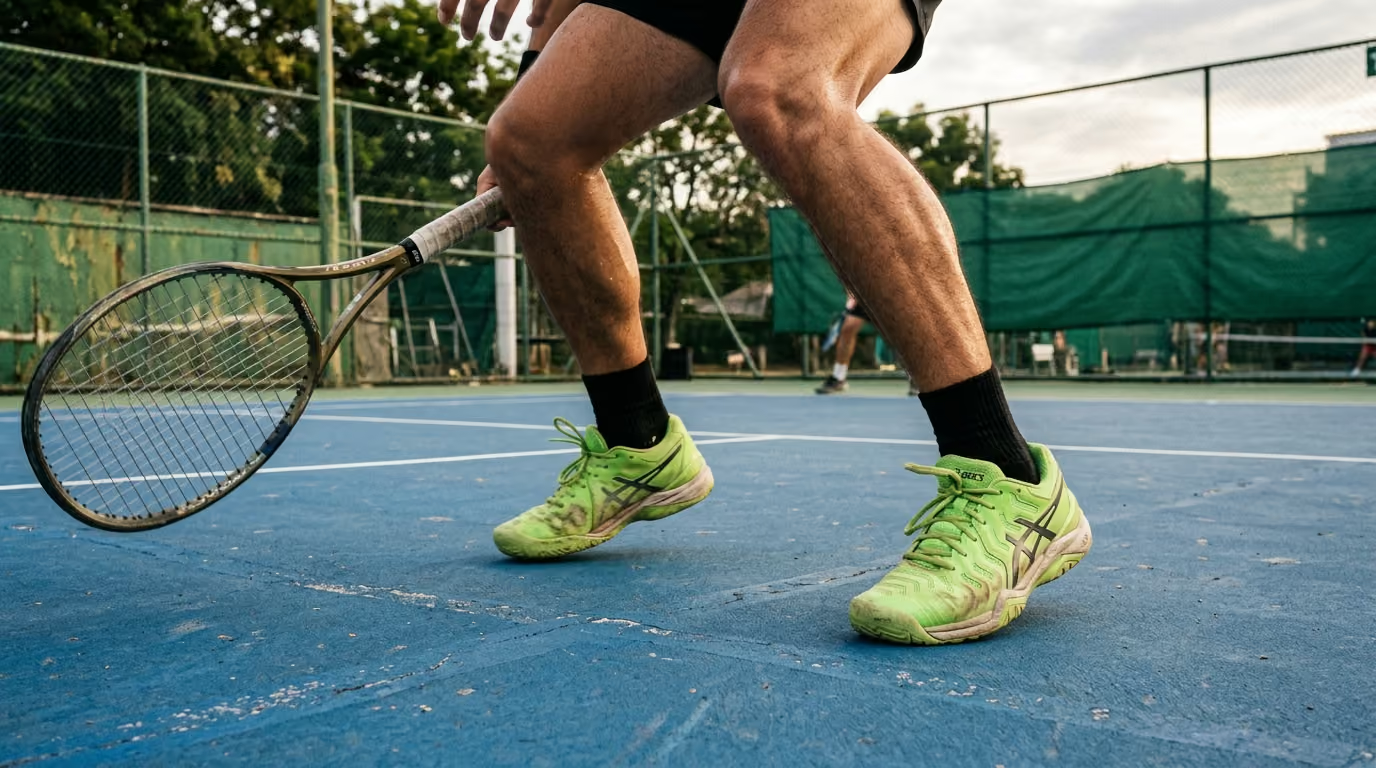
While many players attribute performance dips to bad luck, a structured racquet sports performance journal converts raw experiences into clear, actionable adjustments.




You step off the court after a grueling three set singles match. Your shoulder feels tight, your legs feel heavy, and you cannot quite explain why your backhand volley collapsed during the critical tiebreak. You might attribute the loss to bad luck, a gust of wind, or simply having an off day. Many recreational court players accept these unexplained performance dips as a natural consequence of playing hard.
In our experience, there is a better way to handle these frustrations. I remember finishing a tough two hour padel match on a cold Tuesday night and waking up the next morning feeling like my lower back was locked in concrete. For a long time, I just accepted this as the price of playing hard in my forties. But once I started spending just ten minutes on targeted hip mobility before heading to the club, the stiffness almost completely vanished. It taught me that we do not have to accept pain as a default state of aging. A structured performance journal helps you move away from guesswork by converting raw court experiences into clear, actionable adjustments.
When you track the specific variables that influence your play, you build a customized map of your athletic capabilities. This guide provides a comprehensive framework to establish, maintain, and analyze your own racquet sports performance journal.
A racquet sports performance journal is a structured personal record designed to track your preparation, physical state, tactical decisions, and post-match recovery. By separating subjective feelings from objective match facts, this system helps you identify real playing trends over time. Ultimately, it serves as a practical decision-support tool that guides your practice sessions and supports your long-term athletic longevity.
Using a journal to track performance is supported by sports science principles. Research on reflective diaries shows that they help athletes examine past experiences, increase self-awareness, and manage performance expectations. These diaries are key components of self-regulation, which involves self-monitoring and structured self-evaluation.
A controlled study involving taekwondo athletes found that feedback-enhanced reflective journaling was associated with greater improvements in self-regulation and perceived performance. While these findings should not be automatically applied to tennis, pickleball, or padel, they highlight the value of structured reflection. A performance journal should be designed as a decision-support system rather than a simple emotional diary. To keep your notes objective, you should separate your entries into direct observations, plausible interpretations, and future testing actions.
Another critical scientific aspect of journaling is distinguishing between external load and internal load. External load refers to the physical work you perform on the court, such as session duration, games played, or drills completed. Internal load is how demanding that session felt to your body, reflecting factors like fatigue, stress, and muscle soreness.
The international consensus statement on athlete load monitoring frames this practice as a vital way to understand how training affects the body. A simple way to estimate your internal load is to calculate your session load. You can do this by multiplying the total duration of your session in minutes by your rating of perceived exertion on a scale of one to ten.
For example, a ninety-minute singles match rated as a six out of ten produces a session-load estimate of 540 arbitrary units. This value is not an absolute physiological truth. Instead, it is a tool for comparing your own training demands over time to identify unusually taxing days. Monitoring these changes helps you make informed choices about rest and recovery science resources.
Finally, research in sports statistics warns against making sweeping changes based on a single match. Athlete performance naturally contains meaningful within-athlete variation. Detecting genuine trends requires analyzing repeated measures over a longer period. A small sample of matches often contains too much statistical noise to support a major change in technique or training.
To make your journal effective, you must establish a repeatable routine. The journaling process should follow a continuous cycle that turns every match into a learning opportunity. This cycle consists of seven distinct phases.
This structured flow keeps your journal focused on continuous improvement. It prevents you from getting bogged down in emotional reactions after a tough loss.
Every entry you write should separate information into three distinct layers to ensure clarity.
The first layer is context. This includes basic details such as date, time, court surface, opponent level, and weather conditions. Environmental factors like strong wind or extreme heat directly impact performance metrics. A high error count in heavy wind should not be interpreted the same way as an error count indoors.
The second layer is performance. This domain covers your technical execution, tactical choices, physical movement quality, and psychological focus. By tracking these four areas, you get a complete picture of your on-court capabilities.
The third layer is learning. This section converts your raw match observations into future on-court behavior. You must ask yourself what worked, what failed, and what factors were within your control. This step prevents you from simply accumulating data without creating real behavioral changes.
Before stepping onto the court, take two minutes to complete a quick physical readiness screen. Collecting information on sleep, energy, and muscle soreness provides a broader view of well-being than a single performance test.
You can rate the following variables on a consistent scale from one to ten:
Consistency in how you define these numbers is essential. If a seven means excellent one day and average the next, your tracking data will lose its value over time.
After completing your readiness screen, write down two or three tactical intentions. These intentions should be behavior-based rather than outcome-based. For example, instead of writing that you want to win, state that you will target your opponent's backhand on every return.
Next, record a quick pre-match prediction. Write down what patterns you expect from your opponent, your anticipated physical challenges, and your planned strategy. Comparing this prediction with reality after the match reveals if you consistently overestimate opponents or misidentify tactical issues. This habit sharpens your pre-match judgment and prepares you for real-world scenarios.
Keep your post-play review short to ensure you complete it consistently. A long, complicated review sheet will quickly become a chore that you avoid. Spend five minutes answering five core questions:
To organize this information, use a simple three-column format in your notes.
By labeling your explanation as a hypothesis, you avoid treating a guess as an absolute fact. This approach keeps your analysis objective and prevents emotional rumination.
To make your journal actionable, you must classify your errors by their root cause. Labeling every missed ball as a generic mistake does not help you improve.
Write your errors using a simple formula: shot plus situation plus decision plus execution plus consequence. For example, you might write: backhand return, second serve, neutral target available, attempted aggressive line, contacted late, missed long. This detailed description is far more valuable than simply writing "bad backhand."
The metrics you track must reflect the unique physical and tactical demands of your specific sport. While the general journaling framework remains the same, your on-court data fields will differ depending on whether you play tennis, pickleball, or padel. To learn more about matching your training to your sport, consult our court performance resources.
In tennis, performance analysis focuses heavily on service efficiency, return quality, and rally construction. Because the court is large, tracking court positioning and movement fatigue is highly valuable.
Your tennis journal should focus on:
Research in elite men's tennis shows that starting a point with a second serve reduces your chance of winning the point by up to twenty-one percent on grass and fifteen percent on clay. For recreational players, these figures should not become rigid targets. Instead, use them to evaluate if a conservative second serve is a safer option than a risky, high-speed delivery.
A pickleball journal must prioritize metrics that reflect the sport's fast exchanges and unique point construction. Because the transition to the kitchen line is so critical, your tracking should highlight this zone.
Your pickleball articles log should track:
Always separate your shot attempts from your successes in your logs. Writing down that you made three successful speed-ups out of eight attempts is far more useful than saying your speed-ups felt weak.
Padel is a highly tactical sport dominated by wall rebounds, net defense, and team positioning. Your journal needs to capture how effectively you transition between defense and attack.
Your padel journal should record:
A padel match-analysis study reported that nearly one in five serves in the analyzed matches ended in an error, with half of those occurring at the net. The study also highlighted that winning pairs committed significantly fewer serve-return errors. Track these overhead and return metrics over several matches to see if you are giving away cheap points.
One of the biggest challenges in journaling is separating actual performance trends from random match noise. To make reliable adjustments, you must analyze your data with a structured approach.
A common mistake is grouping all your matches together into a single performance average. A pattern that emerges during windy outdoor matches may not apply when playing indoors.
To find real trends, compare matches that share similar contexts:
Comparing a relaxed weekend doubles match to a high-pressure league singles match will produce misleading conclusions. Keep your comparisons tight and contextual.
Human memory is naturally biased toward dramatic moments, such as a spectacular winner or a frustrating double fault on match point. Your performance journal serves to counter this bias by recording actual frequencies.
Instead of writing that your overheads were terrible, record the exact numbers. Writing that you missed three out of nine overheads provides a clear success rate of sixty-six percent. If you note that all three misses occurred from behind the service line, you have identified a specific tactical issue rather than a general technical failure.
Raw totals are heavily influenced by the length of your matches. A long three-set match will naturally produce more errors than a quick single set.
To normalize your data, track rates rather than simple totals. Focus on metrics such as return errors per attempt, break points converted per opportunity, or successful third-shot drops per try.
However, you must be careful when your sample size is very small. A one hundred percent success rate from a single attempt is not the same as an eighty percent success rate from fifty attempts. Always record the total number of attempts alongside your percentages.
To reduce the urge to overreact after a single bad match, track a four- or five-session moving average. This technique smooths out the natural ups and downs of recreational play.
You can calculate a moving average for key indicators like your first-serve percentage or return success rate. If your moving average is steady, a single poor performance is likely just temporary noise. If the moving average shows a steady decline over several weeks, it is time to look for an underlying physical or technical cause.
Whenever you draw a conclusion from your journal, tag it with a confidence label. This habit keeps you from acting on weak assumptions.
Only make major adjustments to your technique or training when you have high confidence in the pattern. This disciplined approach protects your game from constant, unnecessary changes.
It is easy to look at a spreadsheet of court metrics and draw incorrect conclusions. To keep your journal useful, you must understand the limits of your data.
A match outcome is a complex mixture of opponent quality, weather, luck, and your own physical state. Sports performance analysis shows that athlete performance contains high levels of random variation.
A single win does not prove that your new technique is perfect. Likewise, a tough loss does not mean your entire game plan is broken. A high winner count can sometimes mask poor shot selection, while a low error count might simply reflect passive, defensive play. Look at the broader picture over several weeks before making major changes.
If you notice that poor sleep is often followed by a match loss, do not immediately assume a direct causal link. Several factors could explain this connection.
For example, high stress from a tournament might cause both poor sleep and poor focus on the court. Alternatively, you may have faced much tougher opponents on the days following poor sleep.
The correct way to record this in your journal is to state that poor sleep was associated with lower energy and worse results. Acknowledging this relationship helps you monitor the issue without jumping to unproven conclusions.
More training on the court is not always better for your performance. The International Olympic Committee guidelines emphasize that monitoring training load, well-being, and recovery is essential for athletic longevity.
Your journal should help you find the balance between hard work and adequate rest. Use your logs to see if a high-volume training week leads to better consistency or simply increases your fatigue and muscle soreness. This self-awareness is key to maintaining your physical capabilities as you age. For further advice on managing your training volume, read our healthy aging & athletic longevity resources.
Many fitness sources promote rigid rules, such as never increasing your weekly training volume by more than ten percent. While this is a helpful starting point, sports medicine research shows that individual responses to training load vary widely.
Do not treat the ten percent rule as an absolute physical law. Instead, use your journal to find your personal tolerance for workload increases. Your joints, muscles, and recovery rates are unique to you, meaning your training adjustments must be highly individualized.
Do not try to make your subjective ratings overly precise. Rating your mental focus as a 7.43 out of ten is meaningless because human feelings cannot be measured to that decimal point.
Stick to simple, repeatable whole numbers on your scales. Similarly, do not let wearable device data completely override your personal physical feelings. Combining subjective well-being scores with objective workload metrics provides the most reliable view of your readiness.
To get the most value from your journaling routine, you must avoid several common mistakes that players make. Identifying these hurdles early will save you time and prevent unnecessary frustration.
The final score is a lagging indicator that tells you who won, but it rarely explains why. You can win a match despite playing with a highly flawed tactical plan that will fail against a stronger opponent.
Conversely, you can lose a close match while executing your strategy perfectly. If you only write down the score, you miss the valuable process-level details that drive long-term improvement.
A performance journal with dozens of required entry fields will quickly become overwhelming. If your tracking routine takes thirty minutes to complete, you will likely abandon it within a few weeks.
Start small by tracking just two readiness measures, one workload estimate, and three key technical metrics. You can always add more fields later if they directly support a specific on-court decision. Consistency is far more important than exhaustive detail.
It is easy to watch professional tennis, pickleball, or padel matches and assume you should match their statistics. However, elite performance metrics are shaped by physical capabilities that recreational players rarely possess.
An elite tennis player's serve percentage or a padel pro's smash conversion rate is built on years of high-volume training. Focus on establishing your own personal baseline. Your goal is to improve relative to your past self, not to mimic the habits of professional athletes.
Recording that you hit ten winning shots sounds impressive on paper. However, this statistic is meaningless without knowing how many times you attempted those aggressive shots.
If those ten winners came from thirty high-risk attempts, you also committed twenty errors. A player who hits five winners from six attempts is playing with far better tactical discipline. Always record both the numerator and the denominator when tracking aggressive plays.
Many competitive players are highly self-critical on the court. They label almost every missed shot as an unforced error, even when defending a difficult, high-speed ball.
An unforced error occurs on a routine, highly playable ball under no physical pressure. A forced error happens when your opponent's shot put you in a defensive, unbalanced position. Classifying these errors accurately prevents you from feeling unnecessarily discouraged about your technical skills.
Your journal should never be a place to vent anger or berate yourself for a poor performance. Writing that you played terribly or choked under pressure does not offer a path forward.
Replace emotional self-criticism with objective, physical descriptions of what happened. Instead of writing that you collapsed in the second set, note that you rushed your between-point routine and stopped moving your feet. This objective approach gives you a concrete behavior to adjust in your next practice.
If you change your racquet tension, your nutritional habits, your warm-up routine, and your serve technique all in the same week, you will not know what caused your performance changes. You have introduced too many variables to draw a reliable conclusion.
Test only one primary change at a time. This controlled approach allows you to see if a specific adjustment genuinely improves your court performance or recovery.
In tennis, pickleball, and padel, doubles matches are often decided by team coordination rather than individual strokes. Many players blame their partner or their own technique for errors that are actually caused by poor court positioning.
Make sure your journal has space to record how well you and your partner communicated. Track whether you moved together laterally, covered the middle, and called for balls early. Improving your team's tactical system is often much easier than completely rebuilding your physical strokes.
Looking at real-world examples helps show how to convert raw observations into actionable court adjustments. Here are five common case patterns that recreational players experience.
A tennis player notices that their first-serve percentage drops from sixty-three percent in the first set to forty-six percent in the final set. They also record a high concentration of double faults during long service games.
A pickleball player records a high number of return winners but also struggles with frequent unforced return errors. Consequently, their opponents frequently start points with a distinct tactical advantage.
During a series of matches, a player notes that they attempted ten speed-ups from the kitchen line. This resulted in three winners, four forced errors, and three lost points.
A padel player reports that their bandeja is highly effective early in the match, but they commit numerous net errors during the final set. They also record feeling notable shoulder fatigue and muscle soreness.
A doubles tennis team notices a high number of errors when defending the middle of the court. Both players often retreat to the baseline at the same time, leaving large gaps in their coverage.
A performance journal is a powerful tool for protecting your physical health and supporting your long-term athletic longevity. By tracking your training load, you can catch early signs of physical strain before they turn into nagging injuries.
When you monitor your session load, which is duration multiplied by perceived exertion, you get a clear picture of your weekly physical demands. If your weekly load spikes suddenly, your muscles and joints may not have adequate time to adapt. This tracking helps you make smart decisions about when to schedule rest days or prioritize recovery work.
Your journal also tracks patterns of joint stiffness and muscle soreness. If you notice that playing on hard courts consistently leads to knee soreness the next morning, you can adjust your preparation. You might decide to spend more time on lower-body mobility before playing, or choose to play on softer clay courts when possible. To find strategies for maintaining fluid joint movement, consult our mobility & movement resources.
Ultimately, tracking these physical responses helps you manage the natural fatigue of racquet sports. Instead of playing through pain and hoping for the best, you use real data to guide your recovery. This proactive approach keeps you moving comfortably on the court for many years.
While a performance journal is excellent for tracking physical readiness, it is not a medical diagnostic tool. You should never use your journal to self-diagnose chronic pain or physical injuries.
If you experience persistent joint swelling, localized sharp pain, or pain that worsens after rest, you should stop playing immediately. These red flags indicate that it is time to seek professional medical attention. To learn more about identifying and managing physical strains, visit our injury prevention resources.
Always consult a qualified healthcare professional, such as a physical therapist or sports physician, if you have ongoing physical concerns. You can bring your journal logs to your appointment to help your doctor understand your training volume and physical history. This detailed information can assist them in creating a highly effective recovery plan.
Use these simple, text-based templates to start your performance journal today. You can copy these formats into a physical notebook or a digital document on your phone.
Complete this section ten to fifteen minutes before you head onto the court:
Complete this section within an hour of finishing your match or practice session:
Complete this summary at the end of each training week to identify broader trends:
You should return to this guide whenever you feel your court progress has stalled, or when you find yourself struggling with persistent post-match stiffness. Re-reading these principles will help you simplify your tracking routine and refocus on the baseline trends that truly matter for your athletic longevity.
By committing to a simple, consistent journaling practice, you replace on-court guesswork with reliable data that keeps you playing the sports you love for years to come.
Follow Evercourts for practical insights on tennis, pickleball and padel performance, movement, recovery and healthy ageing. Stay connected for new articles, research-led guidance and ideas to help you play well and keep playing for years.


Read practical guidance for better movement, smarter preparation and a game that keeps working for you.
explore the Blog