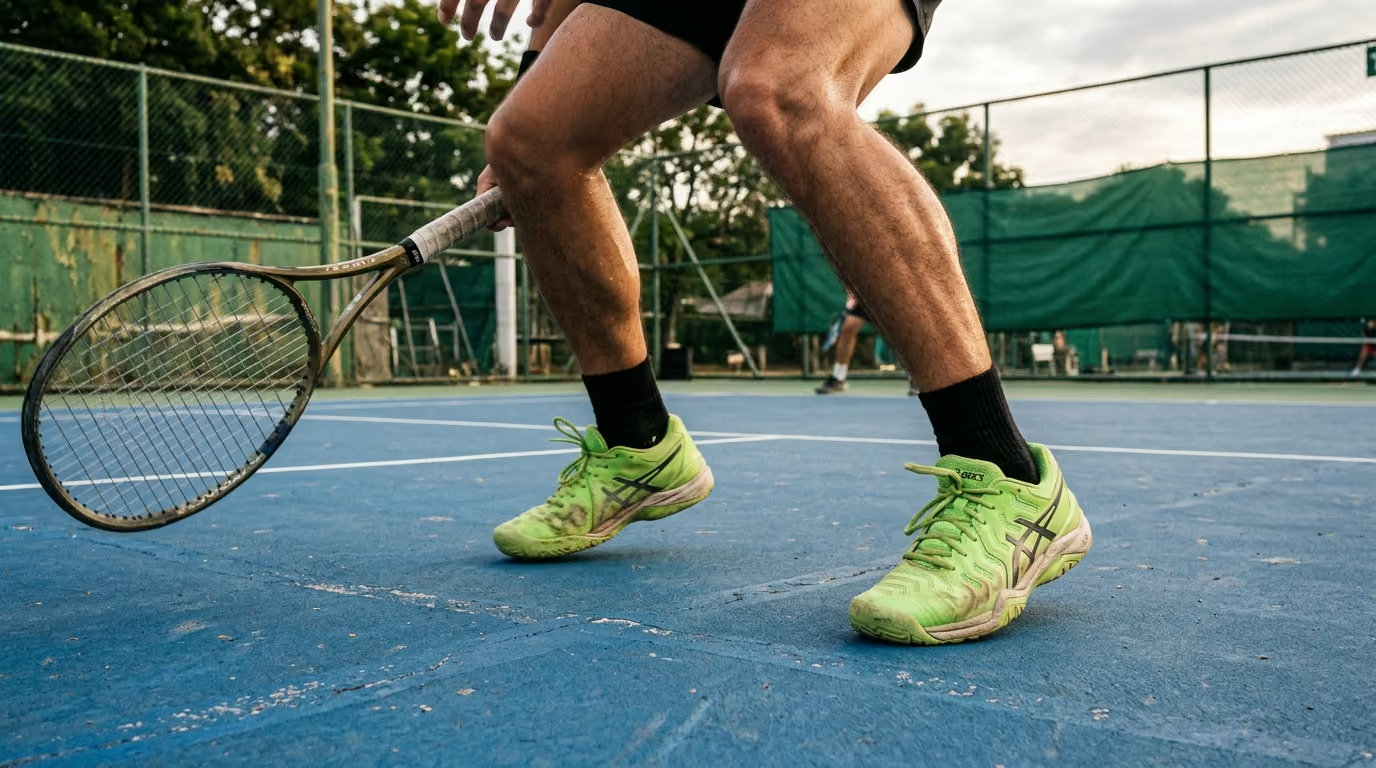
Racquet sports players will achieve peak physical capability and support long-term athletic longevity by implementing a structured, progressive warm-up routine.




Have you ever stepped onto the court for the first match of a tournament and spent the first three games struggling to find your timing while your shoulder felt stiff and your feet felt glued to the ground? This common experience occurs when players treat the brief on-court rally as their entire physical preparation. A structured, progressive warm-up is the most reliable way to start your matches at full speed while supporting your long-term athletic longevity.
A competition warm-up is a progressive physical readiness system that moves from general temperature raising to dynamic mobility, neuromuscular activation, movement preparation, and match-specific intensity. By preparing your body off the court first, you can use the limited on-court warm-up solely to calibrate your strokes and timing. This systematic approach ensures you start the first point at peak physical capability while supporting your long-term athletic longevity.
To design an effective warm-up, we must first understand what occurs within the muscles, nerves, and joints during preparation. Many players still rely on static stretching before they play, holding positions for 30 seconds or more. However, modern sports science suggests that this practice may actually hinder your performance on the court.
A key study published in the journal PLOS ONE evaluated elite junior male tennis players during a tennis-specific warm-up. The researchers compared a routine containing dynamic stretching with a routine utilizing static stretching. The dynamic stretching group showed superior jump height, sprint speed, serving speed, and serving accuracy during a simulated 60-minute match.
The same study revealed that the negative effects of static stretching persisted for nearly 30 minutes into the match. When you perform long, passive static stretches, you temporarily reduce the stiffness of your muscle-tendon units. While increased flexibility sounds helpful, your muscles actually require a certain amount of tension to produce explosive force. Without this tension, your ability to sprint, jump, and serve at high speeds is compromised.
A dynamic warm-up also prepares the cardiovascular and nervous systems. It increases your core temperature, which makes your muscle tissues more pliable and responsive. It improves circulation, delivering oxygen-rich blood to your working limbs. Finally, it primes your nervous system to send faster signals to your muscles, improving your reaction time and coordination.
While a proper warm-up improves performance, we must be realistic about its role in safety. A comprehensive review of warm-up research found that some studies showed a lower injury risk while others showed no significant change. The authors concluded that the evidence is insufficient to guarantee that a warm-up prevents acute injuries.
A warm-up is a highly sensible strategy that prepares your body for stress, but it cannot offset excessive playing volumes, poor biomechanics, or bad footwear. For comprehensive advice on protecting your joints over a long playing career, you can read our injury prevention resources.
Our preparation must also reflect the specific movement demands of racquet sports. Research on tennis movement reveals that the sport is highly intermittent rather than continuous. High-level matches generally feature work-to-rest ratios between 1:2 and 1:5, with active points lasting between 3 and 15 seconds.
During these short bursts, players cover an average of 9.6 meters per point. This means you are constantly accelerating, decelerating, sliding, and changing directions. A jog around the court does not prepare your body for these abrupt forces. Your warm-up must mimic this start-stop nature to be truly effective.
Injury data further highlights the need for a total-body preparation routine. Epidemiological studies show that lower extremity injuries account for 31% to 67% of tennis injuries, with the ankle and thigh being the most common sites. Upper extremity injuries make up 20% to 49% of cases, primarily affecting the shoulder and elbow, while trunk injuries represent 3% to 21% of reports.
Therefore, your pre-match preparation must address the entire kinetic chain. Focusing solely on shoulder circles while ignoring your hips, ankles, and trunk leaves your body unprepared for the multi-directional demands of competitive play.
To prepare your body systematically, you should follow a structured progression. This framework moves from low-intensity general movement to high-intensity, sport-specific actions. By following these six phases off the court, you will arrive at the net fully prepared to compete.
Before you begin moving, take 60 seconds to assess your physical and mental state. Stand quietly and scan your body for any unusual stiffness, lingering muscle soreness, or joint discomfort. Consider your sleep quality, hydration, and overall fatigue levels.
Categorize your readiness using a simple traffic light system. A green light means your body feels normal, coordinated, and free of pain. A yellow light indicates mild stiffness or minor aches that will likely improve with gradual movement. A red light represents sharp pain, joint instability, dizziness, or chest tightness.
If you encounter a red-light symptom, do not attempt to push through it. A warm-up is designed to prepare a healthy body, not to mask a medical issue or joint injury. If your body is clear, you can proceed to the active phases of the framework.
Spend three to five minutes engaging in low-intensity, whole-body movements. The goal of this phase is to break a light sweat and increase your heart rate. Do not run at full speed; keep your breathing controlled so you can easily maintain a conversation.
Begin with a comfortable, slow-paced jog in a straight line for one minute. Next, transition into lateral side-shuffles, keeping your hips low and your chest upright. Follow this with backward jogging, focusing on reaching back with your toes to activate your hamstrings and calves.
Finally, perform low skipping and light marching while swinging your arms in controlled circles. These varied movements wake up your coordination and signal to your cardiovascular system that vigorous work is approaching.
Once your muscles are warm, you must prepare your joints for their required ranges of motion. This phase uses controlled, active movements rather than static holds. You can discover more targeted exercises to improve your baseline joint function in our mobility and movement resources.
Perform each of the following movements with control:
This phase prepares your nervous system to control force and stabilize your joints. It uses low-volume, high-concentration movements that focus on quality rather than fatiguing your muscles.
Start with single-leg balance holds. Stand on one leg with your eyes open for 20 seconds, focusing on keeping your ankle and hip stable. To increase the challenge, gently toss a ball against a wall or close your eyes.
Next, perform 8 controlled mini-squats, focusing on pushing your knees outward and keeping your heels flat. Transition into 6 lateral push-offs per side, where you stand on one leg and push laterally to land softly on the opposite leg.
Finally, perform 5 controlled snap-downs. Stand tall on your toes with your arms overhead, then quickly drop your hips back and bring your arms down, landing in a stable, athletic athletic stance. This exercise teaches your body to absorb force, which is essential for safe deceleration on the court.
Now you will transition into sport-specific footwork patterns at a progressive pace. This phase bridges the gap between basic mobility and actual gameplay.
Perform a series of short court movements over a distance of 10 to 15 meters:
Repeat these drills twice, raising your intensity to 80% on the second run. Keep the repetitions low to avoid building lactic acid or fatiguing your legs.
With your body warm and your nerves primed, pick up your racquet or paddle for shadow swings. This allows you to rehearse your mechanics without the distraction of a moving ball.
Stand in the middle of the court and perform 10 relaxed forehand shadow swings, focusing on a clean unit turn and hip rotation. Follow this with 10 backhand swings, ensuring your weight transfers smoothly from your back foot to your front foot.
Rehearse 5 volleys on each side, emphasizing a short, compact swing and a stable wrist. Finally, perform 5 relaxed serving motions, focusing on a smooth upward reach and a balanced landing. Pay attention to your spacing and balance during each shadow swing.
The final phase of your off-court warm-up consists of a few high-quality, explosive efforts. This phase should bring your heart rate up to match level without causing physical exhaustion.
Perform three simulated points. Start with a split step, react to an imaginary ball, make an explosive lateral run, plant your foot, perform a shadow stroke, and recover to the center.
Follow this with two explosive forward sprints to simulate chasing down a short drop shot. Once you finish, your breathing should be elevated, your muscles should feel warm, and your mind should be fully alert. You are now physically ready to step onto the court.
Most competitive tournaments limit your on-court warm-up to exactly five minutes before the match begins. Many recreational players waste this time by hitting random, high-force shots or trying to win the warm-up.
To maximize this limited time, view the five-minute period as a calibration session rather than a practice session. The USTA Code explicitly states that the pre-match warm-up is for preparation, not practice, and players should provide cooperative, hit-able balls to their opponents.
Begin with cooperative, mid-court rallies. Hit your forehands and backhands at a moderate, 50% pace directly down the center of the court.
Focus entirely on tracking the ball with your eyes, finding the center of your strings, and establishing your footwork timing. Avoid hitting the ball near the lines or trying to hit winners. Your goal is to establish a rhythm and help both yourself and your opponent find a steady groove.
Gradually back up to the baseline and increase your swing speed to a normal match pace. Begin directing your shots with intention, hitting cross-court and down-the-line targets.
Vary the height and spin of your balls to see how the court surface responds. Pay close attention to the wind, court speed, and bounce height. Use these insights to adjust your court positioning and swing path.
Move forward to the net while your opponent remains at the baseline. Have your opponent hit cooperative passing shots so you can practice your volleys.
Focus on clean, compact punching motions and stable footwork. After hitting 6 to 8 volleys, have your opponent hit two or three high lobs. Rehearse your overheads with a focus on tracking the ball and executing a smooth, controlled shoulder rotation. Swap positions with your opponent to repeat the process.
Move to the baseline to practice your serves while your opponent stands in the return position. Do not begin with full-power first serves.
Hit your first two serves at 50% pace to establish your shoulder path and toss consistency. Gradually increase your speed on the next few serves, hitting both flat and spin variations to both service boxes.
While your opponent is serving, focus on calibrating your return timing. Perform your split step as they strike the ball and block the return back deep into the court.
Spend the final minute rehearsing the opening patterns that you plan to use in the match. If you are playing singles, practice a serve followed by a forehand drive. If you are playing doubles, practice a serve followed by a forward move to the net.
Use these final 60 seconds to visualize your opening tactical patterns. When the five minutes expire, you will step up to serve or return with complete physical and mental confidence.
While the progressive readiness framework applies to all racquet sports, each discipline has unique physical demands. Understanding these differences allows you to tailor your warm-up for maximum effectiveness.
Tennis is characterized by its wide physical space and long, high-velocity sprints. Players must cover a court that is 27 feet wide for singles and 36 feet wide for doubles. This requires extensive lateral range, deep sliding steps, and high-force deceleration to reverse direction.
The tennis stroke also involves a high-velocity overhead serve that places immense stress on the shoulder and rotator cuff. If you are a tennis player, your warm-up must prioritize long-distance lateral movement, deep lunging, and extensive rotational mobility for your thoracic spine and shoulder joints.
Pickleball is played on a much smaller court, measuring 20 feet by 44 feet. The physical demands of pickleball focus heavily on quick reaction times, rapid hand speed, and deep, low-stance isometric holds.
Because of the non-volley zone line, players spend a significant portion of the match in a deep squat position. This posture requires excellent hip, knee, and ankle mobility.
Your warm-up should emphasize short, explosive split steps, lateral shuffling, and isometric leg strength. You must also prepare your hips to handle deep, repetitive lunges to reach low dinks without straining your lower back.
Padel is a unique sport played inside a glass-and-mesh enclosure measuring 10 meters by 20 meters. Padel players must constantly adapt to rebounds off the walls, requiring frequent turning, twisting, and backing up.
The game of padel also features an exceptionally high volume of overhead strokes, such as the bandeja, vibora, and smash. These overheads are often hit while moving backward or turning sideways.
Therefore, your padel warm-up must prioritize rotational mobility in your hips and trunk, rapid backward shuffling, and extensive shoulder preparation. You must also focus on your coordination to handle the rapid transitions from defense to offense.
To perform your best, you must adapt your warm-up to your specific environment and match format. Weather, court surfaces, and whether you are playing singles or doubles all influence your physical preparation.
Singles play requires continuous, wide-court movement and places a high demand on your cardiovascular system. Because you have no partner to share the court with, you must cover the entire space yourself.
Your warm-up should include longer movement sequences that span the full width of the court. Practice sprinting to wide balls, planting your foot, and immediately recovering back to the center of the baseline.
Include two or three longer, high-intensity intervals in your off-court movement phase to prepare your heart and lungs for the continuous running of a singles match. For more ways to optimize your competitive performance, explore our court performance resources.
Doubles play is faster, more reactive, and relies heavily on explosive net play. Because points are shorter and featuring rapid exchanges, your first-step quickness and reaction times are critical.
Your doubles warm-up should focus on short, sharp bursts of movement rather than long-distance running. Prioritize split-step timing, forward acceleration, and lateral reaction drills.
Practice moving in sync with your partner, rehearsing how you will slide together to cover the court. Include hand-speed drills, such as rapid volley-to-volley tap drills, to prepare your nervous system for fast exchanges at the net.
Indoor courts present unique environmental factors, such as cooler or drier air, slick hard surfaces, and consistent, fast playing conditions. Because there is no wind or sun, the ball travels through the air faster and bounces more predictably.
However, indoor courts can also be dusty or slick, which increases your risk of slipping. When preparing for an indoor match, spend extra time checking your footwear and the traction of the court.
Because indoor facilities are often cool before the heaters kick in, extend your Phase 1 temperature-raising phase by two to three minutes. This ensures your body is genuinely warm before you attempt any explosive movements.
As we age, our connective tissues lose some of their natural elasticity, and our joints require more time to produce synovial fluid, which acts as a natural lubricant. This does not mean you have to accept pain or physical limitations as an inevitable part of getting older.
I remember finishing a tough two hour padel match on a cold Tuesday night and waking up the next morning feeling like my lower back was locked in concrete. For a long time, I just accepted this as the price of playing hard in my forties. But once I started spending just ten minutes on targeted hip mobility before heading to the club, the stiffness almost completely vanished. It taught me that we do not have to accept pain as a default state of aging.
Mature athletes should make three key adjustments to their pre-match preparation to support their long-term health and athletic longevity. You can read more about maintaining your physical capabilities as you age in our healthy aging and athletic longevity resources.
First, extend the duration of your Phase 1 temperature-raising phase. Spend a full six to eight minutes walking briskly, cycling, or performing easy movements before you attempt any dynamic mobility work. Your tissues require more time to warm up and become pliable.
Second, place a strong emphasis on balance and proprioception. Exercise guidelines for older adults emphasize regular balance training to preserve joint stability and coordination.
Spend extra time on single-leg balances, slow, controlled lateral lunges, and single-leg reaches. These exercises awaken the stabilizer muscles around your ankles, knees, and hips, reducing your risk of missteps on the court.
Finally, build your serving and overhead intensity very gradually. Never attempt to hit a high-power serve or overhead smash at the beginning of your warm-up.
Start with relaxed, low-speed overhead motions, and only build to full power during the final moments of your preparation. This gradual approach protects your shoulders, elbows, and lower back from sudden, high-force loads.
Many players make simple errors during their pre-match preparation that can hinder their performance or lead to unnecessary fatigue. Recognizing these common pitfalls helps you refine your warm-up for better results.
The most common mistake is performing intense, passive static stretching before a match. Holding deep, static stretches for 30 seconds or more temporarily reduces your muscles' ability to contract quickly and explosively.
This can lead to slower sprint times, reduced jump height, and lower serving speeds during the opening games of your match. Keep your pre-match stretching dynamic and active, saving your static stretches for your post-match recovery session.
Many players walk directly onto the court and immediately begin hitting full-power serves. The serve is the most physically demanding stroke in racquet sports, placing high rotational forces on your shoulder, elbow, and spine.
Hitting maximum-effort serves before your body is warm can strain your rotator cuff or lower back. Always complete your off-court mobility work and hit several relaxed groundstrokes before attempting your first serve.
Your warm-up should prepare your body to play, not act as a high-intensity workout. If you finish your warm-up feeling exhausted, sweaty, and out of breath, you have done too much.
Keep your high-intensity drills brief, limiting your explosive sprints to one or two repetitions with plenty of rest in between. Your goal is to feel warm, alert, and energized, preserving your energy reserves for the actual match.
Believing that the five-minute on-court rally with your opponent is enough to prepare your body is a major mistake. Five minutes is simply not enough time to raise your core temperature, mobilize your joints, and prime your nervous system.
If you rely solely on this period, you will likely spend the first few games of your match struggling to find your rhythm while your body slowly warms up. Arrive at the courts early and complete your off-court preparation so you can use the on-court rally solely for calibration.
An effective pre-match warm-up does more than just improve your play; it also sets the stage for a faster post-match recovery. By preparing your tissues for stress, you can reduce the severity of muscle soreness and support your overall recovery.
When you warm up properly, you increase blood flow and oxygen delivery to your working muscles. This helps mitigate the microscopic muscle damage that naturally occurs during high-intensity exercise.
A progressive warm-up also promotes the smooth sliding of your myofascial tissues, reducing post-match stiffness and tightness. To learn more about optimizing your post-match recovery, explore our recovery science resources.
After your match ends, your body needs to transition from a high-stress state to a restful, healing state. Spend three to five minutes walking slowly around the court to allow your heart rate and blood pressure to return to normal.
Follow this with light, passive static stretching, focusing on your calves, hamstrings, hip flexors, and shoulders. This simple routine helps calm your nervous system and initiates the recovery process.
Finally, prioritize proper rehydration and nutrition within 60 minutes of finishing your match. Drink water to replace lost fluids, and consume a balanced snack containing both carbohydrates and protein to rebuild your muscles. This complete approach ensures your body recovers quickly so you can return to the court feeling strong.
While minor stiffness and mild muscle soreness are common aspects of competitive sports, you should never ignore signs of a more serious injury. Knowing when to stop playing and seek professional medical guidance is essential for protecting your long-term joint health.
Consult a qualified healthcare provider, such as a physical therapist or sports medicine physician, if you experience any of the following warning signs:
If you experience any of these red-flag symptoms during your Phase 0 readiness check or at any point during your warm-up, stop playing immediately. Do not attempt to push through the pain or use a warm-up to mask a serious underlying issue. Seeking professional evaluation early can prevent a minor strain from developing into a chronic, season-ending injury.
To get in touch with our team or learn more about our commitment to evidence-led guidance, please visit our about page or use our contact page.
To apply this progressive readiness system to your next competitive match or practice session, use this straightforward checklist:
Follow Evercourts for practical insights on tennis, pickleball and padel performance, movement, recovery and healthy ageing. Stay connected for new articles, research-led guidance and ideas to help you play well and keep playing for years.


Read practical guidance for better movement, smarter preparation and a game that keeps working for you.
explore the Blog