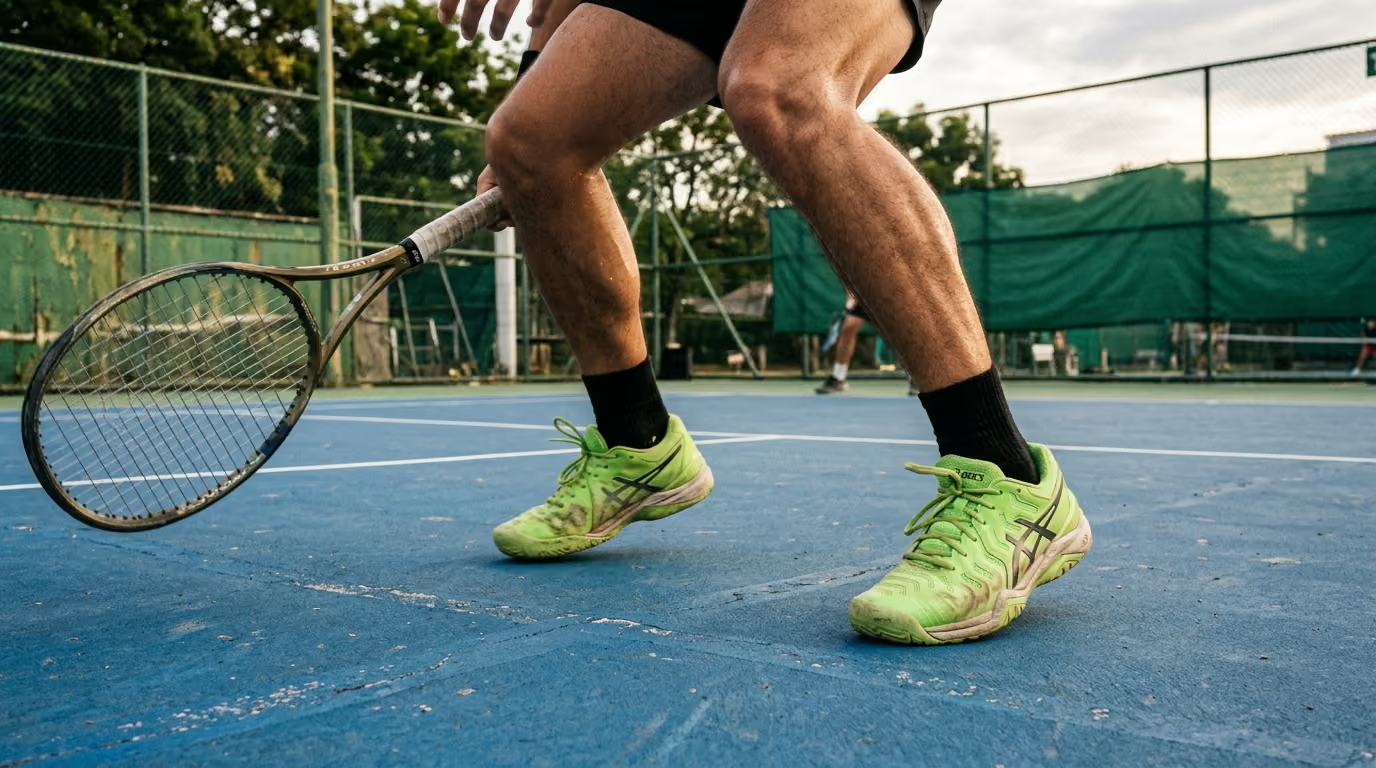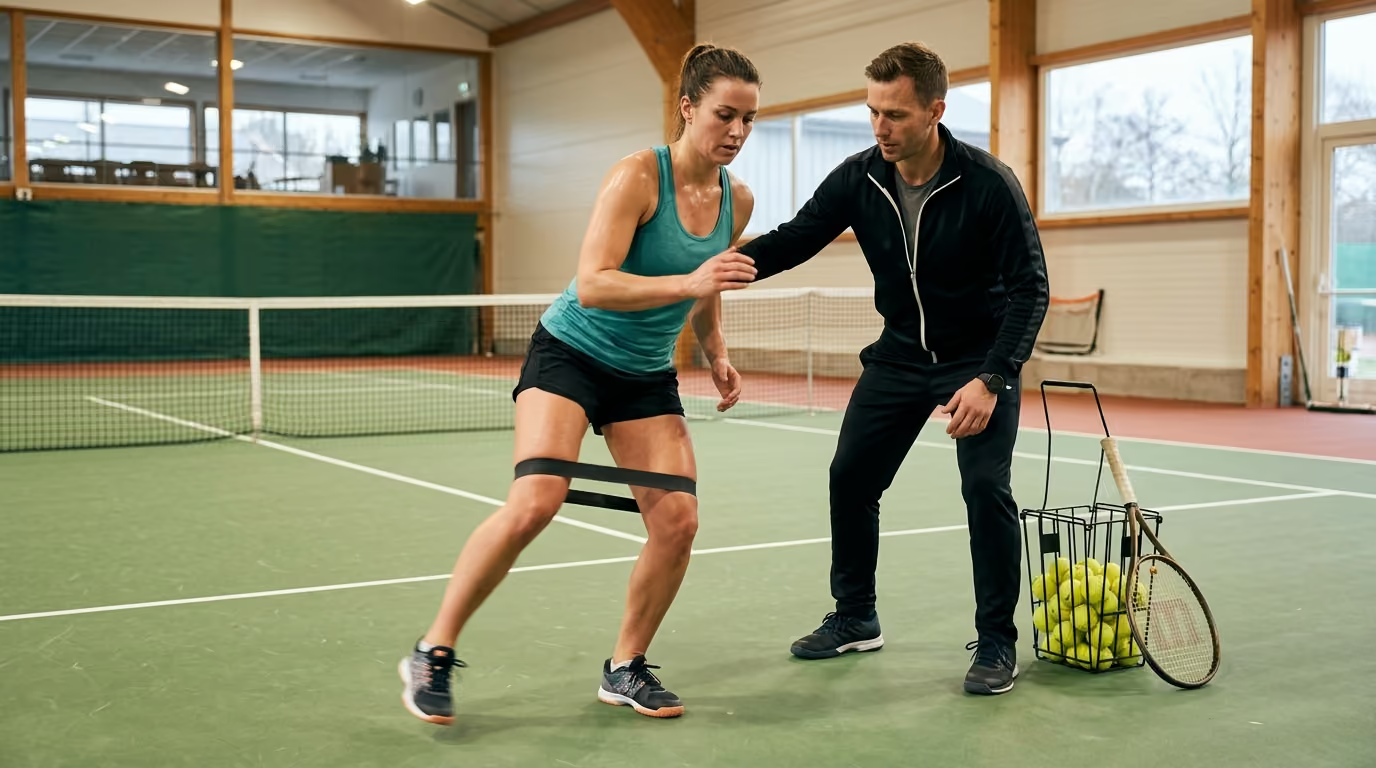

A comprehensive return-to-play fitness plan for racquet sports helps players safely and effectively regain their physical capacity and performance on the court.




Imagine walking back onto the court after a long winter break, a bout of flu, or a demanding travel schedule. You feel eager to strike the ball, so you immediately jump into a high-intensity singles match. By the third game, your lungs burn, your lateral movement feels sluggish, and your shoulder aches with every serve. The next morning, simple tasks like walking down stairs or reaching for a cup feel incredibly difficult.
To avoid these setbacks, you must treat your return to the court as a gradual progression rather than a single event. The sports medicine literature, including the 2016 British Journal of Sports Medicine consensus statement on return to sport, separates this process into clear phases. These phases include a return to participation, a return to sport, and a return to performance. For recreational racquet sport players, this means building movement tolerance and physical capacity before playing competitive matches.
Before you pick up your racquet, you must determine if your body is ready for physical activity. A structured decision framework helps you avoid premature loading, which can lead to injury or illness relapse. The transition from inactivity back to the court should always be guided by physiological readiness rather than calendar dates.
The American College of Sports Medicine, also known as ACSM, emphasizes that exercise screening should focus on your current activity levels and any underlying health conditions. You must assess yourself for signs of cardiovascular, metabolic, or renal issues before starting a training program. If you have been completely inactive, starting too quickly can place excessive stress on your heart and blood vessels.
Certain symptoms are clear indicators that you need a professional medical evaluation before you exercise. Do not start this fitness plan if you experience chest discomfort, unreasonable breathlessness, or dizziness. Fainting, ankle swelling, or an unusual awareness of a rapid heartbeat also require medical clearance.
Below is a list of red flags that demand a consultation with a qualified healthcare provider:
If you are recovering from an infectious illness, you should only resume exercise when your symptoms have fully cleared. You must be free of fever, body aches, and digestive issues for at least twenty-four hours.
To build a safe progression, you must compare your current physical capacity against the demands of your sport. Your current capacity includes your muscle strength, aerobic fitness, lateral speed, and joint tolerance. The demands of racquet sports include explosive lunges, rapid acceleration, sudden braking, and overhead racket swings.
When you return after a layoff, there is a substantial gap between what your tissues can tolerate and what a match requires. A structured return plan works by gradually closing this gap. You should only advance to the next stage of training when your physical capacity matches the stress of that stage. This approach prevents you from overloading your tendons and joints.
Our return-to-play framework is divided into six distinct decision-based stages. These stages guide you from complete rest back to competitive match play.
This continuum is highly individualized. A player returning from a brief vacation may progress through these stages in a single week. A player returning from a severe illness or a multi-month layoff may need several weeks to navigate the same progression.
Many players assume that general cardiovascular fitness, such as running on a treadmill, is enough to prepare them for the court. However, match fitness is highly specific and cannot be replicated by steady-state jogging. Racquet sports require you to repeatedly sprint, stop, change direction, and swing a racket while fatigued.
A systematic review of physiological demands across racquet sports shows that different court disciplines place unique stresses on the human body. For example, research indicates that badminton generally presents the highest cardiovascular and metabolic demands of the major racquet sports. The intense rally density and frequent jumps require exceptional anaerobic capacity.
Understanding the specific mechanics of your sport helps you tailor your return-to-play program. Each discipline targets different muscle groups and joint complexes.
In tennis, the larger court size requires longer sprint distances and substantial acceleration and deceleration efforts. Players must perform high-load rotational strokes, often utilizing open-stance or semi-open-stance patterns. The repetitive nature of the serve places immense stress on the shoulder and lumbar spine.
In badminton, players must tolerate frequent explosive lunges and vertical jumps. The recovery back to the center of the court must be incredibly rapid. The overhead smash demands extreme shoulder and core power.
In squash, the enclosed court leads to high continuous work density with very little rest between rallies. Players must perform deep, repeated lunges into the corners of the court. The game demands rapid trunk rotation and exceptional spatial awareness.
In pickleball, the court is smaller, but the reaction times are faster. Players must endure frequent lateral shuffles and hold low, squatting positions near the kitchen line. The high volume of quick paddle movements places unique stress on the wrist and elbow.
In padel, players experience a mix of short accelerations, reactive wall movements, and overhead shots. The sport requires constant communication and quick changes of direction on a synthetic turf surface. The frequent use of the bandeja and vibora strokes requires excellent shoulder stability.
Because of these diverse demands, a general return plan must address the entire body. Tennis research highlights that repetitive high-load strokes and abrupt changes of direction increase musculoskeletal stress. This stress is not limited to your hitting arm.
Your lower limbs must absorb the impact of landing and braking. Your core and lower back must transfer force from your legs to your upper body. Your shoulder girdle must stabilize the arm during high-speed swings. Therefore, your training should target these areas systematically.
To progress safely, you need a reliable way to track how much work your body is doing. Monitoring your training load allows you to make informed decisions about when to step up your intensity. We divide these measurements into external load, internal load, and recovery indicators.
External load refers to the physical work you perform during a session. This is the objective work that can be easily counted and recorded. You should keep a simple training journal to track these variables.
Key external variables include:
Internal load represents the physiological and psychological stress your body experiences in response to the external workload. Two players can perform the exact same drill but experience completely different levels of internal stress.
A practical way to measure this is the session rating of perceived exertion, or session-RPE. After a workout, rate your overall effort on a scale of 0 to 10. Multiply this rating by the duration of the session in minutes to calculate your session load.
For example, a 60-minute session rated at a 5 RPE equals a load of 300 arbitrary units. A 60-minute session rated at an 8 RPE equals a load of 480 units. This simple calculation helps you see that identical practice times can have very different physiological costs. You should also monitor your breathing difficulty, local muscle fatigue, and technical error rates.
The acute-to-chronic workload ratio compares your training load over the past seven days to your average weekly load over the past twenty-eight days. The return-to-sport consensus suggests using this ratio to plan your physical progression. It helps ensure you do not increase your training volume too quickly.
However, you must use this ratio as a general monitoring guide rather than a strict mathematical rule. A study of tennis players found that injury risk increased when weekly training workloads rose abruptly. Yet, the researchers also noted that workload data alone has weak predictive value for individual injuries.
Your training data cannot replace careful symptom monitoring and clinical judgment. If your joints ache, you must reduce your load even if your workload ratio looks perfect on paper.
Your body does not exist in a vacuum. Work stress, travel fatigue, poor sleep, and nutritional deficits all reduce your ability to tolerate training.
Before every session, ask yourself these recovery questions:
This practical, six-stage program is designed to rebuild your physical capacity systematically. Do not view these stages as rigid calendar weeks. Instead, treat them as milestones. You must satisfy the progression benchmarks of your current stage before moving to the next.
The goal of this stage is to establish your baseline health and ensure you are ready for structured exercise. If you are returning after a long period of inactivity, you must confirm that your body can handle basic movement.
Begin by recording your resting heart rate and checking for any joint stiffness. Perform a simple ten-minute assessment consisting of easy walking, gentle bodyweight squats, and single-leg balance holds. Pay close attention to your knee and ankle stability during these movements. Raise your arms directly overhead to ensure your shoulders have a full, pain-free range of motion.
Do not push yourself to failure or perform maximal testing during this phase. Your only goal is to verify that you can move without pain, dizziness, or chest tightness. Once you can complete light, daily physical activities without unusual fatigue or next-day soreness, you are ready to progress.
During Stage 1, you will focus on restoring your aerobic base and rebuilding your muscle tissue tolerance. This stage is entirely off-court and prepares your connective tissues for the high-impact demands of sport-specific movement. For structured physical preparation, players can utilize targeted strength and conditioning resources to rebuild their athletic foundation.
Your weekly schedule should include two or three low-intensity cardiovascular sessions. These can consist of stationary cycling, rowing, or brisk walking for twenty to thirty minutes. Keep your intensity at a moderate level, which corresponds to a 5 or 6 on the RPE scale. You should be able to maintain a conversation throughout the exercise.
In corporate two full-body strength sessions each week to prepare your muscles. Focus on fundamental movement patterns such as goblet squats, Romanian deadlifts, split squats, and calf raises. To build upper body stability, include dumbbell rows, band pull-aparts, and controlled shoulder external rotations. Keep your repetitions high, around ten to twelve per set, and leave several repetitions in reserve.
Advance to the next stage when you can complete two consecutive weeks of this routine without joint pain or excessive fatigue. Your movement quality should remain stable and consistent across all exercises.
In Stage 2, you will begin to reintroduce court-specific locomotion. This phase teaches your nervous system and muscles how to absorb braking forces and accelerate in multiple directions.
Start your movement sessions with a dynamic warm-up that includes gentle hopping and skipping. Begin practicing split-step mechanics, focusing on landing softly on the balls of your feet. Introduce lateral shuffling, crossover steps, and short forward-to-backward runs over distances of three to five meters. Perform these drills at half-speed, prioritizing balance and posture over rapid execution.
As your comfort increases, transition to planned lunging patterns. Step forward, diagonally, and laterally, ensuring your front knee stays aligned with your foot. Perform three sets of five controlled repetitions in each direction. Avoid reactive drills or sudden, unpredictable changes of direction during this stage.
You are ready for the next phase when you can complete a twenty-minute movement session at moderate speed. You must demonstrate excellent balance, controlled deceleration, and zero joint pain during or after the session.
Stage 3 brings you back to the court with a racquet in your hand. The goal is to build tolerance in your hitting arm, shoulder girdle, and trunk while slowly increasing your stroke volume.
Begin with cooperative, stationary hitting. Stand in the center of the court and have a partner feed balls directly to you. Hit twenty to thirty groundstrokes at a comfortable, medium pace. Focus on your timing, weight transfer, and clean ball contact rather than power.
Gradually introduce light movement to your hitting drills. Have your partner feed balls slightly to your left and right, requiring you to take two or three steps before striking. Limit your serve and overhead volume strictly during this stage. If you play tennis, practice no more than ten to fifteen easy serves per session to protect your shoulder rotator cuff.
To safeguard your joints, you must adhere to a strict progression of stroke intensity. Our team has learned that the delayed response of your tendons is the most critical variable to monitor. If you experience any joint ache in your shoulder, elbow, or wrist, you must reduce your stroke volume immediately.
Stage 4 transitions you from isolated drills to structured, near-normal practice sessions. You will begin to simulate the actual physical and mental demands of match play.
Your practice sessions can now last forty-five to sixty minutes. Introduce cooperative point play, where you and your partner play out rallies with specific tactical constraints. For example, you can play points where every shot must land past the service line, or where you can only score after a minimum of five shots. This keeps the intensity high while keeping the movement patterns relatively predictable.
Begin to combine your on-court practices with your off-court strength work. You can schedule a light resistance session on Monday, a technical court practice on Tuesday, and a recovery session on Wednesday. Always ensure you have at least one full day of complete physical rest each week.
You must tolerate at least two full, high-intensity practices per week before moving forward. Your movement mechanics must remain clean even when you are tired at the end of a session.
The final stage is your return to competitive match play. This is where your body must handle the unpredictable, high-stress environments of tournaments or league games.
Do not start with a demanding, three-set singles match. Instead, begin with a shortened format, such as playing a single set or a timed twenty-minute match. If you are a tennis player, you might consider starting with doubles. This format reduces your overall court coverage while keeping your competitive instincts sharp.
Monitor your physical and mental response closely after your first competitive match. Check for any localized muscle soreness, changes in your sleep quality, or joint swelling. Do not play back-to-back competitive matches until you have fully tolerated single matches with a day of rest in between.
Once you can play a full, unrestricted match without any next-day issues, you have successfully completed your return-to-play plan. You can now resume your normal training and competition schedule.
While a calendar can guide your progression, objective physical benchmarks are much more reliable indicators of readiness. You should test these baseline movements to ensure your muscles and joints are prepared for the stress of competitive play.
To protect your knees, hips, and Achilles tendons, you need a solid foundation of lower body strength. These tasks help verify that your muscles can absorb and produce force symmetrically.
First, you should be able to perform fifteen consecutive, controlled single-leg squats on each leg. Your knee must track straight over your middle toes without buckling inward. Second, you must complete twenty-five continuous, single-leg calf raises on a step. This test ensures your calf muscles and Achilles tendons can tolerate repeated jumping and landing.
Third, perform a lateral step-down test from a fifteen-centimeter box. Lower your heel to touch the floor gently, then return to the starting position using only your lead leg. Your pelvis should remain level throughout the movement, indicating strong hip stabilizer muscles.
Racquet sports require you to recover quickly between long rallies. If your aerobic system is weak, your muscles will fatigue prematurely, leading to technical breakdown and injury risk.
You should be able to complete a twenty-minute continuous jog or cycle at a moderate intensity without joint pain. Your heart rate should recover rapidly during periods of rest. As a practical test, perform three minutes of light shadow footwork on the court. Your breathing should return to a normal, conversational rate within two minutes of finishing the drill.
Agility on the court is not just about raw physical speed. It requires a combination of visual anticipation, split-step timing, and coordinated footwork.
To test your agility, set up a simple lateral shuttle drill over a five-meter distance. Start in the center, shuffle to the right cone, touch it, shuffle back to the left cone, and return to the center. You should be able to complete five round trips in under thirty seconds while maintaining a low, athletic posture. Your feet should never cross, and your braking movements must feel stable and controlled.
Power is the ability to produce force quickly. You must only train for explosive power after you have established a solid foundation of basic strength and movement control.
A study on detraining and retraining found that a prolonged layoff reduces your rate of force development. However, the researchers also discovered that retraining with explosive-strength work can accelerate the recovery of your physical capacity. This means that carefully introduced power exercises are highly beneficial during the later stages of your return.
Begin with low-impact plyometrics, such as double-leg pogo hops. Jump continuously for fifteen seconds, focusing on keeping your contact time with the ground as short as possible. Progress to lateral bounds, jumping from one foot and landing softly on the other, holding the landing for two seconds. These drills prepare your tendons to store and release energy efficiently during fast court movements.
Not all layoffs are the same. A return plan must be adjusted based on whether you are recovering from an illness, an injury, or simply a busy period at work.
An infection can leave your cardiovascular and immune systems temporarily compromised. The IOC consensus statement on acute respiratory illness in athletes provides clear guidance on how to return safely. You must not perform any intense training while you have an active fever, muscle aches, or systemic symptoms.
Once your symptoms have resolved, begin with forty-eight hours of light daily activity, such as walking. If your body responds well, progress to twenty minutes of low-intensity cycling or jogging. Do not jump straight back into high-intensity interval training or heavy weight lifting.
If you experience unusual fatigue, shortness of breath, or chest pressure, stop exercising immediately. These symptoms can indicate cardiac or pulmonary complications that require a thorough medical evaluation.
A concussion is a serious brain injury that requires a highly structured, step-by-step return protocol. CDC guidelines state that each phase of recovery must take a minimum of twenty-four hours. You must only progress to the next step if you remain completely free of symptoms.
Start with daily cognitive and physical rest, followed by light aerobic activity like walking or stationary cycling. Once tolerated, transition to sport-specific drills, such as easy shadow footwork on the court. Do not introduce fast ball-tracking, rapid head turning, or competitive play until you have completed these initial steps.
For racquet sport athletes, visual tracking and rapid coordination are highly demanding. You must have explicit medical clearance from a qualified healthcare provider before you engage in unrestricted match play.
As we age, our tendons, ligaments, and joints require more time to adapt to physical stress. When designing athletic longevity plans, you must prioritize tissue tolerance over cardiovascular conditioning.
Your cardiorespiratory fitness may return faster than your Achilles tendons can adapt to sudden braking. Therefore, older players should spend more time in the general reconditioning and movement tolerance stages. You should also ensure you have forty-eight hours of recovery between high-intensity court sessions.
I remember finishing a tough two hour padel match on a cold Tuesday night and waking up the next morning feeling like my lower back was locked in concrete. For a long time, I just accepted this as the price of playing hard in my forties. But once I started spending just ten minutes on targeted hip mobility before heading to the club, the stiffness almost completely vanished. It taught me that we do not have to accept pain as a default state of aging. Incorporating focused mobility and movement practices into your weekly routine can dramatically reduce stiffness and support your joints.
Long travel days can cause dehydration, joint stiffness, and disrupted sleep patterns. If you have traveled across time zones, do not schedule a high-intensity match on your first day back.
Spend your first session focus on light stretching, hydration, and easy hitting to help your nervous system adapt. If you are playing in hot or humid conditions, allow your body several days to acclimate. Reduce your training volume and take frequent rest breaks in the shade to avoid heat-related illness.
Even the most dedicated players can fall into common traps when returning to the court. Recognizing these pitfalls can save you from unnecessary setbacks and injuries.
Many players believe that because they can run for five miles on a treadmill, they are ready for a competitive match. However, running in a straight line at a constant speed does not prepare your muscles for lateral lunging and rapid deceleration. You must build court-specific movement tolerance before you test your fitness in a game.
Your tendons and joints often do not hurt during a training session. Instead, they react to overload by stiffening and aching the next morning. If you wake up with joint pain or limited movement, your previous session exceeded your current physical capacity. You must use this next-day response to guide your training volume, rather than relying on how you feel on the court. To help manage these symptoms, players should follow structured recovery science methods to support tissue health.
Recreational players often assume that doubles is always an easier return format than singles. While doubles requires less running, it often involves faster reaction times, more rapid net movements, and a higher volume of overhead shots. If you are recovering from a shoulder issue, the frequent overheads in doubles can actually place more stress on your joints than a controlled singles practice.
A thorough warm-up is essential, but it cannot protect you from a sudden, massive spike in training volume. No amount of stretching will prevent injury if you play a three-hour match after months of complete inactivity. Your primary defense against injury is a progressive, weeks-long increase in total workload.
To help you implement this plan, use this simple checklist before, during, and after your training sessions.
This return-to-play plan is designed for players returning after a non-pathological layoff, such as travel, busy work periods, or mild illnesses. If your time away from the court was due to an injury, surgery, or chronic medical condition, you should not self-manage your progression.
You must consult a qualified healthcare provider, such as a sports physiotherapist or sports medicine physician, if you experience persistent joint swelling, sharp pain that alters your movement, or symptoms that do not improve with rest. New neurological symptoms, chest tightness, or unexplained exercise intolerance also require professional assessment. A specialist can provide a tailored rehabilitation plan and ensure you are cleared for the physical demands of your sport.
When to revisit this resource: Keep this guide bookmarked and refer back to it whenever you face a layoff of two weeks or more. By systematically progressing through these stages, you can safeguard your athletic longevity and continue enjoying your sport for many years to come.
Follow Evercourts for practical insights on tennis, pickleball and padel performance, movement, recovery and healthy ageing. Stay connected for new articles, research-led guidance and ideas to help you play well and keep playing for years.


Read practical guidance for better movement, smarter preparation and a game that keeps working for you.
explore the Blog