
While many assume a quick return to peak performance after a break, the body requires a structured, gradual progression to safely rebuild capacity and prevent injury.




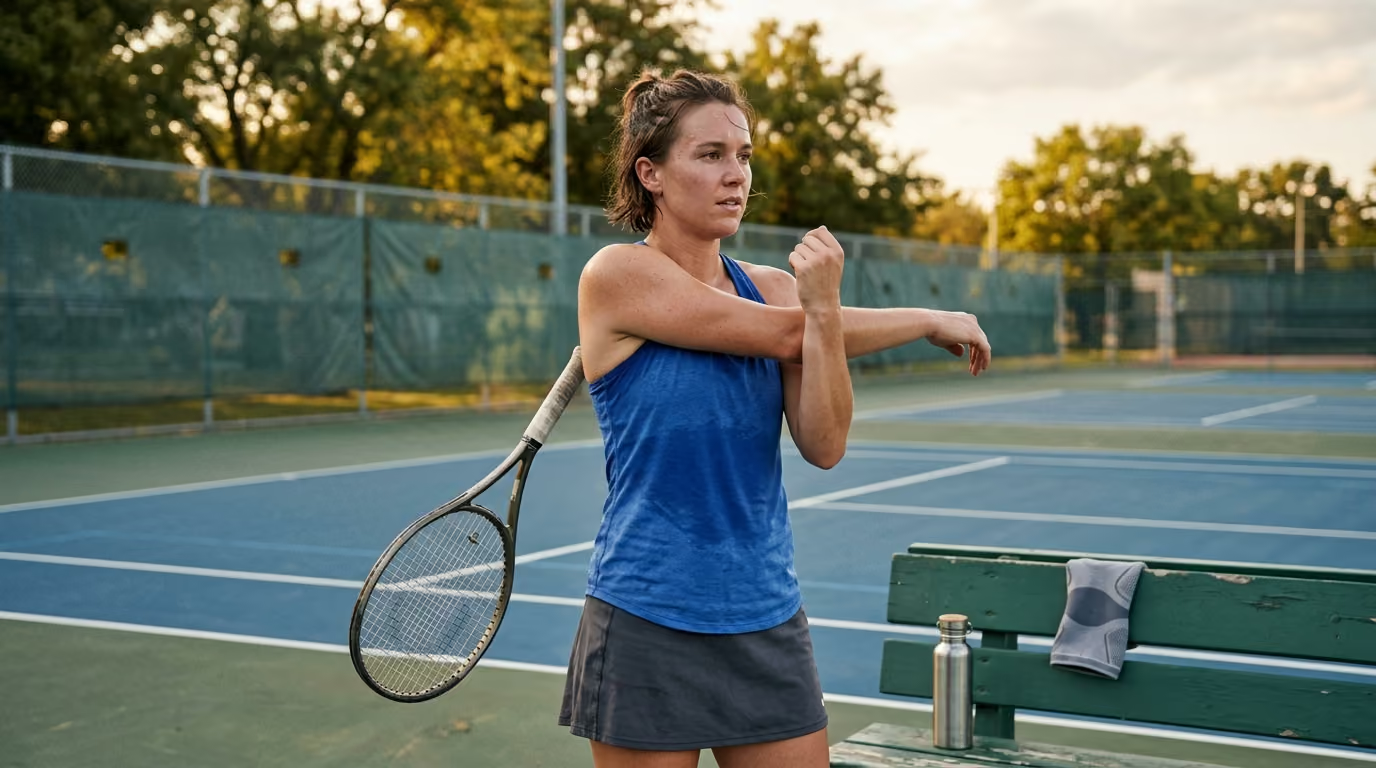
You stand at the edge of the court, racquet in hand, watching the ball bounce. It has been three weeks since you last played. Perhaps you were recovering from a stubborn respiratory illness, traveling for work, or simply buried under a mountain of professional obligations. Your mind is completely ready to play, but your body operates on a different timeline.
Returning safely to the court after a break requires a structured progression that prioritizes physiological recovery over emotional enthusiasm. Players must systematically rebuild their capacity to handle the deceleration, rotation, and high-impact movements of racquet sports. This gradual reloading process is the most effective way to protect your joints, manage fatigue, and support long-term athletic longevity.
To understand how your body reacts to a break, we must first look at the science of detraining. Detraining is the partial or complete loss of physiological adaptations after a reduction in training volume, frequency, or intensity. According to research on sports performance, your cardiorespiratory fitness and muscular qualities do not decline at the same rate. Your aerobic capacity can begin to drop within a few weeks of inactivity. However, the structural integrity of your tendons, ligaments, and joints often degrades even faster under complete rest.
We must distinguish among three separate milestones when discussing a return to the court. The International Olympic Committee (IOC) defines the first step as a return to participation or training. This refers to the first exercise session after an illness or break. The second milestone is a return to sport, where you progress back to your previous sport-specific intensity and duration. The final milestone is a return to competition, which involves unrestricted match play under unpredictable, highly taxing conditions.
When you stop playing, multiple physical systems are affected simultaneously. Your heart rate recovery becomes slower, and your eccentric strength decreases. Eccentric strength is your body's ability to absorb force when you land or brake. Without regular mechanical stress, your tendons lose some of their stiffness. This stiffness is necessary for explosive movements and joint protection.
To manage this return, you must understand the concept of training load. Training load refers to the total physical stress placed on your body during exercise. We divide this into external load and internal load. External load represents the actual work you perform, such as the duration of your session or the number of sprints. Internal load represents your body's physiological and psychological response to that work, such as your heart rate or rating of perceived exertion.
The IOC consensus recommendations emphasize monitoring both types of load to prevent injuries. For recreational players, tracking does not require expensive technology. You can simply record your session duration and rate your effort on a scale of zero to ten. This simple metric is known as the session rating of perceived exertion, or session-RPE. By multiplying duration by effort, you get a clear estimate of your daily workload.
Sports science often references the acute-to-chronic workload ratio, or ACWR. The acute workload is the total load accumulated over the last seven days. The chronic workload is your average weekly load over the past three to six weeks. While some coaches treat this ratio as a precise safety calculator, systematic reviews show that the relationship between ACWR and injury risk is highly variable. One major review showed a small-to-moderate association with injuries, but it also noted substantial differences across various sports.
Therefore, we do not treat these ratios as absolute rules. Instead, we use the core principle behind them: avoid sudden spikes in activity. If your recent training volume is low, you should not jump directly into a highly demanding tournament. Your body needs time to adapt to increased physical demands.
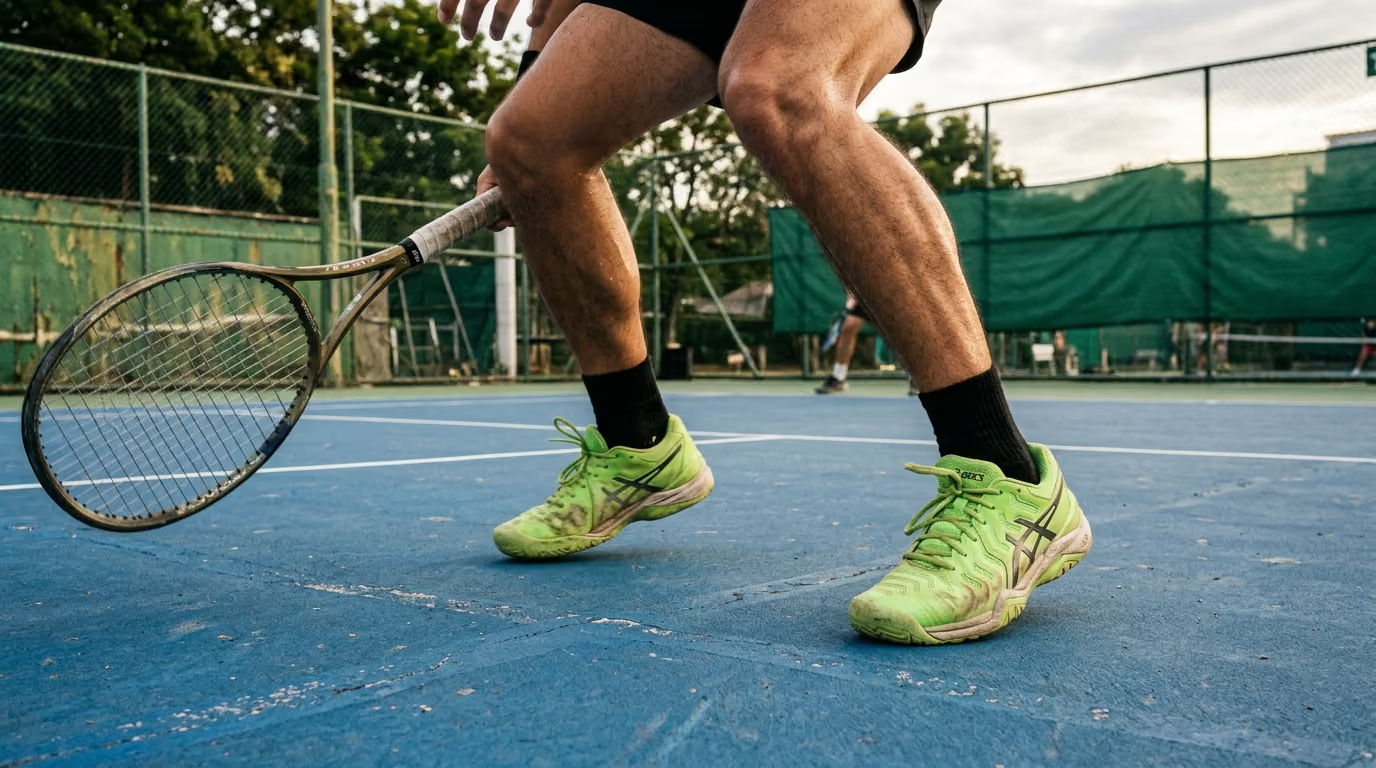
Court sports like tennis, pickleball, and padel are fundamentally different from continuous endurance activities. If you go for an easy jog, you move in a straight line at a predictable speed. On the court, your movement is highly intermittent and chaotic. You must constantly transition between standing, sprinting, shuffling laterally, and stopping abruptly.
These rapid transitions place immense mechanical stress on your muscles and joints. Deceleration is especially taxing. When you run to catch a short ball and brake suddenly, your quadriceps and calf muscles must work eccentrically to stop your momentum. This eccentric loading creates micro-tears in the muscle fibers, which can lead to severe soreness if your body is not accustomed to it.
Furthermore, court sports require quick, multi-directional decisions. When you are tired, your reaction time slows down, and your movement patterns degrade. A tired player is more likely to land with a stiff knee or step awkwardly during a lateral shuffle. These minor technical errors can lead to acute joint sprains or chronic tendon irritation.
The "one good session" trap is a common obstacle for returning players. You might complete a light hitting session and feel completely fine the next morning. However, a light hitting session does not simulate the physical stress of a competitive match. Surviving one controlled practice does not mean your tissues are ready for a full-intensity game. We must evaluate your response over several days before increasing your playing time.
To assess your readiness to return, our team recommends evaluating six specific areas of your health and physical performance. This comprehensive approach ensures you do not overlook hidden deficits in your recovery.
Before you even touch your racquet, you must ensure your body has cleared any active infection or systemic stress. If you are returning after an illness, you must be free of fever and systemic symptoms. General guidelines for infectious diseases recommend waiting until all major symptoms resolve before starting exercise. A resting pulse that is ten beats per minute higher than your normal baseline is a clear sign that your body is still fighting infection. If you experience muscle aches, chills, or systemic fatigue, you must prioritize rest over physical activity.
Your body must handle the demands of everyday life before it can handle the stress of court sports. You should be able to walk at a normal pace, climb stairs, and perform your daily work duties without feeling unusually fatigued. Your sleep quality should return to its normal pattern, and you should maintain adequate hydration and nutrition. If simple daily tasks leave you feeling winded or exhausted, high-intensity athletic play is highly premature.
Before returning to dynamic court play, you should perform a basic physical assessment to check your joint mobility and muscle strength. You should be able to perform a deep bodyweight squat, a controlled split squat, and several single-leg calf raises without pain or instability. These movements screen for obvious asymmetries or force absorption issues. If you cannot perform a controlled landing from a small step, your knees and ankles are not ready to absorb the force of a real match.
Your cardiovascular system must be capable of recovering between intense rallies. To test this, you can perform low-to-moderate intensity intervals on a stationary bike or a treadmill. Monitor how quickly your heart rate and breathing return to normal during your recovery periods. If your heart rate remains elevated for a prolonged period after a light effort, your aerobic energy system needs more baseline training.
Racquet sports require precise technical coordination, which often breaks down as you tire. During your first few practice sessions, pay close attention to your footwork and ball contact when you begin to feel fatigued. If your footwork becomes sloppy or your swing timing suffers, it is a sign that your neuromuscular system is struggling. Technical breakdown is a warning sign that increases your vulnerability to acute injuries on the court.
The ultimate test of readiness is not how you feel during a single session, but how your body responds over the next forty-eight hours. You must ask yourself if you can recover quickly enough to repeat a similar physical effort two days later. If a single workout leaves you bedridden or excessively sore for several days, your body has not successfully adapted to that workload. Repeatability is the cornerstone of athletic longevity and healthy aging.
To safely rebuild your tolerance, we recommend using a staged return progression. This framework is flexible and allows you to move forward or backward based on your symptoms and recovery.
The initial goal is to resolve any active illness, reduce systemic stress, and restore your baseline hydration. No exercise should occur during this stage if you have a fever or severe systemic symptoms. If you are recovering from a hectic work period, focus entirely on improving your sleep and nutrition. This stage is about restoring your energy reserves so your body can handle the training stress to come.
Once you are symptom-free, you can introduce easy, non-impact movement to stimulate circulation. This includes light walking, gentle stationary cycling, and basic mobility exercises. In our experience, spending ten minutes on targeted hip and thoracic spine mobility can make a substantial difference in how your joints feel. Keep these sessions short, lasting no more than fifteen to twenty minutes, and keep your heart rate low.
At this stage, you can begin to rebuild your baseline endurance and muscle strength. You can perform straight-line jogging, light resistance training, and basic bodyweight exercises. Avoid high-impact jumping or rapid directional changes during these workouts. The focus is on preparing your muscles and tendons for the mechanical demands of court play without overloading them. For a comprehensive approach to this phase, you can consult our strength and conditioning programs.
Now you can transition to the court for controlled, non-contact drills. Introduce planned lateral shuffling, moderate acceleration, and light hitting. You can perform shadow swings or cooperative rallying with a partner who hits the ball directly to you. This stage allows you to re-introduce tennis, pickleball, or padel movements without the unpredictability of a real game.
In this stage, you can introduce unpredictability and higher speeds. You can perform harder change-of-direction drills, reactive footwork patterns, and high-intensity interval training. You can also participate in controlled, small-sided games where the court space is restricted. This mimics the cardiovascular demands of a match while keeping the overall joint impact manageable.
You can now rejoin regular training sessions with your peers. However, you should still modify your participation to manage your physical load. You can play practice sets but limit your playing time to thirty or forty minutes. You can also choose to play doubles instead of singles to reduce your overall court coverage. This allows you to experience competitive intensity while keeping a tight limit on your total workload.
You are ready for unrestricted competitive play when you can complete full practices without any lingering symptoms or excessive fatigue. Your movement quality should be high, and your recovery between sessions should be completely normal. Even at this stage, it is wise to avoid playing multiple highly intense matches on consecutive days. Monitor your physical response closely as you transition back to your normal playing schedule.
To assist with managing the demands of this stage, you may find our curated recovery science resources helpful for planning post-match routines.
Each racquet sport places unique demands on your body, which means your return plan must be tailored to your specific discipline.
Tennis requires extensive court coverage, which places unique physical demands on your lower limbs and spine. Because a tennis court is larger than a pickleball or padel court, you must perform longer sprints and cover greater distances. This high-volume running increases your cardiovascular demand and requires excellent aerobic conditioning.
Furthermore, tennis players must absorb significant impact forces during deep baseline rallies. When you slide on clay or sprint and plant your foot on hard courts, your joints experience heavy eccentric loading. The overhead tennis serve also places massive mechanical stress on your shoulder, elbow, and lumbar spine. When returning to tennis, you must gradually rebuild your serving volume to prevent rotator cuff or abdominal muscle strains.
While pickleball has a smaller court, it presents its own distinct set of physical challenges. Pickleball involves rapid, low-amplitude movements that require exceptional reaction time and deceleration capacity. The area near the kitchen line demands constant, rapid lateral shuffling and deep, repetitive lunging. This low-stance play puts a high demand on your quadriceps, glutes, and patellar tendons.
Additionally, pickleball players must perform frequent, low-level bending to reach low balls. This repetitive flexion can place a significant load on your lower back if your hip mobility is limited. The fast-paced, close-range exchanges at the net also require high-frequency wrist and forearm movements, which can irritate your elbow tendons if you return too quickly. If you want to study court-specific movement strategies, you can explore our resources on mobility and movement practices.
Padel is played in an enclosed glass cage, which creates a highly dynamic and fast-paced environment. The game involves constant transitions, wall rebounds, and rapid rotational movements. Padel players must frequently turn and run toward the glass back-wall, requiring rapid hip rotation and sudden deceleration on a turf surface.
The turf surface, which is often laid over concrete, can transmit high-impact forces to your ankles, knees, and lower back. Padel also features a very high volume of overhead smash variations, such as the bandeja and vibora. These shots require repetitive overhead reaching, thoracic extension, and rotational power. If you resume padel too quickly, you risk overloading your shoulder girdle or developing lower back issues.
I remember finishing a tough two hour padel match on a cold Tuesday night and waking up the next morning feeling like my lower back was locked in concrete. For a long time, I just accepted this as the price of playing hard in my forties. But once I started spending just ten minutes on targeted hip mobility before heading to the club, the stiffness almost completely vanished. It taught me that we do not have to accept pain as a default state of aging. By preparing our bodies for the specific rotational and impact demands of padel, we can enjoy the game without paying a heavy physical price the next day.
Even highly experienced athletes often make preventable errors when returning to play after a break.
The most common mistake returning players make is trying to compensate for lost time. If you missed three weeks of play, you might feel tempted to play four or five times in your first week back. This creates a massive spike in your acute training load, which is a major risk factor for soft-tissue injuries. Your body adapts to physical stress slowly, and you cannot rush the physiological process of tissue rebuilding.
Many players assume that because their ball control and tactical awareness feel sharp, their physical conditioning must be intact. Your brain retains movement patterns and skills for a very long time, but your muscle fibers and tendons lose their conditioning much faster. You may still know exactly how to hit a perfect drop shot, but your legs might lack the eccentric strength to decelerate safely afterward. Do not let your technical skills fool you into thinking your body is prepared for match-speed intensity.
When players cannot play their sport, they often decide to spend hours lifting heavy weights in the gym instead. While strength training is highly beneficial, it is not a soft or low-demand alternative to endurance training. High-volume resistance training can create substantial systemic fatigue and muscle damage. If you are recovering from a systemic illness, heavy weightlifting can place a massive stress on your immune and cardiovascular systems. Both types of training must be introduced gradually to support your injury prevention strategies.
While tools like the acute-to-chronic workload ratio can offer helpful context, they are not flawless predictors of safety. Some players believe that as long as their mathematical ratio stays in a "safe zone," they are completely immune to injury. However, these formulas do not account for daily life stress, sleep quality, nutritional status, or age-related tissue changes. We must use these metrics as rough guidelines rather than absolute, scientific laws.
Understanding the biological impact of inactivity can help you appreciate why a gradual return is so critical.
When you stop playing racquet sports, your tendons begin to lose their stiffness within a relatively short period. Tendon stiffness is a positive quality that allows your muscles to transfer force quickly and absorb shock efficiently. Without regular mechanical loading, the rate of collagen synthesis in your tendons decreases. This makes your tendons more compliant and less capable of handling high-speed, explosive forces. Returning to play too quickly can lead to tendinopathy, particularly in your Achilles, patellar, and rotator cuff tendons.
Your muscles lose their eccentric strength much faster than their concentric strength during a break. Concentric strength is used to produce force, such as when you push off the ground to run. Eccentric strength is used to absorb force, such as when you land from a jump or brake after a sprint. When your eccentric strength is compromised, your muscles experience greater micro-damage during deceleration. This leads to more severe delayed onset muscle soreness (DOMS), which can alter your joint mechanics and increase joint stress during subsequent sessions.
To track how your body is coping with your return, we suggest using a simple daily monitoring system. This system relies on recording your training duration, your session effort, and your physical symptoms. You can track these metrics in a simple notebook or on your phone.
A green response indicates that you are recovering well and can cautiously progress your training. This means your symptoms are absent or improving, your movement technique is normal, and you recover fully by the next day. A yellow response indicates that you should maintain or slightly reduce your current workload. This includes moderate muscle soreness that lasts longer than expected, unusual next-day fatigue, or mild joint stiffness. A red response indicates that you must stop exercising immediately and seek a medical assessment.
While mild fatigue and muscle soreness are normal parts of returning to play, certain symptoms require immediate medical attention.
If you experience chest pain, chest tightness, or unusual shortness of breath during or after exercise, you must stop immediately. Other critical warning signs include palpitations, lightheadedness, or syncope, which is fainting or near-fainting. According to the American College of Cardiology (ACC), these cardiopulmonary symptoms after viral illnesses warrant a thorough medical evaluation before you can resume any sport-specific training.
If you are returning after a COVID-19 infection, you should proceed with caution even if your symptoms were mild. If you develop chest pain or shortness of breath during your return, routine exercise should be stopped immediately. If a doctor diagnoses or suspects myocarditis, which is inflammation of the heart muscle, you must follow strict medical guidelines. European and American cardiology recommendations state that athletes with myocarditis should restrict their exercise for three to six months. You will need a formal clearance, including cardiac imaging and exercise testing, before you can safely return to the court.
If your time away from the court was due to a head injury or concussion, you must follow a specialized medical pathway. Concussion recovery is completely different from a generic fitness comeback. The Centers for Disease Control and Prevention (CDC) recommend a progressive, multi-stage return-to-play protocol. Each stage of this protocol must take at least twenty-four hours. You must remain completely symptom-free during and after each step before you can progress to the next stage. If any symptoms recur, you must immediately return to the previous symptom-free step and consult your healthcare provider.
You should also consult a qualified healthcare provider if you experience persistent joint pain, swelling, or an inability to bear weight. Sharp, localized pain that does not improve with rest is a clear indicator of a potential structural injury. Do not attempt to push through joint swelling or structural pain with painkillers or braces. A physical therapist or sports medicine physician can help you identify the root cause of the issue and design a targeted recovery plan.
When to revisit this resource: Review these progression stages whenever you plan a return to play after more than two weeks away from your sport, or if you feel unusual fatigue during your first few sessions back.
By respecting the physical demands of court play and allowing your body the necessary time to readapt, you can protect your joint health and maintain your athletic longevity for many seasons to come.
Follow Evercourts for practical insights on tennis, pickleball and padel performance, movement, recovery and healthy ageing. Stay connected for new articles, research-led guidance and ideas to help you play well and keep playing for years.


Read practical guidance for better movement, smarter preparation and a game that keeps working for you.
explore the Blog