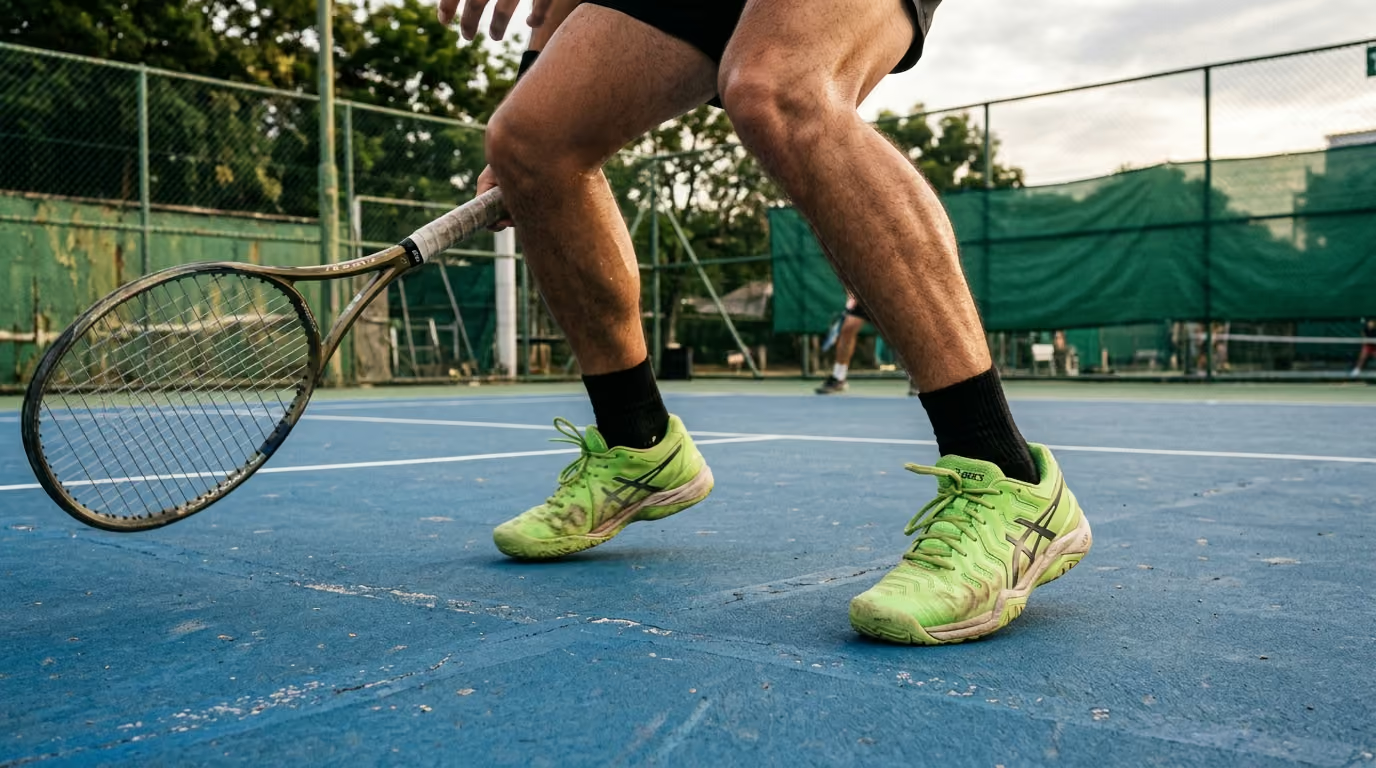
When players notice their court movements slowing down, targeted strength training can help older racquet sport athletes maintain their agility and protect their joints.




Many players believe that playing more matches is the best way to stay fit for racquet sports. They assume that running on the court provides all the conditioning their legs and lungs need. In reality, court play is highly demanding and asymmetrical. It exposes joints to sudden deceleration forces without building the muscular strength needed to absorb them.
To maintain athletic longevity in racquet sports, older players should perform structured resistance training at least twice per week. This training must focus on progressive loading across foundational movement patterns like squatting, hinging, lunging, pushing, and pulling. By prioritizing force production, single-leg stability, and rapid deceleration control, athletes can move with confidence and protect their joints on the court.
This comprehensive guide provides an evidence-based roadmap for older court athletes who want to preserve their movement. It avoids fitness fads and focuses on what the research shows is safe, effective, and necessary for healthy aging. Let us look at how the body responds to aging and how targeted training can protect your playing years.
Aging brings natural changes to our musculoskeletal system. According to research on masters athletes, strength and athletic performance decline significantly with age. This decline affects both men and women, while bone density also shows marked decreases, particularly in female athletes.
However, these declines do not mean you must accept a slower, more painful experience on the court. A systematic review published in clinical journals shows that resistance training can attenuate age-related limitations in functional mobility. This includes improvements in walking speed, static balance, dynamic balance, and overall fall risk.
When we design a strength program for older players, we must understand three distinct physical qualities. First is force production, which is how much weight your muscles can push or pull. Second is joint stability, which is how well you can control your body under rotation and during sudden direction changes. Third is the rate of force development, which is how quickly you can apply your strength.
Sarcopenia is the age-related loss of muscle mass, strength, and function. The European Working Group on Sarcopenia in Older People updated their consensus to define sarcopenia primarily through low muscle strength. This means that losing strength is a more critical marker of aging than losing muscle size alone. Dynapenia refers specifically to this loss of muscle strength and power that occurs independently of muscle mass.
Without targeted resistance training, this loss of strength can accelerate. When strength declines, your force reserve shrinks. This means that simple court movements, such as bending for a low volley, require a much higher percentage of your maximum capacity. This leads to faster fatigue, slower recovery, and a higher risk of joint strain.
Muscle power is the ability to produce force quickly. It is mathematically defined as force multiplied by velocity. In racquet sports, power is the quality that allows you to perform a split step, react to a short ball, or change direction quickly.
Research indicates that muscle power declines even faster than maximal strength as we age. A systematic review of power training in older adults found that power-oriented exercise significantly improves functional capacity and reduces fall risk. It may be even more important than basic strength for maintaining balance and preventing falls.
The rapid loss of muscle power is largely due to the selective atrophy of Type II muscle fibers. These fast-twitch fibers are responsible for explosive movements, rapid reactions, and fast deceleration. As we age, these fibers shrink more quickly than the slow-twitch Type I fibers that support endurance.
Resistance training, especially when performed with fast concentric intent, helps preserve these fast-twitch fibers. By keeping these fibers active, you preserve your ability to react quickly to an opponent's shot. This neuromuscular coordination is what keeps your first-step quickness sharp.
We must also look at eccentric strength, which is the ability to produce force while a muscle is lengthening. Eccentric strength is what allows you to brake. When you run to the sideline and slide or plant your foot to stop, your muscles must work eccentrically to absorb that momentum.
Isometric strength occurs when muscles produce force without visible joint movement. This is essential for stabilizing your core and hips during a swing. Developing both eccentric control and isometric stability ensures that your joints do not take the brunt of the impact during hard court sessions. To build these qualities safely, athletes should consult healthy athletic longevity resources to understand the physiological demands of aging.
To build a resilient body, you do not need to perform complex, circus-like movements. Instead, your training should focus on mastering nine foundational movement patterns. These patterns directly translate to the actions you perform during every match.
By using these patterns, we can structure a program that targets all major muscle groups. This approach builds balanced strength across both sides of the body. Let us break down each pattern, its relevance to racquet sports, and how to progress it safely.
The squat trains coordinated knee and hip flexion with subsequent extension. It is the movement you use to sink into a defensive ready position or rise from a low volley. It builds strength in the quadriceps, glutes, and core.
For older players, the squat should not be a test of maximum depth. The appropriate range of motion depends on your joint health and mobility. You can start with a high-chair sit-to-stand, which is a highly safe option.
To perform a proper box squat, stand with your feet shoulder-width apart in front of a stable bench. Slowly lower your hips backward and downward until your glutes lightly touch the seat. Keep your chest up and ensure your knees do not collapse inward. Press through your heels to return to the starting position under control.
Progressions:
The hinge trains the posterior chain, which includes your glutes, hamstrings, and lower back stabilizers. It involves bending at your hips while keeping your spine straight and neutral. This pattern is vital for acceleration, sudden braking, and protecting your lower back during low hits.
Many players overuse their lower back because they do not know how to hinge. Learning to push your hips backward while maintaining a flat back is a fundamental skill. This pattern teaches you to use your powerful hip muscles to produce force rather than relying on your spine.
To perform a correct hinge, stand with your feet hip-width apart. Imagine you are trying to push a drawer closed with your glutes. Bend forward at the hips with a very slight bend in your knees, keeping your back completely flat. Keep your weight in your heels and squeeze your glutes as you return to a standing position.
Progressions:
Racquet sports are dominated by single-leg movements and asymmetrical stances. Lunges train deceleration, weight transfer, and the ability to recover from a wide lunge. They also build strength in the hips, thighs, and calves.
In our experience, reverse lunges are often much easier on the knees than forward lunges. This is because they do not require you to catch your body's forward momentum. They allow you to load the glutes and hamstrings more evenly.
To perform a reverse lunge, stand tall with your feet together. Step backward with one foot and lower your hips until your front thigh is parallel to the floor. Keep your front knee aligned over your ankle, ensuring it does not wobble. Push off your front foot to return to the starting position.
Progressions:
Step-ups resemble the force demands of climbing, pushing off one leg, and running. Step-downs are even more valuable because they focus on eccentric control. They teach your quadriceps and hips to control your descent, which directly helps with braking on the court.
When performing these, choose a step height that allows you to keep your knee aligned with your toes. Avoid letting your knee collapse inward as you step down. Focus on touching the heel of your trailing foot to the floor softly.
To perform a slow step-down, stand on a low box or step. Slowly extend one foot forward off the box, lowering your hips by bending your standing leg. Take three to five seconds to lower your foot until your heel touches the floor. Push through your standing foot to return to the top under control.
Progressions:
Pushing strength supports your shoulder health, trunk stability, and chest development. It helps you brace during contact and provides the upper-body force needed for deep volleys. We must balance pushing exercises with pulling work to keep the shoulder joint healthy.
If you have a history of shoulder pain, you can use push-up variations that reduce joint stress. Wall and incline push-ups are excellent for reducing the load on the shoulders. They allow you to focus on proper body alignment without straining your neck.
To perform a correct push-up, place your hands slightly wider than shoulder-width apart. Keep your body in a straight line from your head to your heels, squeezing your glutes and core. Lower your chest until your elbows are at a 45-degree angle to your body, then press back up.
Progressions:
Pulling strength is essential for maintaining good posture and shoulder joint stability. It strengthens the upper back, latissimus dorsi, and posterior shoulder. These muscles act as the brakes for your arm during high-velocity swings and serves.
Older players often have rounded shoulders from daily desk work. Pulling exercises help open up the chest and restore proper scapular movement. This counterbalances the repetitive forward hitting motion used in racquet sports.
To perform a seated cable row, sit with your knees slightly bent and grasp the handle. Pull your shoulders down and back, then draw the handle toward your lower ribs. Keep your torso upright and avoid leaning backward as you pull. Slowly return the weight to the starting position to emphasize the eccentric phase.
Progressions:
Carries build grip strength, forearm endurance, and trunk stiffness. They teach your body to remain stable while moving under load. Grip strength is a major indicator of overall health and longevity in older adults.
A strong grip also improves your racquet control. It reduces the risk of developing tennis or pickleball elbow by distributing forces better. Carries train your core muscles to hold your spine steady as you step.
To perform a suitcase carry, hold a single dumbbell in one hand like a suitcase. Stand tall, pull your shoulders back, and engage your core muscles. Walk slowly in a straight line, keeping your torso completely upright without leaning toward the weighted side.
Progressions:
Racquet sports require rotational power, but they also require the ability to stop rotation. Anti-rotation exercises teach your core to resist unwanted movement, which protects your spine. This is critical for preventing lower back strains during awkward reaches.
Rather than performing endless sit-ups, focus on exercises that challenge your torso to stay stiff. This builds a stable midsection that can safely transfer force from your legs to your arms.
To perform a Pallof press, stand sideways to a cable machine or resistance band. Hold the handle at your chest with both hands and stand with your feet shoulder-width apart. Press the handle straight out in front of you, resisting the pull to rotate toward the machine. Hold for two seconds, then return the handle to your chest under control.
Progressions:
Most movements on the court occur on one leg at a time. If you cannot balance on one leg, you will struggle to line up your shots. Single-leg drills build strength in the ankle, foot, knee, and hip.
You do not need to use unstable surfaces like wobble boards to train balance. In fact, training on a solid surface allows you to produce more force and build real-world stability. It teaches your body to coordinate muscle contractions on a firm base.
To perform a supported single-leg stand, stand near a wall or sturdy rack. Lift one foot off the floor and balance on your standing leg, keeping your knee slightly unlocked. Hold this position for 30 seconds, using the wall only when you feel your balance slipping.
Progressions:
To get the most out of your strength training, you must understand how hard to work. Many older players make the mistake of lifting weights that are too light to stimulate adaptation. Others lift too heavy, which leads to joint pain and excessive fatigue. To find the right balance, players can review the strength and conditioning guidelines designed for racquet athletes.
The National Institute on Aging recommends muscle-strengthening activity at least two days per week. This should involve all major muscle groups at a moderate level of effort. The effort should be high enough that another repetition would feel difficult to complete.
A practical way to measure intensity is the Repetitions in Reserve scale. This scale measures how many more repetitions you could perform with good technique before failing. It allows you to train at the right intensity without needing to test your maximum strength.
We recommend staying in the moderate range for most of your training. This provides a strong stimulus for muscle growth and strength without overloading your joints. It ensures you can recover quickly for your next court session.
To build strength, the American College of Sports Medicine recommends training with heavier loads. This generally means lifting loads that are approximately 80 percent of your one-repetition maximum. This load usually corresponds to a weight you can lift for 6 to 8 repetitions before reaching fatigue.
To maintain muscle mass, you should aim for a higher volume of work. Research suggests that performing approximately 10 weekly sets per muscle group is a good target for muscle growth. However, this target can be lower if you are playing multiple matches per week. Your primary goal should be consistency rather than extreme exhaustion.
To train power, you must focus on moving weights quickly during the concentric phase. This is the phase where you push, pull, or stand up. The eccentric phase, or the lowering phase, should always remain slow and controlled.
Power training should use lighter loads, typically 30 to 70 percent of your maximum. You must perform each repetition with maximum speed intent. Stop the set immediately if your movement speed begins to slow down. Fatigued, slow repetitions do not train power and only increase your risk of injury.
Consistency is the key to athletic longevity, but you cannot train hard forever. Your body needs periods of recovery to adapt to the stress of lifting. This is why we use structured progression and planned deloads.
A progressive program starts with a minimum effective dose. This means doing the least amount of work necessary to see results. For most players, this means starting with two sessions per week, using basic exercises, and performing two sets per exercise.
The double progression method is a simple way to increase your weights safely. First, you choose a target repetition range, such as 8 to 12 reps. You keep the weight the same until you can perform 12 repetitions on all of your sets.
Once you can do this with perfect form, you increase the weight slightly. This will naturally drop your repetitions back down to the lower end of the range. You then work your way back up to 12 repetitions over the following weeks. This method prevents you from moving up in weight too quickly.
A deload is a planned reduction in training volume or intensity. It gives your joints, muscles, and nervous system a chance to fully recover. You should plan a deload week every four to six weeks, or whenever you feel persistent fatigue.
During a deload week, you do not stop training entirely. Instead, you can cut the number of sets you perform in half. You can also reduce the weight you are lifting by 20 percent. This allows you to maintain your movement patterns while giving your body a rest.
Your total training volume includes both your gym sessions and your court time. If you have a busy week of matches, you should reduce your gym workload. If you are in an off-season, you can increase your strength training to build a bigger physical base.
Always remember the "one variable at a time" rule. If you increase the weight you are lifting, do not also increase the number of sets. Changing too many things at once makes it difficult to identify what is causing joint irritation or fatigue. Keep a simple training log to track these adjustments.
While the foundational movements remain the same, each racquet sport has unique demands. Tennis, pickleball, and padel challenge your body in slightly different ways. Understanding these differences allows you to tailor your strength program to your chosen sport.
By adjusting your exercise selection, you can build the specific capacities you need on the court. Let us examine the distinct demands of each sport and how to adapt your training. You can also consult sport-specific injury prevention protocols to keep your body safe during play.
Tennis is played on a large court, which requires longer sprint distances and higher maximal velocities. Players must frequently sprint over 10 to 15 meters, brake hard, and change direction. This requires high levels of eccentric lower-body strength and robust lateral stability.
To support these demands, tennis players should place a strong emphasis on lateral lunges and deep split squats. They also need to train their rotational capacity to support powerful groundstrokes and serves. Since tennis involves substantial running, hamstring and calf strength are critical for preventing muscle strains.
Tennis-performance research highlights the importance of combining bilateral and unilateral lower-body exercises. It also emphasizes strengthening the shoulder, forearm, and trunk to handle the forces of racquet contact. A strong core helps transfer energy from the ground to your racquet.
Pickleball is played on a smaller court, but it requires extreme quickness and rapid reaction times. Players spend a significant amount of time in a low, loaded squat position at the kitchen line. This puts a high isometric demand on the quadriceps and glutes.
Pickleball players should focus on building endurance in a deep squat stance. Exercises like wall sits and split-squat holds are highly beneficial. Since the ball moves quickly, upper-body reaction time and wrist stability are also essential.
To protect your shoulders during quick paddle movements, prioritize pulling exercises and rotator cuff work. Exercises like face pulls and band external rotations will help keep your shoulders healthy during fast exchanges. Strengthening your forearms also improves paddle control and reduces wrist fatigue.
Padel is a fast-growing sport that combines elements of tennis and squash. It is played in an enclosed court, which requires constant turning, twisting, and reading the ball off the walls. This creates a high rotational demand on the torso and hips.
Padel also involves a large volume of overhead shots, such as the bandeja and vibora. This can place a lot of stress on the shoulder and upper back. Padel players must build excellent thoracic mobility and upper-body pulling strength to support these overhead actions.
In our experience, failing to prepare for these unique rotational demands can lead to severe stiffness. I remember finishing a tough two hour padel match on a cold Tuesday night and waking up the next morning feeling like my lower back was locked in concrete. For a long time, I just accepted this as the price of playing hard in my forties. But once I started spending just ten minutes on targeted hip mobility and anti-rotation drills before heading to the club, the stiffness almost completely vanished.
This experience taught our team that we do not have to accept pain as a default state of aging. By preparing your body for the specific rotational and decelerating forces of padel, you can enjoy the sport without paying a physical price the next day. Focus on cable chops, Pallof presses, and single-leg balance drills to build the stability needed for wall play.
Even with the best intentions, players can make mistakes that stall their progress or lead to injury. Understanding these pitfalls will help you stay on track and keep playing the sports you love. Let us look at ten common training errors and how to correct them.
Many players think that running on the court is all the leg training they need. While court play is great cardiovascular exercise, it does not build maximal strength or eccentric braking capacity. In fact, playing without a strength foundation can overload your joints and lead to chronic wear and tear. You must build your strength in the gym so you can express it safely on the court.
Racquet sports are naturally asymmetrical. If you only train your hitting side, you will create significant imbalances across your body. To prevent this, always include bilateral exercises and perform equal work on your non-dominant side. This helps balance your spine and pelvis, reducing the risk of lower back strain.
Some older players believe that lifting weights is dangerous for their joints. However, research shows that resistance training is highly safe for healthy older adults when supervised and progressed properly. Avoiding challenging weights means you will miss out on the strength adaptations needed to protect your bones and muscles. Your muscles must feel a challenge to grow stronger.
Many people believe that a workout is only effective if they feel sore the next day. This is a mistake, especially for court athletes. Excessive muscle soreness can ruin your court movement and force your body to use bad biomechanics to compensate. Your goal should be to leave the gym feeling energized, not completely exhausted.
Lifting weights until your muscles completely fail creates a massive amount of fatigue. For racquet players, this fatigue can bleed into your court practice and increase your injury risk. Keep one to three repetitions in reserve on most of your sets to ensure quick recovery. Training to failure should be a rare exception, not the daily rule.
Performing squats on a wobble board or foam pad is popular, but it is not the best way to train for court stability. Balance is highly task-specific. To build real court balance, perform single-leg drills, deceleration steps, and lateral lunges on a solid, stable floor. Unstable surfaces actually reduce the amount of force your muscles can produce.
Traditional sit-ups train your torso to flex, but court athletes need their core to resist movement and transfer force. Focus on anti-extension, anti-rotation, and carry exercises. These patterns build the trunk stiffness needed to support powerful swings and protect your lower back. Sit-ups can also place unnecessary stress on your cervical and lumbar spine.
Many older players focus solely on slow, controlled lifting. While this is great for building muscle mass, it does not train your nervous system to react quickly. To preserve your first-step quickness, include light, fast movements in your routine. Perform your concentric lifts with speed while keeping the lowering phase controlled.
Stretching can help with individual mobility issues, but a systematic review of clinical trials found that stretching alone does not prevent injuries. Strength training and proprioception training have shown much stronger protective effects. Do not let passive stretching replace active strength work. Use a dynamic warm-up to prepare for play instead of long static stretches.
It is easy to focus only on big muscle groups like the chest and legs. However, racquet sports repeatedly stress the delicate tendons of your shoulder, elbow, and wrist. Make sure to include external rotations, scapular rows, and grip carries to keep your hitting arm healthy. These smaller exercises build the local endurance needed for long three-set matches.
To get the full benefits of your strength training, you must provide your body with the right resources to rebuild. Recovery is where the actual adaptations happen. Without proper nutrition and sleep, lifting weights will only leave you feeling exhausted and sore. To optimize this process, athletes should study recovery science principles to support muscle repair.
As we age, our bodies become less efficient at processing protein. This means older athletes need to pay closer attention to their daily intake to maintain muscle mass and recover between matches.
The International Society of Sports Nutrition recommends that active individuals consume 1.4 to 2.0 grams of protein per kilogram of body weight each day. This range is highly appropriate and safe for active older adults who want to maintain their muscle mass. For a 75-kilogram player, this means consuming between 105 and 150 grams of protein daily.
It is also important to distribute your protein intake evenly throughout the day. Aim for 30 to 40 grams of high-quality protein with each meal to maximize muscle protein synthesis. Good sources include lean meats, fish, eggs, dairy, and plant-based proteins.
Carbohydrates are your body's primary fuel source for high-intensity court sessions. Ensure you are consuming enough healthy carbohydrates, such as whole grains, fruits, and vegetables, to keep your energy levels high. This prevents your body from breaking down muscle tissue for energy during long matches.
Proper hydration is equally critical. Dehydration reduces joint lubrication, decreases reaction time, and accelerates fatigue. Drink water consistently throughout the day, and consider electrolyte drinks during long, sweaty matches.
No supplement or recovery tool can replace the benefits of high-quality sleep. During deep sleep, your body releases growth hormones that repair tissue damage and build stronger muscles. Aim for seven to nine hours of quality sleep each night to support your training.
Ensure you have at least one full day of rest each week. On this day, avoid intense physical activity and focus on light walking or gentle mobility work. This active recovery helps clear metabolic waste and keeps your joints moving smoothly.
While strength training is highly safe and beneficial, there are times when you should consult a professional. Knowing the difference between normal training fatigue and a potential injury is vital for your long-term health. If you are unsure of your movement quality, visiting the main Evercourts platform can help you find specialized coaching guidance.
If you experience any warning signs, do not try to push through them. Seeking early advice from a physical therapist or medical doctor can prevent minor issues from becoming chronic injuries.
You should seek professional medical evaluation if you notice any of the following symptoms:
If you have a history of cardiovascular disease, seek medical clearance before starting a new resistance routine. The National Institute on Aging advises stopping any exercise immediately if you feel pressure in your chest, nausea, or lightheadedness.
If you are concerned about rapid strength loss or repeated falls, a physical therapist can perform specific functional tests. The European consensus on sarcopenia uses several screening benchmarks:
These markers can help identify if you need a more specialized, supervised rehabilitation program. Never hesitate to partner with a qualified coach or therapist to build a safe plan.
Let us look at how to put these principles into action. Below are two practical full-body templates designed for racquet sports players. One is a beginner template for those new to lifting, and the other is an intermediate template for experienced players.
Choose the template that matches your current fitness level. Always perform a dynamic warm-up before you start lifting, and focus on moving with perfect form.
Perform this workout twice per week, with at least 48 hours of rest between sessions. Focus on learning the movements and keeping 3 repetitions in reserve.
Session A:
Session B:
This template is for players who have at least six months of consistent lifting experience. It separates sessions into strength-focused and power-focused days.
Strength Emphasis Session:
Power Emphasis Session:
To help you visualize how to apply these concepts, let us look at four common player profiles. These case patterns show how small adjustments to a program can yield significant improvements on the court.
This player is strong in the gym and can squat a respectable amount of weight. However, they feel clumsy when moving side to side on the court. They struggle to brake quickly and often arrive late to wide balls.
For this player, the priority is not building more bilateral squat strength. Instead, they need to focus on lateral stability, eccentric braking, and unilateral control.
This player has excellent court endurance but has noticed a steady decline in their serve speed. They feel like they are swinging as hard as they can, but the ball lacks power. They often end up with a sore shoulder after serving.
This player is losing rotational power and lower-body force transfer. They need to train their body to transfer energy from the ground up through their hips and torso.
This player has recently recovered from mild knee pain and wants to return to the court safely. They are nervous about lunging and stopping suddenly during matches.
This player needs to build tissue tolerance and movement confidence in a gradual, pain-free manner. They should start with supported exercises that reduce the shear stress on the knee.
This player has great cardiovascular fitness from running or playing singles matches. However, they lack overall muscle mass and feel weak when playing against powerful opponents. They are highly susceptible to fatigue and joint strains during long tournaments.
This player needs to build total-body muscle mass to increase their physical reserve. They should focus on a classic hypertrophy-oriented strength program with proper nutritional support.
Strength training is not about looking like a bodybuilder; it is about building the physical capability to play the sports you love for years to come. By moving with control, lifting with progressive resistance, and respecting your recovery needs, you can stay strong, mobile, and confident on the court.
Follow Evercourts for practical insights on tennis, pickleball and padel performance, movement, recovery and healthy ageing. Stay connected for new articles, research-led guidance and ideas to help you play well and keep playing for years.


Read practical guidance for better movement, smarter preparation and a game that keeps working for you.
explore the Blog