
Injury-free racket sports performance depends on balancing physical stress, match duration, and recovery to protect your joints and muscles over time.




Training load is the total physical, physiological, and mental stress placed on your body by athletic training, match play, and daily life. It is not simply the number of minutes you spend holding a racket or paddle. Understanding this concept is the key to maintaining your athletic longevity and playing the sports you love for decades.
In plain terms, training load represents the cumulative stress your body must recover from after every match, practice, and physical task. You can calculate this easily by multiplying the duration of your session by how hard it felt on a scale of one to ten. Tracking this total number helps you avoid sudden spikes in activity, which are the primary drivers of tendon, joint, and muscle problems.
In our experience at Evercourts, players often treat their court time as a simple calendar event. If they played for two hours, they assume they did two hours of work. But this view ignores how hard their cardiovascular and muscular systems actually labored. It also ignores the toll that daily life, stress, and poor sleep take on their physical capacity. To build a sustainable routine, you must understand the difference between external and internal stress.
To manage your schedule properly, you must distinguish between two main categories of workload. The first category is external load. This is the physical work you completed on the court or in the gym. It includes measurable data such as the minutes played, games completed, miles run, or pounds lifted. This is the work you can easily write down in a journal or see on a sport watch.
The second category is internal load. This is the physiological and psychological response your body has to that external work. A two hour match in cool weather might feel easy. The exact same match in humid conditions will trigger a much higher internal stress response. Your heart rate will be higher, your breathing will be heavier, and your muscles will fatigue faster.
Our team has spent years observing how these two factors interact. I remember finishing a tough two hour padel match on a cold Tuesday night and waking up the next morning feeling like my lower back was locked in concrete. For a long time, I just accepted this as the price of playing hard in my forties. But once I started spending just ten minutes on targeted hip mobility before heading to the club, the stiffness almost completely vanished. It taught me that we do not have to accept pain as a default state of aging.
To fully understand how your body reacts to play, you must look at the different types of physical stress. Mechanical load involves the force transmitted through your joints, tendons, and muscles during impact. Think of the sudden braking, lateral lunging, and explosive jumps required to reach a drop shot. This type of stress primarily affects your ankles, knees, hips, and lower back.
Metabolic load is the cardiovascular demand of your play. It is driven by how long your rallies last, how brief your rest periods are, and the environmental temperature. High metabolic load leaves you breathing heavily and elevates your heart rate. It drains your energy reserves and requires systemic recovery. It is the type of tiredness that makes you want to lie down after a match.
Neuromuscular load is the demand on your nervous system to coordinate fast, powerful movements. This load is high when you perform maximum sprints, rapid changes of direction, or high-velocity overheads. Even if a session is short, high neuromuscular demand can leave your muscles feeling flat and sluggish. Your brain simply cannot send signals to your muscles as quickly as usual.
Finally, local tissue load refers to stress focused on a specific body part. For court athletes, this usually affects the rotator cuff, the elbow tendons, or the Achilles tendon. A serving practice might not make you lose your breath, but it places a massive local tissue load on your shoulder. Tracking both global and local load is essential for healthy aging and long-term athletic participation. You can read more about balancing these physical demands in our court performance and longevity resources.
Sports scientists have spent decades researching how physical stress relates to athletic performance and injury rates. A common metric used in professional sports is the acute to chronic workload ratio, or ACWR. To find this ratio, you compare your acute load, which is your current seven day workload, to your chronic load, which is your average weekly workload over the past four weeks. This calculation helps coaches see if an athlete is ramping up their training too quickly.
Historically, sports medicine consensus statements suggested that keeping your ACWR between 0.8 and 1.3 was the safest approach. When a player’s weekly workload rose quickly, leading to an ACWR above 1.5, studies in team sports showed a higher likelihood of tissue breakdown. However, modern scientific research shows that this mathematical formula is not a perfect injury predictor. The relationship between training numbers and injury is far more complex than a single mathematical equation.
A comprehensive meta-analysis found only a small to moderate link between high ACWR values and actual injuries. The relationship is highly individual and depends heavily on your training history, age, and physical preparation. For instance, a player who has built high chronic fitness can tolerate sudden schedule changes much better than a beginner. Research also highlights that building a high, consistent chronic workload can actually protect your tissues from injury. The goal is not to avoid hard work, but to prepare your body to handle it.
Another key concept in sports science is training monotony. Monotony measures how similar your daily training sessions are throughout the week. If you perform the same moderate intensity court drills every single day, your monotony score will be high. High training monotony, combined with a high overall workload, creates a metric known as training strain.
Research indicates that high training strain is strongly linked to overtraining and joint irritation. Your body requires clear variance to adapt and grow stronger. This means your weekly plan must include dedicated high intensity days, low intensity recovery days, and complete rest days. Without this variation, your soft tissues remain in a constant state of low grade inflammation, which hinders tissue remodeling. You can learn more about managing these systemic variables by visiting our resource on managing player health on and off the court.
While all three sports are played on a court, they impose unique physical demands on your body. Understanding these differences allows you to customize your tracking and preparation. Tennis is characterized by large court dimensions, explosive linear sprints, and repetitive high-velocity serving. The physical footprint of a tennis court requires immense movement capacity and power.
A typical three set tennis match can involve several hundred high-intensity efforts. Players must cover a wide area, which places high metabolic and mechanical stress on the entire body. The serve is the most physically taxing stroke in tennis, requiring full-body coordination and generating high forces through the shoulder, elbow, and spine. This repetitive overhead motion requires excellent thoracic mobility and rotator cuff strength.
Because of these demands, tennis players must monitor match minutes, practice minutes, and serve volume separately. A sudden increase in tennis play can lead to rotator cuff irritation or lower back stiffness. If you are returning to the court after a break, you must rebuild your serving tolerance slowly over several weeks to avoid shoulder strain. You can read more about these specific requirements in our guide to tennis physical demands and training.
Pickleball is played on a much smaller court, which often leads players to assume it is physically easy. However, epidemiology studies show a significant rise in pickleball-related injuries, particularly among players aged sixty to seventy-nine. The rapid growth of the sport has brought many previously sedentary adults to the court. These players often have lower baseline tendon and joint capacity, making them more susceptible to sudden changes in activity.
In pickleball, the primary physical stressors are rapid lateral steps and sudden deep lunges at the non-volley zone line. These movements require excellent balance, leg strength, and ankle mobility. Older players face a higher risk of trips, falls, and extremity fractures when moving backward. Therefore, pickleball load tracking should focus on consecutive playing days, lunge counts, and systemic fatigue. Discover more about safe progression in our articles on pickleball performance and injury patterns.
Padel is played within a glass enclosure and combines constant lateral movement, wall rebounds, and frequent overhead actions. Because the ball remains in play longer, rallies are often extended and require continuous activity. This creates a high metabolic demand, even if you do not cover the wide distances found in tennis. The constant changing of directions means your feet and ankles are always working.
The structural design of padel requires players to hit many overhead shots, such as the bandeja and the smash. This repetitive overhead action places substantial local tissue load on the shoulder and elbow. Tendon and muscle injuries are common in padel, with the elbow being a frequent site of complaint. Padel players must track match duration, consecutive playing days, and overhead stroke volume to prevent chronic tendon issues. For more details on padel movement, see our resources on padel movement mechanics and recovery.
To manage your physical stress, you do not need expensive technology or wearable sensors. A simple notebook, spreadsheet, or notes app on your phone is highly effective. The foundation of this system is the session rate of perceived exertion, or sRPE. This method is highly validated in sports science research and is incredibly easy to use.
After every physical session, wait about thirty minutes to let your nervous system settle. Then, rate how hard the session felt on a scale from zero to ten. On this scale, zero represents complete rest, while ten represents a maximal effort that left you completely exhausted. Be honest with your ratings. A friendly doubles match might be a three, while a competitive singles match could be an eight.
Once you have your rating, multiply that number by the total duration of the session in minutes. This calculation gives you a single workload score in arbitrary units. For example, if you played a moderate singles tennis match for ninety minutes and rated it a six, your score is 540 units. This number represents the total internal stress of that specific session.
If you performed an easy forty-five minute recovery walk and rated it a two, your score is ninety units. This method allows you to compare different activities on a single scale. You can track your weekly totals by adding these daily numbers together. Over time, you will establish a normal baseline range for your typical training week.
To make your data actionable, apply a simple traffic light model to your weekly review. The green light means your weekly total is within ten to fifteen percent of your recent average. During green weeks, you feel energetic, experience no new joint pain, and sleep well. This is your training sweet spot where you are building capacity without excessive risk.
The amber light indicates your weekly workload has increased by twenty percent or more. This might happen during a tournament week or when you add a new training session. In amber weeks, you may notice mild morning stiffness or increased general fatigue, requiring you to prioritize sleep and hydration. You should avoid back to back amber weeks to prevent tissue overload.
The red light is a warning that your workload has spiked dramatically or that your body is failing to recover. This is marked by persistent pain that changes how you move on the court, severe fatigue, or poor sleep. If you hit a red week, you must immediately reduce your playing time and focus on active recovery. This traffic light system acts as a simple guide to help you make smart decisions about your playing schedule.
To play your best and protect your joints, you must gradually build your physical capacity. The human body is highly adaptable, but it requires time to reinforce tendons and muscles. The most important rule of progression is to change only one major training variable at a time. If you violate this rule, you risk overloading your tissues.
Training variables include session duration, session intensity, weekly frequency, and match density. If you decide to increase your playing time from two hours to three hours a week, keep your intensity moderate. Do not try to increase your playing hours and start a high-intensity sprinting program in the same week. This double increase is where many recreational players run into trouble.
If you alter too many factors at once, your body cannot adapt efficiently. It also makes it impossible to identify the cause of any sudden joint flare-ups. Slow, methodical changes allow your soft tissues to remodel without becoming inflamed. Think of building physical capacity as a long-term investment rather than a quick sprint.
Many recreational players make the mistake of entering a multi-day tournament with no preparation. They go from playing once a week to playing three high-intensity matches in forty-eight hours. This sudden workload spike is a common cause of acute tendon injuries and severe muscle strains. Your tissues are simply not prepared for that concentration of mechanical and metabolic stress.
To compete safely, you must prepare your body for the specific demands of tournament play. Spend the preceding six weeks gradually increasing your court time and playing consecutive days. This physical preparation builds a high chronic workload, which acts as a protective shield for your joints. It ensures your body is accustomed to recovering quickly between matches.
A sustainable weekly schedule alternates high-load days with low-load recovery days. Avoid scheduling hard matches, heavy leg workouts, and intense drills on consecutive days. For example, if you play a demanding singles match on Monday, make Tuesday a day for technical practice, light walking, or mobility work. This approach allows your nervous system and muscles to recover.
This undulating pattern gives your muscles and tendons time to repair before the next heavy stressor. It also helps lower your weekly training monotony, reducing overall physical strain. Remember to schedule one full day of complete rest each week to allow your mind and body to fully reset. A well-planned week is the foundation of athletic longevity.
Some players believe that strength training is only for younger athletes or bodybuilders. In reality, regular resistance training is the most effective way to maintain athletic longevity and support healthy aging. The World Health Organization recommends that all adults perform muscle-strengthening activities at least two days per week. This advice is even more critical for court athletes who must absorb high impact forces.
For court athletes, your strength program should focus on fundamental, multi-joint movements. These include squats, hinges, lunges, pulling exercises, and pressing movements. These exercises build the structural capacity of your muscles, tendons, and bones, making them more resilient on the court. They also help maintain your muscle mass as you age, which is vital for physical independence.
Single-leg exercises, such as step-ups and lunges, are highly valuable for tennis, pickleball, and padel. They improve your balance, single-leg stability, and deceleration mechanics. Strong calf muscles and robust Achilles tendons are also crucial for preventing lower-limb injuries during quick court movements. You can find comprehensive guidance on building a structured routine in our strength and conditioning guides for racket sports.
You must remember that strength training is not separate from your weekly workload; it contributes to your total physical stress. When you start a resistance program, you may need to temporarily reduce your court time. This prevents your overall weekly load from spiking into the red zone. Your body needs time to adapt to the new mechanical stress of lifting weights.
Use the same sRPE method to track your strength workouts. A forty-five minute gym session rated as a seven contributes 315 units to your weekly total. As your body adapts to the strength work, your overall physical capacity will rise, allowing you to handle more court time safely. Strength training is an investment that pays massive dividends in your court performance and injury resistance.
Your body does not distinguish between the physical stress of a tennis match and the physical stress of daily life. All sources of stress pool into a single systemic bucket. If your daily life is exceptionally demanding, your capacity to recover from court play decreases. This means you must view your training load through a holistic lens.
Everyday tasks such as gardening, manual labor, walking, and carrying heavy items contribute to your total physical workload. If you spend five hours doing heavy yard work on Saturday morning, your body is already fatigued. Playing a competitive match that afternoon will impose a much higher internal stress than usual. Your muscles will be pre-fatigued, and your joints will have less shock absorption capacity.
For older adults, these daily physical tasks make up a significant portion of their total capacity. It is helpful to log these activities in your tracking journal. You do not need to calculate precise units, but you should note if your daily physical demand was low, medium, or high. This simple step helps you understand why some court sessions feel much harder than others.
Psychological stress, work deadlines, travel, and poor sleep have a profound impact on your recovery. When you are stressed or sleep-deprived, your body produces higher levels of stress hormones, which delay tissue healing. Poor sleep also reduces your coordination, reaction time, and pain tolerance on the court. It makes you more susceptible to acute injuries such as ankle sprains or trips.
If you are going through a highly stressful period at work or sleeping poorly, reduce your court intensity. Choose easy technical drills or friendly doubles play over high-stakes singles matches. Adapting your schedule to match your current life circumstances is a vital part of protecting your athletic longevity. It shows a mature understanding of how your body actually works.
One of the most frequent errors we observe is treating mathematical formulas, such as the acute to chronic workload ratio, as a perfect injury calculator. Some players assume that if their ratio is 1.1, they are completely safe from injury. Conversely, they may panic if their ratio rises to 1.6, believing a joint injury is guaranteed. This rigid interpretation ignores the highly individual nature of physical training.
In reality, these mathematical ratios are simple warning lights, not physical laws. They do not account for your specific technical quality, the surface you play on, or your unique medical history. A player with poor biomechanics will place much higher local stress on their elbow than a player with clean technique, regardless of the workload numbers. Use these numbers to notice general trends and make sensible adjustments to your schedule.
Another major mistake is assuming that a smaller court size, such as in pickleball or padel, means low physical risk. While you may not run as far as you would in tennis, these sports feature rapid, explosive movements and frequent overheads. The local tissue stress on your Achilles tendon, knees, and elbows can still be exceptionally high. Never underestimate the physical demands of a sport just because the playing area is smaller.
Many players believe that the only solution to a joint flare-up is to stop all physical activity for several weeks. While short periods of rest are sometimes necessary, prolonged complete rest can actually make your tissues weaker. When you stop moving, your muscles and tendons lose their capacity to handle force. When you eventually return to play, your tissues are even less prepared, often leading to a cycle of re-injury.
A more effective approach is to use relative rest, which involves reducing the load on the painful tissue while staying active. If your shoulder is sore from serving, stop serving but continue your leg strength work and aerobic conditioning. This keeps your overall physical capacity high, making your eventual return to full play much safer. Active recovery is almost always superior to complete inactivity.
Every time you play, your muscles, tendons, and bones experience microscopic damage. This damage is normal and is the precise trigger that tells your body to grow stronger and more resilient. However, this positive adaptation only occurs during periods of rest and recovery. If you do not allow sufficient recovery time, your body remains in a state of breakdown, which eventually leads to injury.
Different tissues in your body recover at different rates. Muscle tissue has a rich blood supply and typically heals within twenty-four to forty-eight hours after a hard session. Tendons and ligaments, however, have a much poorer blood supply, meaning they require more time to recover and adapt to high forces. A tendon may take seventy-two hours or longer to fully recover from a high-impact session.
If you do not allow sufficient recovery time between sessions, your tendons remain in a state of continuous breakdown. Over several weeks, this can lead to chronic tendinopathy in your elbow, knee, or Achilles tendon. This is why managing your weekly load and avoiding back to back high-load days is so critical for joint health. It gives your slower-healing tissues the time they need to rebuild.
Systemic recovery is heavily dependent on basic lifestyle habits. Sleep is the most powerful recovery tool available to athletes. During deep sleep, your body releases growth hormones that facilitate tissue repair and muscle growth. Aim for seven to nine hours of quality sleep per night to support your training load. Poor sleep quality will instantly reduce your physical capacity and increase your injury risk.
Proper hydration and nutrition are also essential for tissue healing. Drinking sufficient water helps maintain the elasticity of your fascial tissues and supports joint lubrication. Consuming adequate protein provides the building blocks your body needs to repair muscle fibers and reinforce tendon structures. Without these basic foundations, even the best workload tracking system will fail to protect your joints.
While tracking your training load can prevent many common physical issues, it is important to know when to seek professional help. Do not try to push through severe pain or ignore symptoms that alter how you move on the court. Working with a qualified physical therapist or sports medicine physician can help you address issues before they become chronic. Early intervention is the key to maintaining your athletic longevity.
You should consult a healthcare provider if you experience any of the following warning signs:
A professional assessment can give you a clear diagnosis and a targeted rehabilitation plan. They can help you identify specific weaknesses in your kinetic chain and guide you on how to adjust your training load safely. Remember that pain is a signal from your body that something needs to change, and ignoring that signal rarely leads to a positive outcome.
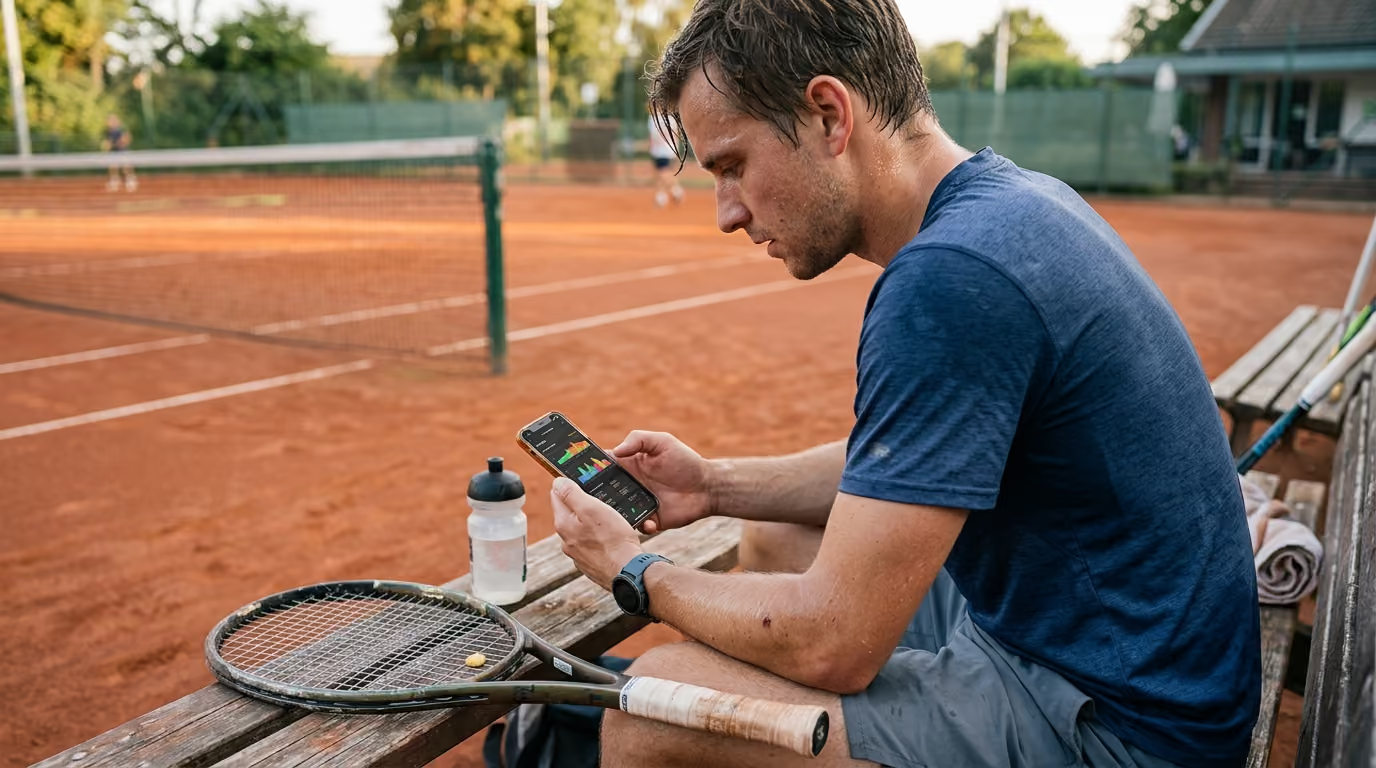
Yes, smartwatches are excellent for tracking external load metrics such as steps, distance, and heart rate. However, they often struggle to accurately capture the local joint stress of court sports, such as the shoulder load of serving or the impact forces of lateral lunging. Combining your watch data with the simple sRPE method gives you a much more complete picture of both your internal and external workload.
If you experience an unexpected spike in workload, do not panic. The key is to adjust your schedule for the next several days to allow your body to recover. Replace any high-intensity sessions with light walking, gentle mobility work, or complete rest. This proactive adjustment helps bring your acute workload back into a safe range and prevents the spike from causing tissue damage.
Playing multiple sports is great for overall physical development, but it requires careful coordination. You must track all of these sessions in a single master log using the sRPE method. This ensures you do not inadvertently double your weekly workload. Try to schedule your most demanding tennis and pickleball sessions on separate days, and include a dedicated rest day to allow your body to recover from both movement patterns.
While doubles play generally involves less running and lower cardiovascular demand, it does not cut your physical load in half. You still perform rapid lateral steps, sudden lunges, and repetitive overhead strokes. The mechanical and neuromuscular stress on your joints remains high. You should still track your doubles sessions using the sRPE method, though you may find your intensity rating is slightly lower than a singles match of the same duration.
Follow Evercourts for practical insights on tennis, pickleball and padel performance, movement, recovery and healthy ageing. Stay connected for new articles, research-led guidance and ideas to help you play well and keep playing for years.


Read practical guidance for better movement, smarter preparation and a game that keeps working for you.
explore the Blog