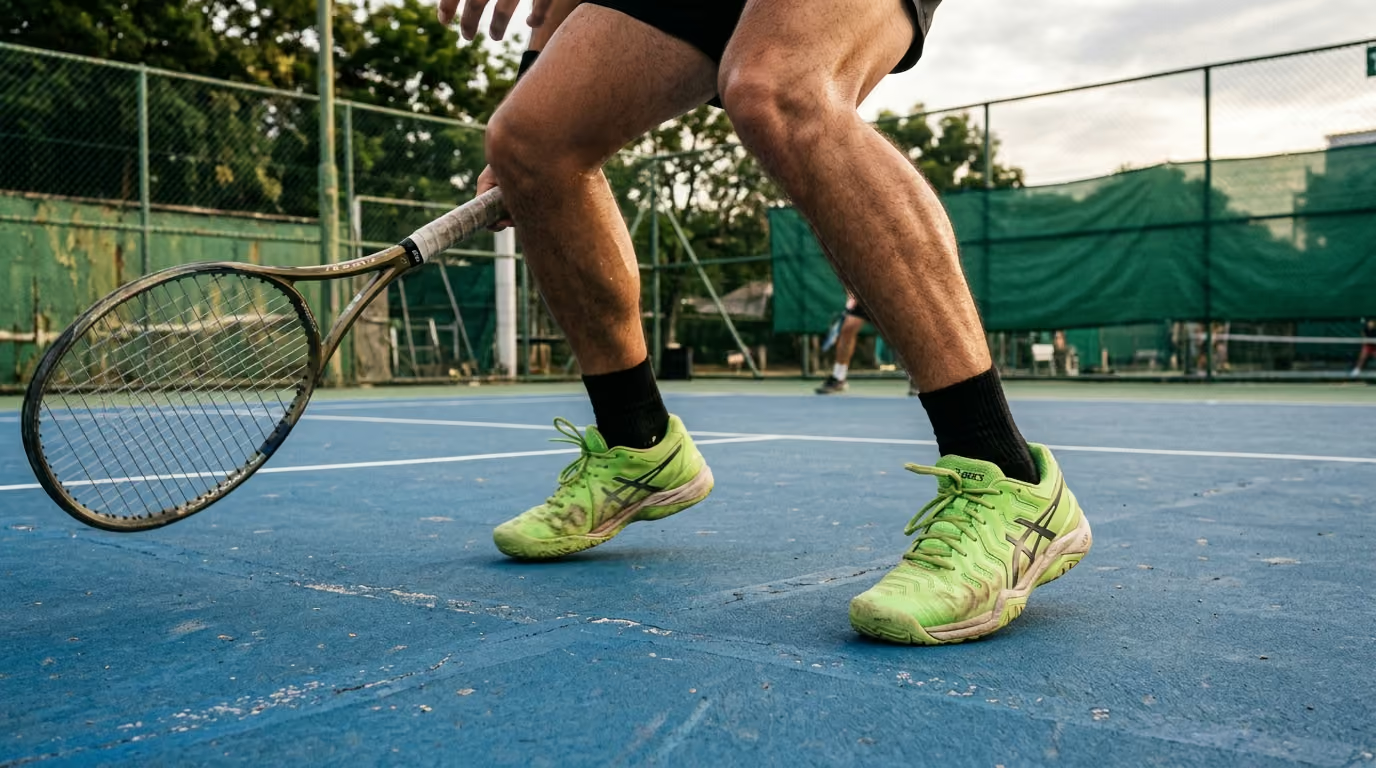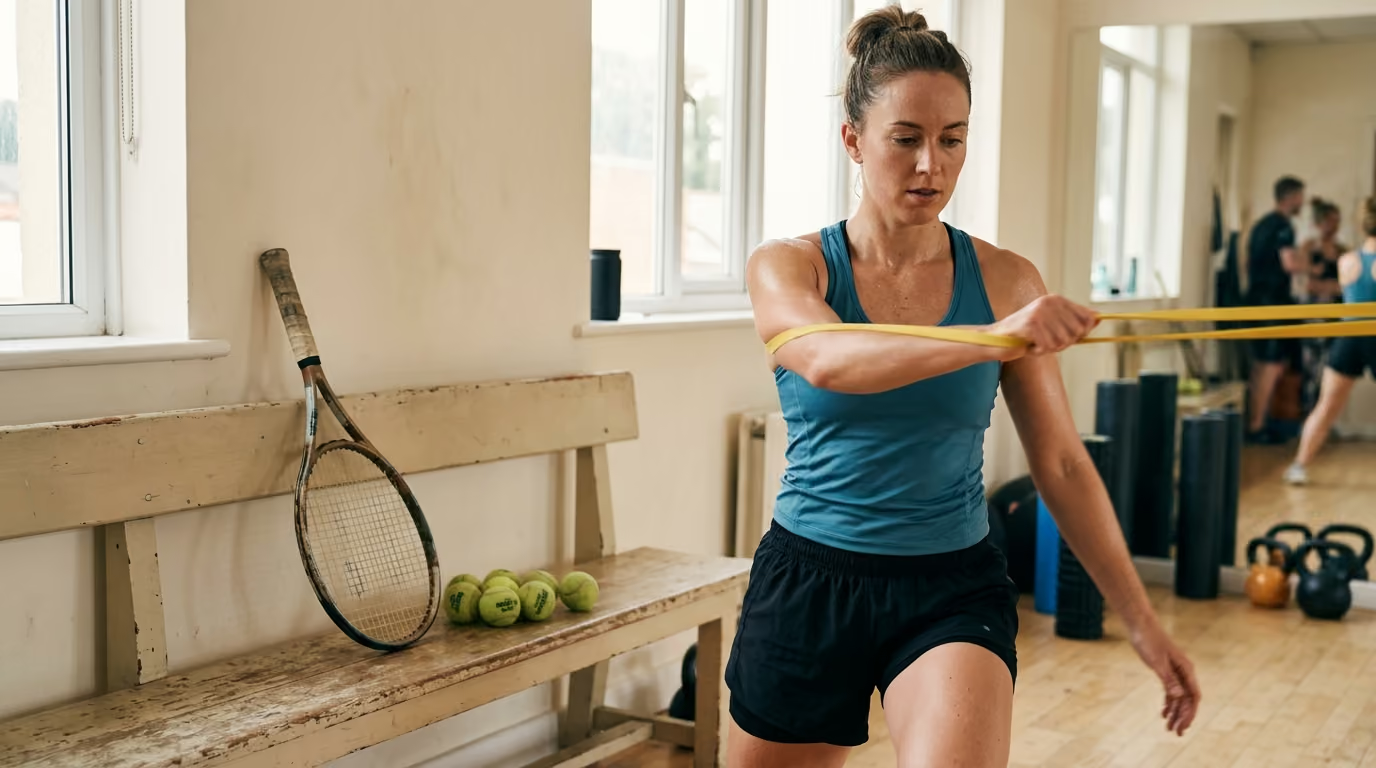

While many assume upper-body strength for racquet sports requires exhaustive bodybuilding, court performance actually demands a highly specific approach to training.




Imagine finishing a long, competitive match and feeling a deep, persistent ache in your hitting shoulder. You might think this discomfort is just the unavoidable cost of playing racquet sports as you age. Many players assume that getting stronger in the gym requires long, exhausting bodybuilding routines. However, court performance demands a highly specific approach to upper-body training.
To build an upper body that supports fast racket speed and lasting shoulder health, you must focus on balanced pushing and pulling alongside targeted rotator cuff and scapular work. Rather than trying to build bulky muscles, a court athlete should train the upper body to transfer power efficiently from the legs through a coordinated kinetic chain. This approach stabilizes the shoulder joint, protects the elbow, and keeps you playing without interruption.
I remember finishing a tough two hour padel match on a cold Tuesday night and waking up the next morning feeling like my lower back was locked in concrete. For a long time, I just accepted this as the price of playing hard in my forties. But once I started spending just ten minutes on targeted hip mobility before heading to the club, the stiffness almost completely vanished. It taught me that we do not have to accept pain as a default state of aging. The same principle applies to your shoulders and elbows.
To improve your shots, you must understand that the shoulder is not an isolated power source. In racquet sports, force travels through a coordinated sequence of muscle groups. This sequence is known as the kinetic chain.
The energy for a powerful serve or groundstroke begins in the ground. It travels through the feet, legs, knees, hips, trunk, shoulder, elbow, wrist, hand, and finally into the racket. According to research on rotator cuff injuries in tennis players, any break in this chain increases the mechanical load on your upper extremity. If your legs or trunk do not contribute enough force, your shoulder and elbow must overwork to compensate. This compensation often leads to overuse injuries and reduced ball velocity.
Biomechanical studies show exactly how different joints contribute to racket speed. In a three dimensional analysis of 66 male tennis players, shoulder internal rotation contributed 41.1% of horizontal racket-head velocity at impact. Wrist palmar flexion contributed 31.7%. Together, these two movements account for nearly three quarters of your hitting power.
However, you should not try to increase your racket speed by simply training these two movements in isolation. A pilot study of 42 competitive tennis players found that serve speed is highly multifactorial. The researchers found that serve speed was predicted by a combination of skill, height, hip mobility, single-leg hopping power, and unilateral upper-body power. Specifically, these factors explained 84% of the variance in serve speed.
Additional research published in 2025 studied 15 nationally ranked junior tennis players to identify physical correlates of serve speed. The study found that lean arm mass had a very strong correlation with serve speed. Concentric shoulder external-rotation and internal-rotation strength at fast speeds also showed significant correlations.
Interestingly, grip strength was not significantly correlated with serve speed in this sample. This suggests that while a secure grip is necessary to control the racket, raw grip strength does not dictate ball velocity. Instead, the total muscle mass of the arm and the rotational strength of the shoulder joint are far more influential.
The rotator cuff consists of four small muscles: the supraspinatus, infraspinatus, teres minor, and subscapularis. Together, these muscles work to keep the head of your arm bone centered in its shallow socket. They also produce internal and external rotation while stabilizing the joint during high-speed movements.
During the follow-through of a serve or smash, your rotator cuff must work incredibly hard. The forward swing of a tennis serve can reach an angular velocity of approximately 2420 degrees per second. After contact, the muscles at the back of your shoulder must contract eccentrically to slow your arm down. This rapid braking action generates immense tensile forces that can progressively overload the tendons over time.
Because of these extreme demands, shoulder injuries are common among racquet players. Research indicates that the overall prevalence of shoulder injuries in tennis players ranges from 4% to 17%. The injury incidence is estimated between 0.05 and 2.9 injuries per player each year.
Interestingly, medical imaging does not always match physical pain. In one study of asymptomatic overhead athletes, 40% of their dominant shoulders showed rotator cuff tears on MRI scans. These athletes felt no pain and played without limitation. This means some structural changes are simply healthy athletic adaptations to the physical demands of the sport.
However, strength imbalances are highly correlated with actual pain and injury. A study of 58 elite male tennis players compared those with a history of shoulder pain to those without. The players with a pain history had significantly weaker external-rotation strength on their dominant side. They also had a lower ratio of external-to-internal rotation strength.
Specifically, the pain-free players had an external-to-internal strength ratio of 0.79. The players with a history of pain had a ratio of 0.68. This demonstrates that keeping the muscles at the back of your shoulder strong relative to the front is vital for long-term health.
A 2025 systematic review and meta-analysis confirmed these findings across 29 different studies. The researchers identified that a lower external-to-internal rotation strength ratio was a significant risk factor for serve-related injuries. They also noted that weekly playing volume, age, and body mass were key risk factors. Managing your total workload while training the decelerator muscles of the shoulder is the best way to maintain physical durability.
The shoulder blade, or scapula, also plays a critical role in this system. It must slide, tilt, and rotate smoothly to provide a stable base for your arm. If the shoulder blade does not move correctly, a condition called scapular dyskinesia can develop. This movement error reduces the space in your shoulder joint, which can lead to painful pinching of the rotator cuff tendons.
To address all of these physical demands, you should follow a structured training system. Our team recommends organizing your program into six distinct training pillars. This ensures that you build power, stability, and endurance without creating physical imbalances. You can find more comprehensive strategies in our Strength & Conditioning Resources to help structure your weekly routine.
Pressing exercises build force capacity in your chest, anterior shoulders, and triceps. These muscles help you push off opponents in close-quarters padel play and provide stability during heavy volleys.
The dumbbell bench press is an excellent choice because it allows your hands to rotate naturally. This natural rotation reduces stress on the front of the shoulder compared to a rigid barbell. Focus on lowering the weights slowly under control, pausing briefly at the bottom, and pressing up smoothly.
The half-kneeling landmine press is another highly effective variation. By pressing a barbell at an angle from a kneeling position, you reduce the need to reach directly overhead. This is highly beneficial for players who experience mild shoulder discomfort when lifting their arms straight up. It also forces your core muscles to engage to keep your torso upright.
Push-ups and weighted push-ups are excellent closed-chain movements. Unlike the bench press, a push-up allows your shoulder blades to move freely across your ribcage. This free movement supports healthier scapular function. Make sure to keep your body in a straight line from your head to your heels during every repetition.
Pulling exercises target the latissimus dorsi, rhomboids, middle trapezius, and posterior rotator cuff. These muscles act as the brakes for your high-speed swings. They also help maintain good posture, which is essential for efficient energy transfer.
The chest-supported dumbbell row is a premier exercise for isolating the upper back. By resting your chest on an incline bench, you eliminate momentum and prevent your lower back from doing the work. Pull your elbows toward your hips and squeeze your shoulder blades together at the top of each movement.
One-arm cable rows are highly functional because they allow you to rotate your torso slightly. This rotation mimics the rotational demands of groundstrokes and volleys. Stand in a split stance, row the cable toward your ribs, and control the weight as it returns to the starting position.
Inverted rows using a suspension trainer or barbell are highly adjustable. You can change the angle of your body to make the exercise easier or harder. This movement teaches you to keep your core stiff while pulling your shoulder blades into retraction.
Rotator-cuff training must move beyond light, mindless band warm-ups. You need to progressively challenge these muscles to tolerate the rapid forces of the court.
The side-lying external rotation is one of the most effective exercises for isolating the infraspinatus and teres minor. Lie on your side with a small rolled towel tucked under your upper arm. Hold a light dumbbell, keep your elbow bent at 90 degrees, and rotate your forearm up toward the ceiling. Lower the weight slowly over three seconds to build eccentric strength.
The standing cable external rotation at 90 degrees of abduction replicates the throwing position. Stand facing a cable machine with your arm raised to shoulder height and your elbow bent. Rotate your hand backward against the resistance of the cable, keeping your elbow stationary. This movement directly strengthens the rotator cuff in the position used during a serve or smash.
According to guidance from the National Strength and Conditioning Association, you should perform these exercises three to five times per week. For general maintenance, perform three sets of 10 to 15 repetitions with a slow, controlled tempo. If you are recovering from minor stiffness, use lighter weights and complete 12 to 20 slow repetitions to stimulate blood flow.
Your shoulder blade must rotate upward and tilt backward to clear space for your arm during overhead movements. Without this control, you are highly susceptible to shoulder impingement.
Wall slides are a simple but powerful tool for training upward rotation. Stand facing a wall with your forearms resting against it. Slide your arms upward in a "V" pattern, focusing on letting your shoulder blades glide up and out. Avoid shrugging your neck muscles as you reach the top of the movement.
The push-up plus targets the serratus anterior, a muscle that holds the shoulder blade flat against your ribs. Perform a standard push-up, but at the top of the movement, press through the floor to spread your shoulder blades apart. Hold this extended position for one second before lowering yourself down again.
Prone lower-trapezius raises target the muscles responsible for pulling the shoulder blade down and back. Lie face down on a bench or the floor with your arms extended at a 45 degree angle, forming a "Y" shape. Raise your arms toward the ceiling with your thumbs pointing up, focusing on the contraction in your mid-back.
A strong forearm and grip ensure that the racket does not twist in your hand during off-center hits. It also helps absorb the vibration from ball impact, which protects your elbow.
Wrist extensions and flexions should be performed with a dumbbell or a wrist roller. Rest your forearm on a flat bench with your hand hanging over the edge. Perform slow, controlled raises to strengthen the tendons that cross the elbow joint.
Forearm pronation and supination are critical for controlling the angle of your racket face. Hold a hammer or a dumbbell that is loaded on only one side. Slowly rotate your forearm back and forth, letting the heavy end of the weight control the movement. This exercise builds durability in the tendons commonly associated with tennis elbow.
Farmer carries are highly effective for building endurance and grip strength. Hold a heavy dumbbell or kettlebell in each hand and walk slowly in a straight line. Keep your shoulders pulled down and back, and avoid letting the weights bounce against your legs.
Once you have built a foundation of strength, you must train your muscles to apply that force rapidly. This is where medicine-ball training becomes invaluable.
The seated unilateral shot-put throw is a highly specific power test and exercise. Sit on a bench, hold a light medicine ball in one hand at shoulder level, and push it forward as explosively as possible against a wall. This exercise develops independent upper-body power and correlates strongly with serving velocity.
Rotational medicine-ball tosses teach your body to transfer power from your hips through your trunk and into your arms. Stand sideways next to a solid wall, hold a medicine ball at hip level, and throw it horizontally against the wall. Focus on rotating your hips first, followed by your torso and arms.
Medicine-ball overhead slams develop power in your latissimus dorsi, abdominals, and shoulders. Reach the ball high above your head, rise up onto your toes, and use your entire body to slam the ball down into the floor. This downward deceleration pattern helps build the eccentric capacity needed to slow down your racket after a hard hit.
To get the most out of your training, you should sequence your exercises logically. This prevents early fatigue from ruining your technique on complex movements.
The recommended order for an upper-body session is:
By placing your low-load cuff work first, you wake up the stabilizing muscles of the shoulder before lifting heavier weights. Performing explosive work before heavy strength exercises ensures your nervous system is fresh, allowing for maximum speed.
When planning your training volume, use these simple guidelines:
Always adjust these parameters based on your current playing volume. If you have a busy week of matches, reduce your gym volume to avoid excessive fatigue.
To track your progress and identify potential weak links, you should test your upper-body capacity periodically. This testing battery covers mobility, strength, and power.
To test your rotational range of motion, lie flat on your back with your arm out at a 90 degree angle. Have a partner gently guide your forearm backward into external rotation, then forward into internal rotation. Compare the movement of your dominant arm to your nondominant arm.
A moderate loss of internal rotation on your dominant side is normal. However, if your dominant side has a total arc of motion that is 20 degrees less than your nondominant side, you may have a significant deficit. For targeted stretching routines to address these limitations, look through our Mobility & Movement Resources.
Assess your external-rotation strength using a handheld dynamometer or a cable machine. If you can perform 15 controlled repetitions of external rotation at 10% of your body weight with perfect form, your stabilizer strength is generally adequate.
Ensure that your external-to-internal rotation strength ratio feels balanced. If your internal rotation is exceptionally strong but you struggle with light external rotation, you need to prioritize posterior-cuff training. Our Injury Prevention Resources offer detailed advice on how to correct these imbalances.
The seated unilateral shot-put throw is a simple way to test your explosive power. Sit flat against a wall, hold a two kilogram medicine ball against your chest with one hand, and push it as far as you can. Measure the distance of the throw for both your dominant and nondominant arms.
A significant difference between your arms can point to a power deficit. While your dominant arm will likely throw further, a massive gap suggests your nondominant side is not contributing enough to your trunk rotation.
Keep a simple log of your weekly court hours, match count, and gym sessions. Research demonstrates that sudden spikes in playing volume are highly correlated with shoulder and elbow injuries. Keeping your weekly workload stable is one of the most effective ways to stay healthy on the court.
Every player has a unique physical profile, playing style, and injury history. These four case patterns show how to tailor your upper-body training to your specific needs.
The Presentation: You have a fast, powerful serve, but your accuracy drops significantly during the second and third sets. You often experience dull soreness at the back of your shoulder the day after playing.
The Strategy: Your primary need is muscular endurance in your posterior rotator cuff and scapular stabilizers. You do not need more maximum pressing power; you need the endurance to decelerate your arm repeatedly.
Training Adjustments:
The Presentation: You rely almost entirely on your arm to hit groundstrokes and serves. You do not use much leg drive or trunk rotation, and you frequently experience forearm tightness or elbow pain.
The Strategy: You need to learn how to transfer force through your entire body. Your training should focus on hip mobility, core stiffness, and explosive rotational exercises.
Training Adjustments:
The Presentation: You can bench press and pull up heavy weights, but your shots lack fluid speed. Your upper body feels stiff, and you struggle to get your racket back early.
The Strategy: You have plenty of absolute strength, but you lack high-velocity power and rotational mobility. You need to reduce heavy lifting volume and focus on explosive, fast-tempo exercises.
Training Adjustments:
The Presentation: Your dominant shoulder has significantly less internal rotation than your nondominant shoulder, but you have no pain and your performance is excellent.
The Strategy: This is a common physical adaptation to playing racquet sports. You do not need to aggressively stretch or force your shoulder into symmetry, as this can destabilize the joint.
Training Adjustments:
While the fundamentals of upper-body strength remain the same, tennis, pickleball, and padel place distinct physical demands on your body. Understanding these differences allows you to tailor your training program.
Tennis involves a high volume of overhead serves and long, powerful groundstrokes from the baseline. This requires excellent shoulder deceleration capacity and substantial trunk rotation.
Because the tennis racket is relatively heavy and the court is large, your upper body must absorb significant impact forces. Focus heavily on building a robust rotator cuff to handle the high eccentric loads of serving. You also need excellent thoracic mobility to reach the deep extension required for a kick serve.
Pickleball is played on a smaller court, which means matches are faster and involve rapid, short-range reactions. You do not perform many high-velocity overhead serves, but you do perform hundreds of quick volleys and low dinks.
This demands excellent forearm endurance, quick wrist deceleration, and quick shoulder stability. Your training should focus on grip endurance, rapid push-up variations, and lateral shoulder stability. Because you spend a lot of time in a low, crouched position, maintaining a strong upper back is essential to prevent a slouched posture.
Padel is a fast-paced game that features continuous overhead play, including smashes, bandejas, and viboras. You frequently hit balls off the glass walls, requiring quick changes of direction and rapid upper-body rotations.
The padel racket is shorter but heavier than a tennis racket, which alters the leverage on your wrist and elbow. This heavy, short lever requires exceptional wrist stability and forearm strength. Your training should prioritize high-volume overhead stability, rotational power, and specific grip and forearm work to prevent elbow strain.
Many well-meaning players make simple mistakes in their gym routines that can actually hinder their performance on the court.
It is natural for your hitting shoulder to have different mobility and strength compared to your other side. Trying to force both shoulders to look exactly the same can lead to joint instability. Unless you are experiencing pain or a severe loss of function, focus on maintaining your current range of motion and building strength rather than chasing perfect symmetry.
Lifting heavy weights to absolute failure causes significant nervous system and muscular fatigue. If you do a heavy chest and shoulder workout right before heading to the court, your stabilizer muscles will be too tired to protect your joints. This can lead to poor hitting mechanics and a higher risk of injury. Keep your hard gym sessions separate from your competitive playing days.
Many players focus solely on upper-body exercises like chest presses and bicep curls to improve their racket speed. However, as we have discussed, your power comes from the ground up. If you ignore your legs and hips, your shoulder has to work twice as hard to produce the same ball speed. Always combine your upper-body training with a solid lower-body strength routine.
Building a strong upper body is only half the battle; you must also allow your muscles and tendons to recover. Understanding how your tissues adapt to stress is key to preventing long-term fatigue.
During a long match, your muscles gradually lose their ability to contract quickly. Research shows that shoulder internal rotation and scapular upward rotation can decrease significantly after three hours of play. This fatigue alters your biomechanics, making you more vulnerable to joint pinching and strain.
Your tendons also require adequate recovery time to rebuild after a heavy session. Tendon tissue has a slower blood supply than muscle, meaning it takes longer to adapt and repair. If you play high-volume matches or lift heavy weights day after day without rest, your tendons can begin to break down, leading to painful tendinopathy.
To support healthy recovery:
By respecting your body's need for rest, you ensure that your hard work in the gym actually translates to better performance on the court.
While minor stiffness and muscle fatigue are normal parts of training, you should never ignore persistent pain. Understanding when to seek professional help can prevent a minor irritation from turning into a chronic injury.
Consult a qualified healthcare provider if you experience:
A professional assessment can provide an accurate diagnosis and a tailored rehabilitation plan to get you back on the court safely. For more information on maintaining your physical well-being, read about our commitment to research-led guidance on our About Evercourts page.
When to revisit this resource: Review these training pillars and testing protocols at the start of every new season, or whenever you make significant changes to your playing volume or equipment.
Building a strong, durable upper body is a continuous process that supports athletic longevity, helping you enjoy the sports you love for many years to come.
Follow Evercourts for practical insights on tennis, pickleball and padel performance, movement, recovery and healthy ageing. Stay connected for new articles, research-led guidance and ideas to help you play well and keep playing for years.


Read practical guidance for better movement, smarter preparation and a game that keeps working for you.
explore the Blog