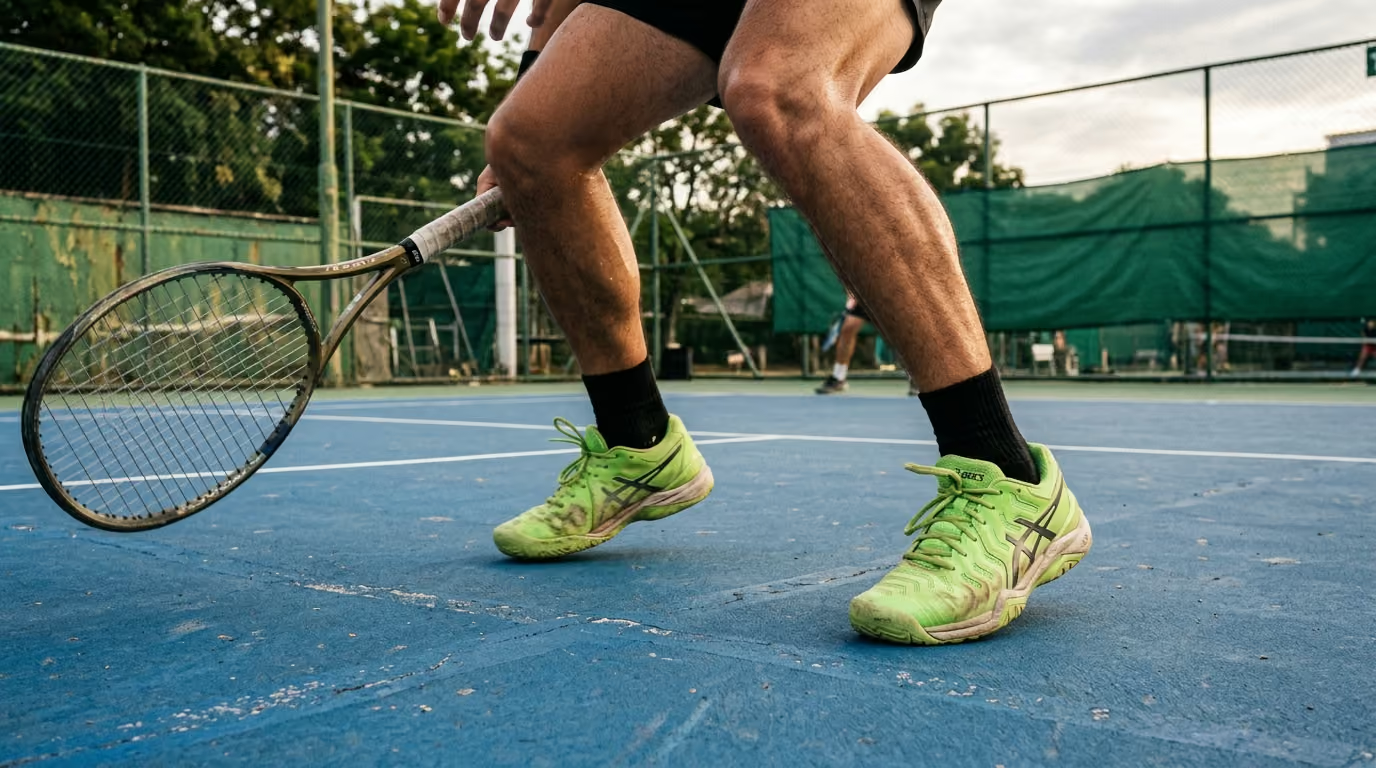
Adult racquet sports players can achieve a sustainable weekly training schedule that balances court time, strength training, and recovery for long-term athletic health.




You step out of bed on a Thursday morning and feel a familiar, dull stiffness in your heel and lower back. Two nights ago, you played a grueling singles match at your local club. Yesterday evening, you attended a high-energy group clinic to work on your backhand. This cumulative physical fatigue is not an accident, but rather the predictable result of an unmanaged weekly schedule.
For most adult court athletes, training is often approached as a scheduling challenge rather than a biological load-management problem. We fit matches, clinics, and gym sessions into whatever free calendar blocks remain after work and family commitments. Without a structured blueprint, this approach leads to a cycle of chronic soreness, performance plateaus, and preventable overuse injuries. To play consistently for years to come, you must design a weekly structure that balances training stress with your body's actual capacity to recover.
A sustainable weekly schedule for adult racquet players balances court sessions, strength training, and recovery by strategically spacing high-intensity efforts. Rather than maximizing weekly volume, players must manage the cumulative physical load to match their age and personal schedule. This approach preserves movement quality and ensures athletic longevity over many seasons of play.
Adult recreational and competitive players differ substantially from elite competitors. Elite athletes have access to full-time coaching, daily physical therapy, and optimized sleep schedules. Recreational players must balance their court time with full-time careers, family responsibilities, and inconsistent sleep. These external pressures reduce overall recovery capacity and make the body more susceptible to injury.
Furthermore, many court athletes carry a history of minor injuries, such as shoulder impingement, tennis elbow, knee pain, or Achilles tendon issues. A systematic review published in Frontiers in Psychology noted that the vast majority of racquet-sport research focuses on elite, competitive male athletes. This means that directly copying professional training schedules is rarely appropriate for recreational players. To build a sustainable routine, you must look at athletic longevity resources that respect your actual recovery limits.
The governing principle of a successful weekly blueprint is simple. You must train the physical qualities that matter, place hard sessions deliberately, protect your recovery windows, and adapt the week to your match schedule.
To plan a training week, you must first understand the physiological demands of your sport. Racquet sports are highly intermittent activities. They require a unique mix of aerobic endurance, anaerobic power, rapid deceleration, and multi-directional speed.
Match durations vary widely across different sports. According to a systematic review of racquet-sport physiology, tennis matches can last anywhere from one to five hours. However, typical best-of-three matches average roughly 60 to 90 minutes. In contrast, padel matches in the cited studies lasted approximately 35 to 36 minutes. Competitive badminton matches generally run between 17 and 40 minutes, while table tennis matches average 10 to 25 minutes.
These sports also impose different cardiovascular demands. The same systematic review showed average heart rates in tennis range from 128 to 154 beats per minute. Badminton matches show significantly higher values, ranging from 157 to 182 beats per minute. Badminton demands high metabolic output, with the glycolytic anaerobic system playing a dominant role. Tennis relies heavily on aerobic capacity to recover between points, combined with the anaerobic ATP-PC system for explosive serves and sprints.
Crucially, the scientific evidence base contains major gaps. The systematic review highlighted a lack of high-quality physiological data for squash during the studied period. Furthermore, pickleball was not included in the review at all. Because scientific consensus is still developing for newer court sports, players must combine established research with practical field experience to guide their weekly programming.
To manage your weekly schedule, you must measure the physical stress placed on your body. Physical stress is known as training load, and it is divided into two distinct categories.
External load refers to the objective work you perform on the court or in the gym. This includes your total court minutes, the number of matches played, your total sprint distance, or the weight you lift.
Internal load refers to the biological and psychological stress your body experiences as a result of that work. One hour of doubles is not equivalent to one hour of singles. A high-stakes league match on a hot, humid afternoon creates a much higher internal load than an easy technical clinic on an indoor court. Your current fitness levels, sleep quality, and daily stress all dictate how your body processes external load.
You can easily estimate your internal load using the Session Rating of Perceived Exertion, or sRPE. This system uses a simple 1-10 scale to rate the difficulty of a session. You then multiply that rating by the duration of the session in minutes to calculate your workload in arbitrary units.
A 60-minute singles match rated as a 7 out of 10 effort produces a workload of 420 units (60 multiplied by 7). Conversely, a 90-minute technical lesson focused on light drilling might be rated as a 3 out of 10 effort. This session produces a workload of 270 units (90 multiplied by 3). Even though the technical lesson lasted longer, the singles match imposed a significantly higher physical load on your body.
Tracking these daily numbers helps you monitor your acute-to-chronic workload. Your acute workload is the total physical stress you accumulate over a seven-day period. Your chronic workload is your average weekly training history over several weeks.
Research in high-level junior tennis players shows that injury rates rise when acute training loads spike suddenly. Specifically, injury risk increased 1.62 times for every additional 1,858.7 arbitrary units added to a training week. While you do not need to calculate precise mathematical ratios, you must monitor your weekly court minutes, serve volumes, and match counts. If you plan to increase your playing time, do so gradually to allow your joints and tendons to adapt. You can find detailed tracking strategies in our court performance guides.
A complete training schedule must address five core pillars. These pillars build your physical capacity, protect your joints, and improve your performance on the court.
Technical training should not always feel like a conditioning workout. A productive technical session allows you to learn and refine movement patterns without high levels of physical fatigue. You should divide your technical training into skill acquisition, high-quality repetitions, and pressure practice under game-like constraints.
A standard 60-minute technical session should follow a structured progression:
Court movement involves far more than raw sprinting speed. Players must master the split-step, first-step acceleration, lateral shuffling, crossover steps, and rapid recovery positioning.
Importantly, deceleration is a highly trainable skill. Adult players frequently focus on how fast they can reach the ball, but they neglect their ability to stop safely. Poor braking mechanics put immense stress on the knees, hips, and lower back. Your movement drills should progress from slow, planned movement patterns to reactive, multi-directional changes of direction with a racquet in hand.
Strength training builds the physical foundation required to handle the impact forces of court sports. The World Health Organization recommends that adults perform muscle-strengthening activities for all major muscle groups at least two days per week. For court athletes, this training must address the entire kinetic chain rather than just isolated upper-body muscles.
An effective strength routine for a racquet player must target three key areas:
According to the American College of Sports Medicine, healthy adults can build strength using loads around 80% of their one-repetition maximum for two to three sets per exercise. However, the most important factor is consistency. Moving from zero strength workouts to two short sessions per week provides the greatest relative health and performance benefit.
Power is your ability to produce force quickly. It is what allows you to sprint to a drop shot, jump for an overhead, or rotate powerfully into a forehand.
You should only train power once you have developed a solid foundation of controlled strength. Begin with medicine ball throws and low-impact jumps, focusing entirely on landing mechanics. Always stop your power sets as soon as your speed or coordination begins to drop. In power training, quality is infinitely more important than cardiovascular fatigue.
Conditioning prepares your cardiovascular system to recover quickly between long rallies and intense matches. You can divide your conditioning into extensive aerobic work, intermittent court-specific runs, and repeated-sprint training.
If you already play multiple high-intensity matches each week, you do not need extra high-intensity interval training. The matches themselves act as your anaerobic conditioning. In this scenario, your extra conditioning should focus on low-intensity aerobic work, such as cycling or swimming, to support recovery without adding joint impact.
Designing your weekly training schedule requires a systematic approach. You can apply this knowledge directly to your calendar using a simple, five-step planning process.
First, identify your immovable court commitments. These are your weekly league matches, scheduled tournaments, or competitive group matches. Mark these days on your calendar as your primary physical efforts. These are your high-intensity, high-load days.
Next, block out your work hours, travel times, and family responsibilities. If you have a highly demanding work project on a Tuesday, do not schedule a heavy strength workout or an intense singles match that evening. Physical and mental stress utilize the same recovery resources. Respect your real-world capacity by keeping stressful days physically manageable.
Schedule at least one full day of rest each week. True rest allows your nervous system to recover and your connective tissues to remodel. Additionally, place a dedicated recovery window, such as a short mobility session or light walking, the day after your hardest match.
Insert your strength training and technical practices around your matches. Use the hard-day spacing rule: avoid scheduling highly fatiguing physical sessions on consecutive days.
If you play a competitive match on Saturday, do not perform a heavy lower-body strength workout on Friday afternoon. Instead, place your strength sessions on mid-week days, leaving at least 48 hours of recovery before your primary competitive matches. This ensures you step onto the court feeling fast and explosive.
When your calendar becomes crowded, use a priority hierarchy to decide what to keep and what to cut. This prevent-injury system ensures you do not sacrifice your health for extra training volume:
If you are short on time, remove the optional conditioning and extra hitting sessions first. Never sacrifice your recovery windows or your basic strength training to pack more court time into an already exhausting week.
The physical demands of racquet sports are not identical. To optimize your weekly plan, you must tailor your training to the specific movement and impact patterns of your chosen sport.
Tennis demands exceptional rotational power and multi-directional speed across a large playing surface. The high volume of serving places significant stress on the shoulder joint, upper back, and abdominal muscles.
To support these demands, tennis players must prioritize rotator-cuff capacity, thoracic spine mobility, and hamstring strength. Because tennis points can be long and grueling, building a strong aerobic base is essential for recovering between rallies. If you struggle with shoulder fatigue, you should review our dedicated injury prevention strategies to protect your overhead strokes.
Pickleball is played on a smaller court, which reduces long-distance running but increases the frequency of rapid accelerations and sharp decelerations. The game requires constant lateral shuffling and deep knee flexion at the non-volley zone.
According to a 2024 review of pickleball injuries, muscle strains, joint sprains, and fractures are the most common emergency department presentations. Older players frequently experience lower-extremity tendon issues. Pickleball players must focus their weekly training on calf strength, Achilles tendon capacity, and rapid ankle stabilization to handle the constant, short braking movements.
Padel is played in an enclosed glass court, leading to highly dynamic rallies with continuous transitions from defense to offense. The sport requires frequent overhead shots, lobs, and rotational movements to play balls off the walls.
This creates a high cumulative load on the shoulder, elbow, and trunk. Padel players should prioritize rotational trunk stability, hip mobility, and single-leg landing control to safely execute repeated overheads and rapid direction changes.
The following schedules demonstrate how to apply these loading principles to different real-world scenarios.
This blueprint is designed for an adult player who has one highly competitive singles match on Saturday and wants to build physical capacity during the week.
This schedule is optimized for a player who competes twice a week. Because matches provide high-intensity conditioning, extra cardiovascular training is eliminated to prevent overuse injuries.
This model is designed for players who struggle to find large blocks of training time. It utilizes short, highly focused "training anchors" to maintain physical readiness.
If you are returning to the court after several weeks of inactivity or injury, you must rebuild your capacity gradually. Use this progressive four-week framework:
Even well-meaning athletes frequently fall into common training traps. Recognizing these mistakes is the first step toward correcting them.
Many players view any hour spent on the court as the same physical stress. In reality, a light coaching session has a completely different physical profile than a singles match. If you do not categorize your sessions by intensity, you will accidentally stack high-load days together. This leads to cumulative tissue damage and eventual overuse injuries. Always use sRPE to categorize your days as hard, moderate, or easy.
Recreational players often believe they need to perform exhausting sprint intervals to get in shape for their sport. However, if you are already playing competitive singles or intense doubles multiple times per week, your high-intensity conditioning is already built-in. Adding brutal treadmill runs or court sprints on top of matches will quickly lead to overtraining. If your match volume is high, your extra physical training should focus on strength, mobility, and low-impact aerobic recovery.
When a tendon or joint begins to ache, many players assume they simply need to stretch more. While stretching can temporarily reduce muscle tension, it does not build the tissue resilience needed to handle court forces. Overuse injuries are usually caused by a lack of strength or a sudden spike in playing volume.
A randomized controlled trial investigating the "TennisReady" prevention program found that unsupervised stretching and exercise programs did not reduce overall injury rates on their own. To protect your joints, you must combine sensible load progression with consistent resistance training to build structural tissue tolerance.
Every time you sprint, stop, or swing a racquet, you create micro-tears in your muscle fibers and place stress on your connective tissues. Recovery is the process by which your body repairs this damage, making you stronger and more resilient for the next session.
I remember finishing a tough two hour padel match on a cold Tuesday night and waking up the next morning feeling like my lower back was locked in concrete. For a long time, I just accepted this as the price of playing hard in my forties. But once I started spending just ten minutes on targeted hip mobility before heading to the club, the stiffness almost completely vanished. It taught me that we do not have to accept pain as a default state of aging.
To manage your recovery effectively, look at it through three distinct timelines:
To make recovery practical, ask yourself these simple self-assessment questions each morning:
If your sleep is poor, your soreness is increasing, and your motivation is low, your body is telling you to modify your upcoming session. In these moments, switching a hard match to a light technical hit or a mobility session is the smartest decision you can make. You can read more about the biology of muscle repair in our recovery science articles.
While muscle soreness is a normal response to training, persistent or sharp pain is a warning sign that requires professional attention. You should stop playing and consult a qualified physiotherapist or sports medicine physician if you experience any of the following:
The International Tennis Federation Injury Clinic lists common racquet-sport issues involving the shoulder, elbow, wrist, lower back, knee, and Achilles tendon. Seeking professional care early can prevent a minor tendon irritation from turning into a chronic tear that keeps you off the court for months.
You should bookmark and return to this blueprint whenever you experience a change in your training environment or playing schedule. Revisit these guidelines when you are transitioning to a different court surface, starting a new competitive league, returning from an extended holiday, or recovering from a physical setback.
Consistency on the court is not built through occasional, heroic efforts, but through a structured, respectful approach to your body's physical limits. By managing your weekly training load, protecting your recovery, and building a foundation of strength, you can continue to enjoy the speed, competition, and community of racquet sports for many years to come.
Follow Evercourts for practical insights on tennis, pickleball and padel performance, movement, recovery and healthy ageing. Stay connected for new articles, research-led guidance and ideas to help you play well and keep playing for years.


Read practical guidance for better movement, smarter preparation and a game that keeps working for you.
explore the Blog